Discussion of Survival Models and Health Sequences Setup: Subjects - - PDF document

discussion of survival models and health sequences
SMART_READER_LITE
LIVE PREVIEW

Discussion of Survival Models and Health Sequences Setup: Subjects - - PDF document

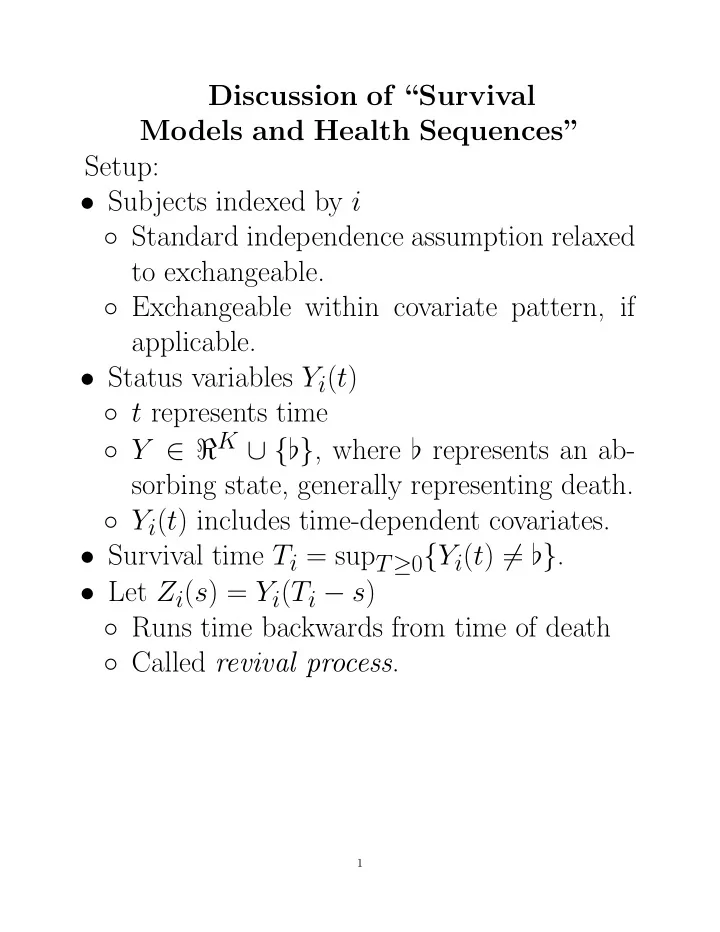
Discussion of Survival Models and Health Sequences Setup: Subjects indexed by i Standard independence assumption relaxed to exchangeable. Exchangeable within covariate pattern, if applicable. Status variables Y i ( t )


slide-1
SLIDE 1

Discussion of “Survival Models and Health Sequences” Setup:

  • Subjects indexed by i
  • Standard independence assumption relaxed

to exchangeable.

  • Exchangeable within covariate pattern, if

applicable.

  • Status variables Yi(t)
  • t represents time
  • Y ∈ ℜK ∪ {♭}, where ♭ represents an ab-

sorbing state, generally representing death.

  • Yi(t) includes time-dependent covariates.
  • Survival time Ti = supT≥0{Yi(t) = ♭}.
  • Let Zi(s) = Yi(Ti − s)
  • Runs time backwards from time of death
  • Called revival process.

1

slide-2
SLIDE 2

Objective Model Zi(s)

  • Look for pattern in E [Zi(s)] predicting death
  • Model Zi(s) as a Gaussian process

2

slide-3
SLIDE 3

Key Observation Zi(s) should be independent of Ti

  • Assumption is called revival assumption.
  • Heuristically, time reversal captures all depen-

dence of Y on T

  • Survival processes are aligned at failure time,

rather than at randomization

  • Avoids extra variability induced by hetero-

geneity in disease stage at enrollment.

3

slide-4
SLIDE 4

Place of common survival analysis concepts in revival framework

  • Treatment: modeled as time-dependent
  • In this framework the only change is at ran-

domization.

  • Assume value of Z depends on treatment
  • nly through current treatment arm
  • Censoring: Stratify based on whether censor-

ing has occurred.

  • Pattern of interest should be apparent in

the uncensored individuals

  • Pattern should be attenuated in censored

individuals

4

slide-5
SLIDE 5

Open Questions

  • Can we use the information in censored ob-

servations more intensively?

  • If one reverses at censoring times, the expec-

tation of covariates should be a mixture of the expectations for observations near fail- ure, and less extreme observations.

  • Can we model this?

5