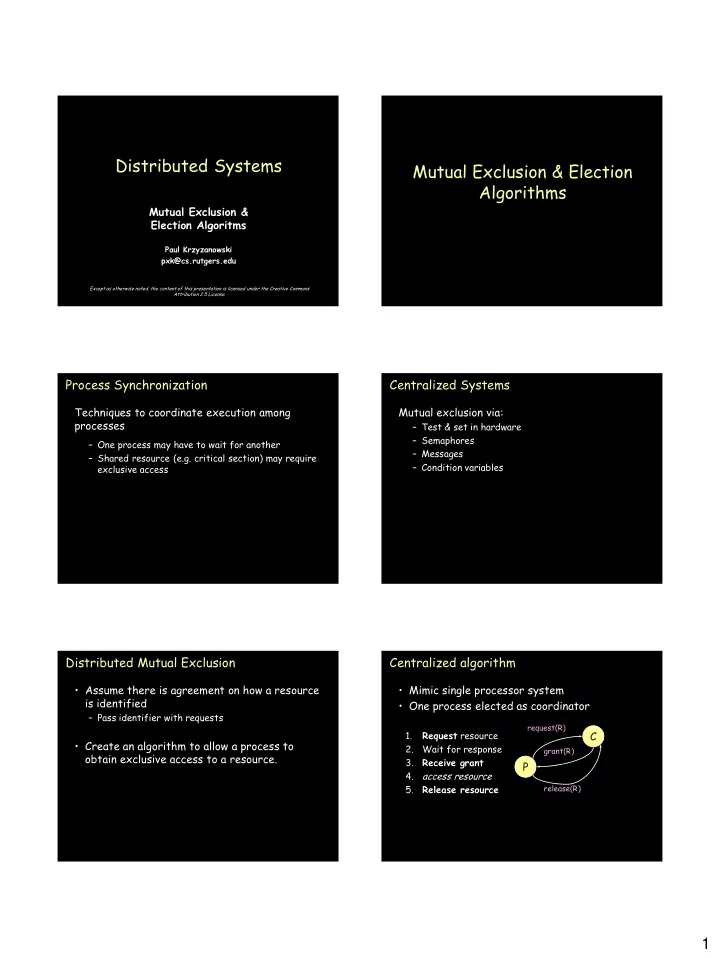
Distributed Systems Mutual Exclusion & Election Algorithms - - PDF document

distributed systems mutual exclusion election algorithms
SMART_READER_LITE
LIVE PREVIEW

Distributed Systems Mutual Exclusion & Election Algorithms - - PDF document

Distributed Systems Mutual Exclusion & Election Algorithms Mutual Exclusion & Election Algoritms Paul Krzyzanowski pxk@cs.rutgers.edu Except as otherwise noted, the content of this presentation is licensed under the Creative Commons


slide-1
SLIDE 1

1

Page 1 Page 1

Mutual Exclusion & Election Algoritms

Paul Krzyzanowski pxk@cs.rutgers.edu

Distributed Systems

Except as otherwise noted, the content of this presentation is licensed under the Creative Commons Attribution 2.5 License.

Page 2 Page 2

Mutual Exclusion & Election Algorithms

Page 3

Process Synchronization

Techniques to coordinate execution among processes

– One process may have to wait for another – Shared resource (e.g. critical section) may require exclusive access

Page 4

Centralized Systems

Mutual exclusion via:

– Test & set in hardware – Semaphores – Messages – Condition variables

Page 5

Distributed Mutual Exclusion

  • Assume there is agreement on how a resource

is identified

– Pass identifier with requests

  • Create an algorithm to allow a process to
  • btain exclusive access to a resource.

Page 6

Centralized algorithm

  • Mimic single processor system
  • One process elected as coordinator

P C

request(R) grant(R)

1. Request resource 2. Wait for response 3. Receive grant 4. access resource 5. Release resource

release(R)

slide-2
SLIDE 2

2

Page 7

Centralized algorithm

If another process claimed resource:

– Coordinator does not reply until release – Maintain queue

  • Service requests in FIFO order

P0 C

request(R) grant(R) release(R)

P1 P2

request(R)

Queue

P1

request(R)

P2

grant(R)

Page 8

Centralized algorithm

Benefits

  • Fair

– All requests processed in order

  • Easy to implement, understand, verify

Problems

  • Process cannot distinguish being blocked from

a dead coordinator

  • Centralized server can be a bottleneck

Page 9

Token Ring algorithm

Assume known group of processes

– Some ordering can be imposed on group – Construct logical ring in software – Process communicates with neighbor P0 P1 P2 P3 P4 P5

Page 10

Token Ring algorithm

  • Initialization

– Process 0 gets token for resource R

  • Token circulates around ring

– From Pi to P(i+1)mod N

  • When process acquires token

– Checks to see if it needs to enter critical section – If no, send ring to neighbor – If yes, access resource

  • Hold token until done

P0 P1 P2 P3 P4 P5 token(R)

Page 11

Token Ring algorithm

  • Only one process at a time has token

– Mutual exclusion guaranteed

  • Order well-defined

– Starvation cannot occur

  • If token is lost (e.g. process died)

– It will have to be regenerated

  • Does not guarantee FIFO order

– sometimes this is undesirable

Page 12

Ricart & Agrawala algorithm

  • Distributed algorithm using reliable multicast

and logical clocks

  • Process wants to enter critical section:

– Compose message containing:

  • Identifier (machine ID, process ID)
  • Name of resource
  • Timestamp (totally-ordered Lamport)

– Send request to all processes in group – Wait until everyone gives permission – Enter critical section / use resource

slide-3
SLIDE 3

3

Page 13

Ricart & Agrawala algorithm

  • When process receives request:

– If receiver not interested:

  • Send OK to sender

– If receiver is in critical section

  • Do not reply; add request to queue

– If receiver just sent a request as well:

  • Compare timestamps: received & sent messages
  • Earliest wins
  • If receiver is loser, send OK
  • If receiver is winner, do not reply, queue
  • When done with critical section

– Send OK to all queued requests

Page 14

Ricart & Agrawala algorithm

  • N points of failure
  • A lot of messaging traffic
  • Demonstrates that a fully distributed

algorithm is possible

Page 15

Lamport’s Mutual Exclusion

Each process maintains request queue

– Contains mutual exclusion requests

Requesting critical section:

– Process Pi sends request(i, Ti) to all nodes – Places request on its own queue – When a process Pj receives a request, it returns a timestamped ack Lamport time

Page 16

Lamport’s Mutual Exclusion

Entering critical section (accessing resource):

– Pi received a message (ack or release) from every

  • ther process with a timestamp larger than Ti

– Pi’s request has the earliest timestamp in its queue

Difference from Ricart-Agrawala:

– Everyone responds (acks) … always - no hold-back – Process decides to go based on whether its request is the earliest in its queue

Page 17

Lamport’s Mutual Exclusion

Releasing critical section:

– Remove request from its own queue – Send a timestamped release message – When a process receives a release message

  • Removes request for that process from its queue
  • This may cause its own entry have the earliest timestamp in

the queue, enabling it to access the critical section

Page 18 Page 18

Election algorithms

slide-4
SLIDE 4

4

Page 19

Elections

  • Need one process to act as coordinator
  • Processes have no distinguishing

characteristics

  • Each process can obtain a unique ID

Page 20

Bully algorithm

  • Select process with largest ID as coordinator
  • When process P detects dead coordinator:

– Send election message to all processes with higher IDs.

  • If nobody responds, P wins and takes over.
  • If any process responds, P’s job is done.

– Optional: Let all nodes with lower IDs know an election is taking place.

  • If process receives an election message

– Send OK message back – Hold election (unless it is already holding one)

Page 21

Bully algorithm

  • A process announces victory by sending all

processes a message telling them that it is the new coordinator

  • If a dead process recovers, it holds an

election to find the coordinator.

Page 22

Ring algorithm

  • Ring arrangement of processes
  • If any process detects failure of coordinator

– Construct election message with process ID and send to next process – If successor is down, skip over – Repeat until a running process is located

  • Upon receiving an election message

– Process forwards the message, adding its process ID to the body

Page 23

Ring algorithm

Eventually message returns to originator

– Process sees its ID on list – Circulates (or multicasts) a coordinator message announcing coordinator

  • E.g. lowest numbered process

Page 24

Problems with elections

Network segmentation

– Split brain

Rely on alternate communication mechanism

– Redundant network, shared disk, serial line, SCSI

slide-5
SLIDE 5

5

Page 25 Page 25

The end.