
SLIDE 1
Carlos Carrasco-González
Max-Planck-Institut für Radioastronomie
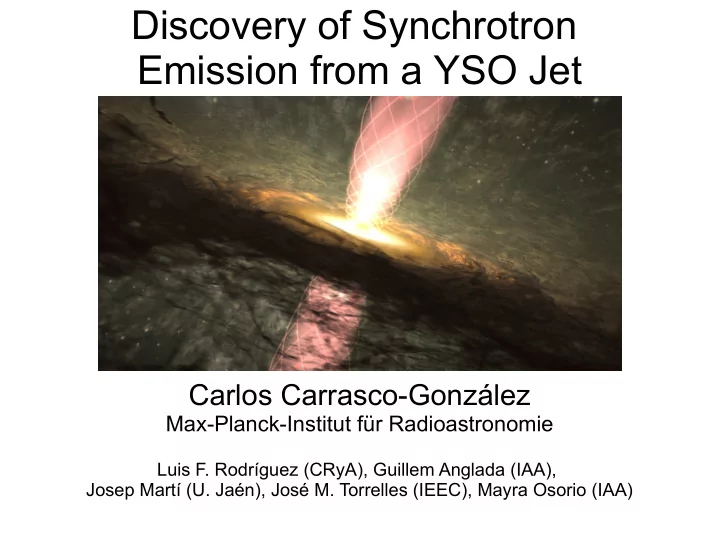
Discovery of Synchrotron Emission from a YSO Jet
Luis F. Rodríguez (CRyA), Guillem Anglada (IAA), Josep Martí (U. Jaén), José M. Torrelles (IEEC), Mayra Osorio (IAA)
Discovery of Synchrotron Emission from a YSO Jet Carlos - - PowerPoint PPT Presentation
Discovery of Synchrotron Emission from a YSO Jet Carlos Carrasco-Gonzlez Max-Planck-Institut fr Radioastronomie Luis F. Rodrguez (CRyA), Guillem Anglada (IAA), Josep Mart (U. Jan), Jos M. Torrelles (IEEC), Mayra Osorio (IAA) Jet
Luis F. Rodríguez (CRyA), Guillem Anglada (IAA), Josep Martí (U. Jaén), José M. Torrelles (IEEC), Mayra Osorio (IAA)
Dust Polarization Girart et al. (2006) Maser Polarization Vlemmings et al. (2010) Cloud's Magnetic Field Launching region
SERPENS Cep A W3 (H2O) HH 80-81 Marti et al. (1993) Rodriguez et al. (1989) Garay et al. (1996) Wilner et al. (1999) IRAS 16547-4247 Rodriguez et al. (2005)
Distance: 1.7 kpc IRAS 18162–2048 ; 17,000 L (B0; 10 M ) HH 80, HH 81, HH 80 N (Martí et al. 1993) Largest (~5.3 pc) and most collimated (<1º) YSO radio jet known
Carrasco-González et al., in prep. Radius ~ 200 AU Mass ~ 4-7 Msun Accretion rate ~ 10-4 Msun/yr SMA & VLA Observations
5 A U 7 A U
Disk
Martí et al. (1993) Central source: Thermal free-free emission and dust from the disk HHs and knots in the radio jet: non-thermal Which is the emission mechanism? If synchrotron → magnetic field + relativistic electrons electron acceleration → strong shocks (Fermi mechanism) POSSIBILITY TO STUDY THE MAGNETIC FIELD IN THE JET THROUGH LINEAR POLARIZATION!!! ...but weak → very high sensitivity required
So, we observed with the VLA at 6 cm during 12 hours We reached a rms noise of ~ 10 microJy/beam
Carrasco-González et al. (2010) Magnetic field appears parallel to the jet axis We estimate magnetic field strength 0.2 mG
Polarized dust emission direction shows considerable scatter with respect to the jet direction (Curran et al. 2007) → envelope/disk Magnetic field traced by synchrotron emission is intrinsic to the jet We measure similar values for the magnetic field strength at 0.5 pc from the star The jet is removing magnetic field from the disk
Polarization degree increases towards the edges of the jet
Gómez et al. (2008)
Similar to what is commonly found in extragalactic jets and what we would expect to
magnetic field (e.g. Lyutikov et al. 2005)
Compatible with helical magnetic field. But need of Farady Rotation measurements.
100 000 AU Expanded Very Large Array Higher Sensitivity Observations of a sample of protostellar jets Using this technique and combining with others (optical/IR) we can obtain full description of jets ALMA High angular resolution and sensitivity at (sub)mm wavelengths Disk's magnetic field