
SLIDE 1
Sascha Trippe Sascha Trippe
SNU Seoul SNU Seoul
사샤 트리페 사샤 트리페
서울대학교 서울대학교
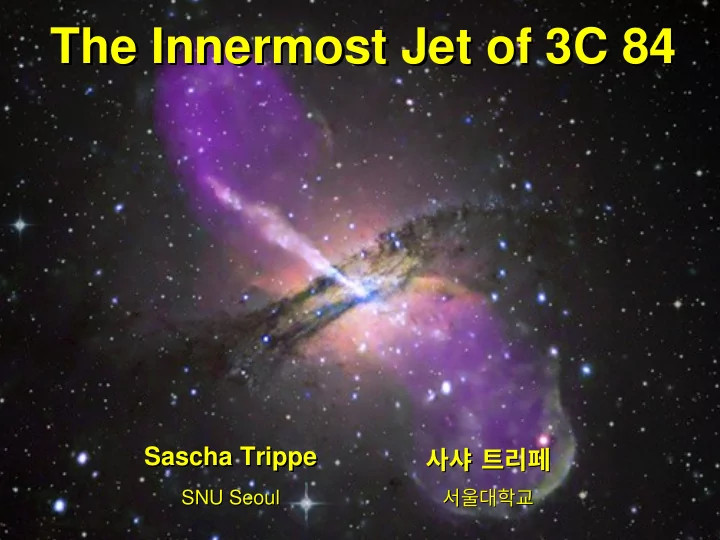
The Innermost Jet of 3C 84 The Innermost Jet of 3C 84 Sascha Trippe - - PowerPoint PPT Presentation
The Innermost Jet of 3C 84 The Innermost Jet of 3C 84 Sascha Trippe Sascha Trippe SNU Seoul SNU Seoul The Innermost Jet of 3C 84 The Innermost Jet of 3C 84 Junghwan Oh
SNU Seoul SNU Seoul
서울대학교 서울대학교
Junghwan Oh Jeff Hodgson Sascha Trippe Thomas Krichbaum Jae-Young Kim Bindu Rani
Marscher (2005)
(Blandford & Znajek 1977) (Blandford & Znajek 1977)
Narayan & Quataert (2005)
(Blandford & Payne 1982) (Blandford & Payne 1982)
Hujeirat+ (2003)
Disk jet Disk jet BH jet Hardee+ (2007)
C1 C2 C3 3C 84 (NGC 1275)
➢ z = 0.0176 ➢ Radio galaxy / Seyfert 1.5 ➢ γ-ray bright
BU blazar monitoring group
Diagram: M.-L. Menzel (MPE) 3C 84
(MBH = 3.2108 Msol, H0 = 70 km/s/Mpc)
Distance C1a – C1b is ~800 RS (~1 light-month) If C1 were the jet base, we have Blandford–Payne mechanism at work (Blandford–Znajek requires <10 RS). However, the required size is probably even too large for an accretion disk: Accretion disk size vs. black hole mass (Morgan+ 2010): Expected for 3C 84: ~54 RS (half-light radius) ↳ C1 is probably not the jet base
Scaling of brightness temperature … with Doppler factor … constrains bulk speed to Scaling of flux … constrains power-law index to … which gives a spectral index of
But: Geometry? Why for C1a and C1b separately? Consistency with projected bulk flow speeds ≺c ?
SSA?
Assumption: we observe multiple, independent, emitters cooling down while traveling along the jet. Fluxes decay by factors ≽5 within ≼1 year synchrotron cooling times ≼6 months. Because this is consistent with B ≈ 10 μT, γelectron ≈ 10,000 (for δ ≈ 1) But: requires roughly constant “start” fluxes in 2008 – 2015?
S behind C1a/b
Projected: ≾ 2400 RS De-projection with θ = 65̊
(Fujita & Nagai 2017)
conical jet profile parabolic jet profile
➢ We monitored the structure of 3C 84 with GMVA in 2008–2015 ➢ There are two “cores” separated by ~800 RS we do not see the jet base but rather a jet sheath above the central engine ➢ Brightness temperatures and fluxes of C1a/b correlate with relative position angle, varying by factors ~10 and ~5, respectively ➢ Doppler boosting is possible but seems to require improbable bulk flow speeds and/or geometries ➢ Intrinsic variability consistent with B ≈ 10 μT, γelectron ≈ 10,000, but seems to require roughly constant initial fluxes over 7 years ➢ The central black hole is located ≾ 2700 RS behind C1a/b