
SLIDE 1
RADIO HALOS AND SYNCHROTRON RADIATION
WOLFGANG KLASSEN
SECOND READER: ROBERT GLEISINGER
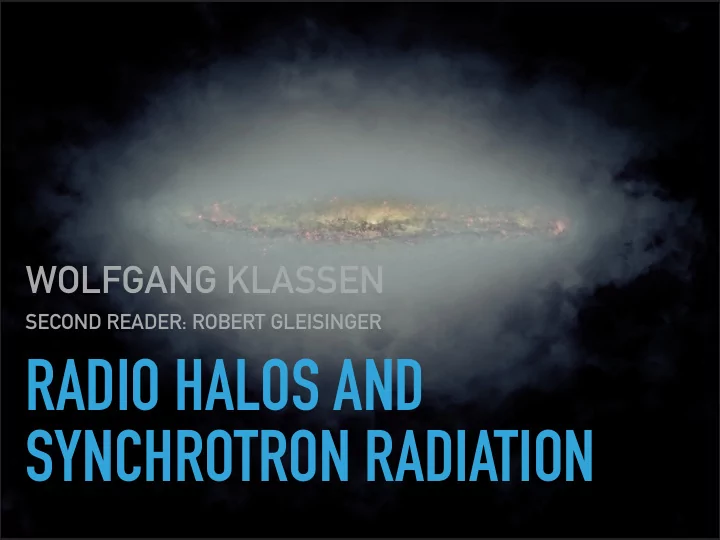
RADIO HALOS AND SYNCHROTRON RADIATION CONTENTS CONTENTS - - PowerPoint PPT Presentation
WOLFGANG KLASSEN SECOND READER: ROBERT GLEISINGER RADIO HALOS AND SYNCHROTRON RADIATION CONTENTS CONTENTS Synchrotron radiation Spectral Index Radio Halos SYNCHROTRON RADIATION SEEING MAGNETIC FIELDS Synchrotron radiation
SECOND READER: ROBERT GLEISINGER
CONTENTS
CONTENTS
▸ Synchrotron radiation ▸ Spectral Index ▸ Radio Halos
SYNCHROTRON RADIATION
SEEING MAGNETIC FIELDS
▸ Synchrotron radiation comes from relativistic electrons
interacting with magnetic fields
▸ Like Bremsstrahlung, it is the result of an electron
changing its momentum by “scattering” off a field
▸ In order to preserve momentum, it emits a photon in the
corresponding direction in order to conserve momentum
SYNCHROTRON RADIATION
SEEING MAGNETIC FIELDS
▸ From J. A. Irwin Astrophysics: ▸ Synchrotron radiation is a continuous, rather than a line
emission
SPECTRAL INDEX
SPECTRAL INDEX
▸ Like a blackbody, the intensity of the radio halo varies
predictably with frequency
▸ Instead of following the Stefan-Boltzmann law, the radio
spectrum is approximated as a power law:
SPECTRAL INDEX
SPECTRAL INDEX
RADIO HALOS
BEYOND THE DISC
▸ Radio emission extends well above and below the disc of
a galaxy
▸ Generally synchrotron radiation
RADIO HALOS
CLUSTERS
▸ Also present in large galactic clusters, where the radio
emission has no apparent parent galaxy.
RADIO HALOS
SOURCE
▸ Radio halos are now thought to be the result of galactic
“Chimneys” venting the hot ionized gas from supernovae into the galactic halo
RADIO HALOS
WHAT DO WE LEARN FROM THEM?
▸ Star formation rates ▸ Winds from supernovae ▸ Galactic magnetic fields ▸ Cosmic ray generation and transport ▸ Active Galactic Nuclei