Gam Gamma- ma-Ra Ray Ob y Obse servatio ions ns of f - - PowerPoint PPT Presentation

gam gamma ma ra ray ob y obse servatio ions ns of f
SMART_READER_LITE
LIVE PREVIEW

Gam Gamma- ma-Ra Ray Ob y Obse servatio ions ns of f - - PowerPoint PPT Presentation

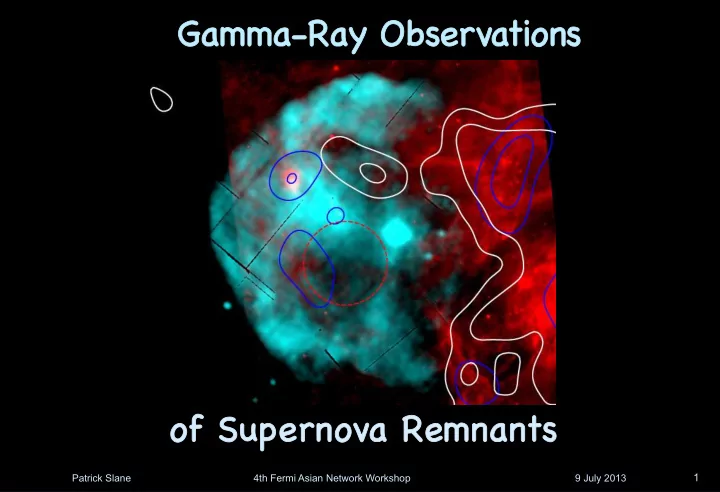
Gam Gamma- ma-Ra Ray Ob y Obse servatio ions ns of f Supernova Rem emnants 1 Patrick Slane 4th Fermi Asian Network Workshop 9 July 2013 Cosmic Rays and SNRs CR spectrum is a power

slide-1
SLIDE 1

Gam Gamma- ma-Ra Ray Ob y Obse servatio ions ns

  • f

f Supernova Rem emnants

9 July 2013

1

Patrick Slane 4th Fermi Asian Network Workshop

slide-2
SLIDE 2

Cosmic Rays and SNRs

9 July 2013 Patrick Slane 4th Fermi Asian Network Workshop

2

knee Galactic Extragalactic Solar Modulation

  • CR spectrum is a power law covering

more than 10 decades in energy.

  • “knee” in spectrum at ~1015-16 eV
  • CRs below knee thought to be

Galactic in origin

  • Composition of Galactic CRs similar

to well-mixed ISM

  • energy density ∼1 eV cm-3
  • Direct evidence of CR acceleration

provides opportunity to constrain acceleration physics and address source of CRs

  • multi-λ observations are crucial

for source/counterpart identification, constraining emission geometry, probing source environment, and breaking modeling degeneracies

slide-3
SLIDE 3

Diffusive Shock Acceleration

9 July 2013

3

Patrick Slane 4th Fermi Asian Network Workshop

  • Particles scatter from MHD

waves in background plasma

  • pre-existing, or generated

by streaming ions themselves

  • scattering mean-free-path

(i.e., most energetic particles have very large λ and escape)

λ ∝ rg = E /eB

Reynolds 2008 ρ1 ρ2 ~E-2.2 (p-4.2)

slide-4
SLIDE 4

Gamma-Ray Emission from SNRs

9 July 2013

4

Patrick Slane 4th Fermi Asian Network Workshop

  • Inverse-Compton
  • energetic electrons

upscatter ambient photons to γ-ray energies

  • also produce synchrotron
slide-5
SLIDE 5

Gamma-Ray Emission from SNRs

9 July 2013

5

Patrick Slane 4th Fermi Asian Network Workshop

  • Inverse-Compton
  • energetic electrons

upscatter ambient photons to γ-ray energies

  • also produce synchrotron
  • Nonthermal bremsstrahlung
  • energetic electrons

decelerated by collisons w/ ions

slide-6
SLIDE 6
  • Inverse-Compton
  • energetic electrons

upscatter ambient photons to γ-ray energies

  • also produce synchrotron
  • Nonthermal bremsstrahlung
  • energetic electrons

decelerated by collisons w/ ions

  • Neutral pion decay:

π0 → γγ

  • flux proportional

to ambient density; SNR-cloud interactions particularly likely sites

Gamma-Ray Emission from SNRs

9 July 2013

6

Patrick Slane 4th Fermi Asian Network Workshop

slide-7
SLIDE 7

Patrick Slane 4th Fermi Asian Network Workshop

Gamma-Ray Emission from SNRs

9 July 2013

7 Castro et al. 2013

  • Inverse-Compton
  • energetic electrons

upscatter ambient photons to γ-ray energies

  • also produce synchrotron
  • Nonthermal bremsstrahlung
  • energetic electrons

decelerated by collisons w/ ions

  • Neutral pion decay:

π0 → γγ

  • flux proportional

to ambient density; SNR-cloud interactions particularly likely sites

slide-8
SLIDE 8
  • Semi-analytical calculation of DSA
  • VH-1 hydrodynamics code to follow

SNR evolution

  • NEI calculation of ionization fractions

from hydro

  • Plasma emissivity code for spectra
  • Emission from superthermal/relativistic

particles

  • synchrotron
  • inverse Compton
  • nonthermal bremsstrahlung
  • pion-decay

" " "Ellison et al. 2007

" " "Patnaude et al. 2009 " " "Ellison et al. 2010 " " "Patnaude et al. 2010

Modeling: CR-Hydro

9 July 2013

8

Patrick Slane 4th Fermi Asian Network Workshop

slide-9
SLIDE 9

Gamma-Rays from SNRs

9 July 2013

9

Patrick Slane 4th Fermi Asian Network Workshop

slide-10
SLIDE 10

G347 .3-0.5/RX J1713.7

  • 3946

9 July 2013

10

Patrick Slane 4th Fermi Asian Network Workshop

Aharonian et al. 2004 H.E.S.S.

  • X-ray observations reveal

nonthermal spectrum

  • no hint of thermal emission
slide-11
SLIDE 11

G347 .3-0.5/RX J1713.7

  • 3946

9 July 2013

11

Patrick Slane 4th Fermi Asian Network Workshop

Ellison et al. 2010

NOTE: Hadrons are accelerated; they dominate the energy.

  • X-ray observations reveal

nonthermal spectrum

  • no hint of thermal emission
  • Broadband emission can be fit

with hadronic or leptonic models

  • hadronic model predicts

bright thermal X-rays, which are not observed

  • γ-rays dominated by leptons
slide-12
SLIDE 12

G347 .3-0.5/RX J1713.7

  • 3946

9 July 2013

12

Patrick Slane 4th Fermi Asian Network Workshop

NOTE: Hadrons are accelerated; they dominate the energy.

  • X-ray observations reveal

nonthermal spectrum

  • no hint of thermal emission
  • Broadband emission can be fit

with hadronic or leptonic models

  • hadronic model predicts

bright thermal X-rays, which are not observed

  • γ-rays dominated by leptons
  • Hadrons could dominate γ-rays

if shell consists of many cold clumps in interclump medium

Inoue et al. 2012

slide-13
SLIDE 13

Gamma-Rays from Tycho’ s SNR

9 July 2013

13

Patrick Slane 4th Fermi Asian Network Workshop

  • Tycho’

s SNR is shows strong dynamical evidence for CR acceleration

Warren et al. 2005

slide-14
SLIDE 14

Gamma-Rays from Tycho’ s SNR

9 July 2013

14

Patrick Slane 4th Fermi Asian Network Workshop

Acciari et al. 2011

  • Tycho’

s SNR is shows strong dynamical evidence for CR acceleration

  • Tycho is also detected in γ-rays
  • VERITAS centroid appears shifted

slightly toward molecular cloud

slide-15
SLIDE 15

Gamma-Rays from Tycho’ s SNR

9 July 2013

15

Patrick Slane 4th Fermi Asian Network Workshop

Acciari et al. 2011

  • Tycho’

s SNR is shows strong dynamical evidence for CR acceleration

  • Tycho is also detected in γ-rays
  • VERITAS centroid appears shifted

slightly toward molecular cloud

  • Both hadronic and leptonic models

can reproduce broadband spectrum

slide-16
SLIDE 16

Gamma-Rays from Tycho’ s SNR

9 July 2013

16

Patrick Slane 4th Fermi Asian Network Workshop

Giordano et al. 2012

  • Tycho’

s SNR is shows strong dynamical evidence for CR acceleration

  • Tycho is also detected in γ-rays
  • VERITAS centroid appears shifted

slightly toward molecular cloud

  • Both hadronic and leptonic models

can reproduce broadband spectrum

  • Fermi detection strongly favors

hadrons as primary source of γ-rays

slide-17
SLIDE 17

SNRs Interacting w/ Molecular Clouds

9 July 2013

17

Patrick Slane 4th Fermi Asian Network Workshop

  • SNRs with maser

emission interacting with molecular clouds

  • likely sources of

γ-ray emission

  • Fermi/LAT detects

GeV emission from several SNRs with masers

  • inferred density

much higher than X-rays indicate

  • may imply clumping
  • r escaping cosmic-

ray population that is interacting with nearby clouds

Uchiyama et al. 2011

slide-18
SLIDE 18

SNRs Interacting w/ Molecular Clouds

9 July 2013

18

Patrick Slane 4th Fermi Asian Network Workshop

  • SNRs with maser

emission interacting with molecular clouds

  • likely sources of

γ-ray emission

  • Fermi/LAT detects

GeV emission from several SNRs with masers

  • inferred density

much higher than X-rays indicate

  • may imply clumping
  • r escaping cosmic-

ray population that is interacting with nearby clouds

G349.7+0.2 CTB 37A 3C 391 G8.7-0.1 Castro & Slane 2010

slide-19
SLIDE 19

SNRs Interacting w/ Molecular Clouds

9 July 2013

19

Patrick Slane 4th Fermi Asian Network Workshop

  • SNRs with maser

emission interacting with molecular clouds

  • likely sources of

γ-ray emission

  • Fermi/LAT detects

GeV emission from several SNRs with masers

  • inferred density

much higher than X-rays indicate

  • may imply clumping
  • r escaping cosmic-

ray population that is interacting with nearby clouds

W41 G337 .7-0.1 Castro et al. 2013 MSH 17-39 Kes 79 Auchettl et al. 2013

slide-20
SLIDE 20

SNRs in Dense Environments: 3C 391

9 July 2013

20

Patrick Slane 4th Fermi Asian Network Workshop

Chen et al. (2004)

  • 3C 391 shows distinct evidence of
  • f MC interaction
  • bright, flattened radio morphology
  • adjacent CO cloud
  • OH masers
slide-21
SLIDE 21

SNRs in Dense Environments: 3C 391

9 July 2013

21

Patrick Slane 4th Fermi Asian Network Workshop

  • 3C 391 shows distinct evidence of
  • f MC interaction
  • bright, flattened radio morphology
  • adjacent CO cloud
  • OH masers
slide-22
SLIDE 22

SNRs in Dense Environments: 3C 391

9 July 2013

22

Patrick Slane 4th Fermi Asian Network Workshop

free-free absorption

  • 3C 391 shows distinct evidence of
  • f MC interaction
  • bright, flattened radio morphology
  • adjacent CO cloud
  • OH masers
  • GeV emission detected from Fermi LAT
  • IC model requires Ee > 1051 erg;

π0 emission must dominate

  • inferred density much higher than

X-rays indicate; suggests clumping, which is supported by X-ray images

IC IC

π0

slide-23
SLIDE 23

SNRs in Dense Environments: 3C 391

9 July 2013

23

Patrick Slane 4th Fermi Asian Network Workshop

Chen et al. (2004)

  • 3C 391 shows distinct evidence of
  • f MC interaction
  • bright, flattened radio morphology
  • adjacent CO cloud
  • OH masers
  • GeV emission detected from Fermi LAT
  • IC model requires Ee > 1051 erg;

π0 emission must dominate

  • inferred density much higher than

X-rays indicate; suggests clumping, which is supported by X-ray images

slide-24
SLIDE 24

SNRs in Dense Environments: 3C 391

9 July 2013

24

Patrick Slane 4th Fermi Asian Network Workshop

  • 3C 391 shows distinct evidence of
  • f MC interaction
  • bright, flattened radio morphology
  • adjacent CO cloud
  • OH masers
  • GeV emission detected from Fermi LAT
  • IC model requires Ee > 1051 erg;

π0 emission must dominate

  • inferred density much higher than

X-rays indicate; suggests clumping, which is supported by X-ray images

  • but IR suggests local IR could be very
  • high. Is IC still possible? Is Kep ∼ 1?

(Both seem unlikely…)

Pinheiro Goncalves et al. 2011

slide-25
SLIDE 25

Hadronic Emission: IC 443 & W44

  • Modeling of γ-ray emission requires π0-decay to explain low energy behavior
  • confirms that these remnants are accelerating ions to very high energies
  • pushing to low energies with Fermi LAT is crucial

9 July 2013

25

Patrick Slane 4th Fermi Asian Network Workshop

Ackermann et al. 2013

slide-26
SLIDE 26

Constraining Particle Acceleration in CTB 109

9 July 2013

26

Patrick Slane 4th Fermi Asian Network Workshop

  • CTB 109 is interacting with a

massive molecular cloud

  • small cloud interactions as well
  • no nonthermal X-ray emission

Castro et al. (2012)

XMM Spitzer 24µm CO (CGPS)

slide-27
SLIDE 27

Constraining Particle Acceleration in CTB 109

9 July 2013

27

Patrick Slane 4th Fermi Asian Network Workshop

  • CTB 109 is interacting with a

massive molecular cloud

  • small cloud interactions as well
  • no nonthermal X-ray emission
  • SNR is detected in Fermi LAT
  • emission concentrated on SNR,

not from western MC region

  • GeV emission can be fit by both

hadronic and leptonic models

  • self-consistent modeling that

includes thermal X-ray emission solves the problem

Castro et al. (2012)

slide-28
SLIDE 28

Constraining Particle Acceleration in CTB 109

9 July 2013

28

Patrick Slane 4th Fermi Asian Network Workshop

Castro et al. (2012)

  • Hadronic model requires

high density and small distance

  • high ionization states
  • verpredicted due to

high density

Si XIII Si XIV

slide-29
SLIDE 29

Constraining Particle Acceleration in CTB 109

9 July 2013

29

Patrick Slane 4th Fermi Asian Network Workshop

Castro et al. (2012)

  • Hadronic model requires

high density and small distance

  • high ionization states
  • verpredicted due to

high density

  • Leptonic model requires

low density and larger distance

  • high ionization states

now underpredicted

slide-30
SLIDE 30

Constraining Particle Acceleration in CTB 109

9 July 2013

30

Patrick Slane 4th Fermi Asian Network Workshop

Castro et al. (2012)

  • Mixed leptonic/hadronic scenario provides excellent fit to X-ray spectrum
slide-31
SLIDE 31

Summary

  • Cosmic ray particles appear to have Galactic component below 1015 eV
  • Shock properties and overall energetics suggest SNRs may produce the

bulk of these particles

  • Multi-λ observations provide unique information on energetic particles
  • Synchrotron emission from multi-TeV electrons
  • Dynamical evidence of ion acceleration in SNRs
  • Identification of dense gas for efficient beam dump target
  • Gamma-ray observations are a key part of the multi-λ program
  • Modeling of broadband emission, including thermal X-ray emission, is

generally required understand gamma-ray emission

  • SNRs interacting with molecular clouds provide important environment

for detection of gamma-ray emission from hadronic component; signatures have been confirmed from spectral and energetic arguments

9 July 2013 Patrick Slane 4th Fermi Asian Network Workshop

31