SLIDE 1
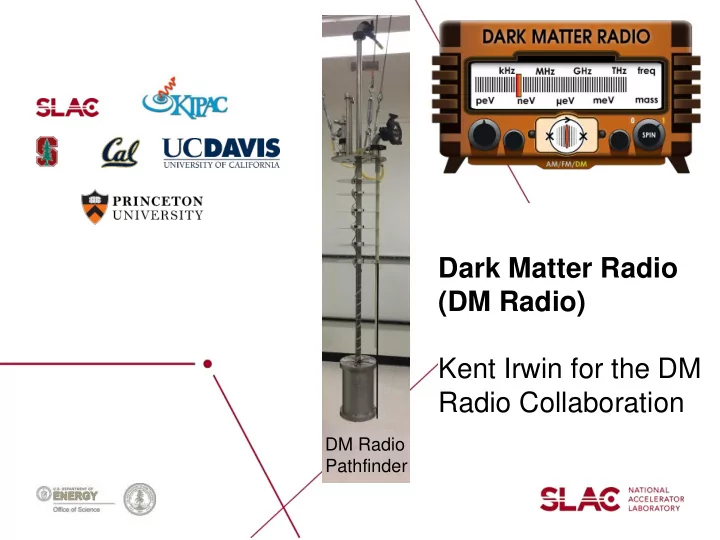
Dark Matter Radio (DM Radio) Kent Irwin for the DM Radio Collaboration
DM Radio Pathfinder
SLIDE 2
(small occupation)
- Tiny wavelength
- No detector-scale coherence
- Look for scattering of individual
particles
Heavy Particles Light Fields
(must be bosons)
- Long wavelength
- Coherent within detector
- Look for classical, oscillating
background field Detector Detector
2
Particle-like and field-like dark matter
SLIDE 3 Light-field dark matter is a boson
1. Scalar field (spin-0) 2. Pseudoscalar (spin-0, but changes sign under parity inversion) “axion” 3. Vector (spin-1): “hidden photon” 4. Pseudovector (spin-1, but changes sign on parity inversion)
DM mass:
Light (field) DM
- Spin-0 scalar
- Spin-1 vector
- Higher spin (tensor) disfavored
Heavy (particle) DM
The light-field d dark matter zoo
SLIDE 4
Thermal production of ~100 GeV particles (WIMPs) at the electroweak energy scale produces ~ observed abundances of dark matter. “WIMP miracle.”
Supersymmetry suggests particles with WIMP-like properties. Axion: solves strong CP problem in QCD.
About those priors…
SLIDE 5
Thermal production of ~100 GeV particles (WIMPs) at the electroweak energy scale produces ~ observed abundances of dark matter. “WIMP miracle.” Inflationary production of >~ 1 meV vectors (hidden photons) under high- scale inflation naturally produces ~ observed abundances of dark matter. “Hidden photon miracle.”
Supersymmetry suggests particles with WIMP-like properties. Axion: solves strong CP problem in QCD.
About those priors…
- P. Graham et al., “Vector Dark Matter from Inflationary Fluctuations,” arxiv:1504.02102
SLIDE 6
Thermal production of ~100 GeV particles (WIMPs) at the electroweak energy scale produces ~ observed abundances of dark matter. “WIMP miracle.” Inflationary production of >~ 1 meV vectors (hidden photons) under high- scale inflation naturally produces ~ observed abundances of dark matter. “Hidden photon miracle.”
Supersymmetry suggests particles with WIMP-like properties. Axion: solves strong CP problem in QCD.
About those priors…
- P. Graham et al., “Vector Dark Matter from Inflationary Fluctuations,” arxiv:1504.02102
But the universe doesn’t seem so “natural”… and Occam so rarely seems to apply in normal life.
SLIDE 7
- Strong CP Problem
- Spin-0 boson
- Can be detected via inverse
Primakoff effect
Neutron Electric Dipole Moment Why is it so small? Solution: is a dynamical field (Peccei-Quinn solution, the axion)
7
gaγγ axion dc magnetic field photon
Leslie J Rosenberg PNAS 2015;112:12278-12281
Possible dark matter candidate: axion (spin 0)
SLIDE 8 “Hidden” photon: generic vector boson (spin 1)
- A new photon, but with a mass, and weak
coupling
- Couples to ordinary electromagnetism via
kinetic mixing
Hidden photon DM drives EM currents
CMB photon Hidden Photon DM
(oscillating E’ field)
SLIDE 9 Wide range of unexplored parameter space
9
Axions: plenty of room at the bottom
SLIDE 10 Wide range of unexplored parameter space
10
Hidden p photons: plenty of room at the bottom
SLIDE 11 Power Frequency
6
10 ~
Pierre Sikivie (1983)
Primakoff Conversion Expected Signal
Amplifier Magnet Cavity
Thanks to John Clarke
Resonant conversion of axions into photons
ADMX experiment
SLIDE 12
Workshop Axions 2010, U. Florida, 2010
SLIDE 13 Workshop Axions 2010, U. Florida, 2010
Also: Sikivie, P., N. Sullivan, and D. B. Tanner. "Physical review letters 112.13 (2014): 131301.
Also useful for hidden photons: Arias et al., arxiv:1411.4986 Chaudhuri et al., arxiv: 1411.7382v2
SLIDE 14
Stanford: Arran Phipps, Dale Li, Saptarshi Chaudhuri, Peter Graham, Jeremy Mardon, Hsiao-Mei Cho, Stephen Kuenstner, Harvey Moseley, Richard Mule, Max Silva-Feaver, Zach Steffen, Betty Young, Sarah Church, Kent Irwin Berkeley: Surjeet Rajendran Collaborators on DM Radio extensions: Tony Tyson, UC Davis Lyman Page, Princeton
SLIDE 15
Stanford: Arran Phipps, Dale Li, Saptarshi Chaudhuri, Peter Graham, Jeremy Mardon, Hsiao-Mei Cho, Stephen Kuenstner, Harvey Moseley, Richard Mule, Max Silva-Feaver, Zach Steffen, Betty Young, Sarah Church, Kent Irwin Berkeley: Surjeet Rajendran Collaborators on DM Radio extensions: Tony Tyson, UC Davis Lyman Page, Princeton
Distance Coherence E Coherence f 0 km 3 km 300 neV 70 MHz 40 km 20 neV 5 MHz 120 km 7 neV 2 MHz 5,000 km 0.2 neV 40 kHz
SLIDE 16 Cross-section
Superconducting shield Hollow, superconducting sheath (like a hollow donut)
16
Block EMI background with a a superconducting shield
- In the subwavelength limit of
DM Radio, you can approximate the signal from axions and hidden photons as an effective stiff ac current filling all space, with frequency f = mc2/h (the “interaction basis”)
- To detect this signal, we need
to block out ordinary photons with a superconducting shield
SLIDE 17
ac current penetrates superconductors
17
How t to measure effective hidden p photon current
SLIDE 18
ac current penetrates superconductors
circumferential, quasi- static B-field
superconductor surface flow to cancel field in bulk
Meissner Effect
18
How t to measure effective hidden p photon current
SLIDE 19
bottom of cylinder
return on outer surface
19
How t to measure effective hidden p photon current
SLIDE 20
bottom of cylinder
return on outer surface
to couple some of the screening current to SQUID
20
How t to measure effective hidden p photon current
SLIDE 21
- Toroidal coil produces DC
magnetic field inside superconducting cylinder
- Axions interact with DC field,
generates effective AC current along direction of applied field
(B0 toroid inside cylinder) Top-Down Cross-section
21
How t to measure effective axion current
SLIDE 22
- Toroidal coil produces DC
magnetic field inside superconducting cylinder
- Axions interact with DC field,
generates effective AC current along direction of applied field
- Produces REAL quasi-static
AC magnetic field
22
How t to measure effective axion current
SLIDE 23
superconductor flow to cancel field in bulk
Meissner Effect
23
How t to measure effective axion current
SLIDE 24
- Cut a slit from top to bottom
- f the superconducting
cylinder
- Screening currents continue
along outer surface
24
How t to measure effective axion current
SLIDE 25
- Cut a slit from top to bottom
- f the superconducting
cylinder
- Screening currents continue
along outer surface
- Use inductive loop to couple
screening current to SQUID
25
How t to measure effective axion current
SLIDE 26 Hidden Photon Detector Axion Detector
no need to scan
- Long integration times
- Interfering EMI pickup
difficult to manage If it is possible to build a resonator, signal to noise is improved, even considering the need to scan.
26
ABRACADABRA
arXiv:1602.01086, 2016
Broadband detection: limited s signal to noise
Chaudhuri et al., in preparation, 2017
SLIDE 27
enhanced through the use of a resonator
element resonator to ring up the magnetic fields sourced by local dark matter
- Tune dark matter radio over
frequency span to hunt for signal
27
Resonant enhancement
SLIDE 28
enhanced through the use of a resonator
element resonator to ring up the magnetic fields sourced by local dark matter
- Tune dark matter radio over
frequency span to hunt for signal
28
Resonant enhancement
SLIDE 29 ac SQUIDs
- dc SQUIDs can be used at low frequency, but at >~1 MHz,
dissipation in the resistive shunts used in dc SQUIDs degrades the Q of the DM Radio resonator
- At higher frequencies, we are using an “ac SQUID”: a
reactive device that operates as a flux-variable inductor
- Flux detected by change in frequency of a resonator
- Can be quantum limited
Inductance response Resonance response
F
SLIDE 30 750 mL Pathfinder now being tested
- Initial focus on hidden photons
- T=4K (Helium Dip Probe)
- Frequency/Mass Range:
100 kHz – 10 MHz 500 peV – 50 neV
: 10-9 – 10-11
4K Dip Probe Detector inside superconducting shield Inserts into Cryoperm-lined helium dewar 67 inches 9.5 inches
Design Overview of the DM Radio Pathfinder Experiment
- M. Silva, arXiv:1610.09344, 2016
30
DM Radio pathfinder experiment
SLIDE 31 Scan time
- 30 days/decade
- 3-6 months total scan
Ultra-coarse tuning
- fixed sapphire plate fully
inserted/removed (tune C)
- change number of turns in
solenoid coil (tune L) Coarse tuning
- position of sapphire dielectric
plates (3) Fine tuning
- position of sapphire needle
- position of niobium needle
per .001” of motion
31
Resonant frequency tuning
SLIDE 32
- Pathfinder construction complete
- SQUIDs and readout electronics
tested / working
- Now testing fixed resonators to
evaluate Q, material properties, then scan
- Initial science scans Summer
2017
32
Present status - Pathfinder
SLIDE 33 33
DM Radio science reach: hidden photons (l (lumped-element)
SLIDE 34 34
DM Radio science reach: axions
SLIDE 35 35
Potential Budget
- Pathfinder is funded and becoming operational
- Stage 2 $1.3 M
- With DOE lab overhead & costs (less expensive on campus
with students and postdocs)
- Dilution refrigerator, materials, supplies, equipment, FTEs
- Stages 2+3, One-site ~$5M
- Stage 2+3 Multi-site, multi-orientation $5-10M
SLIDE 36 36
Conclusions
Hidden Photons Axions
SLIDE 37 37
Conclusions
Hidden Photons Axions
SLIDE 38 38
Conclusions
Hidden Photons Axions