Disclosures Current Management of Consultant: WL Gore, Medtronic, - - PowerPoint PPT Presentation

disclosures current management of
SMART_READER_LITE
LIVE PREVIEW

Disclosures Current Management of Consultant: WL Gore, Medtronic, - - PowerPoint PPT Presentation

4/19/2013 Disclosures Current Management of Consultant: WL Gore, Medtronic, Cordis Acute Aortic Injuries Research Grants: WL Gore, Cook, Cordis, Medtronic, Boston Scientific, Abbott Michel Makaroun MD Edwards Life Sciences, Bolton, Lombard


slide-1
SLIDE 1

4/19/2013 1

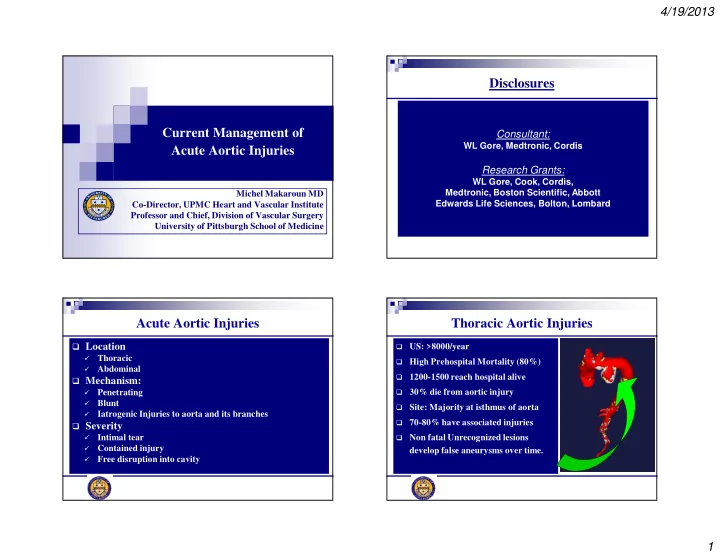
Current Management of Acute Aortic Injuries

Michel Makaroun MD Co-Director, UPMC Heart and Vascular Institute Professor and Chief, Division of Vascular Surgery University of Pittsburgh School of Medicine

Disclosures

Consultant:

WL Gore, Medtronic, Cordis

Research Grants:

WL Gore, Cook, Cordis, Medtronic, Boston Scientific, Abbott Edwards Life Sciences, Bolton, Lombard

Acute Aortic Injuries

Location

  • Thoracic
  • Abdominal

Mechanism:

  • Penetrating
  • Blunt
  • Iatrogenic Injuries to aorta and its branches

Severity

  • Intimal tear
  • Contained injury
  • Free disruption into cavity

Thoracic Aortic Injuries

US: >8000/year High Prehospital Mortality (80%) 1200-1500 reach hospital alive 30% die from aortic injury Site: Majority at isthmus of aorta 70-80% have associated injuries Non fatal Unrecognized lesions

develop false aneurysms over time.

slide-2
SLIDE 2

4/19/2013 2

Aortic Transection: Diagnosis Transection Diagnosis: Angiography Transection Diagnosis: TEE Transection Diagnosis: CT Scan

slide-3
SLIDE 3

4/19/2013 3

Traumatic Aortic Transection

Standard Open repair

Left Thoracotomy

Single lung ventilation Systemic Anticoagulation Aortic Cross Clamping Possible left Heart Bypass

Traumatic Aortic Transection

Benefits of TEVAR

Possible under Local anesthesia

No cross clamping Short procedure Minimal or No Anticoagulation

FS: 45 year old Male / MVA accident Multiple Injuries: Long bone/ Abdomen 21-22 mm aorta 26mm Thoracic Endograft

FS: Use of Thoracic Endografts Acute Aortic Trauma: Challenges

Small Aortic Diameter Acute Arch Curvature Tapering lumens Small Access vessels

slide-4
SLIDE 4

4/19/2013 4

JT: 29 year old Female / ATV vs Tree accident Multiple Injuries: Head/ Abdomen / Pulmonary / Spine

JT: Use of Cuffs for Transection

Proximal Aorta: 17.7 mm Distal Aorta: 17.2 mm JT: 29 year old Female / ATV vs Tree accident Multiple Injuries: Head/ Abdomen / Pulmonary / Spine

JT: Use of Aortic Cuffs for Transection

23 mm Aortic cuffs

Traumatic Aortic Transection

Potential Drawbacks of TEVAR

Possible residual endoleak and bleeding Possible migration or fistula formation Young Patients No Long term durability data/ Long FU Approved grafts only available recently Graft Collapse

Causes: Oversizing and poor apposition

Potential Drawbacks of TEVAR

Possible residual endoleak and bleeding

Possible migration or fistula formation Young Patients No Long term durability data/ Long FU Approved grafts only available recently Graft Collapse

Causes: Oversizing and poor apposition

Traumatic Aortic Transection

APR 08: 9 Year FU

slide-5
SLIDE 5

4/19/2013 5

Potential Drawbacks of TEVAR

Possible residual endoleak and bleeding

Possible migration or fistula formation Young Patients No Long term durability data/ Long FU Approved grafts only available recently Graft Collapse

Causes: Oversizing and poor apposition

Traumatic Aortic Transection

Potential Drawbacks of TEVAR

Possible residual endoleak and bleeding

Possible migration or fistula formation Young Patients No Long term durability data/ Long FU Approved grafts only available recently Graft Collapse

Causes: Oversizing and poor apposition

Traumatic Aortic Transection New Approved Device Modification Despite All The Actual and The Theoretical Shortcomings What are the Results?

slide-6
SLIDE 6

4/19/2013 6

Traumatic Aortic Transection

J Vasc Surg 2006: 43 (2): A22-A29 Open results

Clamp and Sew Distal Perfusion Paraplegia Mortality Paraplegia Mortality

Von Oppell (94) 87 studies 1492 pts

19.0% 16.0% 6.1% 15.0%

Kadali (91)

28.5% 3.8%

Standard Open Repair

Single Center Series over 27 years

Attar et al Ann Thor Surg 1999 263 patients over 27 years Operative Mortality 1971-1975

19%

1976-1984

36%

1985-1994 26% 1995-1998

16%

Paraplegia

17%

Standard Open Repair

Prospective Multicenter AAST trial

Fabian et al J Trauma 1997 274 patients over 2.5 years from 50 centers From injury to thoracotomy: 16.5 hours Mortality 31% two thirds from Aortic source Paraplegia Full Bypass

4.5%

Partial Bypass

7.7%

Clamp and Saw 16.4%

Traumatic Aortic Transection

J Vasc Surg 2006: 43 (2): A22-A29

slide-7
SLIDE 7

4/19/2013 7

Traumatic Aortic Transection

Endo Results 17 Reports

Author Year Patients Technical Success (%) Endograft type Mortality Paraplegia Follow-up (months) Bortone 2002 10 100% Gore NA None 14 Orend 2002 11 92% Gore, Talent NA None 14 Thompson 2002 5 100% Gore, custom None 20 Fattori 2002 11 100% Gore, Talent None 20 Lachat 2002 12 100% Gore, Talent 1 None 9 Kasirajan 2003 5 100% Gore, Talent, homemade None 10 Karmy-Jones 2003 11 100% AneuRx cuff, Ancure, Talent, homemade NA None 16 Iannelli 2004 3 100% Gore NA None 13 Wellons 2004 9 100% AneuRx cuff, Excluder cuff None 6 Kato 2004 6 100% Homemade NA None 6 Scheinert 2004 10 100% Gore, Talent NA None 17 Czermak 2004 12 92% Gore, Talent NA None 9 Morishita 2004 7 100% Homemade NA None 12 Neuhauser 2004 10 100% Gore, Talent, Vanguard NA None 26 Ott 2004 6 100% Talent None 16 Uzieblo 2004 4 100% Talent NA None 8 Bortone 2004 14 100% Talent, Gore, Zenith, Endofit NA None 14 Total 146 99% 1 of 48 (2%) None

J Vasc Surg 2006: 43 (2): A22-A29 Patients Technical Success Mortality Paraplegia Total 146 99% 2% 0

Traumatic Aortic Transection

J Vasc Surg 2007; 46:928-33 J Vasc Surg 2012;56:74-80

Traumatic Aortic Transection

TEVAR vs Open Thoracotomy at UPMC 1999-2011

41 open Repairs 1999- January 2011 8 deaths

Mortality 19.5%

2 Paraplegia

Paraplegia 4.4%

50 TEVAR : 46 Acute within 3 days of injury three death

Mortality 6.1%

No paraplegia

Paraplegia 0%

Last Open Case Jan 2007: 18 year old with isolated injury 8 hour procedure, massive bleeding and Death

Since Feb 2007 All Transections Rx by TEVAR

Traumatic Aortic Transection

50 TEVAR 38 Men and 12 women Mean Age: 39 years

Youngest 17 years Oldest 79 years

Grafts Thoracic endografts: 34 TAG / 3 TX2 / 2 Talent Abdominal Cuffs: 9 Excluder / 2 AneuRx

TEVAR at UPMC 1999 - 2011

slide-8
SLIDE 8

4/19/2013 8

Traumatic Aortic Transection

No conduits. 6 percutaneous No Iliac artery Injuries. ONLY 10 LSA coverage (20%) Only 2 delayed LCS bypass No Arm ischemia or related strokes Two strokes: (Unrecognized associated injury to the

Innominate artery, Fat embolus)

Mean FU 27 months. Longest 11 years.

TEVAR at UPMC 1999 - 2011

Traumatic Aortic Transection

Lessons Learned From Early Results

TEVAR is Superior to open repair for aortic trauma Conduits are almost never needed Coverage of L. Subclavian artery is rarely needed Use of abdominal cuffs is feasible and quite safe

TEVAR at UPMC 1999 - 2011

Traumatic Aortic Transection

J Trauma 2008;64:1415-19

Compared to the 1997 Survey

Open Repair 100% 35% Mortality 22% 13% Paraplegia 8.7% 1.6%

Conclusions: Comparison between the two AAST studies in 1997 and 2007 showed a major shift in the diagnosis of the aortic injury, with the widespread use of CT scan and the almost complete elimination of aortography and TEE. The concept of delayed definitive repair has gained wide acceptance. Endovascular repair has replaced open repair to a great extent. These changes have resulted in a major reduction of mortality and procedure-related paraplegia but also a significant increase

  • f graft related complications.

Traumatic Aortic Transection

Graft Related Complications: 8 patients (16%)

4 isolated graft collapses treated with second TEVAR 1 conversion @ 6 m after graft collapse and AEF 1 conversion @ 3 yrs for Sx dynamic Carotid obstruction 1 conversion @ 2yrs for Carotid obstruction. No Sxs 1 conversion @ 18 months for arm hypertension

No DEATHS or PARAPLEGIA

TEVAR at UPMC 1999 - 2011

slide-9
SLIDE 9

4/19/2013 9

WM: 50 year old Man with Sky diving accident Multiple Injuries: Long bones, pelvis, abdominal, chest, spine and Closed head Injury

WM: Open Conversion for Collapse and AEF WM: Open Conversion for Collapse and AEF

July 10 Oct 18 Dec 6

WM: 50 year old with Sky diving accident Multiple Injuries: Long bones, pelvis, abdominal, chest, spine and Closed head Injury

WM: Open Conversion for Collapse and AEF

POST BALLOON

Dec 8 Jan 3

In Situ Reconstruction Rifampin Impregnated Graft

WM: Open Conversion for Collapse and AEF

POST BALLOON

Esophagectomy and Subsequent Substernal Stomach Pull-up One Year Later

slide-10
SLIDE 10

4/19/2013 10

LS: 17 year old Female / Car accident Multiple Injuries: Pelvic and facial fractures / Bladder and Liver injuries / Intracranial injuries

LS: Conversion for dynamic obstruction of LCCA

TAG 26 x 10 LS: 27 month FU: Left Amaurosis and Light headedness To and Fro motion in Left CCA on Duplex Angiogram and Pressure measurement in LCCA

LS: Conversion for dynamic obstruction of LCCA

27 months LCCA SAP 15mmHg < Proximal Aorta BC: 21 year old Male / Snowmobile accident Multiple Injuries: Diaphragm / Abdomen / Pulmonary 22mm Aorta / 26mm TAG’s

BC: Conversion for obstruction of Aorta

1 month CT: Collapse of inner graft BC: 22 year old Male / Snowmobile accident Multiple Injuries: Diaphragm / Abdomen / Pulmonary 10 months Later. SEVERE Hypertension R Arm 180/110

BC: Conversion for obstruction of Aorta

slide-11
SLIDE 11

4/19/2013 11

Summary: Thoracic aortic Transection

Even with devices not designed for

traumatic transection, results of TEVAR are superior to emergency open repair

Conversion can be done safely at a later

date if needed.

Newer Modified devices are expected to

decrease late graft complications

Endovascular is the Treatment of choice for Aortic Transection

J Vasc Surg 2012;56:656-60

Abdominal Aortic Injury

Vasc Endovasc Surg 2012;46:329-331

Abdominal Aortic Injuries Less Common than Thoracic < 25% of abdominal vascular trauma Blunt injuries very rare. Very high Mortality Endovascular therapy replacing open repair

Abdominal Aortic Injury Ascending Arch Iatrogenic Injury

slide-12
SLIDE 12

4/19/2013 12

Right Subclavian Trauma: Endo-Rescue

Conclusion

Endovascular Options are becoming quickly the standard of care for most Aortic and Arterial Trauma University

  • f

Pittsburgh