Diode 2 Unidirectional current characteristics Permit current to - - PowerPoint PPT Presentation

diode
SMART_READER_LITE
LIVE PREVIEW

Diode 2 Unidirectional current characteristics Permit current to - - PowerPoint PPT Presentation

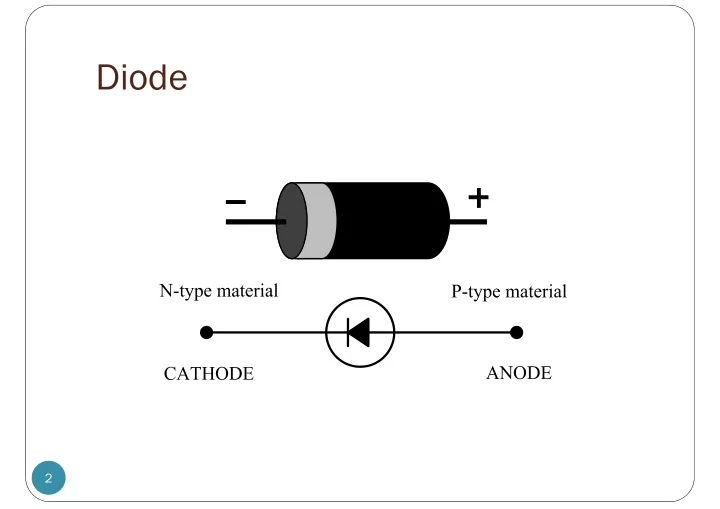
Diode 2 Unidirectional current characteristics Permit current to flow through in one direction (when forward-biased ), but not the other ( reverse-biased ). 3 Transformer 4 Transformer 240 V 5 Part A + 240 V v in - + v in - L out


slide-1
SLIDE 1

Diode

2

slide-2
SLIDE 2

Unidirectional current characteristics

3

 Permit current to flow through in one direction (when

forward-biased), but not the other (reverse-biased).

slide-3
SLIDE 3

Transformer

4

slide-4
SLIDE 4

Transformer

5

240 V

slide-5
SLIDE 5

Part A

6

  • ut

L

+ vin

  • +

vin

  • 240 V
slide-6
SLIDE 6

Part A: Half-Wave Rectifier (HWR)

7

 A rectifier is an electrical device that converts alternating

current (AC) to direct current (DC).

240 V

slide-7
SLIDE 7

Part A: Full-Wave Rectifier (FWR)

8

240 V

slide-8
SLIDE 8

Part B: Filter Capacitor

9

  • ut

L

240 V

slide-9
SLIDE 9

Electrolytic Capacitor

11

 The polarity is almost always indicated by a printed band.

 The lead nearest to that band is the cathode lead (-).

 Additionally, the positive lead is usually longer.  Hook them up the wrong way and at best, you’ll block the

signal passing through. At worst (for higher voltage applications) they’ll explode.

Also check that it is 100-F 50-V

slide-10
SLIDE 10

Oscilloscope: DC vs. AC

12

 Input signal:  DC mode: Show  AC mode: Show

 vAC(t) always have 0 average (theoretically)

when VDC = 0.

 

v t

   

DC

V

AC

v t v t  

   

DC

v t v t 

   

AC DC

v t v t 

slide-11
SLIDE 11

In DC mode…

13

Not enough to move the interesting part

  • f the waveform

into the screen

slide-12
SLIDE 12

Part C: Bridge rectifier

17