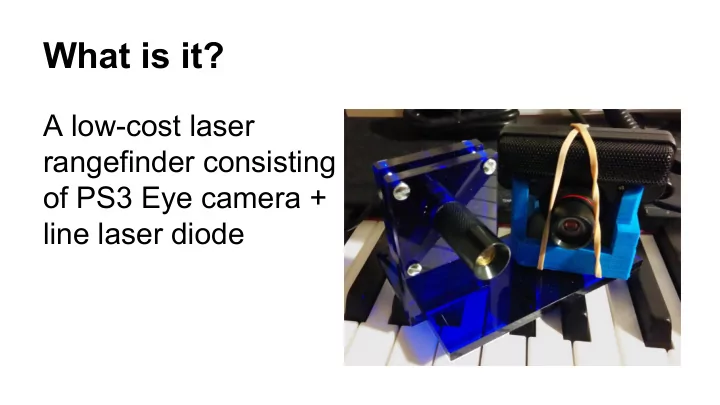
What is it? A low-cost laser rangefinder consisting of PS3 Eye - - PowerPoint PPT Presentation

what is it
SMART_READER_LITE
LIVE PREVIEW

What is it? A low-cost laser rangefinder consisting of PS3 Eye - - PowerPoint PPT Presentation

What is it? A low-cost laser rangefinder consisting of PS3 Eye camera + line laser diode Algorithm 1. RGB -> Greyscale 2. Noise elimination: Gaussian convolution 3. Finds the index which has the maximum convolved peak 4. Find distance


slide-1
SLIDE 1

What is it?

A low-cost laser rangefinder consisting

  • f PS3 Eye camera +

line laser diode

slide-2
SLIDE 2

Algorithm

  • 1. RGB -> Greyscale
  • 2. Noise elimination: Gaussian convolution
  • 3. Finds the index which has the maximum

convolved peak

  • 4. Find distance from the peak index using pre-

calibrated settings

slide-3
SLIDE 3

HARDWARE FPGA SOFTWARE Userland

SOFTWARE INTERFACE

  • Calibrating the

relationship between laser distance and image pixel Eliminate noise and find max value pixel index using 16x1 Gaussian convolution

  • Driver kernel to

communicate between the software and the hardware.

  • Use ioread32/

iowrite32

  • Get image
  • RGB -> Grayscale
  • Make a group of

32 pixel horizontally for the convolution later

  • Calibrating

laser distance given max pixel image Image

slide-4
SLIDE 4

Hardware

  • a 60-byte addressable memory device

implemented using unpacked byte array

  • A single read-only 32-bit word is used to

hold the results

  • 32 convolutions done in parallel within a

single clock cycle, using Altera IP-based 16- way parallel adder and multiplier units

slide-5
SLIDE 5

Hardware-software Interface

A large contiguous shared memory with the following layout:

initial fill 8 bytes data 32 bytes end fill 8 bytes convolution vector 8 bytes max value 2 bytes max position 1 byte

slide-6
SLIDE 6

Software

  • Kernel driver: uses ioread32/iowrite32 to

transfer data between software and hardware

  • Userland: reads in an image, converts it to

grayscale, sends pixels in groups 32 to hardware for convolution, and calculate distance from convolved peaks and pre- calibrated settings

slide-7
SLIDE 7

Distance Calibration

  • Take image of the laser project onto the wall as it shows in

the image below.

  • Keep the angle between laser and camera constant, increase

the laser distance from the wall

  • To calculate the pixel

corresponding to each distance, we just manually measure the horizontal distance of the laser line from the image

slide-8
SLIDE 8

Calibration (2)

  • Plot the relationship between the laser

distance and pixel image, do a best fit line

where x is the distance from the laser, and y is the pixel location

  • f the laser point
slide-9
SLIDE 9

Conclusion

  • Challenges:
  • USB Bus Bandwidth
  • PCI-E Communication
  • Avalon bus width
  • Lessons learned
  • software and hardware connection
  • interface available