Design and Performance of Retrofitted Roadside Biofilter Swales, - - PowerPoint PPT Presentation

design and performance of retrofitted roadside biofilter
SMART_READER_LITE
LIVE PREVIEW

Design and Performance of Retrofitted Roadside Biofilter Swales, - - PowerPoint PPT Presentation

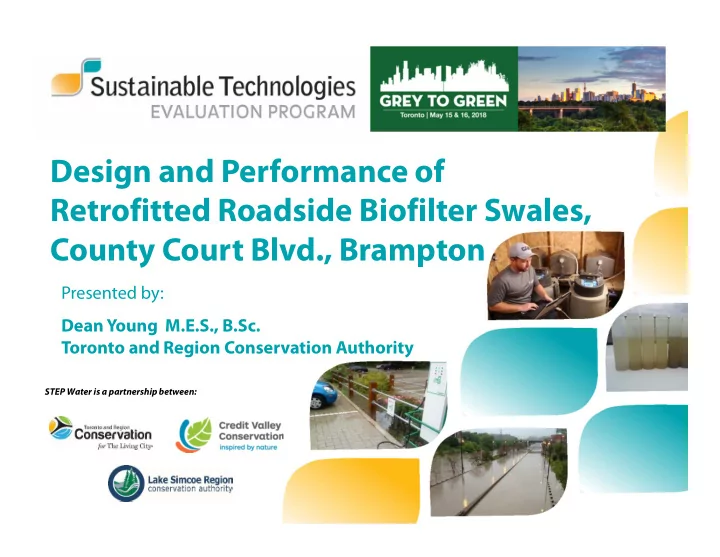
Design and Performance of Retrofitted Roadside Biofilter Swales, County Court Blvd., Brampton Presented by: Dean Young M.E.S., B.Sc. Toronto and Region Conservation Authority STEP Water is a partnership between: Infrastructure renewal in a

slide-1
SLIDE 1

STEP Water is a partnership between:

Design and Performance of Retrofitted Roadside Biofilter Swales, County Court Blvd., Brampton

Presented by: Dean Young M.E.S., B.Sc. Toronto and Region Conservation Authority

slide-2
SLIDE 2

Infrastructure renewal in a changing climate

slide-3
SLIDE 3

A neighbourhood-based solution for sustainable urban renewal and climate action.

 Brings efficiencies  Draws strong community support  Builds innovative partnerships for implementation

slide-4
SLIDE 4

County Court SNAP - Creating a sense of community

slide-5
SLIDE 5

County Court Blvd. Biofilter Swales

Demonstrating a strategic financing model and interdepartmental cooperation. Basis for engaging community and measuring

  • utcomes
slide-6
SLIDE 6
  • Two lined bioretention (biofilter)

swales, 70 m (West) and 85 m (East) length x 3 m width, constructed in 2014/15 that receives runoff from 1,904 m2 portion of County Court Blvd.;

  • Impervious liner and perforated

sub-drain pipe to limit risk of damage to watermain located below swale footprints;

  • Construction and routine

inspections and 18 mo. performance monitoring by STEP.

Before (2014) After (2016)

County Court Blvd. Biofilter Swales

slide-7
SLIDE 7

County Court Blvd. Biofilter Swales – Design

  • Impervious to pervious area (I:P)

ratio of 4:1;

  • ~ 1 m deep, vertical walled

excavation lined with EPDM (rubber) geomembrane;

  • 150 mm dia. perforated pipe sub-

drain with filter sock and standpipes;

  • 15 cm coarse sand transition layer

sandwiched between geotextile;

  • 50 to 75 cm depth of filter media

(85% sand-sized, 4% O.M.);

  • OPSD 605.040 concrete asphalt

spillways (2 per bioswale) and simple curb cuts as inlets (5 to 6).

slide-8
SLIDE 8

County Court Blvd. Biofilter Swales – Construction

  • Vertical excavation destabilized the

gravel base of the existing curb, necessitating replacement with wider curb and delaying construction;

  • Lab testing of biomedia prior to

delivery delayed installation;

  • Modified curbs not constructed to

OPSD specifications – needed to replace of 4 of 15 with OPSD 605.040 concrete asphalt spillways;

  • Missing curb cut inlet u/s of one

road catchbasin.

Missing inlet Destabilized curb base

slide-9
SLIDE 9

County Court Blvd. Biofilter Swales – Landscaping

  • Original planting plan: mix of flowers,

herbs and ornamental grasses with shredded mulch cover to create attractive landscaped feature;

  • Community planting event in fall 2014;
  • Vegetation cover <80% after 2 years –

too few plants, lack of watering and mulch, dry spring 2015, road reconstruction in summer 2016 were contributing factors;

  • Grass/herb seed mix spread on

biomedia in fall 2015 - poor results;

  • Added river-run stone cover around

surviving plants in 2016.

West Swale - June 2016 West Swale – Oct. 2016

slide-10
SLIDE 10

County Court Blvd. Biofilter Swales – Performance Evaluation

  • Conducted inspections using visual

indicators and test methods recommended in LID I&M Guide (TRCA, 2016);

  • Continuous field monitoring to

evaluate runoff volume and pollutant load reduction and examine effects

  • n effluent temperature;
  • Examine effects of winter operation
  • n treatment performance and

maintenance needs;

  • Compared bioswale flow volumes,

rates & water quality to runoff from an untreated portion of County Court

  • Blvd. (Control catchment);
slide-11
SLIDE 11

County Court Blvd. Biofilter Swales – Performance Evaluation

slide-12
SLIDE 12

County Court Blvd. Biofilter Swales – Performance Evaluation

  • Evaluated runoff reduction through

continuous flow monitoring during simulated and natural storm events;

  • Simulated storm event testing (Nov.

2014) indicated potential to reduce runoff in order of 30% for a 12 mm simulated event on dry soil;

  • Biofilter swales with 4:1 I:P ratio can

retain all runoff from rainfall events up to 3.0 mm in depth;

  • Runoff reduction (2015/16 rain

events, n = 80):

  • East Bioswale: 17%
  • West Bioswale: 34%
slide-13
SLIDE 13

Peak Flow Rate Reduction

4 8 12 16 20 3 6 9 12 15 9/7/2016 0:00:00 9/7/2016 12:00:00 9/8/2016 0:00:00 9/8/2016 12:00:00 9/9/2016 0:00:00

Rainfall (mm/hour) Flow (L/hour/m2)

Rainfall Control BioEast BioWest Peak flow ratesreduced by 53% (BioEast) and 67% (BioWest) 20.8 mm rain event, 12.4 mm/h maximum rainfall intensity

slide-14
SLIDE 14

County Court Blvd. Biofilter Swales – Winter Operation

  • West Biowale inlets blocked over

winter 2016 while East remained on- line;

  • Some snowmelt and plowed snow still

able to enter West Bioswale;

  • Sediment accumulation at inlets ≥5

cm – sediment removal needed annually in early spring;

  • Bioswales affected by ingress of salty

interflow from surrounding landscapes;

  • Biomedia samples at inlets and along

centreline showed sodium (SAR) contamination during winter, but back below guideline by end of April.

slide-15
SLIDE 15

County Court Blvd. Biofilter Swales – Sodium Adsorption Ratio in Biomedia

  • 1

1 3 5 7 9 11 13 15 1-Dec-15 20-Jan-16 10-Mar-16 29-Apr-16 18-Jun-16 7-Aug-16 26-Sep-16 Sodium Adsorption Ratio (SAR) EC-2 EC-3 WC-1 OMOE Residential/Parkland guideline

slide-16
SLIDE 16

n = 11 n = 24 n = 24 n = 11 n = 24 n = 11

County Court Blvd. Biofilter Swales – Suspended Solids, Total

slide-17
SLIDE 17

n = 11 n = 24 n = 24 n = 11 n = 24 n = 11

County Court Blvd. Biofilter Swales – Copper

slide-18
SLIDE 18

n = 11 n = 24 n = 24 n = 11 n = 24 n = 11

County Court Blvd. Biofilter Swales – Phosphorus, Total

slide-19
SLIDE 19

Statistical Significance - concentrations

Pollutant Control vs. East (ANOVA 2015-2016) Control vs. West (ANOVA 2015-2016) East vs. West (ANOVA 2015-2016) Chloride C < E C < W Not sig. Suspended Solids C > E C > W Not sig. Nitrogen, Total Not sig. Not sig. Not sig. Phosphorus, Total Not sig. Not sig. Not sig. Phosphate C < E C < W Not sig. Oil and Grease C > E C > W Not sig. Hardness C < E C < W Not sig. Chromium C > E C > W Not sig. Copper C > E C > W Not sig. Sodium C < E C < W Not sig. Zinc C < E Not sig. Not sig.

slide-20
SLIDE 20

*Results based on event mean water quality sampling results from 2015 & 2016 (combined), measured outflow volumes from East and West Bioswales and modelled control catchment outflow volumes for 35 paired rain events.

Contaminant Load Reduction Results, %*

Effluent Pollutant Concentrations

Parameter Unit Guideline Control East Bioswale West Bioswale Effluent conc. (median) Effluent conc. (median) Removal Efficiency (%) Effluent conc. (median) Removal Efficiency (%) Chloride mg/L 120/640 32.1 149

  • 364

81.35

  • 153

Solids, suspended mg/L 25 27.8 5 82 5.4 81 Nitrogen, Total mg/L n/a 1.11 0.81 27 0.86 23 Nitrogen; NH3+NH4 mg/L 0.019 0.246 0.034 86 0.03 88 Nitrogen, nitrite (NO2) mg/L 0.060 0.055 0.008 85 0.01 82 Nitrogen, NO2+NO3 mg/L n/a 0.373 0.297 20 0.31 17 Phosphorus, Total (TP) mg/L 0.03 0.066 0.059 11 0.05 24 Phosphorus, Phosphate mg/L n/a 0.018 0.041

  • 128

0.03

  • 67

Oil & Grease mg/L n/a 1.85 0.5 73 0.5 73 Aluminum ug/L 75 180 130 28 95.5 47 Boron ug/L 1500/2900 13.5 46

  • 241

47

  • 248

Chromium ug/L 9.9 11.8 2.5 79 2.5 79 Copper ug/L 5 21.3 13.6 36 12.05 43 Iron ug/L 300 360 190 47 180 50 Sodium ug/L n/a 22.6 135

  • 496

101.6

  • 349

Zinc ug/L 20 85.7 95.5

  • 11

87

  • 2

Control catchment concentrations low to being with Bioretention 78% Enhanced Swale 47% Bioretention ‐28% Enhanced Swale ‐72% Bioretention 36% Enhanced Swale 37% Int’l SWM BMP Database:

slide-21
SLIDE 21

Parameter East West Parameter East West Suspended Solids, Total 64 52 Aluminum

  • 129
  • 138

Oil and Grease 65 73 Chloride

  • 309
  • 311

Phosphorus, Total

  • 90
  • 96

Chromium 76 78 Phosphorus, Phosphate

  • 275
  • 264

Copper 5 13 Nitrogen, Ammonia + Ammonium 77 73 Iron

  • 48
  • 48

Nitrogen, Nitrate + Nitrite

  • 8
  • 1

Sodium

  • 624
  • 507

Nitrogen, Total 4

  • 1

Zinc

  • 46
  • 37

*Results based on event mean water quality sampling results from 2015 & 2016 (combined), measured outflow volumes from East and West Bioswales and modelled control catchment

  • utflow volumes for 35 paired rain events.

County Court Blvd. Biofilter Swales – Pollutant Load Removal Efficiency (%)

slide-22
SLIDE 22

Effect on Effluent Temperature

Redside dace habitat Threshold value

slide-23
SLIDE 23

LID BMP Life Cycle Costing Tool

  • User enters site characteristics,

and can modify default design and maintenance parameters;

  • Tool provides capital,

maintenance, inspection and rehabilitation cost estimates;

  • Inflation factor can be applied to

update costs to current year;

  • Version 1.1 free to download;
  • Version 2.0 coming soon!

https://sustainabletechnologies.ca

slide-24
SLIDE 24

Life cycle cost per paved drainage area

But OGS and enhanced swales provide less treatment…

slide-25
SLIDE 25

Life cycle cost per pollutant load removal

Biofilter swales still more expensive to construct and operate than enhanced swales…

slide-26
SLIDE 26

Barriers Enablers Concern that projects could be more expensive and time-consuming than ‘business-as-usual”

  • Community engagement builds

excitement and support;

  • Business cases to show project

achieves greater outcomes; Different tolerances for risk versus

  • ptimism among partners
  • Use SNAPs to pilot new projects;
  • Prepare contingency plans as a

group and share experience/risk; Inflexible permitting processes

  • Early engagement with permitting

agencies; Unforeseen issues

  • Build a buffer into project timeline;
  • Keep focused on key objectives.

Lessons Learned – Partner Feedback

slide-27
SLIDE 27

Lessons Learned - Implementation

  • Construction supervision, rigorous

inspection and testing prior to assumption and routine maintenance (annual to biannual) is critical;

  • Landscaping plan needed further

consideration of context and available resources/capacity for maintenance – choose easy to maintain plants tolerant to wet, dry and salt; plants need watering during 1st growing season (biweekly for 1st 2 months in absence of rain) & maintain 5 to10 cm shredded wood mulch cover.

slide-28
SLIDE 28

Conclusions

  • Planned infrastructure renewal projects can be leveraged to

achieve greater impact by taking an integrated, multi-

  • bjective approach;
  • Biofilter swales are effective at reducing runoff volume,

attenuating peak flow rate, removing some pollutants and reducing thermal loading relative to the control catchment.

  • Weak removal efficiencies for nutrients and some metals –

biomedia specifications for lined, filtration-only bioswales should include additive(s) to enhance removal;

  • Life cycle cost of suspended solids removal for biofilter

swales estimated to be favorable to HDS/OGS units but slightly higher than enhanced swales;

slide-29
SLIDE 29

Conclusions (cont’d)

  • Operation during winter 2016 had no significant effects on

biofilter swale treatment performance;

  • Biomedia showed sodium contamination within the top 10

cm at inlets during winter months; SAR declined to below Ontario parkland/residential guideline of 5 by end of April.

  • Despite efforts to dam inlets, monitoring results show that

substantial quantities of snowmelt and plowed snow enters the bioswales over the curb (and past dams/sandbags?);

  • In contexts where BMPs are to be taken out of service during

winter, inlets should be designed with sluice gates or other flow diversion devices.

slide-30
SLIDE 30

Project supporters

slide-31
SLIDE 31

31

  • WWW. SUSTAINABLETECHNOLOGIES.CA

Thank you

For more information:

https://sustainabletechnologies.ca

Contact:

Dean Young M.E.S., B.Sc. Phone: 416-661-6600 ext. 5794 Email: dyoung@trca.on.ca