Decision Networks CS 188: Artificial Intelligence Decision Networks - - PDF document

decision networks cs 188 artificial intelligence
SMART_READER_LITE
LIVE PREVIEW

Decision Networks CS 188: Artificial Intelligence Decision Networks - - PDF document

Decision Networks CS 188: Artificial Intelligence Decision Networks and Value of Information Instructors: Dan Klein and Pieter Abbeel University of California, Berkeley [These slides were created by Dan Klein and Pieter Abbeel for CS188 Intro


slide-1
SLIDE 1

CS 188: Artificial Intelligence Decision Networks and Value of Information

Instructors: Dan Klein and Pieter Abbeel University of California, Berkeley

[These slides were created by Dan Klein and Pieter Abbeel for CS188 Intro to AI at UC Berkeley. All CS188 materials are available at http://ai.berkeley.edu.]

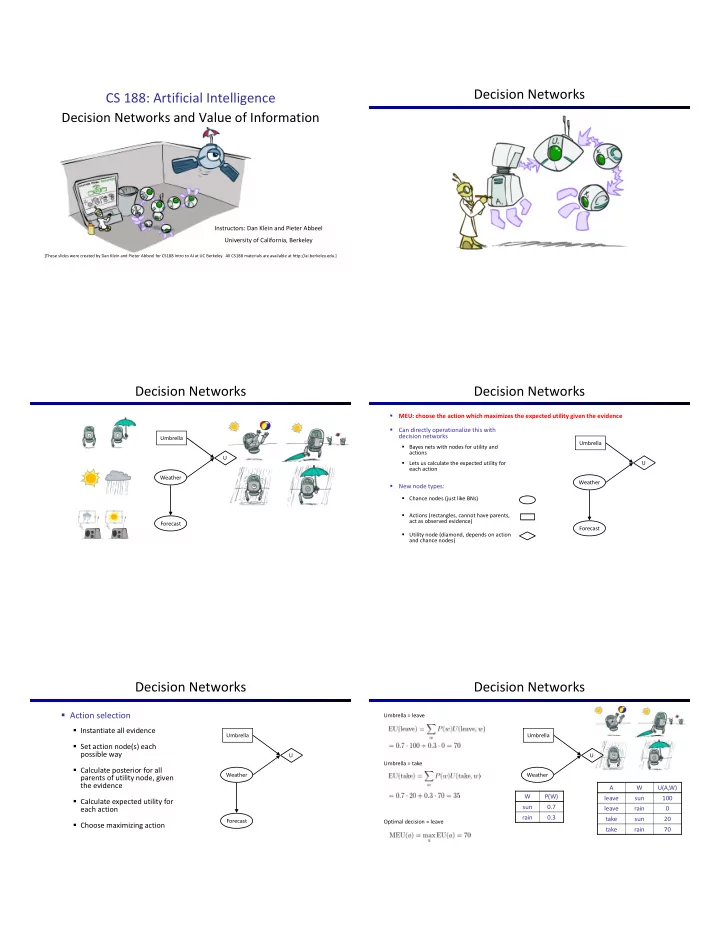
Decision Networks Decision Networks

Weather Forecast Umbrella U

Decision Networks

  • MEU: choose the action which maximizes the expected utility given the evidence

Weather Forecast Umbrella U

  • Can directly operationalize this with

decision networks

Bayes nets with nodes for utility and actions Lets us calculate the expected utility for each action

  • New node types:

Chance nodes (just like BNs) Actions (rectangles, cannot have parents, act as observed evidence) Utility node (diamond, depends on action and chance nodes)

Decision Networks

Weather Forecast Umbrella U

Action selection

Instantiate all evidence Set action node(s) each possible way Calculate posterior for all parents of utility node, given the evidence Calculate expected utility for each action Choose maximizing action

Decision Networks

Weather Umbrella U

W P(W) sun 0.7 rain 0.3

Umbrella = leave Umbrella = take Optimal decision = leave

A W U(A,W) leave sun 100 leave rain take sun 20 take rain 70

slide-2
SLIDE 2

Decisions as Outcome Trees

Almost exactly like expectimax / MDPs What’s changed?

U(t,s) Weather | {} Weather | {} {} U(t,r) U(l,s) U(l,r) Weather Umbrella U

Example: Decision Networks

Weather Forecast =bad Umbrella U

A W U(A,W) leave sun 100 leave rain take sun 20 take rain 70 W P(W|F=bad) sun 0.34 rain 0.66

Umbrella = leave Umbrella = take Optimal decision = take

Decisions as Outcome Trees

U(t,s) W | {b} W | {b} U(t,r) U(l,s) U(l,r) {b} Weather Forecast =bad Umbrella U

Ghostbusters Decision Network

Ghost Location Sensor (1,1) Bust U Sensor (1,2) Sensor (1,3) Sensor (1,n) Sensor (2,1) Sensor (m,1) Sensor (m,n)

… … … …

Demo: Ghostbusters with probability

Video of Demo Ghostbusters with Probability Value of Information

slide-3
SLIDE 3

Value of Information

  • Idea: compute value of acquiring evidence

Can be done directly from decision network

  • Example: buying oil drilling rights

Two blocks A and B, exactly one has oil, worth k You can drill in one location Prior probabilities 0.5 each, & mutually exclusive Drilling in either A or B has EU = k/2, MEU = k/2

  • Question: what’s the value of information of O?

Value of knowing which of A or B has oil Value is expected gain in MEU from new info Survey may say “oil in a” or “oil in b”, prob 0.5 each If we know OilLoc, MEU is k (either way) Gain in MEU from knowing OilLoc? VPI(OilLoc) = k/2 Fair price of information: k/2 OilLoc DrillLoc U

D O U a a k a b b a b b k O P a 1/2 b 1/2

VPI Example: Weather

Weather Forecast Umbrella U

A W U leave sun 100 leave rain take sun 20 take rain 70

MEU with no evidence MEU if forecast is bad MEU if forecast is good

F P(F) good 0.59 bad 0.41

Forecast distribution

Value of Information

  • Assume we have evidence E=e. Value if we act now:
  • Assume we see that E’ = e’. Value if we act then:
  • BUT E’ is a random variable whose value is

unknown, so we don’t know what e’ will be

  • Expected value if E’ is revealed and then we act:
  • Value of information: how much MEU goes up

by revealing E’ first then acting, over acting now: P(s | +e) {+e} a U {+e, +e’} a P(s | +e, +e’) U {+e} P(+e’ | +e)

{+e, +e’}

P(-e’ | +e)

{+e, -e’}

a

VPI Properties

Nonnegative Nonadditive

(think of observing Ej twice)

Order-independent

Quick VPI Questions

The soup of the day is either clam chowder or split pea, but you wouldn’t order either one. What’s the value of knowing which it is? There are two kinds of plastic forks at a picnic. One kind is slightly sturdier. What’s the value of knowing which? You’re playing the lottery. The prize will be $0 or $100. You can play any number between 1 and 100 (chance of winning is 1%). What is the value

  • f knowing the winning number?

Value of Imperfect Information?

No such thing (as we formulate it) Information corresponds to the

  • bservation of a node in the

decision network If data is “noisy” that just means we don’t observe the original variable, but another variable which is a noisy version of the original one

slide-4
SLIDE 4

VPI Question

VPI(OilLoc) ? VPI(ScoutingReport) ? VPI(Scout) ? VPI(Scout | ScoutingReport) ? Generally:

If Parents(U) Z | CurrentEvidence Then VPI( Z | CurrentEvidence) = 0

OilLoc DrillLoc U Scouting Report Scout

POMDPs POMDPs

MDPs have:

States S Actions A Transition function P(s’|s,a) (or T(s,a,s’)) Rewards R(s,a,s’)

POMDPs add:

Observations O Observation function P(o|s) (or O(s,o))

POMDPs are MDPs over belief states b (distributions over S) We’ll be able to say more in a few lectures

a s s, a s,a,s’ s' a b b, a

  • b'

Example: Ghostbusters

In (static) Ghostbusters:

Belief state determined by evidence to date {e} Tree really over evidence sets Probabilistic reasoning needed to predict new evidence given past evidence

Solving POMDPs

One way: use truncated expectimax to compute approximate value of actions What if you only considered busting or one sense followed by a bust? You get a VPI-based agent!

a {e} e, a e’ {e, e’} a b b, a b’ abust {e} {e}, asense e’ {e, e’} asense U(abust, {e}) abust U(abust, {e, e’})

Demo: Ghostbusters with VPI

e’

Video of Demo Ghostbusters with VPI More Generally*

General solutions map belief functions to actions

Can divide regions of belief space (set of belief functions) into policy regions (gets complex quickly) Can build approximate policies using discretization methods Can factor belief functions in various ways

Overall, POMDPs are very (actually PSPACE-) hard Most real problems are POMDPs, and we can rarely solve then in their full generality

slide-5
SLIDE 5

Next Time: Dynamic Models