Today CS 188: Artificial Intelligence Neural Nets (wrap-up) and - - PowerPoint PPT Presentation

today cs 188 artificial intelligence
SMART_READER_LITE
LIVE PREVIEW

Today CS 188: Artificial Intelligence Neural Nets (wrap-up) and - - PowerPoint PPT Presentation

Today CS 188: Artificial Intelligence Neural Nets (wrap-up) and Decision Trees Neural Nets -- wrap Formalizing Learning Consistency Simplicity Decision Trees Expressiveness Information Gain Overfitting Instructors: Pieter


slide-1
SLIDE 1

CS 188: Artificial Intelligence Neural Nets (wrap-up) and Decision Trees

Instructors: Pieter Abbeel and Dan Klein --- University of California, Berkeley

[These slides were created by Dan Klein and Pieter Abbeel for CS188 Intro to AI at UC Berkeley. All CS188 materials are available at http://ai.berkeley.edu.]

Today

§ Neural Nets -- wrap § Formalizing Learning

§ Consistency § Simplicity

§ Decision Trees

§ Expressiveness § Information Gain § Overfitting

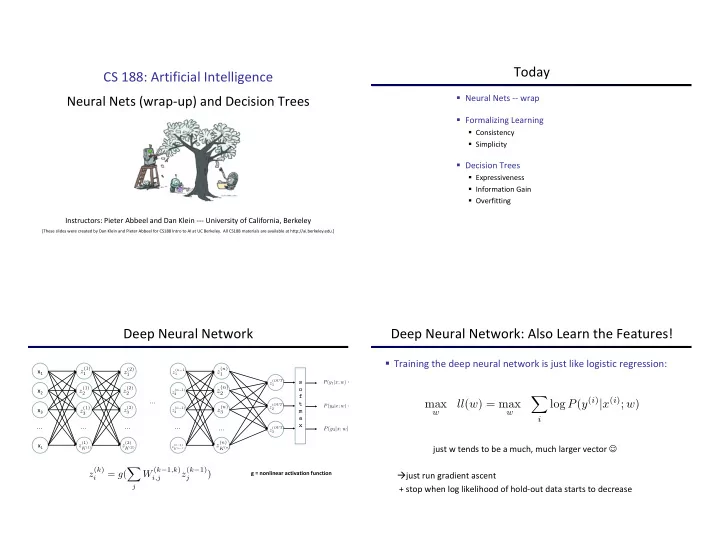
Deep Neural Network

s

  • f

t m a x

P(y1|x; w) = P(y2|x; w) =

P(y3|x; w) = …

x1 x2 x3 xL

… … … …

z(1)

1

z(1)

2

z(1)

3

z(1)

K(1)

z(n)

K(n)

z(2)

K(2)

z(2)

1

z(2)

2

z(2)

3

z(n)

3

z(n)

2

z(n)

1 z(OUT )

1

z(OUT )

2

z(OUT )

3

z(n−1)

3

z(n−1)

2

z(n−1)

1

z(n−1)

K(n−1)

z(k)

i

= g( X

j

W (k−1,k)

i,j

z(k−1)

j

)

g = nonlinear activation function

Deep Neural Network: Also Learn the Features!

§ Training the deep neural network is just like logistic regression:

just w tends to be a much, much larger vector J àjust run gradient ascent + stop when log likelihood of hold-out data starts to decrease

max

w

ll(w) = max

w

X

i

log P(y(i)|x(i); w)

slide-2
SLIDE 2

Neural Networks Properties

§ Theorem (Universal Function Approximators). A two-layer neural network with a sufficient number of neurons can approximate any continuous function to any desired accuracy. § Practical considerations

§ Can be seen as learning the features § Large number of neurons

§ Danger for overfitting § (hence early stopping!)

How well does it work? Computer Vision Object Detection

slide-3
SLIDE 3

Manual Feature Design Features and Generalization

[HoG: Dalal and Triggs, 2005]

Features and Generalization

Image HoG

Performance

graph credit Matt Zeiler, Clarifai

slide-4
SLIDE 4

Performance

graph credit Matt Zeiler, Clarifai

Performance

graph credit Matt Zeiler, Clarifai

AlexNet

Performance

graph credit Matt Zeiler, Clarifai

AlexNet

Performance

graph credit Matt Zeiler, Clarifai

AlexNet

slide-5
SLIDE 5

MS COCO Image Captioning Challenge

Karpathy & Fei-Fei, 2015; Donahue et al., 2015; Xu et al, 2015; many more

Visual QA Challenge

Stanislaw Antol, Aishwarya Agrawal, Jiasen Lu, Margaret Mitchell, Dhruv Batra, C. Lawrence Zitnick, Devi Parikh

Speech Recognition

graph credit Matt Zeiler, Clarifai

Machine Translation

Google Neural Machine Translation (in production)

slide-6
SLIDE 6

Today

§ Neural Nets -- wrap § Formalizing Learning

§ Consistency § Simplicity

§ Decision Trees

§ Expressiveness § Information Gain § Overfitting

§ Clustering

Inductive Learning Inductive Learning (Science)

§ Simplest form: learn a function from examples

§ A target function: g § Examples: input-output pairs (x, g(x)) § E.g. x is an email and g(x) is spam / ham § E.g. x is a house and g(x) is its selling price

§ Problem:

§ Given a hypothesis space H § Given a training set of examples xi § Find a hypothesis h(x) such that h ~ g

§ Includes:

§ Classification (outputs = class labels) § Regression (outputs = real numbers)

§ How do perceptron and naïve Bayes fit in? (H, h, g, etc.)

Inductive Learning

§ Curve fitting (regression, function approximation): § Consistency vs. simplicity § Ockham’s razor

slide-7
SLIDE 7

Consistency vs. Simplicity

§ Fundamental tradeoff: bias vs. variance § Usually algorithms prefer consistency by default (why?) § Several ways to operationalize “simplicity”

§ Reduce the hypothesis space

§ Assume more: e.g. independence assumptions, as in naïve Bayes § Have fewer, better features / attributes: feature selection § Other structural limitations (decision lists vs trees)

§ Regularization

§ Smoothing: cautious use of small counts § Many other generalization parameters (pruning cutoffs today) § Hypothesis space stays big, but harder to get to the outskirts

Decision Trees Reminder: Features

§ Features, aka attributes

§ Sometimes: TYPE=French § Sometimes: fTYPE=French(x) = 1

Decision Trees

§ Compact representation of a function:

§ Truth table § Conditional probability table § Regression values

§ True function

§ Realizable: in H

slide-8
SLIDE 8

Expressiveness of DTs

§ Can express any function of the features § However, we hope for compact trees

Comparison: Perceptrons

§ What is the expressiveness of a perceptron over these features? § For a perceptron, a feature’s contribution is either positive or negative

§ If you want one feature’s effect to depend on another, you have to add a new conjunction feature § E.g. adding “PATRONS=full Ù WAIT = 60” allows a perceptron to model the interaction between the two atomic features

§ DTs automatically conjoin features / attributes

§ Features can have different effects in different branches of the tree!

§ Difference between modeling relative evidence weighting (NB) and complex evidence interaction (DTs)

§ Though if the interactions are too complex, may not find the DT greedily

Hypothesis Spaces

§ How many distinct decision trees with n Boolean attributes?

= number of Boolean functions over n attributes = number of distinct truth tables with 2n rows = 2^(2n) § E.g., with 6 Boolean attributes, there are 18,446,744,073,709,551,616 trees

§ How many trees of depth 1 (decision stumps)?

= number of Boolean functions over 1 attribute = number of truth tables with 2 rows, times n = 4n § E.g. with 6 Boolean attributes, there are 24 decision stumps

§ More expressive hypothesis space:

§ Increases chance that target function can be expressed (good) § Increases number of hypotheses consistent with training set (bad, why?) § Means we can get better predictions (lower bias) § But we may get worse predictions (higher variance)

Decision Tree Learning

§ Aim: find a small tree consistent with the training examples § Idea: (recursively) choose “most significant” attribute as root of (sub)tree
slide-9
SLIDE 9

Choosing an Attribute

§ Idea: a good attribute splits the examples into subsets that are (ideally) “all positive” or “all negative” § So: we need a measure of how “good” a split is, even if the results aren’t perfectly separated out

Entropy and Information

§ Information answers questions

§ The more uncertain about the answer initially, the more information in the answer § Scale: bits

§ Answer to Boolean question with prior <1/2, 1/2>? § Answer to 4-way question with prior <1/4, 1/4, 1/4, 1/4>? § Answer to 4-way question with prior <0, 0, 0, 1>? § Answer to 3-way question with prior <1/2, 1/4, 1/4>?

§ A probability p is typical of:

§ A uniform distribution of size 1/p § A code of length log 1/p

Entropy

§ General answer: if prior is <p1,…,pn>:

§ Information is the expected code length

§ Also called the entropy of the distribution

§ More uniform = higher entropy § More values = higher entropy § More peaked = lower entropy § Rare values almost “don’t count”

1 bit 0 bits 0.5 bit

Information Gain

§ Back to decision trees! § For each split, compare entropy before and after

§ Difference is the information gain § Problem: there’s more than one distribution after split! § Solution: use expected entropy, weighted by the number of examples

slide-10
SLIDE 10

Next Step: Recurse

§ Now we need to keep growing the tree! § Two branches are done (why?) § What to do under “full”?

§ See what examples are there…

Example: Learned Tree

§ Decision tree learned from these 12 examples: § Substantially simpler than “true” tree

§ A more complex hypothesis isn't justified by data

§ Also: it’s reasonable, but wrong

Example: Miles Per Gallon

40 Examples

mpg cylinders displacement horsepower weight acceleration modelyear maker good 4 low low low high 75to78 asia bad 6 medium medium medium medium 70to74 america bad 4 medium medium medium low 75to78 europe bad 8 high high high low 70to74 america bad 6 medium medium medium medium 70to74 america bad 4 low medium low medium 70to74 asia bad 4 low medium low low 70to74 asia bad 8 high high high low 75to78 america : : : : : : : : : : : : : : : : : : : : : : : : bad 8 high high high low 70to74 america good 8 high medium high high 79to83 america bad 8 high high high low 75to78 america good 4 low low low low 79to83 america bad 6 medium medium medium high 75to78 america good 4 medium low low low 79to83 america good 4 low low medium high 79to83 america bad 8 high high high low 70to74 america good 4 low medium low medium 75to78 europe bad 5 medium medium medium medium 75to78 europe

Find the First Split

§ Look at information gain for each attribute § Note that each attribute is correlated with the target! § What do we split on?

slide-11
SLIDE 11

Result: Decision Stump Second Level Final Tree Reminder: Overfitting

§ Overfitting:

§ When you stop modeling the patterns in the training data (which generalize) § And start modeling the noise (which doesn’t)

§ We had this before:

§ Naïve Bayes: needed to smooth § Perceptron: early stopping

slide-12
SLIDE 12

MPG Training Error

The test set error is much worse than the training set error…

…why? Consider this split

Significance of a Split

§ Starting with:

§ Three cars with 4 cylinders, from Asia, with medium HP § 2 bad MPG § 1 good MPG

§ What do we expect from a three-way split?

§ Maybe each example in its own subset? § Maybe just what we saw in the last slide?

§ Probably shouldn’t split if the counts are so small they could be due to chance § A chi-squared test can tell us how likely it is that deviations from a perfect split are due to chance* § Each split will have a significance value, pCHANCE

Keeping it General

§ Pruning:

§ Build the full decision tree § Begin at the bottom of the tree § Delete splits in which pCHANCE > MaxPCHANCE § Continue working upward until there are no more prunable nodes § Note: some chance nodes may not get pruned because they were “redeemed” later

a b y 1 1 1 1 1 1

y = a XOR b

slide-13
SLIDE 13

Pruning example

§ With MaxPCHANCE = 0.1:

Note the improved test set accuracy compared with the unpruned tree

Regularization

§ MaxPCHANCE is a regularization parameter § Generally, set it using held-out data (as usual)

Small Trees Large Trees MaxPCHANCE Increasing Decreasing Accuracy High Bias High Variance Held-out / Test Training

Two Ways of Controlling Overfitting

§ Limit the hypothesis space

§ E.g. limit the max depth of trees § Easier to analyze

§ Regularize the hypothesis selection

§ E.g. chance cutoff § Disprefer most of the hypotheses unless data is clear § Usually done in practice

Next Lecture: Applications!