IB 1A5 (=E1R86), 1L1 (=E1R05) , IIB E2R40 , 2011 L2 URL - - PowerPoint PPT Presentation

ib 1a5 e1r86 1l1 e1r05 iib e2r40 2011 l2
SMART_READER_LITE
LIVE PREVIEW

IB 1A5 (=E1R86), 1L1 (=E1R05) , IIB E2R40 , 2011 L2 URL - - PowerPoint PPT Presentation

IB 1A5 (=E1R86), 1L1 (=E1R05) , IIB E2R40 , 2011 L2 URL : http://clsl.hi.h.kyoto-u.ac.jp/~kkuroda/lectures/11B-KU/KU-2011B-L01- slides.pdf ( ) substituting


slide-1
SLIDE 1

2011-10-13 (木)

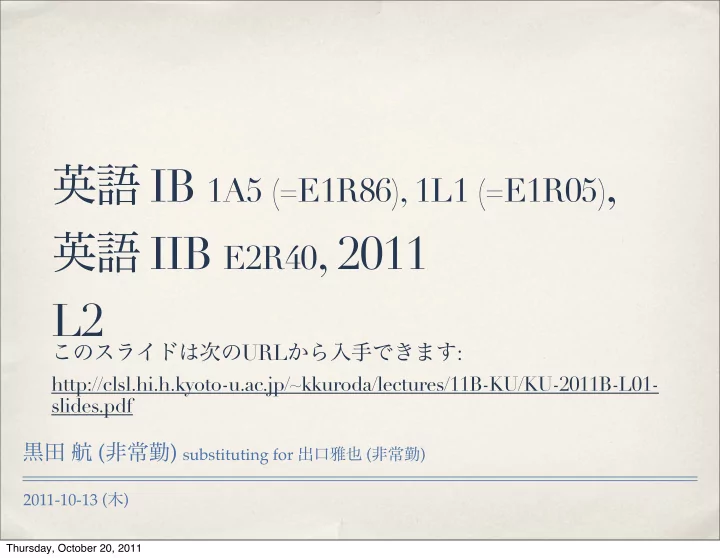
英語 IB 1A5 (=E1R86), 1L1 (=E1R05), 英語 IIB E2R40, 2011 L2

このスライドは次のURLから入手できます:

http://clsl.hi.h.kyoto-u.ac.jp/~kkuroda/lectures/11B-KU/KU-2011B-L01- slides.pdf

黒田 航 (非常勤) substituting for 出口雅也 (非常勤)

Thursday, October 20, 2011

slide-2
SLIDE 2

連絡 1/2

✤ 日程

✤ 2011年11月24日(木)の講義を12月27日(火)に振替え ✤ 2012年1月12日(木)は休講

✤ 2012月1月9日(月)から13日(金)まで松江で開催される Global WordNet Associationに参加

✤ 2012年2月2日が最終日=ボーナス試験 (L=13に相当)

✤ 日程の変更があるかも知れない

✤ 欠席の扱い

✤ 明示的な上限はないですけど,欠席が多い方は不利です ✤ 今期に関しては最後のボーナス試験での挽回は不可能です

Thursday, October 20, 2011

slide-3
SLIDE 3

連絡 2/2

✤ Fast Readingのため

✤ 12月8日,15日,22日,27日は ✤ 共同東棟 22教室

✤ その後の二回は元の教室に戻る

Thursday, October 20, 2011

slide-4
SLIDE 4

講義資料

✤ 聴き取り用の教材は次の Web ページから入手可能

✤ http://clsl.hi.h.kyoto-u.ac.jp/~kkuroda/lectures/KU-11B.html

✤ 授業時間外での予習や復習に利用して下さい

✤ 特にボーナス試験対策には有効でしょう

✤ 速読に関して完全に同じことはできませんが,工夫

します

Thursday, October 20, 2011

slide-5
SLIDE 5

本日の予定

✤ 前半60分(休憩5分を含む)

✤ L1の結果の報告 ✤ L1の正解の解説

✤ 後半30分

✤ TEDを使った聴き取り訓練

✤ Paul Bloom: The Origins of Pleasureの後半8分 Thursday, October 20, 2011

slide-6
SLIDE 6

TEDの日本語訳

✤ TED講演の全訳を見たいという希望がありました ✤ Paul Bloom の講演では

✤ Subtitles Available in:

✤ で “Japanese” を選ぶと,日本語訳が見れます

✤ 全部の講演で日本語訳が利用できるわけではないです

Thursday, October 20, 2011

slide-7
SLIDE 7

Date

L1の聴き取り課題の結果

Thursday, October 20, 2011

slide-8
SLIDE 8

採点法

✤ 点数

✤ 完全正解 1.0 (◯で表示) ✤ 不完全解 0.5 (△で表示)

✤ 評価基準

✤ 素得点 S = ◯の数 + (△の数)/2 ✤ 正答率 P = ◯の数/S ✤ 成績評価用の得点: S* = 100 × S/問題の総数 (e.g., 30)

✤ 採点誤りがあるかも知れません

✤ たし算を時々間違うので,該当者は報告して下さい

Thursday, October 20, 2011

slide-9
SLIDE 9

出題への評価

Q1: Quant 1: Quantity uantity Q2: Diffic 2: Difficulty ulty Av. Stdev Max Min Av. Stdev Max Min 1A5 2.93 0.38 4 2 2.57 0.69 4 2 2R 3.11 0.33 4 2 2.22 0.44 3 2 1L1 3.00 0.38 4 2 2.93 0.80 4 2

調査の回答は表に書いて下さい

Thursday, October 20, 2011

slide-10
SLIDE 10

L1の得点分布 1A5, 2R, 1L1

✤ 参加者: 88人

✤ 平均: 70.38; 標準偏差: 9.28 ✤ 最高: 84.85; 最低: 43.94

✤ 得点グループ2つ

✤ 70点後半が中心 ✤ 80点前半が中心 Thursday, October 20, 2011

slide-11
SLIDE 11

L1の得点分布 1A5

✤ 受講者数: 28人

✤ 平均: 74.95 [24.73/n] 点

✤ 標準偏差: 9.66 [ 3.19] 点

✤ 最高: 92.42/n [30.50] 点 ✤ 最低: 53.03/n [17.50] 点

✤ n = 33

✤ 得点グループ

✤ 60点中心, 70点中心, 85点中心

Thursday, October 20, 2011

slide-12
SLIDE 12

L1の得点分布 2R

✤ 受講者数: 31人

✤ 平均: 70.38 [23.23/n] 点

標準偏差: 9.28 [ 3.06] 点

✤ 最高: 84.85 [28.00/n] 点 ✤ 最低: 43.945 [14.50/n] 点

n = 33

✤ 得点グループ

✤ 40点後半が中心, 70点後半が中心 ✤ 80点が中心

Thursday, October 20, 2011

slide-13
SLIDE 13

L1の得点分布 1L1

✤ 受講者数: 29人

✤ 平均: 78.74 [25.98/n] 点

✤ 標準偏差: 7.85 [ 2.59] 点

✤ 最高: 93.94/n [31.00/n] 点 ✤ 最低: 54.55/n [18.00/n] 点

✤ n = 33

✤ 得点グループ

✤ 80点後半中心

Thursday, October 20, 2011

slide-14
SLIDE 14

L1の正解率分布 1A5, 2R, 1L1

✤ 参加者: 88人

✤ 平均値: 0.79 ✤ 最高値: 0.92; 最低値: 0.60 ✤ 標準偏差: 0.07

✤ 正答率のグループ

✤ 0.8が中心 ✤ 0.9が中心

Thursday, October 20, 2011

slide-15
SLIDE 15

L1の正答率分布 1A5

✤ 参加者: 28人

✤ 平均: 0.82; 標準偏差: 0.09 ✤ 最高: 0.95; 最低: 0.51

✤ 正答率のグループ

✤ 0.7, 0.8後半が中心 Thursday, October 20, 2011

slide-16
SLIDE 16

L1の正答率分布 2R

✤ 参加者: 31人

✤ 平均: 0.74; 標準偏差: 0.08 ✤ 最高: 0.87; 最低: 0.55

✤ 正答率のグループ

✤ 0.6, 0.7後半, 0.8後半が中心 Thursday, October 20, 2011

slide-17
SLIDE 17

L1の正答率分布 1L1

✤ 参加者: 29人

✤ 平均: 0.84; 標準偏差: 0.06 ✤ 最高: 0.97; 最低: 0.72

✤ 正答率のグループ

✤ 0.7が中心, 0.8が中心 ✤ 0.9が中心 Thursday, October 20, 2011

slide-18
SLIDE 18

L1の正解

Thursday, October 20, 2011

slide-19
SLIDE 19

誤りの傾向

  • 1. pleasures ⇒ pleasure, pressure (NO -s)

  • 2. designated ⇒ doesn’t, NULL

  • 3. paintings ⇒ painting (NO -s)

  • 4. ever ⇒ forever, gather

  • 5. arrested ⇒ rest(ed)

  • 6. confessed ⇒ confess

  • 7. better

  • 8. hero ⇒ hear, here

  • 9. accounts ⇒ count, cancer, chance

  • 10. sympathy ⇒ simplicity, simpathy, simpacy

  • 11. himself

  • 12. talking

  • 13. forgery ⇒ fortune, fortury, fortuantely

  • 14. would ⇒ will

  • 15. rich ⇒ reach, original

  • 16. convince

  • 17. suggest ⇒ see, saggest

  • 18. seemingly ⇒ see

  • 19. eat ⇒ be

  • 20. you’re ⇒ of, about

  • 21. simple

  • 22. bottle ⇒ borrow, arrow, water

  • 23. wine

  • 24. experience

  • 25. rests ⇒ less, rest

  • 26. discover

  • 27. libido

  • 27. psychology ⇒ phychology, sycology

  • 28. this

  • 29. love

  • 30. happy

  • 31. syndrome ⇒ sydrome

  • 33. ways ⇒ way (NO -s)

Thursday, October 20, 2011

slide-20
SLIDE 20

聞き取りの心得その1

✤ 実際の発音はローマ字読みと

別物

✤ 話し言葉は“正しい”とは限らず

✤ 母語話者も言いマチガイをする ✤ 母語話者も文法マチガイをする

✤ tastier, awesomer

✤ 唯一の正しい発音はない

✤ 話し言葉特有の表現への対応

が必要

✤ gonna ⇐ going to ✤ wanna ⇐ want to ✤ kinda ⇐ kind of

✤ kind of は副詞に使う

✤ 言いよどみや言いさしにも対

応できないとダメ

✤ ah, uh, um / えーと, うーん,あのー

Thursday, October 20, 2011

slide-21
SLIDE 21

聞き取りの心得その2

✤ 例

✤ it is hoped that の発音は

✤ [ɨɗɨz hoʊp ðə]

✤ 母音前の有声化

✤ it is ⇒ [ɨɗɨz] ✤ look at the ⇒[lʊɡæðə]

✤ アメリカ英語の t の発音

✤ bottle ⇒ [bʌɔɗl] ✤ atoms = Adums ⇒ [æbɗəmz]

✤ 子音の前の語末子音の脱落

✤ hoped ⇒ hope [hoʊp] ✤ that ⇒ tha [ðə]

✤ th 音の変化

✤ that ⇒ nat [næ(t)] Thursday, October 20, 2011

slide-22
SLIDE 22

01/13

✤ I’m gonna talk today about the [1. pleasures] of everyday life. But

I wanna begin with a story of an unusual and terrible man. This is Hermann Goering. Goering was Hitler’s second in command in World War II, his [2. designated] successor. And like Hitler, Goering fancied himself a collector of art. He went through Europe, through World War II, stealing, extorting and occasionally buying various [3. paintings] for his collection. And what he really wanted was something by Vermeer. Hitler had two of them, and he didn’t have any. So he finally found an art dealer, a Dutch art dealer named Han van Meegeren, who sold him a wonderful Vermeer for the cost of what would now be 10 million dollars. And it was his favorite artwork [4. ever].

Thursday, October 20, 2011

slide-23
SLIDE 23

02/13

✤ World War II came to an end, and Goering was captured, tried

at Nuremberg and ultimately sentenced to death. Then the allied forces went through his collections and found the paintings and went after the people who sold it to him. And at— at some point the Dutch police came into Amsterdam and [5. arrested] Van Meegeren. Van Meegeren was charged with the crime of treason, which is itself punishable by death.

✤ Six weeks into his prison sentence, Van Meegeren [6. confessed].

But he didn’t confess to treason. He said, “I did not sell a great masterpiece to that Nazi. I painted it myself; I’m a forger.”

Thursday, October 20, 2011

slide-24
SLIDE 24

03/13

✤ Nobody— now nobody believed him. And he said, “I’ll prove it.

Bring me a canvas and some paint, and I will paint a Vermeer much [7. better] than I sold that disgusting Nazi. I also need alcohol and morphine, because it's the only way I can work.” So they brought him in. He painted a beautiful Vermeer. Um, and then he uh— the charges of treason were dropped. He had a lesser charge of forgery, got a year uh sentence and died a [8. hero] to the Dutch people.

✤ There’s a lot more to be said about Van Meegeren, but I wanna

turn now to Goering, who’s pictured here being interrogated at Nuremberg.

Thursday, October 20, 2011

slide-25
SLIDE 25

04/13

✤ Now Goering was, by all [9. accounts], a terrible man. Even for

a Nazi, he was a terrible man. His American interrogators described him as an amicable psychopath. But you could feel [10. sympathy] for the reaction he had when he was told that his favorite painting was actually a forgery. According to his biographer, “He looked as if for the first time he had discovered there was evil in the world. (Big Laughter) And he killed [11. himself] soon afterwards.

✤ He had discovered after all that the painting he thought was this

—was actually that. It looked the same, but it had a different

  • rigin, it was a different artwork.

Thursday, October 20, 2011

slide-26
SLIDE 26

05/13

✤ It wasn’t just him who was in for a shock. Once Van

Meegeren was on trial, he couldn’t stop [12. talking]. And he boasted about all the great masterpieces that he himself had painted that were attributed to other artists. In particular, The Supper at Emmaus which was viewed as Vermeer’s finest masterpiece, his best work —people would come from all over the world to see it— was actually a [13. forgery]. It was not that painting, but that

  • painting. And when that was discovered, it lost all its

value and was taken away from the museum.

Thursday, October 20, 2011

slide-27
SLIDE 27

06/13

✤ Why does this matter? You psychologists, why do origins

matter so much? Why do we respond so much to our knowledge of where something comes from? Well there’s an answer to that many people [14. would] give. Many sociologists like Veblen and Wolfe would argue that the reason why we— we take origins so seriously is because we’re snobs, because we’re focused on status. Among other things, if you wanna show off how [15. rich] you are, how powerful you are, it’s always better to own an original than a forgery because there’s always going to be fewer originals than forgeries.

Thursday, October 20, 2011

slide-28
SLIDE 28

07/13

✤ I don’t doubt that that plays some role, but what I wanna

convince you today is that there’s something else going on. I wanna [16. convince] you that humans are, to some extent, natural born essentialists. What I mean by this is we don’t just respond to things as we see them, or feel them, or hear

  • them. Rather, our response is conditioned on our beliefs,

but what they really are, what they came from, what they’re made of, what their hidden nature is.

✤ I wanna [17. suggest] that this is true, not just for how we

think about things, but how we react to things.

Thursday, October 20, 2011

slide-29
SLIDE 29

08/13

✤ So I wanna suggest that pleasure is deep —and that this

isn’t true just for sort of —higher level pleasures like art, but even the most [18. seemingly] simple pleasures are affected by our beliefs about hidden essences.

✤ So take food. Would you eat this? Well, a good answer is,

“It depends. What is it?” Some of you would eat it if it’s pork, but not beef. Some of you would eat it if it’s beef, but not pork. Few of you would eat it if it’s a rat or a human. Some of you would [19. eat] it only if it’s a strangely colored piece of tofu. That’s not so surprising.

Thursday, October 20, 2011

slide-30
SLIDE 30

09/13

✤ But what’s more interesting is how it tastes to you will

depend critically on what you think [20. you’re] eating. So

  • ne demonstration of this was done with young children.

How do you make children not just be more likely to eat carrots and drink milk, but to get more pleasure from eating carrots and drinking milk —to think they taste better? It’s [21. simple], you tell them they’re from McDonald’s. They believe McDonald’s food is tastier, and it leads them to experience it as tastier. How do you get adults to really enjoy wine? It’s very simple: pour it from an expensive [22. bottle].

Thursday, October 20, 2011

slide-31
SLIDE 31

10/13

✤ There are now dozens, perhaps hundreds of studies showing

that if you believe you’re drinking the expensive stuff, it tastes better to you. This was recently done with a neuroscientific

  • twist. They get people into an fMRI scanner, and while they’re

lying there, through a tube, they get to sip wine. In front of them on a screen is information about the [23. wine]. Everybody, of course, drinks exactly the same wine. But if you believe you’re drinking expensive stuff, parts of the brain associated with pleasure and reward light up like a Christmas

  • tree. It’s not just that you say it’s more pleasurable, you say you

like it more, you really [22. experience] it in a different way.

Thursday, October 20, 2011

slide-32
SLIDE 32

11/13

✤ Or take sex. These are stimuli I’ve used in some of my studies. And

if you simply show people these pictures, they’ll say these are fairly attractive people. But how attractive you find them, how sexually or romantically moved you are by them, [24. rests] critically on who you think you’re looking at. You probably think the picture on the left is male, the one on the right is female. If that belief turns out to be mistaken, it will make a difference. It will make a difference if they turn out to be much younger or much older than you think they are. It will make a difference if you were to [25. discover] that the person you’re looking at with lust is actually a disguised version

  • f your son or daughter, your mother or father. Knowing

somebody’s your kin typically kills the [26. libido].

Thursday, October 20, 2011

slide-33
SLIDE 33

12/13

✤ Maybe one of the most heartening findings from the [28.

psychology] of pleasure is there’s more to looking good than your physical appearance. Um, if you like somebody, they look better to you. This is why spouses in happy marriages tend to think that their husband or wife looks much better than anyone else thinks that they do.

✤ Um, a particularly dramatic example of [29. this] comes from a

neurological disorder known as Capgras syndrome. So Capgras syndrome is a disorder where, um, you get a specific delusion. Sufferers of Capgras syndrome believe that the people they [30. love] most in the world have been replaced by perfect duplicates.

Thursday, October 20, 2011

slide-34
SLIDE 34

13/13

✤ Now often, a result of Capgras syndrome is tragic. People

have murdered those that they loved, believing they were murdering an imposter. But there’s at least one case where Capgras syndrome had a [31. happy] ending. This was recorded in 1931. “Research described a woman with Capgras syndrome who complained about her poorly endowed and sexually inadequate lover.” But that was before she got Capgras [32. syndrome]. After she got it, “She was happy to report that she has discovered that he possessed a double who was rich, virile, handsome and aristocratic.” Of course, it was the same man, but she was seeing him in different [33. ways].

Thursday, October 20, 2011

slide-35
SLIDE 35

Date

TEDを使った聴き取り訓練

Thursday, October 20, 2011

slide-36
SLIDE 36

Paul Bloom: The Origins of Pleasure

✤ TEDの講演

✤ 全部で約16分

✤ 特徴

✤ Paul Bloom はゆっくりと丁寧に話し,発音がきれいな米語話

✤ テーマ

✤ 喜び(あるいは苦痛)の感覚/感情と想像/信念の不思議な関係

✤ 履歴 history が感情を支配する

Thursday, October 20, 2011

slide-37
SLIDE 37

Thursday, October 20, 2011