SLIDE 1 1
Prepared Text of Remarks by David Poisson1 SCG Legal 2016 Annual Meeting Boston, Massachusetts September 15, 2016 Good afternoon, everyone, and welcome to Boston. It’s great to see so many familiar faces – and so many new ones as well. In fact, as Henry mentioned, we have more than three dozen first-timers here this week, more than we’ve ever had at an annual meeting. I hope that those of you who’ve been to a few of these before will make a point of going up to them and welcoming them to our organization. I don’t typically spend much time at our meetings addressing you as a group. In my
- pinion, there are many far more interesting people from whom you’d prefer to hear than
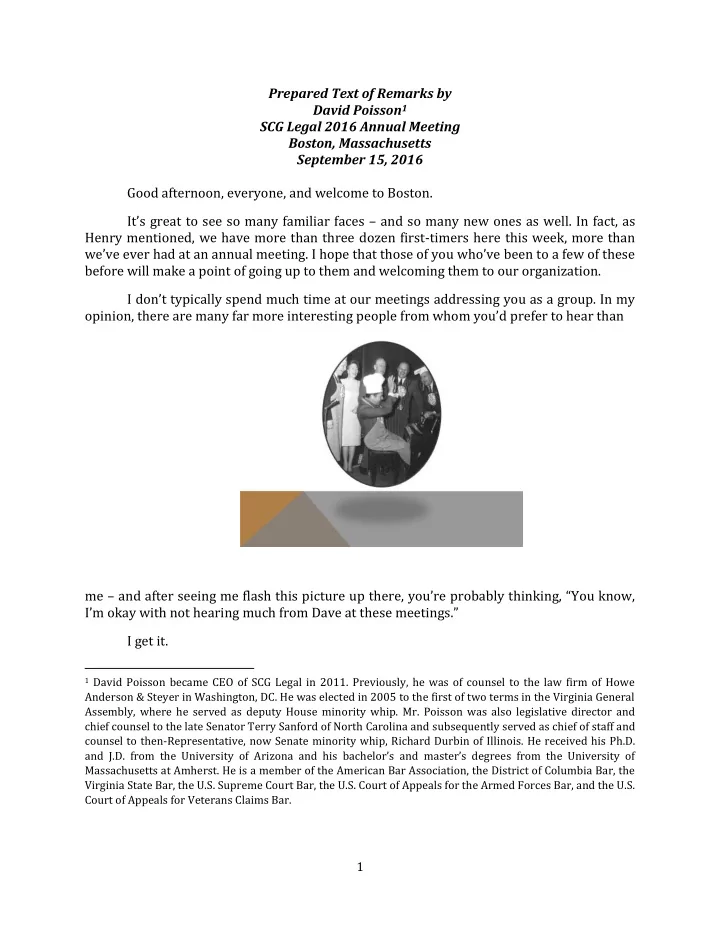
me – and after seeing me flash this picture up there, you’re probably thinking, “You know, I’m okay with not hearing much from Dave at these meetings.” I get it.
1 David Poisson became CEO of SCG Legal in 2011. Previously, he was of counsel to the law firm of Howe
Anderson & Steyer in Washington, DC. He was elected in 2005 to the first of two terms in the Virginia General Assembly, where he served as deputy House minority whip. Mr. Poisson was also legislative director and chief counsel to the late Senator Terry Sanford of North Carolina and subsequently served as chief of staff and counsel to then-Representative, now Senate minority whip, Richard Durbin of Illinois. He received his Ph.D. and J.D. from the University of Arizona and his bachelor’s and master’s degrees from the University of Massachusetts at Amherst. He is a member of the American Bar Association, the District of Columbia Bar, the Virginia State Bar, the U.S. Supreme Court Bar, the U.S. Court of Appeals for the Armed Forces Bar, and the U.S. Court of Appeals for Veterans Claims Bar.
SLIDE 2 2
A couple of weeks ago, however, I reached a major milestone. I received my Medicare card in the mail. When you reach that exalted station in life, you begin to ask yourself questions like, “What am I doing? Why am I doing it?” And that most existential question of all, “Can this really be all there is?” The photograph you see here is of what was once the most famous, if not the first, Chowder and Marching Club. How many of you know what a chowder and marching club is? Well, for those of you who don’t know, it was an informal club especially for new Congressmen – and only Congressmen, since at the time there were very few female members of the House of Representatives. It was created to help newcomers to the House learn the ropes, swap strategies, and, sometimes, as you see here, simply to socialize. Meetings rotated among the offices of the various members each Wednesday the House was in session, with the host providing refreshments. To celebrate the club’s anniversaries, members would put on gaudy chef’s hats and striped aprons. Aside from these getups, there was basically no structure: no bylaws or rules of procedure, no set agenda or dues, and no elected officers. Even the name, which is said to have been coined in the late 1940s by California Congressman Don Jackson, was devoid of any specific meaning, as best anyone knew. But however whimsical the name or irreverent its traditions, the Chowder and Marching Club was a force to be reckoned with. Its founders became a “who’s who” of national Republican leaders: Richard Nixon of California and Gerald Ford of Michigan served as vice presidents, then presidents. Nixon went on to name Melvin Laird of Wisconsin, also a member, his secretary of defense. Bob Michel, another member, who represented the 18th congressional district of Illinois for 38 years, served 14 of them as House minority leader and six more as House minority whip. And John Lodge, one of the group’s founders, went on to become governor of Connecticut and subsequently was appointed U.S. ambassador to Spain, then Argentina and finally Switzerland. Many years later, Melvin Laird said, “Information is power in Washington, and the Chowder and Marching Club became a unique repository of political insight.” When I applied for this job, some six years or so ago now, I remember saying to the search committee, “I don’t want to run just a chowder and marching club.” By that, I didn’t mean to slight in any way all of the good that can come from being part of social
- rganizations like the Chowder and Marching Club. Not in the least. What I actually meant
SLIDE 3 3
is that groups like the Chowder and Marching Club always need to be changing – and so does SCG Legal. It can’t all be about funny hats and silly costumes, secret handshakes or outworn
- rituals. It has to involve something more.
This afternoon I’d like to talk about some of the things we’re doing to invigorate SCG Legal – to make it more than just a chowder and marching club. First, a little perspective. As most of you know, when we began in 1989, the idea that gave rise to our formation was that clients needed lawyers where their problems were. They needed lawyers who not only understood the law of the land, but also the lay of the land. As the saying went, “Good lawyers know the law. Great ones know the judge!” And so, while it wasn’t necessarily our aim to “know the judges” in our jurisdictions,
- ne of our objectives clearly was to be recognized for knowing better than most firms in
- ur respective states and countries the way government operates.
Our founders believed, and to some extent I believe it’s still true, it would be very difficult for any firm to be expert in the way government functions in more than one jurisdiction at a time. This view is what ultimately led to our adopting a strategy based on geography to serve the legal market. At the time this was all going on, of course, very few of our firms had more than one
- ffice – and even if they did, they were almost always in the same jurisdiction. But that, as
you’re all now very well aware, is no longer true. And so the question we’ve been struggling
SLIDE 4
4
with over the last few years is, “Does our approach to the market need to change?” Now, before you start worrying about whether I’m going to propose adding lots and lots of new firms, let me reassure you. I have no such intention. But what I am suggesting is that being a one-firm-per-jurisdiction network can no longer be our major calling card. We have several different options, in terms of how we communicate the value we provide our clients. I just don’t think geography should be the principal one anymore. I believe, first and foremost, what our clients want is quality – and, as you’ve already seen this year, this is the issue the board first turned its attention to as it began rethinking SCG Legal’s value proposition. As all of you know, the board adopted a policy, supported by 97 percent of our members, to require each of our firms to be reviewed by their peers at least once every five years regarding the quality of legal services they provide.
SLIDE 5 5
A committee made up of Claudia Barrero, Cliff Webster and Beth Clyne spent months after our meeting last year in Vancouver coming up with a way for member firms to evaluate each other’s performance. The survey focused on five important areas. The first was Responsiveness, which asked respondents to rate you on: − How quickly you return phone calls and answer e-mails − Whether you provide more than one way to be reached, if you expect to be
- ut of touch for an extended period of time, and
− How thorough you are in gathering facts, so as not to have to bother the referring firm with repeated requests for additional information. Next, we asked about Institutional Loyalty, by which we were trying to get at whether you: − Regularly attend and participate in our meetings
SLIDE 6
6
− Speak – or recruit others to speak – at our meetings − Contribute to our publications, such as the Lobbying Handbook and other communications vehicles, and − Use the network as your primary vehicle for referring outbound legal work. The next area was Project Management. What we were looking for here is how well your firm: − Organizes its work in order to make sure nothing is ever overlooked and that ultimately your clients’ objectives are always fully satisfied, as well as − How well you track your cases and communicate their progress at key intervals. Another area we asked about was Legal Proficiency, which was aimed at determining your firm’s:
SLIDE 7
7
− Command of the law in any and all areas affecting the scope of an engagement you might have had referred to you, as well as your − Ability to anticipate obstacles and propose legal strategies to overcome them. Finally, we asked about Fees and Billing. Here, we focused on whether your firm’s: − Fees relate reasonably to the scope and complexity of the engagement and compare favorably with those of other firms in the same or similar markets, and whether your − Fee information is both timely and transparent. Firms that received a superior rating in any given area were awarded one point, none for an average rating, and one point was taken away for an unsatisfactory rating. The final number was then divided by the total number of responses received to come up with a weighted total.
SLIDE 8
8
For example, if on one of the criteria a firm received a superior rating from 90 of the 100 firms that evaluated it, an average rating from five of the firms, and an unsatisfactory rating from the other five firms, its score for that criterion would be 85. If on three of the five criteria it received an 85, and on the other two 80, its overall score would be 83. Also, to help provide some additional context, we added what we called a recognition score, which was the percentage of firms who had something – anything at all – to say about a particular firm’s performance. Now, I know when we first broached the idea of having our firms evaluate one another, some of you were skeptical. You wondered if this effort wouldn’t be undercut by the “Lake Woebegone effect” – that we would all end up finding each other above average. As it turned out, of the 30 firms that were reviewed, a little over a third earned what can objectively be said to be superior scores. A third received what I’d call average scores. And the rest ended up with unsatisfactory scores, seven of which were told they’d have to undergo the process again in 2018, while one was simply expelled. What do these results tell us? Well, one thing I think we can safely say is that there was no “Lake Woebegone effect.” Those of you who had something to say about your fellow member firms – whether good or bad – had no compunction about letting your views be known. But there are also a number of other very useful insights we were able to glean from this process. The first, and perhaps the most eye-opening of any of our findings, was how many firms knew nothing about some of the 30 firms they were asked to evaluate. Bear in mind that the firms selected for this first round of evaluations were among those that have been in the group the longest.
SLIDE 9 9
But this finding aside, what the data also showed is that firms that invest in the network – that regularly attend meetings, visit other firms’ offices, and make a point of referring work to others in the group – were among the best recognized firms in the sample and, correspondingly, ended up getting the highest ratings. Conversely, those firms that did none of these things mostly received mediocre scores. As a first try, I believe this exercise was a great success – and will lead to a number
- f refinements in the way we go about evaluating firms.
For example, the board is considering changing our membership criteria to require that state capital firms maintain active government relations practices, and that all others demonstrate transactional expertise. Furthermore, it has proposed that every member firm be required to have a representative present at no less than one meeting per year, something which most of the member firms that fell into the bottom third of this year’s rankings failed to do. As I said earlier, there is nothing inherently wrong with our sharing some of the characteristics of the Chowder and Marching Club. But even its members knew that to get anything out of it, they had to show up. Next, let’s talk about consistency. Whenever I speak to in-house counsel about using our firms, the issue they raise most often after quality is, “How can you assure me that the firm you have doing my work in one place is going to perform as well as a firm doing my work in another?” The reason, of course, is because almost every in-house lawyer I meet is not only looking for great lawyers but also for a way to minimize their workload. Many of them believe that if they go with just one big firm with many offices they will get the same results regardless of where the work is performed.
SLIDE 10 10
Now, you and I both know that there is every bit as much variation between offices in a single global firm as there is between the firms in our network. But that really doesn’t matter. The point is, the perception is there – and we need to overcome it. At our international meeting in Zurich last May, we took a step in that direction by convening a group of lawyers from our firms to discuss how to compete in the insurance
- market. The aim of this effort was to share strategies for how to win business from legal
departments in major insurance carriers and to develop approaches that give insurers the benefit of uniformly high-quality legal services delivered in the jurisdictions where they’re needed, when they’re needed. This is admittedly a different take on the way we’ve traditionally related to one another. This isn’t about referring work we don’t want or can’t handle. This is about working collaboratively to capture more work for all of us rather than trying to take the market on by ourselves. There are other things we can do besides forming special interest groups, many of which have worked well for some of the very firms in this room. Some of you have invited your colleagues from other firms in the network to spend several months in your offices, learning firsthand how you do things in your firm. Others of you have recruited colleagues in other SCG Legal firms to create tailor- made responses to business opportunities you’re chasing, much in the same way we did in Zurich. Another approach, without trying to sound too highfalutin, would be to create an SCG Legal “institute,” with the focus being on leadership training, team-building and law- firm entrepreneurship. I’ve already had discussions with a number of different providers, including law- school and business-school faculty, who, perhaps along with some of you in this room, would develop a multi-day curriculum to help our member attorneys develop the skills necessary to cultivate long-term relationships with clients and each other. In addition, by pooling our efforts, it would put training like this within reach of many more of our firms who would otherwise not be able to take on an effort like this on their own.
SLIDE 11
11
The third – and, in my opinion, the most important – issue we have to put on our agenda right now is becoming mission driven. Being everywhere, all the time, may have seemed at one time to be a mission. But now, with the advent of globalization and the way technology has changed the delivery of legal services, anyone can be just about anywhere anytime. Geography, therefore, no longer gives us the advantage it once did. Being mission driven can. In-house attorneys are having more and more demands placed upon them by the companies they work for.
SLIDE 12 12
They’re being expected to do more with less. In fact, a recent Deloitte study on “Future Trends for Legal Services” found that for 44 percent of all in-house counsel the biggest challenge they have is doing more with less. In addition, they are being expected to handle challenges they can’t possibly be completely familiar with. The same Deloitte study I just alluded to reported that for over a quarter of all in-house lawyers global compliance is their biggest challenge, mostly because they haven’t the skills or background to deal with it. And like every other department head, they’re being expected to hire vendors whose employment practices emulate those of the companies they work for. If we can’t – or won’t – help, the chances of our getting their work will be zero. In fact, many in-house counsel believe we aren’t interested in helping. Both the Deloitte study, and a more recent one from BTI Consulting Group, say that better than half are in the market to find someone new to provide them outside legal services. Transitioning from a geography-bound business model to a mission-driven one is probably the trickiest part of our three-part strategy, because we’re not all starting from the same place. So, where do we begin? For my part, I believe our board of directors, as I mentioned earlier, has it exactly
- right. We need to double-down on the one thing more than any other that has gotten us to
where we are today – and that means that in every one of our state capital firms there has to reside a robust government relations practice. That is our brand, and we have to do everything we possibly can to protect it. What else can we do to set ourselves apart from the pack? How about tackling the number one complaint clients have about lawyers? When we began in 1989, there were far fewer networks than there are today. In fact, we were among the very first, which gave us the unique advantage of being able to decide where to set the bar. When it came to the issue of responsiveness, we set it at 24 hours. Of course, that was at a time when the vast majority of us were still relying on pagers to get our messages. Today, there probably isn’t one of you sitting in this room that doesn’t have a smartphone – and there are probably a lot of you who don’t even know what a pager is. What if we decided to move the needle? What if we agreed we’d be held to a same- day standard? How about a four-hour standard?
SLIDE 13 13
It wouldn’t be easy, I admit. But there is no denying there is almost nothing that would have more impact on our brand than being able to say we’re the most responsive lawyers our clients are going to find. What about addressing another major complaint our clients have about lawyers? Fees. I doubt seriously that there’s ever been a time when clients haven’t complained about fees. But the challenge for us now is much greater than it used to be. Back in the so-called “good old days,” it wasn’t as often the case as it is today that the client was another lawyer. Now, in-house counsel, whose ranks have literally exploded in the last three decades, are far more informed – and appreciably more skeptical – than the non-lawyer clients that went before them. I know that for some firms abandoning the billable hour will not be easy – and some
- f our clients may not even want us to. But surely saying we’re prepared to offer the choice
- f being charged by the hour or on some other basis would put us in a much better position
with our clients than if we simply refuse to budge. Another area that is getting more and more attention is the job law firms are doing –
- r not doing – recruiting and promoting women.
While the percentage of women now serving as chief legal officers at Fortune 500 companies has tripped 20 percent, only four percent of the top 200 U.S. law firms have female, firm-wide managing partners. Furthermore, the most recent Law Firm Gender Diversity Index, which ranks firms based on how well women lawyers fare in the workplace, listed only one of our more than 140 firms in the top 100. We have more than once since I’ve been here lost the opportunity to pick up a new client because the firms in our group weren’t able to put forward the name of a single woman lawyer, other than in a junior role. If we’re going to keep that from happening in the future, we’re going to have to make sure our firms start looking a lot more like our clients than they do right now. Finally, there is the issue of cybersecurity, about which you’re going to be hearing more shortly. Perhaps more than any of the other issues I’ve already mentioned, this is the
- ne keeping most general counsel awake at night. And the more clients read about cyber-
attacks in the press, the more their questions about our security programs are going to grow. Imagine being able to say to any client who has such concerns that every firm in our group has undergone a third-party cybersecurity audit. In fact, we require it to be a member of our group because there is nothing more important to us than keeping our clients’ data safe.
SLIDE 14
14
Okay, so let’s run through this quickly one more time. Which one of these pitches is likely to give us a better shot at winning a client’s business? We’re a network of law firms in every state capital, Los Angeles, Miami, New York City, and Washington, D.C., and in capitals and leading commercial centers in over 75 countries around the globe. Or, we’re a network of law firms whose U.S. members all have established government relations practices, whose international members all have transactional expertise, who will respond to you the same day you call, whose fees will be determined with your input, who have as many women partners percentage-wise as there are women in each firm as a whole, every one of which meets the very highest cybersecurity standards attainable, and whose commitment to improving client relations is evidenced by the
SLIDE 15 15
voluntary participation of its member-attorneys in an ongoing program of leadership development. Some of you may have heard recently that one global firm has decided to create a law firm network of its own. According to the e-mail its global chairman sent out in May, “Unlike all other networks today, we will charge no fees to join or participate. In addition, there will be no geographic exclusivity. We want to focus on quality, period.” Sounds enticing, doesn’t it? Especially the “free” part. But before you go running out
- f the room to sign on the dotted line, consider that this offer comes from a firm with over
9,000 lawyers in 140 offices in 57 countries around the world, and that what makes it so attractive is that – in its words, not mine – “firms can grow existing business through a direct line to the largest pool of legal talent in the world,” which, of course, just so happens to be theirs. This is what makes this proposal so fundamentally flawed. If building your practice were as easy as just tying your firm’s fortunes to those of a global firm, you’d have done it already – and I assure you, you still can without joining this
- network. But I believe you and every firm that has ever been part of this network
recognizes today that our future success depends much more on what we are willing to do
- urselves than it does on what we can reasonably expect others to do for us.
This network belongs to you. You decide who will lead it. You decide what direction it will take. You decide what you want to get out of it. Theirs, on the other hand, not so much. Quality focused. Reliably consistent.
SLIDE 16 16
Mission driven. These are the things to which I believe we need to direct our attention. These are the things the legal market is calling for. Achieving them won’t be easy, but at least we can be assured that whatever benefits
- ur efforts yield will accrue to us.
We don’t need “a direct line to the largest pool of legal talent in the world.” We’ve already got one. What we need is to adapt it to the realities of today’s market. We’re more than a chowder and marching club. We’re an agglomeration of some of the finest legal minds the global legal profession has ever known. It would be a shame if, after all the work we’ve put into building this organization
- ver the last 27 years, pictures like this were all had to show for it.
Thank you for listening – and as always, for the privilege of being able to serve you. # # #