Poisson Distribution: Review Poisson Over Time Let B 1 Poisson( ) - - PowerPoint PPT Presentation

poisson distribution review poisson over time
SMART_READER_LITE
LIVE PREVIEW

Poisson Distribution: Review Poisson Over Time Let B 1 Poisson( ) - - PowerPoint PPT Presentation

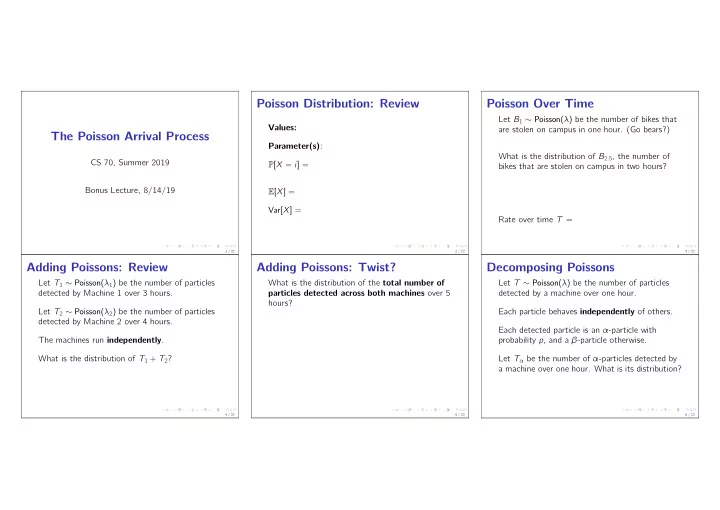
Poisson Distribution: Review Poisson Over Time Let B 1 Poisson( ) be the number of bikes that Values: are stolen on campus in one hour. (Go bears?) The Poisson Arrival Process Parameter(s) : What is the distribution of B 2 . 5 , the


slide-1
SLIDE 1

The Poisson Arrival Process

CS 70, Summer 2019 Bonus Lecture, 8/14/19

1 / 22

Poisson Distribution: Review

Values: Parameter(s): P[X = i] = E[X] = Var[X] =

2 / 22

Poisson Over Time

Let B1 ∼ Poisson(λ) be the number of bikes that are stolen on campus in one hour. (Go bears?) What is the distribution of B2.5, the number of bikes that are stolen on campus in two hours? Rate over time T =

3 / 22

Adding Poissons: Review

Let T1 ∼ Poisson(λ1) be the number of particles detected by Machine 1 over 3 hours. Let T2 ∼ Poisson(λ2) be the number of particles detected by Machine 2 over 4 hours. The machines run independently. What is the distribution of T1 + T2?

4 / 22

Adding Poissons: Twist?

What is the distribution of the total number of particles detected across both machines over 5 hours?

5 / 22

Decomposing Poissons

Let T ∼ Poisson(λ) be the number of particles detected by a machine over one hour. Each particle behaves independently of others. Each detected particle is an α-particle with probability p, and a β-particle otherwise. Let Tα be the number of α-particles detected by a machine over one hour. What is its distribution?

6 / 22

slide-2
SLIDE 2

Decomposing Poissons

Let Tα be the number of α-particles detected by a machine over one hour. What is its distribution? How about Tβ, the number of β-particles?

7 / 22

Independence?

Are Tα and Tβ independent?

8 / 22

Decomposing Poissons Remix

Now there are 3 kinds of particles: α, β, γ. Each detected particle behaves independently of

  • thers, and is α with probability p, β with

probability q, and γ otherwise. Tα ∼ Tβ ∼ Tγ ∼ Punt: Tα, Tβ, Tγ are mutually independent. Sanity Check: Tα + Tβ + Tγ ∼

9 / 22

Exponential Distribution: Review

Values: Parameter(s): P[X = i] = E[X] = Var[X] =

10 / 22

Break

If you could rename the Poisson RV (or any RV for that matter), what would you call it?

11 / 22

Poisson Arrival Process Properties

We’ll now work with a specific setup: ◮ There are independent “arrivals” over time. ◮ The time between consecutive arrivals is Expo(λ). We call λ the rate. Times between arrivals also independent. ◮ For a time period of length t, the number of arrivals in that period is Poisson(λt). ◮ Disjoint time intervals have independent numbers of arrivals.

12 / 22

slide-3
SLIDE 3

Poisson Arrival Process: A Visual

13 / 22

Transmitters I

A transmitter sends messages according to a Poisson Process with hourly rate λ. Given that I’ve seen 0 messages at time t, what is the expected time until I see the first?

14 / 22

Transmitters I

How many messages should I expect to see from 12:00-2:00 and 5:00-5:30?

15 / 22

Transmitters II: Superposition

Transmitters A, B sends messages according to Poisson Processes of rates λA, λB respectively. The two transmitters are independent. We receive messages from both A and B. What is the expected amount of time until the first message from either transmitter?

16 / 22

Transmitters II: Superposition

Transmitters A, B sends messages according to Poisson Processes of rates λA, λB respectively. The two transmitters are independent. We receive messages from both A and B. What is the expected amount of time until the first message from either transmitter?

17 / 22

Transmitters II: Superposition

If the messages from A all have 3 words, and the messages from B all have 2 words, how many words do we expect to see from 12:00-2:00?

18 / 22

slide-4
SLIDE 4

Kidney Donation: Decomposition

My probability instructor’s favorite example... Kidney donations at a hospital follow a Poisson Process of rate λ per day. Each kidney either comes from blood type A or blood type B, with probabilities p and (1 − p) respectively.

19 / 22

Kidney Donation: Decomposition

If I have blood type B, how long do I need to wait before receiving a compatible kidney? Say I just received a type A kidney. The patient receiving a type A kidney after me is expected to live 50 more days without a kidney

  • donation. What is the probability they survive?

20 / 22

Kidney Donation: Decomposition

Now imagine kidneys are types A, B, O with probabilities p, q, (1 − p − q), respectively. If I have type B blood, I can receive both B and O. How many compatible kidneys do I expect to see

  • ver the next 3 days?

21 / 22

Summary

When working with time, use Expo(λ) RVs. When working with counts, use Poisson(λ) RVs. Superposition: combine independent Poisson Processes, add their rates. Decomposition: break Poisson Process with rate λ down into rates p1λ, p2λ, and so on, where pi’s are probabilities.

22 / 22