
The Poisson Arrival Process
CS 70, Summer 2019 Bonus Lecture, 8/14/19
1 / 22Poisson Distribution: Review
Values: Parameter(s): P[X = i] = E[X] = Var[X] =
2 / 22non
- neg
integers
X
, "rate
"e-
a
.it
.x
x
Poisson Over Time
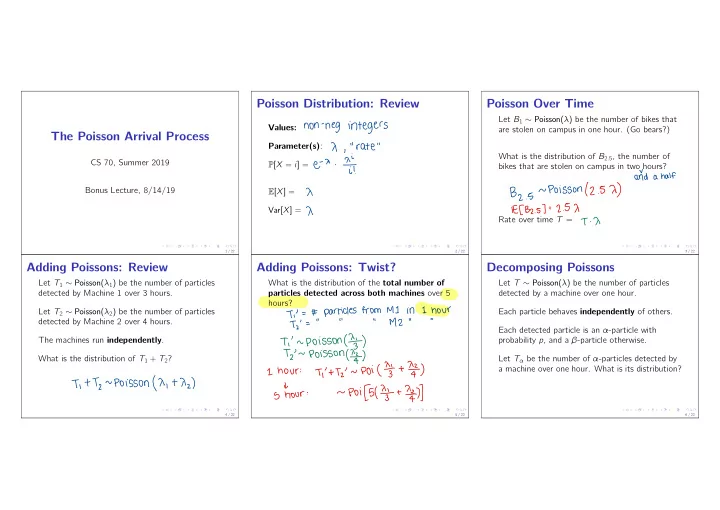
Let B1 ∼ Poisson(λ) be the number of bikes that are stolen on campus in one hour. (Go bears?) What is the distribution of B2.5, the number of bikes that are stolen on campus in two hours? Rate over time T =
3 / 22Atd
a
half
Bz
. as ~Poisson
( 2.52 )
ECB 2.57
=2.5 X
T
. XAdding Poissons: Review
Let T1 ∼ Poisson(λ1) be the number of particles detected by Machine 1 over 3 hours. Let T2 ∼ Poisson(λ2) be the number of particles detected by Machine 2 over 4 hours. The machines run independently. What is the distribution of T1 + T2?
4 / 22T ,
t Tz
nPoisson
( X ,
+ Az)
Adding Poissons: Twist?
What is the distribution of the total number of particles detected across both machines over 5 hours?
5 / 22T
, ' =#
particles
from M1 in
1
hour
Tz
' = " " "M2
" "Tin
Poisson ( ¥ ) Tz
'- Poisson
( ⇒
1- hour
:T ,
'+ Tz
' npoi ( ¥ -1¥)
s
"
hour
:- poi [5131+7*7]
Decomposing Poissons
Let T ∼ Poisson(λ) be the number of particles detected by a machine over one hour. Each particle behaves independently of others. Each detected particle is an α-particle with probability p, and a β-particle otherwise. Let Tα be the number of α-particles detected by a machine over one hour. What is its distribution?
6 / 22