Space of Search Strategies CSE 473: Artificial Intelligence Blind - - PDF document

space of search strategies cse 473 artificial intelligence
SMART_READER_LITE
LIVE PREVIEW

Space of Search Strategies CSE 473: Artificial Intelligence Blind - - PDF document

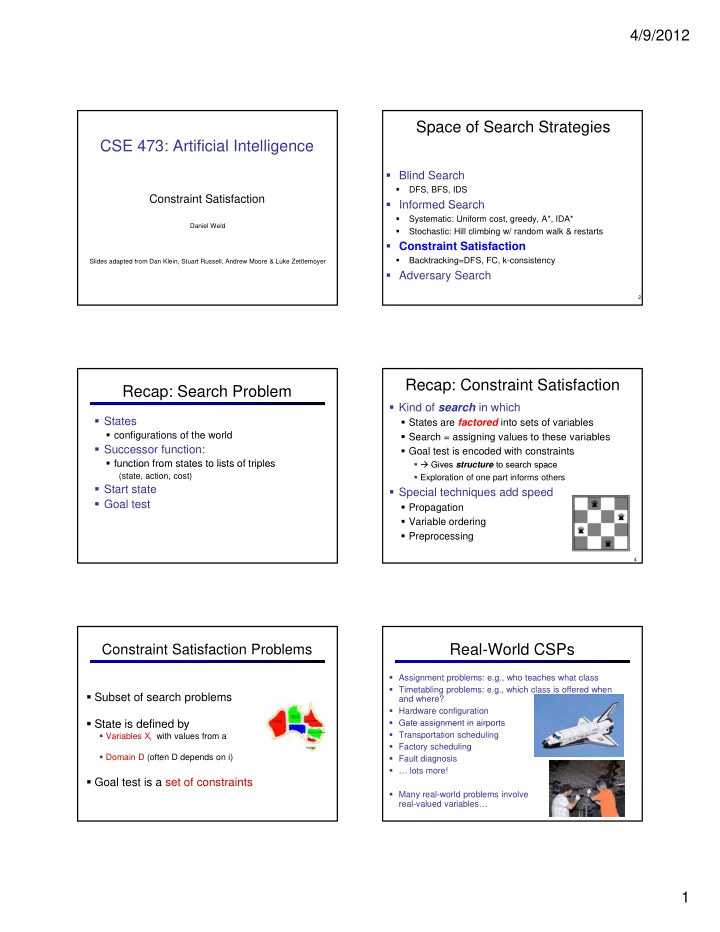
4/9/2012 Space of Search Strategies CSE 473: Artificial Intelligence Blind Search DFS, BFS, IDS Constraint Satisfaction Informed Search Informed Search Systematic: Uniform cost, greedy, A*, IDA* Daniel Weld Stochastic:


slide-1
SLIDE 1

4/9/2012 1

CSE 473: Artificial Intelligence

Constraint Satisfaction

Daniel Weld Slides adapted from Dan Klein, Stuart Russell, Andrew Moore & Luke Zettlemoyer

Space of Search Strategies

  • Blind Search
  • DFS, BFS, IDS
  • Informed Search

2

Informed Search

  • Systematic: Uniform cost, greedy, A*, IDA*
  • Stochastic: Hill climbing w/ random walk & restarts
  • Constraint Satisfaction
  • Backtracking=DFS, FC, k-consistency
  • Adversary Search

Recap: Search Problem

  • States
  • configurations of the world
  • Successor function:
  • function from states to lists of triples

function from states to lists of triples

(state, action, cost)

  • Start state
  • Goal test

Recap: Constraint Satisfaction

  • Kind of search in which
  • States are factored into sets of variables
  • Search = assigning values to these variables
  • Goal test is encoded with constraints
  •  Gives structure to search space

4

 Gives structure to search space

  • Exploration of one part informs others
  • Special techniques add speed
  • Propagation
  • Variable ordering
  • Preprocessing

Constraint Satisfaction Problems

  • Subset of search problems
  • State is defined by
  • State is defined by
  • Variables Xi with values from a
  • Domain D (often D depends on i)
  • Goal test is a set of constraints

Real-World CSPs

  • Assignment problems: e.g., who teaches what class
  • Timetabling problems: e.g., which class is offered when

and where?

  • Hardware configuration
  • Gate assignment in airports
  • Gate assignment in airports
  • Transportation scheduling
  • Factory scheduling
  • Fault diagnosis
  • … lots more!
  • Many real-world problems involve

real-valued variables…

slide-2
SLIDE 2

4/9/2012 2

Chinese Food, Family Style

  • Suppose k people…
  • Variables & Domains?
  • Constraints?

7

Factoring States

  • Model state’s (independent) parts, e.g.

Suppose every meal for n people Has n dishes plus soup

  • Soup =
  • Meal 1 =

8

  • Meal 1 =
  • Meal 2 =

  • Meal n =

Chinese Constraint Network

Soup Total Cost Chicken Dish Appetizer Must be Hot&Sour No Peanuts

9

< $40 Vegetable Rice Seafood Pork Dish No Peanuts Not Chow Mein Not Both Spicy

Crossword Puzzle

  • Variables & domains?
  • Constraints?

10

Standard Search Formulation

  • States are defined by the values assigned so far
  • Initial state: the empty assignment, {}
  • Successor function:
  • assign value to an unassigned variable
  • Goal test:
  • the current assignment is complete &
  • satisfies all constraints

Backtracking Example

slide-3
SLIDE 3

4/9/2012 3

Backtracking Search

  • Note 1: Only consider a single variable at each point
  • Variable assignments are commutative, so fix ordering of variables

I.e., [WA = red then NT = blue] same as [NT = blue then WA = red] [ ]

  • What is branching factor of this search?

Backtracking Search

Note 2: Only allow legal assignments at each point

  • I.e. Ignore values which conflict previous assignments
  • Might need some computation to eliminate such conflicts
  • “Incremental goal test”

“Backtracking Search”

Depth-first search for CSPs with these two ideas

  • One variable at a time, fixed order
  • Only trying consistent assignments

Is called “Backtracking Search”

  • Basic uninformed algorithm for CSPs
  • Can solve n-queens for n  25

Backtracking Search

  • What are the choice points?

Improving Backtracking

  • General-purpose ideas give huge gains in

speed

  • Ordering:
  • Which variable should be assigned next?

c a ab e s ou d be ass g ed e t

  • In what order should its values be tried?
  • Filtering: Can we detect inevitable failure early?
  • Structure: Can we exploit the problem structure?

Forward Checking

  • Idea: Keep track of remaining legal values for

unassigned variables (using immediate constraints)

  • Idea: Terminate when any variable has no legal values

WA SA NT Q

NSW

V

slide-4
SLIDE 4

4/9/2012 4

Forward Checking

Row 1 Row 2 Row 3 QA QB QC QD

21

Row 4 1 2 3 4 1 2 3 4 1 2 3 4 1 2 3 4

Forward Checking

Q Row 1 Row 2 Row 3 QA QB QC QD

22

Row 4 1 2 3 4 1 2 3 4 1 2 3 4 1 2 3 4

Forward Checking

Q Row 1 Row 2 Row 3 Prune inconsistent values QA QB QC QD

23

Row 4 1 2 3 4 1 2 3 4 1 2 3 4 1 2 3 4

Forward Checking

Q Row 1 Row 2 Row 3 Where can QB Go? QA QB QC QD

24

Row 4 1 2 3 4 1 2 3 4 1 2 3 4 1 2 3 4

Forward Checking

Q Row 1 Row 2 Row 3 Q QA QB QC QD Prune inconsistent values

25

Row 4 1 2 3 4 1 2 3 4 1 2 3 4 1 2 3 4

Forward Checking

Q Row 1 Row 2 Row 3 Where can QB Go? QA QB QC QD

26

Row 4 1 2 3 4 1 2 3 4 1 2 3 4 1 2 3 4

slide-5
SLIDE 5

4/9/2012 5

Forward Checking Cuts the Search Space

4 16

27

16 64 256

Are We Done?

28

Constraint Propagation

  • Forward checking propagates information from assigned to adjacent

unassigned variables, but doesn't detect more distant failures:

WA SA NT Q

NSW

V

  • NT and SA cannot both be blue!
  • Why didn’t we detect this yet?
  • Constraint propagation repeatedly enforces constraints (locally)

Arc Consistency

  • Simplest form of propagation makes each arc consistent
  • X ฀ Y is consistent iff for every value x there is some allowed y

WA SA NT Q

NSW

V

  • If X loses a value, neighbors of X need to be rechecked!
  • Arc consistency detects failure earlier than forward checking
  • What’s the downside of arc consistency?
  • Can be run as a preprocessor or after each assignment

Arc Consistency

  • Runtime: O(n2d3), can be reduced to O(n2d2)
  • … but detecting all possible future problems is NP-hard – why?

[demo: arc consistency animation]

Limitations of Arc Consistency

  • After running arc

consistency:

  • Can have one solution

left

  • Can have multiple

solutions left

  • Can have no solutions

left (and not know it)

What went wrong here?

slide-6
SLIDE 6

4/9/2012 6

K-Consistency*

  • Increasing degrees of consistency
  • 1-Consistency (Node Consistency):

Each single node’s domain has a value which meets that node’s unary constraints

  • 2-Consistency (Arc Consistency): For

y ( y) each pair of nodes, any consistent assignment to one can be extended to the other

  • K-Consistency: For each k nodes, any

consistent assignment to k-1 can be extended to the kth node.

  • Higher k more expensive to compute
  • (You need to know the k=2 algorithm)

Ordering: Minimum Remaining Values

  • Minimum remaining values (MRV):
  • Choose the variable with the fewest legal values
  • Why min rather than max?
  • Also called “most constrained variable”
  • “Fail-fast” ordering

Ordering: Degree Heuristic

  • Tie-breaker among MRV variables
  • Degree heuristic:
  • Choose the variable participating in the most

constraints on remaining variables

  • Why most rather than fewest constraints?

Ordering: Least Constraining Value

  • Given a choice of variable:
  • Choose the least constraining

value

  • The one that rules out the

fewest values in the remaining variables variables

  • Note that it may take some

computation to determine this!

  • Why least rather than most?
  • Combining these heuristics

makes 1000 queens feasible

Problem Structure

  • Tasmania and mainland are

independent subproblems

  • Identifiable as connected

components of constraint graph

  • Suppose each subproblem

Suppose each subproblem has c variables out of n total

  • Worst-case solution cost is

O((n/c)(dc)), linear in n

  • E.g., n = 80, d = 2, c =20
  • 280 = 4 billion years at 10

million nodes/sec

  • (4)(220) = 0.4 seconds at 10

million nodes/sec

Tree-Structured CSPs

  • Choose a variable as root, order

variables from root to leaves such that every node's parent precedes it in the ordering

  • For i = n : 2, apply RemoveInconsistent(Parent(Xi),Xi)
  • For i = 1 : n, assign Xi consistently with Parent(Xi)
  • Runtime: O(n d2)
slide-7
SLIDE 7

4/9/2012 7

Tree-Structured CSPs

  • Theorem: if the constraint graph has no loops, the CSP can

be solved in O(n d2) time!

  • Compare to general CSPs, where worst-case time is O(dn)
  • This property also applies to logical and probabilistic

reasoning: an important example of the relation between syntactic restrictions and the complexity of reasoning.

Nearly Tree-Structured CSPs

  • Conditioning: instantiate a variable, prune its neighbors'

domains

  • Cutset conditioning: instantiate (in all ways) a set of

variables such that the remaining constraint graph is a tree

  • Cutset size c gives runtime O( (dc) (n-c) d2 ), very fast for

small c

Iterative Algorithms for CSPs

  • Greedy and local methods typically work with “complete”

states, i.e., all variables assigned

  • To apply to CSPs:
  • Allow states with unsatisfied constraints

O t i i bl l

  • Operators reassign variable values
  • Variable selection: randomly select any conflicted

variable

  • Value selection by min-conflicts heuristic:
  • Choose value that violates the fewest constraints
  • I.e., hill climb with h(n) = total number of violated constraints

Example: 4-Queens

  • States: 4 queens in 4 columns (44 = 256 states)
  • Operators: move queen in column
  • Goal test: no attacks
  • Evaluation: h(n) = number of attacks

Performance of Min-Conflicts

  • Given random initial state, can solve n-queens in almost constant

time for arbitrary n with high probability (e.g., n = 10,000,000)

  • The same appears to be true for any randomly-generated CSP

except in a narrow range of the ratio

Summary

  • CSPs are a special kind of search problem:
  • States defined by values (domains) of a fixed set of variables
  • Goal test defined by constraints on variable values
  • Backtracking = DFS - one legal variable assigned per node
  • Variable ordering and value selection heuristics help
  • Forward checking prevents assignments that fail later
  • Forward checking prevents assignments that fail later
  • Constraint propagation (e.g., arc consistency)
  • does additional work to constrain values and detect inconsistencies
  • Constraint graph representation
  • Allows analysis of problem structure
  • Tree-structured CSPs can be solved in linear time
  • Iterative min-conflicts is usually effective in practice
  • Local (stochastic) search