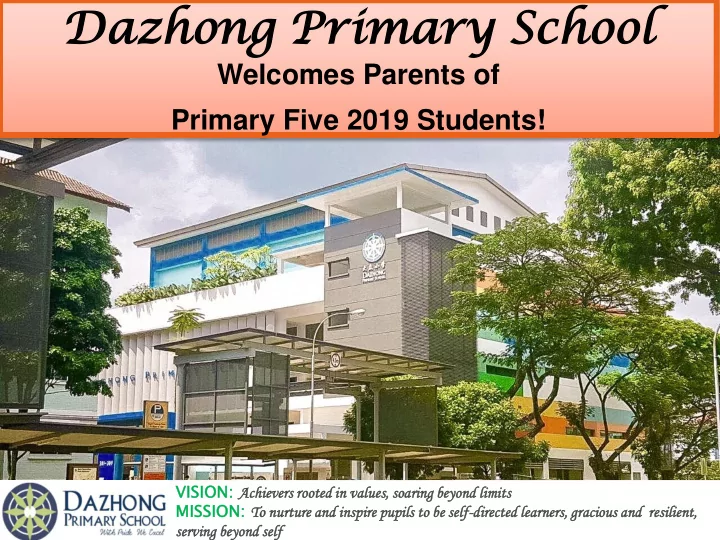
Dazhong azhong Prim imary ry Sc School ool Welcomes Parents of - - PowerPoint PPT Presentation

dazhong azhong prim imary ry sc school ool
SMART_READER_LITE
LIVE PREVIEW

Dazhong azhong Prim imary ry Sc School ool Welcomes Parents of - - PowerPoint PPT Presentation

Dazhong azhong Prim imary ry Sc School ool Welcomes Parents of Primary Five 2019 Students! VISION: Achievers evers rooted ed in value ues, , soarin ring g beyond nd limits MISSIO SION: To nurture ure and inspire ire pupils ils to


slide-1
SLIDE 1

Dazhong azhong Prim imary ry Sc School

  • ol

Welcomes Parents of Primary Five 2019 Students!

VISION: Achievers evers rooted ed in value ues, , soarin ring g beyond nd limits MISSIO SION: To nurture ure and inspire ire pupils ils to be self-dire irected ed learne ners rs, gracious ious and resili ilien ent, , serv rving ng beyond self

slide-2
SLIDE 2

Parent Engagement Session Programme

Time Item 2.30 p.m. FT Interaction Time 3.00 p.m. Principal’s Address 3.15 p.m. Year Head Sharing 3.45 p.m. Curriculum Briefing (English, Math, Science, MTL) 4.45 p.m. End

slide-3
SLIDE 3

Use of photographs and videos

  • Photographs and video images of students and their

parents/guardians may be captured during school activities and events.

  • The school may use and publish these in school publications,

websites, social media channels and other communication channels.

  • If for any reason you are not comfortable with the school’s use
  • f the materials, please write in to dazhong_ps@moe.edu.sg.

Please indicate the source of the image (e.g. where you saw it, when it was published).

slide-4
SLIDE 4

Welcome Address

Mrs Serene Boey

Vice Principal, DZPS

slide-5
SLIDE 5

Vision

Achievers rooted in values, Soaring beyond limits

Mission

To nurture and inspire pupils to be self- directed learners, gracious and resilient, serving beyond self

Motto

With Pride We Excel

slide-6
SLIDE 6
  • Integrity

I

  • Responsibility

R

  • Excellence

E

  • Acceptance

A

  • Perseverance

P

Our School Values

slide-7
SLIDE 7
slide-8
SLIDE 8

Do you know????

The percentage of children aged six to nine who do not get the recommended amount of sleep for their age: nine to 10 hours of sleep.

57.6 %

 The percentage of parents who do not think their child has a sleep

problem.

89 %

 The percentage of parents who watch TV an hour before bedtime.

Watching TV is the most popular activity among parents one hour before they sleep.

71 %

 Experts say watching TV before sleeping could excite

children at a time they should be relaxing.

 The percentage of children who watch TV an hour before bedtime.

74.6 %

slide-9
SLIDE 9

Screen Time

Dr Lim a consultant in National University Hospital’s Division of Paediatric Pulmonary and Sleep, said: “Children should not be exposed to so much

screen time just before they sleep. It may arouse them and affect their sleep hormones.”

In many cases, parents are the reason behind their

children’s sleep deprivation, added Dr Lim.

 “Kids emulate their parents’ sleeping habits. If they

see their parents watching TV or using their phones, they will pick up such habits, too.”

 “If bad pre-bedtime activities are perceived as

normal by parents, then they will not see it as a problem for

their kids.”

slide-10
SLIDE 10

3 Quick Tips on how you can also bring home the Healthy Meals in Schools Programme:

  • 1. Look out for snacks/drinks with the

Healthier Choice symbol

  • 2. Include at least 20% whole-grain

in meals

  • 3. Include more fruits and vegetables

to obtain 2 servings of fruits and 2 servings of vegetables a day

slide-11
SLIDE 11
slide-12
SLIDE 12

YH Sharing

Mdm Jan Lin

Year Head (Primary 2 and 5)

slide-13
SLIDE 13

P5 Form Teachers

P5 FT 1 FT 2 5I Mrs Amelia Phua Mdm Xie Shuang 5R Mr Heng Chee Kiang Mr Choy Yu Wai 5E Ms Ummu Salma Binte Hamaradeen Mr Su Yizhong 5A Mdm Tan Shew Kee Mdm M B Sheirin Habibah 5P Mdm Suriatie Bte Abdul Samat Mr Wu Zongbing

slide-14
SLIDE 14

 School hours for 2019:

Important Information

School Hours Monday, Thursday, Friday 7.30 a.m. to 1.40 p.m. Tuesday 7.30 a.m. to 3.10 p.m. (includes 30-min Lunch Break) Wednesday 7.30 a.m. to 1.10 p.m. Recess P1, P4 & P6 9.40 a.m. to 10.10 a.m. P2, P3 & P5 10.10 a.m. to 10.40 a.m. All pupils must be in school by 7.30 a.m. Pupils who reach after 7.30 a.m. will be considered late for school.

slide-15
SLIDE 15

 Programmes after school hours:

Important Information

Programme Level Day Time Talent Management CCA Selected P3-P6 students Friday After school, as informed by teachers Reading Remediation Programme/ School-based Dyslexic Remediation Programme Selected P3-P4 students Different days of the week Extended Curriculum All P6 students Monday, Thursday Targeted Remediation Selected P5 students Monday, Thursday Higher Mother Tongue Selected P5 and P6 students Thursday Students should not be staying back on other days unless consent form has been issued or parents have been notified by teacher I/C.

slide-16
SLIDE 16

Key Programmes

English Math Mother Tongue Science

  • EL Fiesta
  • Joy to Read
  • Factual Fluency
  • ICAN
  • Model Drawing

Package

  • Math

Exploration Week

  • Koobits
  • MTL

Fortnight

  • Joy to

Read

  • Creative Toy

Competittion

  • I3 Process

Skills Worksheets

slide-17
SLIDE 17

Key Programmes

ICT PM/CCE PE/CCA Aesthetics

  • Cyber-

wellness

  • Leadership in the

Classroom

  • Gratitude Journal
  • Heart-to-Heart
  • FTGP
  • Values-in-Action:

Pots of Kindness

  • ECG
  • Sexuality Education

programme

  • NE Show
  • Internationalisation

Programme (Melaka & Bangkok)

  • Dragon-

boating

  • CCA
  • Batik Painting
  • Dance

Workshop

slide-18
SLIDE 18

Dazhong Pupil Outcome Standards

slide-19
SLIDE 19

Self-di direct ected ed Lea earne rner Res esilient ent Grac acious

  • us

Se Serving g beyond nd self Res esilient ent

Pupil il Outco tcome me Sta tandar dards ds (P (POS) S)

slide-20
SLIDE 20

Pup upil il Ou Outcome come St Standar andards ds (PO POS) S)

Primary 5

Sets learning goals and works towards it independently. Able to apply what they have learnt in new contexts.

  • Questions assumptions
  • Uses ICT and collaborates with
  • thers to create new knowledge

and extend learning. Takes initiative to apply or share learning with others

Self lf-di directed Learne rner

Graciou ious s

Servin ing g beyon

  • nd

d self

Resili ilient ent

slide-21
SLIDE 21

Pup upil il Ou Outcome come Standar andards ds (POS) OS)

Primary 5 Does the right thing even in difficult situations Puts the needs of others before his/her own. Contributes positively to the community.

Self lf-di directed Learne rner

Graciou ious s

Servin ing g beyon

  • nd

d self

Resili ilient ent

slide-22
SLIDE 22

Pup upil il Ou Outcome come Standar andards ds (POS) OS)

Primary 5

Values others and respects their

  • pinions

Appreciates strengths and uniqueness of friends from diverse communities

Self lf-di directed Learne rner

Graciou ious s

Servin ing g beyon

  • nd

d self

Resili ilient ent

slide-23
SLIDE 23

Pup upil il Ou Outcome come Standar andards ds (POS) OS)

Primary 5

Encourages others to have a positive attitude when dealing with change Takes on challenges independently. Applies new strategies to solve problems Encourages others not to give up when working on challenging tasks

Self lf-di directed Learne rner

Graciou ious s

Servin ing g beyon

  • nd

d self

Resili ilient ent

slide-24
SLIDE 24

Direct School Admission for Secondary Schools

slide-25
SLIDE 25

Entering a secondary school

PSLE/S1 Posting Process DSA-Sec

  • Based on a student’s PSLE score
  • Most students enter secondary

schools this way

  • Based on a diverse range of talents and

achievements in specific academic subjects or non-academic areas, beyond what the PSLE recognises

  • Allows students to access school

programmes to develop their talents

25
slide-26
SLIDE 26

Is the DSA-Sec right for my child?

If your child has specific talents which a school offers the DSA-Sec in And is passionate about and committed to developing his/her strengths and interests

Talent

Passion Commit

  • ment
26

DSA-Sec can support his/her development in that talent area.

slide-27
SLIDE 27

Which school should my child apply to?

  • Look for a school with programmes that match your child’s

strengths and interests

  • Schools are looking out for students whose interests and

talents they can develop further.

  • Learn more about the secondary school’s pace of learning

and overall range of programmes

  • Get the latest information about what each school offers by:
  • Visiting schools’ websites
  • Attending schools’ Open Houses to also experience their

environments and cultures

  • Visiting the MOE’s DSA-Sec website (will be updated

around April 2019)

DSA-SEC APPLICATION

27
slide-28
SLIDE 28 28

A new DSA-Sec Application Portal

  • To encourage students to tap on the expanded DSA opportunities, the

DSA-Sec application process will be simplified

  • From the 2019 DSA-Sec, students will be able to apply for DSA through

a centralised DSA-Sec Application Portal, using a common application form.

  • The portal will simplify and streamline the DSA application process,

making it convenient for all students.

NEW – DSA-SEC APPLICATION PORTAL

slide-29
SLIDE 29

Features of the DSA-Sec Portal

  • 1. Centralised online applications
  • Applications will be centralised across all participating secondary schools
  • The form will be easy to fill – you only have to key in contact details and your

school and talent choices

  • You do not need to submit testimonials or hardcopy documents to the

secondary school during application.

  • 2. Application using Singpass
  • Parents can access the Portal via their SingPass login. Only one parent’s

SingPass login is required.

  • Parents who are unable to access their SingPass can approach the primary

school for assistance. 3. No application fees

  • No fees charged for DSA-Sec application and selection.
  • We encourage all students who are passionate about and committed to

developing particular talents to apply, regardless of family backgrounds.

29

NEW – DSA-SEC APPLICATION PORTAL

slide-30
SLIDE 30

Parent Engagement

slide-31
SLIDE 31
  • Be involved in your child’s education
  • Set goals with your child
  • Monitor your child’s daily work
  • Create a conducive environment for your child to complete his/her work

at home

  • Establish helpful routines at home – e.g. reading with your child
  • Familiarise your child with routines of checking homework, packing

school bag

Every Dazhong Parent a Supportive Partner

slide-32
SLIDE 32
  • Be involved in your child’s education
  • Keep track of holistic assessment schedule, but don’t have to over-

prepare

  • Check Student’s Handbook daily. Students are taught to record their

homework in their Student’s Handbook daily.

  • Read Termly Letters from the Principal
  • Check School Calendar for updates on school programmes

Every Dazhong Parent a Supportive Partner

slide-33
SLIDE 33
  • Teach responsibility
  • Don’t do your child’s homework for him/her.
  • Don’t deliver your child’s forgotten items to school, unless it is a medical

emergency.

  • Don’t be over-dependent on teachers to update you on homework.
  • Don’t contact the teachers to check on the things that your child needs

to do.

  • Limit screen time

Every Dazhong Parent a Supportive Partner

slide-34
SLIDE 34

 Termly newsletter  School calendar  Termly Holistic Assessment schedule  Student Handbook  School website: http://dazhongpri.moe.edu.sg/  Telephone: 6565 8002  School email: dazhong_ps@moe.edu.sg  Teacher’s email address (found on school website)  YH email address: Lin_Shihua@moe.edu.sg  Parent-Teacher Meetings

Channels of Communication

Respect teachers’ personal time after school hours. Avoid contacting teachers outside school operating hours.

slide-35
SLIDE 35
  • What questions did you ask the teacher today?
  • What would you like to do more of?
  • What did you learn about using computers?
  • Have you done anything nice for someone else?
  • What are you looking forward to next week?

5 questions to ask your child over dinner

slide-36
SLIDE 36

P5 English Language

VISION: Achiev evers rs root

  • ted

ed in values es, , soar aring ng beyond nd limit its MISSION: To nurture ure and inspir ire pupils ils to be self-direc irected ed learners, ers, graciou ious and resil ilie ient, nt, serv rving ng beyond self

slide-37
SLIDE 37

Our Curriculum

slide-38
SLIDE 38

English Language Skills

Grammar Reading and Viewing Vocabulary Listening Speaking Writing and Representing

slide-39
SLIDE 39

P5 EL Curriculum

Explicit Teaching of Language

STELLAR

Compre OE Grammar Synthesis & Transformation Compre Cloze Listening Oral Writing Reading Grammar Vocabulary Write with Purpose Package, Joy to Read, Little Red Dot, Targeted Remediation, EL Fiesta

slide-40
SLIDE 40

Assessment

slide-41
SLIDE 41

PAPER COMPONENT MARKS WEIGHTAGE DURATION

1

  • Situational

Writing

  • Continuous

Writing 55 27.5% 1h 10 min 2 Language Use & Comprehension 95 47.5% 1h 50 min 3 Listening Comprehension 20 10% About 30 min 4 Oral Communication 30 15% About 15min Total 200 100% Term 2 and Term 4 Standard English SA1 & SA2

slide-42
SLIDE 42

PAPER COMPONENT MARKS WEIGHTAGE DURATION 1

  • Situational

Writing

  • Continuous

Writing 40 26.7% 1h 10 min 2 Language Use & Comprehension 60 40% 1h 20 min 3 Listening Comprehension 20 13.3% About 30 min 4 Oral Communication 30 20% About 15min

Total 150 100% Term 2 and Term 4 Foundation English SA1 & SA2

slide-43
SLIDE 43

Part 1 – Situational Writing Pupils will need to write a letter/email/report based on a given situational context.

Paper 1 (Writing)

slide-44
SLIDE 44

Sample Question

slide-45
SLIDE 45

Part 2 – Continuous Writing

  • Stimuli (pictures and pointers) to help pupils

view the topic from different perspectives

  • Continuous prose (narrative/non-narrative)
  • Composition must be based on:

 the topic at least 1 out of the 3 given pictures

Paper 1 (Writing)

slide-46
SLIDE 46

Sample Question

PSLE 2018 question

slide-47
SLIDE 47
  • Pronunciation
  • final consonants (ed/d/t/s/k)
  • th consonants (third, mother, fifth)
  • Long vs short vowels (bit vs beat)
  • Stress pattern (forget, a project)
  • Expression
  • Appropriate for the situation, dialogue
  • Fluency
  • hesitation, self-correction

Part 1 – Reading Aloud

Paper 4 (Oral Communication)

slide-48
SLIDE 48

Paper 4 (Oral Communication) Part 2 – Stimulus-based Conversation

slide-49
SLIDE 49

Stimulus-Based Conversation

A

Answer

Answer the question.

R R

2 Reasons

Give a reason to support your answer. Give another reason to support your answer.

E

Experiences

Share your personal experience related to the question.

S

Suggestion

Offer a suggestion to broaden the scope of the question.

T

Theme

Link back to school values.

slide-50
SLIDE 50

ARREST

slide-51
SLIDE 51

Support for your Child

slide-52
SLIDE 52

1.

Encourage your child to read widely.

2.

Talk to your child. Every day.

3.

Create “experiences” with your child.

4.

Monitor gadget use.

5.

Be their “Superhero”.

slide-53
SLIDE 53

P5 Mathematics

VISION: Achiev evers rs root

  • ted

ed in values es, , soar aring ng beyond nd limit its MISSION: To nurture ure and inspir ire pupils ils to be self-direc irected ed learners, ers, graciou ious and resil ilie ient, nt, serv rving ng beyond self

slide-54
SLIDE 54

Mathematics in Dazhong

  • Direction: Mastery of Maths for Life
  • Focus on:
  • 1. Joy of Learning – use of real-life
  • 2. Confidence – built from mastery
slide-55
SLIDE 55

Joy of Learning

  • Maths Exploration Week
slide-56
SLIDE 56

Joy of Learning

  • P1 & P2 Maths Carnival
slide-57
SLIDE 57

Joy of Learning

  • P3 & P4 Maths Trail
slide-58
SLIDE 58

Joy of Learning

  • Learning Fractions in a P3 class
slide-59
SLIDE 59

Self-Directed Learning – KooBits

  • eLearning portal
slide-60
SLIDE 60

Problem-solving

Syllabus emphasis

slide-61
SLIDE 61
slide-62
SLIDE 62

Assessment…

slide-63
SLIDE 63

P5 Assessments

Term Assessment Weightage Term 1 Weighted Assessment 1 10% Term 2 SA1 20% Term 3 Weighted Assessment 2 10% Term 4 SA2 60% Total 100%

slide-64
SLIDE 64

Paper 1 Marks

  • No. of Qns

Multiple Choice Questions (MCQs) 1-2 15 Short Answer Questions (SAQs) 1-2 15

Total 45

Format of Standard Maths SA1/2

Duration: 1 h – no calculator

Paper 1 Marks

  • No. of Qns

Short Answer Questions (SAQs) 2 5 Long Answer Questions (LAQs) 3-5 12

Total 55

Duration: 1 h 30 mins – calculator

slide-65
SLIDE 65

Paper 1 Marks

  • No. of Qns

Multiple Choice Questions (MCQs) 1-2 20 Short Answer Questions (SAQs) 2 10

Total 50

Format of Foundation Maths SA1/2

Duration: 1 h – no calculator

Paper 1 Marks

  • No. of Qns

Short Answer Questions (SAQs) 2 10 Long Answer Questions (LAQs) 3-4 6

Total 40

Duration: 1 h – calculator

slide-66
SLIDE 66

How you can support…

slide-67
SLIDE 67

1.

Encourage your child to put in consistent effort throughout this year

2.

Inculcate and enforce good work habits like doing daily homework and bringing right resources everyday.

3.

Promote a balanced approach towards home practices for Maths questions

  • Focus on learning gaps or weaknesses and conceptual

understanding, not quantity of practices

  • Balance against the homework load from school
  • teachers. It should not be overly-taxing.

4.

Monitor the use of calculators in homework

  • r in other assessments at home.
slide-68
SLIDE 68

PRIMARY 5 SCIENCE

slide-69
SLIDE 69

OUR SCIENCE CURRICULUM

slide-70
SLIDE 70

Science Department Direction

  • Science as an Inquiry
  • Language of Science
  • Science Around Us

Hands-on Experiences and Experiments to promote the Joy of Learning!

slide-71
SLIDE 71

I3 (Inquire, Ignite & Inspire) E3 (Explore, Excite & Enrich) Focuses on the teaching of key scientific concepts and process skills Process Skills: Classifying Observing Comparing Classifying Analysing Inferring Communicating Focuses on providing students with opportunities for Science

  • utdoor learning

Includes learning journey to Science Centre and field trip to Sungei Buloh Nature Reserve

Science Curriculum

 Scientific Skills and Processes  Experiential Learning – experiments and outdoor learning

slide-72
SLIDE 72
  • Experiential learning and technologies to foster deep learning of Science

Science Curriculum

slide-73
SLIDE 73
  • Collaborative learning and class discussions

Science Curriculum

slide-74
SLIDE 74
  • Hands-on experiments, learning by doing

Science Curriculum

slide-75
SLIDE 75
  • Learning environments around the school

Science Curriculum

slide-76
SLIDE 76

ASSESSMENT

slide-77
SLIDE 77
  • Knowledge with understanding
  • Students should be able to demonstrate

knowledge and understanding of scientific facts, concepts and principles

  • Application of knowledge and process skills
  • Students should be able to apply scientific facts,

concepts and principles to new situations

  • Students should be able to interpret information and

investigate them using process skills

Assessment Objectives

slide-78
SLIDE 78

BOOKLET COMPONENT MARKS A Multiple Choice 28 questions 56 B Open-ended 12-13 questions 44 Total 100 Duration: 1h 45 min

Format of SA1 and SA2

Standard Science

All assessments for P5 will adopt the PSLE format

slide-79
SLIDE 79

BOOKLET COMPONENT MARKS A Multiple Choice 18 questions 36 B Structured and Open- ended 34 Total 70 Duration: 1h 15 min

Format of Examinations

Foundation Science

All assessments for P5 will adopt the PSLE format

slide-80
SLIDE 80

How can I help my child?

slide-81
SLIDE 81

1.

Encourage your child to read about Science (Science magazines in class library) – to be Self-Directed Learners

2.

Encourage your child to actively apply their Science knowledge to explain things around them!

3.

Join us as Dazhong Science Mummies/Daddies to help arouse our children’s sense of wonder for Science!

slide-82
SLIDE 82

Science around us

Science Topics: Materials (P3) Environment (P6)

slide-83
SLIDE 83

Science around us

Science Topics: Water Cycle (P5)

slide-84
SLIDE 84

Science around us

Science Topics: Materials (P3) Heat (P4) Environment (P6)

slide-85
SLIDE 85

VISION: Achiev evers rs root

  • ted

ed in values es, , soar aring ng beyond nd limit its MISSION: To nurture ure and inspir ire pupils ils to be self-direc irected ed learners, ers, graciou ious and resil ilie ient, nt, serv rving ng beyond self

五年级华文

slide-86
SLIDE 86

VISION: Achiev evers rs root

  • ted

ed in values es, , soar aring ng beyond nd limit its MISSION: To nurture ure and inspir ire pupils ils to be self-direc irected ed learners, ers, graciou ious and resil ilie ient, nt, serv rving ng beyond self

课程重点

slide-87
SLIDE 87

五年级课程重点

  • 1. 校本课程:

学习单(阅读理解)、每课听写、看图作文、听力练习、看录像 会话练习、练习试卷。

  • 2. 辅助活动:

Ezhishi知识网、 SLS新加坡学生学习平台、乐学善用平台(iMTL)、 母语双周活动。

slide-88
SLIDE 88

VISION: Achiev evers rs root

  • ted

ed in values es, , soar aring ng beyond nd limit its MISSION: To nurture ure and inspir ire pupils ils to be self-direc irected ed learners, ers, graciou ious and resil ilie ient, nt, serv rving ng beyond self

评价

slide-89
SLIDE 89

试卷 考查项目 分数 比重 测试时间 1

  • 命题作文
  • 看图作文

40 20% 50 分钟 2 语文理解 与运用 90 45% 1小时40分 钟 3 口试 50 25% 约10分钟 听力 20 10% 约30分钟 总计 200 100%

slide-90
SLIDE 90

试卷一:命题作文

slide-91
SLIDE 91

试卷一:看图作文

slide-92
SLIDE 92

试卷二:语文理解与应用

试卷/时间 考查项目 考查方式 题数 分数 比重 试卷二 (1小时40 分钟) (A部分) 语文理解与应用 40 90 45% ∙ 语文应用 多项选择 15 30 15% ∙ 短文填空 多项选择 5 10 5% ∙ 阅读理解一 (1个篇章) 多项选择 5 10 5% (B部分) ∙ 完成对话 填空 (提供选项) 4 8 4% ∙ 阅读理解二 (2个篇章) 开放式 11 32 16%

slide-93
SLIDE 93

试卷样例

slide-94
SLIDE 94

试卷样例

slide-95
SLIDE 95

试卷样例

slide-96
SLIDE 96

试卷 样例

slide-97
SLIDE 97

试卷样例

slide-98
SLIDE 98

试卷样例

slide-99
SLIDE 99

试卷样例

slide-100
SLIDE 100

试卷样例

slide-101
SLIDE 101

试卷样例

slide-102
SLIDE 102

试卷三(口试)

slide-103
SLIDE 103

试卷样例

提示:

  • 1. 谈谈你在录像中看到的一件好事。
  • 2. 除了录像中所看到的,谈谈一件别人曾经为

你做过的好事。

  • 3. 你认为学校是否应该举办“好人好事周”?

为什么?

slide-104
SLIDE 104

试卷三(听力)

slide-105
SLIDE 105

如何帮助孩子…

slide-106
SLIDE 106

每天有机会听 华文,如对话 、看电视等。 每天用华文对 话,可把练习 的会话录下来 ,上Ezhishi做 会话练习。 每天朗读课文 ,可在朗读时 录音,上 Ezhishi阅读和 做习题。 勤做笔记,把读到的好词 好句记下来,多用华文短 讯或便条跟孩子沟通。

slide-107
SLIDE 107
  • 每个学生都有帐号,只需根据教师给的帐号和密码登入即可。
  • 学生可在家自主学习,在家做网上试题,阅读电子书和进行口试线上

练习。

  • https://www.ezhishi.net/Contents/index.html

Ezhishi 知识网

slide-108
SLIDE 108
  • 1. 教育部的课程网站:
  • https://www.moe.gov.sg/education/syllabuses
  • 2. 教育部的小学华文“欢乐伙伴”数码教学资源:
  • https://xuele.moe.edu.sg
  • 3. 教育部的小学华文“欢乐小镇”网站:
  • https://xuele.moe.edu.sg/xuele/slot/u108/happytown%20old/Index.html
  • 4. 教育部各科线上教学资源一览表:
  • https://www.moe.gov.sg/education/syllabuses/resources
  • 5. 教育部考评局小六会考考查项目:
  • https://www.seab.gov.sg/pages/nationalExaminations/PSLE/syllabuses

教育部网上资源

slide-109
SLIDE 109
  • 1. 教育部的课程网站:
  • https://www.moe.gov.sg/education/syllabuses

教育部网上资源

slide-110
SLIDE 110
  • 2. 教育部的小学华文数码教学资源:
  • https://xuele.moe.edu.sg

教育部网上资源

slide-111
SLIDE 111
  • 3. 教育部的小学华文“欢乐小镇”网站:
  • https://xuele.moe.edu.sg/xuele/slot/u108/happytown%20old/Index.html
  • 教育部网上资源
slide-112
SLIDE 112
  • 4. 教育部各科线上教学资源一览表:
  • https://www.moe.gov.sg/education/syllabuses/resources

教育部网上资源

slide-113
SLIDE 113
  • 5. 教育部考评局小六会考考查项目:
  • https://www.seab.gov.sg/pages/nationalExaminations/PSLE/syllabuses

教育部网上资源

slide-114
SLIDE 114
  • “讲华语运动”
  • http://mandarin.org.sg/ch
  • 讲华语运动
slide-115
SLIDE 115
  • https://tinyurl.com/ftc2019
  • 讲华语运动

亲子才艺比赛2019

slide-116
SLIDE 116

谢谢 !

slide-117
SLIDE 117

BAHASA MELAYU PRIMARI 5

slide-118
SLIDE 118

Fokus kami untuk Bahasa Melayu

slide-119
SLIDE 119

Bahasa Melayu P5

Pakej Kefahaman dan Karangan, Portal iMTL/SLS, Minggu Dwibahasa Kemahiran

menulis mendengar Interaksi lisan bertutur membaca Interaksi penulisan

slide-120
SLIDE 120

Penilaian

slide-121
SLIDE 121

KERTAS KOMPONEN MARKAH TIMBANGAN MASA 1 Karangan 40 20% 50 min 2 Penggunaan Bahasa dan Kefahaman 90 45% 1 jam 40 min 3 Lisan 50 25% 15 min Kefahaman Mendengar 20 10% Lebih kurang 30 min Total 200 100%

slide-122
SLIDE 122

Soalan 1 Karangan berdasarkan topik Contoh :

  • Hadiah yang saya hargai
  • Pengalaman manis yang tidak dapat

saya lupakan Kertas 1 (Karangan) menulis sebuah cerita tidak kurang daripada 120 perkataan

slide-123
SLIDE 123

Soalan 2

slide-124
SLIDE 124

Kertas 2 (Penggunaan Bahasa dan Kefahaman)

Booklet A Komponen Bilangan Item Imbuhan MCQ 10 Peribahasa MCQ 5 Golongan Kata MCQ 5 Kefahaman 1 MCQ 5 Booklet B Frasa FIB 4 Kefahaman 2 MCQ/ 11 (2 teks – 1 teks rangsangan grafik, 1 teks naratif) OE

slide-125
SLIDE 125
slide-126
SLIDE 126
slide-127
SLIDE 127
slide-128
SLIDE 128
slide-129
SLIDE 129
slide-130
SLIDE 130

Kertas 3 (Lisan)

Bahagian 1 : Bacaan Lantang (20 markah) Bahagian 2 : (30 markah) Perbualan berdasarkan video

slide-131
SLIDE 131

Jenis-jenis soalan rangsangan berdasarkan video

Rangsangan 1

  • berkaitan dengan video
  • menerangkan/menceritakan sesuatu (seperti penerangan berdasarkan gambar)

Bolehkah kamu menceritakan salah satu daripada perbuatan baik yang kamu saksikan dalam video tadi?

  • Pilih salah satu daripada aktiviti yang dipaparkan.
  • Buat perbandingan

Terdapat beberapa aktiviti yang ditunjukkan dalam video tadi. Jika diberi peluang, aktiviti yang mana satukah yang mahu kamu sertai?

slide-132
SLIDE 132

Jenis-jenis soalan rangsangan berdasarkan video

Rangsangan 2

  • Memberikan respons peribadi tentang konteks lain atau isu yang

berkaitan dengan tema yang diberikan. Ceritakan salah satu perbuatan baik yang pernah dilakukan oleh seseorang terhadap kamu selain daripada terpapar dalam video tadi. Pada pendapat kamu, haruskah semua murid mengambil bahagian dalam aktiviti-aktiviti sedemikian? Mengapa?

slide-133
SLIDE 133

Jenis-jenis soalan rangsangan berdasarkan video

Rangsangan 3

  • Memberikan pendapat atau saranan berserta sebab

Pada pendapat kamu, haruskah sekolah-sekolah menganjurkan Minggu Baik Budi? Mengapa? Sarankan cara-cara untuk menggalakkan murid-murid agar melakukan perbuatan baik. Terangkan.

slide-134
SLIDE 134

Contoh: Video 1

slide-135
SLIDE 135

Penerangan

Apakah yang positif tentang mengamalkan gaya hidup sihat?

slide-136
SLIDE 136

Pengalaman

Apakah contoh-contoh senaman yang boleh kita lakukan ? Jika seseorang menghadapi masalah kegemukan, apakah yang boleh dia lakukan untuk mengatasi masalah itu?

slide-137
SLIDE 137

Kesan/Impak/pendapat

Bagaimanakah kita dapat memberi kesedaran kepada teman-teman tentang kesihatan? Pada pendapat kamu, apakah yang akan terjadi sekiranya kita tidak mengendahkan kepentingan gaya hidup sihat?

slide-138
SLIDE 138

Contoh: Video 2

slide-139
SLIDE 139

Penerangan

Apakah yang negatif tentang video tersebut?

slide-140
SLIDE 140

Pengalaman

Apakah yang boleh kita lakukan untuk berjimat cermat setiap hari? Jika seseorang sering lupa tentang keburukan membazir, apakah yang boleh dia lakukan untuk mengatasi masalah itu?

slide-141
SLIDE 141

Kesan/Impak/pendapat

Mengapakah pembaziran itu memberi kesan yang negatif? Pada pendapat kamu, apakah yang akan terjadi sekiranya kita tidak mengamalkan sifat berjimat cermat?

slide-142
SLIDE 142

Sokongan daripada ibu bapa

slide-143
SLIDE 143

1.

Galakkan memberikan pendapat atau respons mereka dengan menggunakan pengalaman peribadi atau perkara yang berkaitan dengan kehidupan mereka.

2.

Galakkan anak-anak membaca secara meluas di rumah dengan menyediakan bahan bacaan Bahasa Melayu.

3.

Galakkan anak-anak menonton berita Bahasa Melayu atau dokumentari supaya lebih prihatin tentang isu semasa.

slide-144
SLIDE 144
slide-145
SLIDE 145
  • We would appreciate if you could take some time to complete the

feedback form.

Feedback

slide-146
SLIDE 146
slide-147
SLIDE 147

த ொடக௎கநீலை 5

மீழ௎த ொழீ

slide-148
SLIDE 148

தீப௎புட௎டீன௎ ந ொக௎கங௎கள௎

slide-149
SLIDE 149
slide-150
SLIDE 150

ந ர௎வூ அல ப௎பூமூல

slide-151
SLIDE 151

வீனொத௎ ொள௎ 1 : லைப௎பூ கட௎டூலை

slide-152
SLIDE 152

வீனொத௎ ொள௎ 1 : படக௎ கட௎டூலை

slide-153
SLIDE 153

வீனொத௎ ொள௎ 2 : த ொழீ

slide-154
SLIDE 154

ந ர௎வூக௎ க௃றீல௎ மூக௎கீய ொற௎ ங௎கள௎

slide-155
SLIDE 155

எடூத௎தூக௎கொட௎டூ..

slide-156
SLIDE 156

வீனொத௎ ொள௎ 3: வொய௎த ொழீ [e-

  • ral]
slide-157
SLIDE 157

எடூத௎தூக௎கொட௎டூ..

slide-158
SLIDE 158

உங௎கள௎ பீள௎லைக௎கூ எவ௎வொறூ உ வைொம௎?

slide-159
SLIDE 159
  • 1. வுட௎டீல௎ நபச௎சூ மீழீல௎ உலையொடூவதூ
  • 2. நீல ய பூத௎ கங௎கள௎ படீப௎பதூ

மூக௎கீய ொக..

  • 3. மீழ௎ த ொழீயீன௎ முதூ ஆர௎வம௎

உண௎டொக௎கூவதூ

slide-160
SLIDE 160