Liv Liver dise diseas ase in in pr prim imary car are: - - PDF document

liv liver dise diseas ase in in pr prim imary car are
SMART_READER_LITE
LIVE PREVIEW

Liv Liver dise diseas ase in in pr prim imary car are: - - PDF document

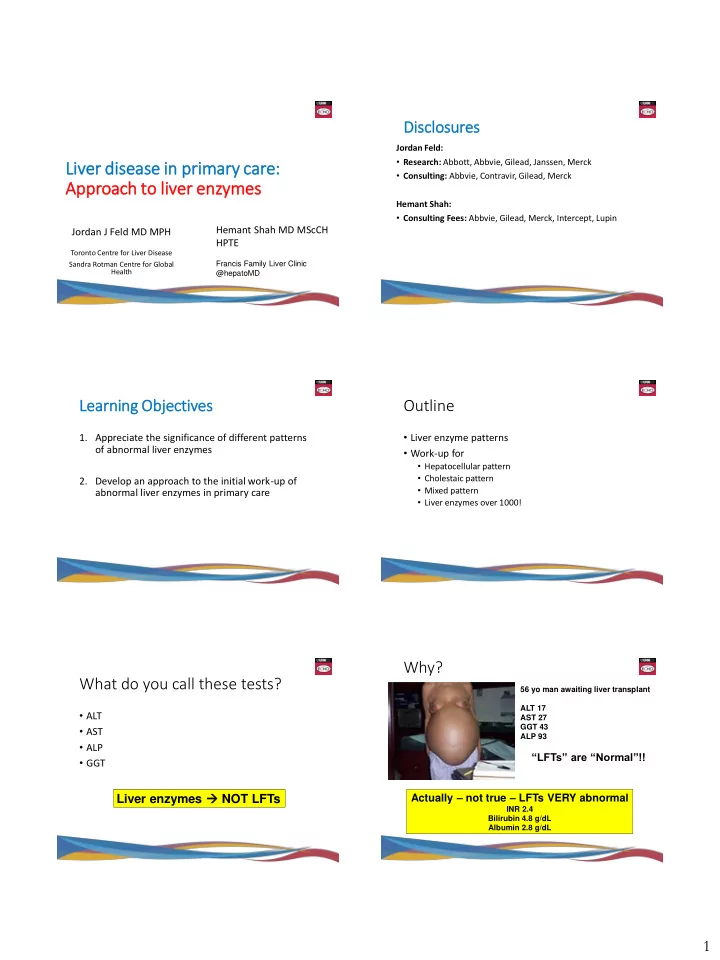
Dis isclosures Jordan Feld: Research: Abbott, Abbvie, Gilead, Janssen, Merck Liv Liver dise diseas ase in in pr prim imary car are: Consulting: Abbvie, Contravir, Gilead, Merck App Approach to o live liver en enzymes Hemant


slide-1
SLIDE 1

1

Liv Liver dise diseas ase in in pr prim imary car are: App Approach to

  • live

liver en enzymes

Jordan J Feld MD MPH

Toronto Centre for Liver Disease Sandra Rotman Centre for Global Health

Hemant Shah MD MScCH HPTE

Francis Family Liver Clinic @hepatoMD

Dis isclosures

Jordan Feld:

  • Research: Abbott, Abbvie, Gilead, Janssen, Merck
  • Consulting: Abbvie, Contravir, Gilead, Merck

Hemant Shah:

  • Consulting Fees: Abbvie, Gilead, Merck, Intercept, Lupin

Le Learn arning Obje bjectives

  • 1. Appreciate the significance of different patterns
  • f abnormal liver enzymes
  • 2. Develop an approach to the initial work-up of

abnormal liver enzymes in primary care

Outline

  • Liver enzyme patterns
  • Work-up for
  • Hepatocellular pattern
  • Cholestaic pattern
  • Mixed pattern
  • Liver enzymes over 1000!

What do you call these tests?

  • ALT
  • AST
  • ALP
  • GGT

Liver enzymes  NOT LFTs

Why?

56 yo man awaiting liver transplant ALT 17 AST 27 GGT 43 ALP 93

“LFTs” are “Normal”!! Actually – not true – LFTs VERY abnormal

INR 2.4 Bilirubin 4.8 g/dL Albumin 2.8 g/dL

slide-2
SLIDE 2

2

Liver tests/enzymes ≠ LFTs

  • Liver Functions
  • Synthesis:
  • Protein – Albumin, Clotting factors (INR)
  • Glucose – gluconeogenesis (only impaired very late)
  • Metabolism:
  • Bilirubin conjugation
  • Ammonia breakdown (encephalopathy)
  • Drug/toxin breakdown
  • (Portal Hypertension)
  • Ascites
  • Varices
  • Encephalopathy

Liver function tests: INR, albumin, bilirubin (direct)

What do the liver enzymes mean?

  • Ongoing injury
  • Hepatocellular injury
  • ALT (SGPT) – L for Liver specific (small amount muscle)
  • AST (SGOT) – lots of other sources (RBC, muscle, heart)
  • Normal for both lower than the labs!
  • Men – ALT 30
  • Women – ALT 19
  • Cholestatic/infiltrative injury or obstruction
  • ALP (alkaline phosphatase)
  • GGT

Categorization

  • Most useful relative to upper limit of normal
  • Hepatocellular pattern (ALT/ULN >> ALP/ULN)
  • Cholestatic/infiltrative pattern (opposite)
  • Mixed (ALT/ULN ≈ ALP/ULN)
  • Helps with narrowing a broad differential
  • Height & duration of elevation also important
  • Check trend ie historical labs

Hepatocellular Pattern (ALT/AST)

  • Organization is key
  • Infectious
  • Toxic
  • Metabolic
  • Genetic
  • Autoimmune
  • Other

This should be the focus Probably leave this stuff for us to do

Infectious

Screen EVERYONE!

  • HBV (HBsAg, anti-HBc, anti-HBs)
  • HCV (anti-HCV Ab)

Screen Selectively

  • HAV – very high ALT (>1000, exposure hx) – IgM
  • CMV/EBV – immunosuppressed, ALP elevated

Common enough to screen even if ALT normal

Toxin

  • Medications, medications, medications
  • Almost any drug can do it
  • Take a good history  may have stopped the drug

(ask about drugs in past 3 months)

  • Antibiotics (Amox/Clav!!, minocycline, nitrofurantoin)
  • Don’t forget herbals, OTC and recreational drugs –

need to ask

slide-3
SLIDE 3

3

Alcohol – how much is too much?

  • History is everything
  • AST>ALT (2:1) (+GGT)
  • CAGE questionnaire
  • Trust your patients (mostly)
  • If ALT>500  not alcohol

alone Men: 1-2 per day Women: 1 per day Avoid binge drinking Avoid daily drinking

Metabolic – fatty liver

  • ALT> AST (+ GGT)
  • Metabolic risk factors
  • DM, HTN, lipids
  • Weight gain or loss
  • Still screen for HCV,

HBV & ETOH – not mutually exclusive!

  • More to come…

Genetic

  • Hemochromatosis
  • Not rare in Caucasians (think Vikings – northern Europe)
  • Fe Sat > 50%, Ferritin
  • But both can be up in ETOH or Fatty liver disease
  • Again…not mutually exclusive!
  • More likely if also DM, arthritis, bronzing of the skin…etc
  • Wilson Disease
  • Screen all if < 30 and maybe all up to age 50
  • Ceruloplasmin
  • Bad to miss this – deadly disease that is treatable

Autoimmune??

  • Diagnosis is not straightforward
  • Variable presentation from asymptomatic liver test

abnormalities to fulminant liver failure

  • Useful diagnosis because it has a bad prognosis and

it’s treatable!

  • Start with IgG  if high, follow with ANA, SMA (and

LKM if children) and biopsy (or just refer!)

A few ‘general’ rules

  • ALT>AST – most liver diseases
  • Viral hepatitis
  • NAFLD/NASH
  • Most drug induced liver injury
  • AST>ALT
  • Alcohol – >2:1 ratio
  • Ischemia (low flow or congestion)
  • Wilson disease (hemolysis – 4:1)
  • Cirrhosis!! (AST>ALT but <2:1)

So bottom line – ALT/AST

  • Etiology Search
  • History – meds, alcohol & other drugs
  • HBV, HCV for everyone, (HAV, other viruses in context)
  • Fe Sat/ferritin for everyone
  • (ceruloplasmin)
  • (IgG – if persistent)
  • Severity assessment
  • CBC – low platelets suggest cirrhosis or acute alcohol
  • Bilirubin, INR, Albumin (if persistent)
  • Ultrasound (if persistent)
slide-4
SLIDE 4

4

What about high ALP?

  • First prove it’s from the liver  GGT (usually up), ALP

isoenzymes

  • GGT is pretty useless on its own – VERY non-specific

(almost any liver disease) and inducible (by meds)

  • Cholestatic
  • Extra-hepatic obstruction (stone/tumor)
  • Intrahepatic duct disease
  • Cholestasis (poor bile flow) – e.g. alcohol!!
  • Infiltrative
  • Granulomatous
  • Mass / tumor

Cholestatic

  • Rule out obstruction  US usually adequate
  • If painless jaundice  need to see pancreas (CT or MRCP)
  • If no obstruction (this is where we come in…):
  • Large Ducts: Primary/Secondary Sclerosing Cholangitis

(stones, IgG4)  MRCP

  • Small Ducts: Primary Biliary Cholangitis, vanishing bile duct

syndrome, portal biliopathy (PV thrombosis)  biopsy

  • Drugs (or alcohol)  history +/- biopsy

Granulomatous/Infiltrative

  • Granulomatous (biopsy)
  • Sarcoid
  • TB/Fungal
  • Schistosomiasis – even years after leaving endemic area
  • Infiltrative (imaging +/- biopsy)
  • Lymphoma
  • Mass lesion (HCC, mets, abscess, hydatid cyst)

High ALP – Work-up

History

  • Symptoms – may be absent
  • Itch
  • Jaundice (dark urine –

useful for timing)

  • Pain, Fever (stones)
  • Constitutional symptoms
  • DRUGS + Herbals
  • Risk factors for TB, HCC
  • History of IBD (PSC), past

stones, surgery (chole), bone disease

Labs/Radiology

  • GGT – confirm liver (ie not

bone, placenta etc)

  • Imaging – US
  • If high suspicion, CT/MR even

if US negative

  • Etiology:
  • Anti-mitochondrial Ab (PBC)
  • Immunoglobulins (IgG, IgM)
  • Biopsy

Mixed Picture

  • Similar approach to hepatocellular (AST/ALT)
  • A few common ones:
  • Meds – antibiotics!
  • Alcohol – acute alcoholic hepatitis
  • Stones – AST/ALT up first followed by ALP (+/- Bili)
  • Sepsis
  • Viruses – CMV/EBV (not HBV, HCV)
  • Rarer conditions (overlap syndromes etc)

A good list to remember – ALT>1000

  • 1. Virus
  • 2. Toxin
  • 3. Vascular
  • 4. Stone
  • 5. Autoimmune hepatitis

Not alcohol (unless alcohol plus)

slide-5
SLIDE 5

5

Viral Infection (ALT>1000)

  • Hepatitis A to E
  • A – HAV IgM – only order if ALT very high &/or exposure
  • B – flare or acute infection
  • C – rare unless acute (if high suspicion, HCV RNA)
  • D – super-infection with HBV or flare
  • E – think Hep A (travel history)
  • CMV/EBV
  • Rare to be >1000, usually cholestatic too (ALP up)
  • HSV
  • Important – if you think of it, start the acyclovir!
  • Rare – VZV, SARS, influenza, adenovirus

Toxin (ALT>1000)

  • Medications, medications, medications
  • Take a good history  may have stopped the drug

(ask about drugs in past 3 months)

  • Acetaminophen classic
  • Many others
  • Don’t forget herbals, OTC and recreational drugs –

need to ask

Vascular (ALT>1000)

  • Forward flow – Shock Liver
  • Usually underlying cardiac disease
  • Rapid increase and rapid normalization
  • Mild affect on liver function (INR may go up transiently)
  • Congestion
  • Acute Budd-Chiari
  • Even severe heart failure (not very common)

Stone (ALT>1000)

  • ALT and AST go up BEFORE ALP and Bilirubin
  • Typically associated with pain +/- fever (others may

be asymptomatic)

  • Prompt normalization with passing of the stone

Autoimmune Hepatitis (ALT>1000)

  • Not all that common but you have to think of it
  • Diagnostic tests:
  • Quantitative immunoglobulins  IgG
  • ANA
  • Smooth Muscle Antibody
  • Liver Kidney Microsomal (Type II – children)
  • Liver biopsy

Liver Disease Catches You By Surprise…

slide-6
SLIDE 6

6

Liver May Look Normal Even with Cirrhosis

Stages F1-3 and even early F4 may “look normal” on imaging A “normal” liver ultrasound does not exclude fibrosis and may miss cirrhosis

The Spectrum of Cirrhosis: From Subtle to Overt

Compensated Cirrhosis

Diagnosis subtle Few or no symptoms

  • Possibly fatigue

Subtle or no physical exam abnormalities Subtle or no laboratory abnormalities

  • Low platelet count, AST > ALT

Decompensated Cirrhosis

Diagnosis usually obvious Complication(s) of cirrhosis

  • Ascites/edema
  • Variceal hemorrhage
  • Encephalopathy
  • Jaundice

Abnormal liver function

  • Bilirubin
  • Albumin
  • INR

Tools to Assess Fibrosis

  • Exam & radiology – very insensitive!!
  • Laboratory tests
  • Liver enzymes (AST/ALT) may be normal even with

cirrhosis – not helpful

  • Liver function (bilirubin, albumin, INR) normal until

advanced cirrhosis

Tests suggesting advanced fibrosis/cirrhosis

  • Platelet count < 150 x 10E9/µl
  • AST:ALT ratio > 1 (typically < 1 in HCV & most liver dx)
  • Elevated IgG (polyclonal)
  • (Abnormal bilirubin, INR, albumin  late finding)

Simple Test: APRI

  • Cirrhosis
  • Platelets fall
  • AST > ALT
  • Very useful to exclude

cirrhosis

  • Low is good
  • <0.5 is good – 98% NPV for

cirrhosis!

  • High is bad
  • >2.0 – worry about cirrhosis
  • Caveat – AST high if active

inflammation

AST/ULN x 100 Platelet count

Castera et al., 2005

Liver Stiffness by Transient Elastography (Fibroscan)

Ultrasound-based technique Determines liver “stiffness” Correlates with liver fibrosis No ceiling, ie, increases with worsening cirrhosis → predicts complications (eg, varices) Simple to use – minimal training

Caveats: May fail with obesity Influenced by inflammation – it falsely elevates measurements

Child-Pugh-Turcotte Assessing Severity of Cirrhosis

Lab 1 2 3

INR (N<1.2) <1.7 1.7-2.2 >2.2 Albumin (N>40) >35 28-35 <28 Bilirubin (N<17) <34 34-54 >54

Clinical

Ascites none mild severe Encephalopathy none mild severe Child’s CPT score Surgical Mortality Survival A 5-6 ~10% 10-15 yrs B 7-9 ~30% 5 yrs C 10-15 ~80% 2 yrs

slide-7
SLIDE 7

7

MELD – Very objective

  • INR, Bilirubin, Creatinine

Baseline MELD 10 Yr Mortality <8 17% 8-10 18% 10-13 32% >13 66%

MELD = (3.8 ln Bili (mg/dL)) + 11.2 (ln INR) + 9.6 (ln Creat (mg/dL) (or use an online calculator!)

Bruno Am J Gastro 2009

MELD - Model End Stage Liver Disease

Summary

  • Enzymes are not liver function tests!
  • Categorize by pattern
  • Hepatocellular (ALT/AST)
  • Cholestatic (ALP)
  • Mixed (ALT & ALP)
  • Directed work-up: history & physical, labs, imaging
  • Fibrosis assessment critical for prognosis
  • Remember low platelets  think cirrhosis!
  • New tools – biopsy rarely required
  • CP & MELD score very useful for prognosis