CSE 142 Chapter 4 Programming I l Read Sections 4.14.5, 4.74.9 l - - PDF document

cse 142
SMART_READER_LITE
LIVE PREVIEW

CSE 142 Chapter 4 Programming I l Read Sections 4.14.5, 4.74.9 l - - PDF document

CSE 142 Chapter 4 Programming I l Read Sections 4.14.5, 4.74.9 l The book assumes that youve read chapter 3 on functions Read it anyway, you should do fine Conditionals Their order is a little screwy... 28. June, 2000 F-2 CSE


slide-1
SLIDE 1

1

  • 28. June, 2000

CSE 142 Summer 2000 — Isaac Kunen F-1

CSE 142 Programming I

Conditionals

  • 28. June, 2000

CSE 142 Summer 2000 — Isaac Kunen F-2

Chapter 4

lRead Sections 4.1–4.5, 4.7–4.9 lThe book assumes that you’ve read chapter 3 on functions

➤Read it anyway, you should do fine ➤Their order is a little screwy...

  • 28. June, 2000

CSE 142 Summer 2000 — Isaac Kunen F-3

Preview of Things to Come

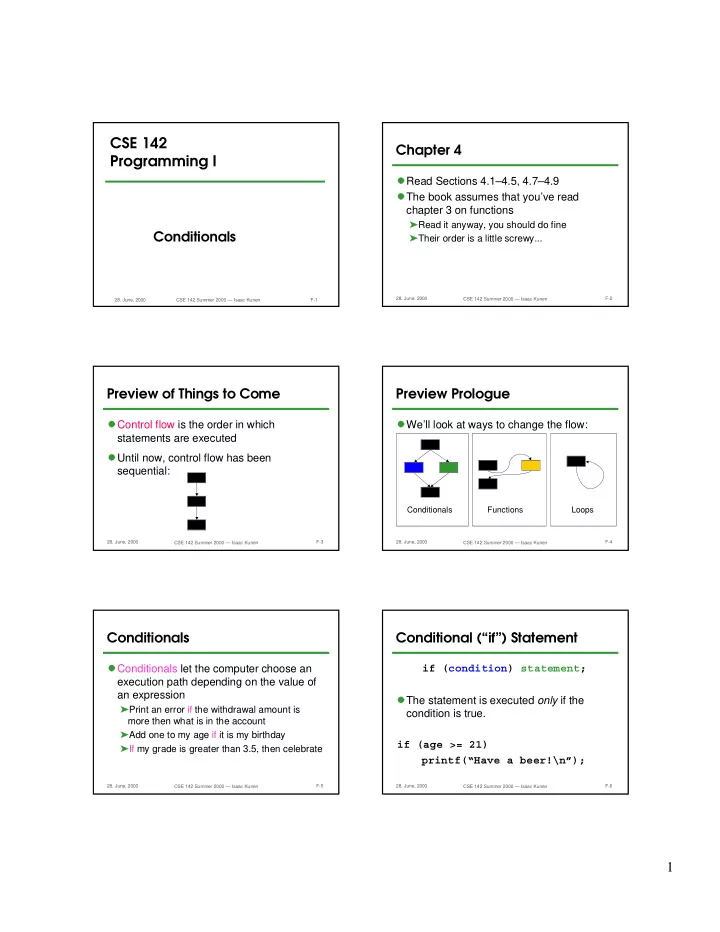
lControl flow is the order in which statements are executed lUntil now, control flow has been sequential:

  • 28. June, 2000

CSE 142 Summer 2000 — Isaac Kunen F-4

Preview Prologue

lWe’ll look at ways to change the flow:

Conditionals Functions Loops

  • 28. June, 2000

CSE 142 Summer 2000 — Isaac Kunen F-5

Conditionals

lConditionals let the computer choose an execution path depending on the value of an expression

➤Print an error if the withdrawal amount is more then what is in the account ➤Add one to my age if it is my birthday ➤If my grade is greater than 3.5, then celebrate

  • 28. June, 2000

CSE 142 Summer 2000 — Isaac Kunen F-6

Conditional (“if”) Statement

if (condition) statement; lThe statement is executed only if the condition is true. if (age >= 21) printf(“Have a beer!\n”);

slide-2
SLIDE 2

2

  • 28. June, 2000

CSE 142 Summer 2000 — Isaac Kunen F-7

Conditional Flow Chart

if (x < 100) x = x + 1; y = y + 1; y = y + 1; yes no X < 100 ? x = x + 1

  • 28. June, 2000

CSE 142 Summer 2000 — Isaac Kunen F-8

Conditional Expressions

lAlso called “logical”, or “Boolean” expressions lMake use of relational operators lA relational operator compares two values lExamples: (x < 30) (12 > y)

  • 28. June, 2000

CSE 142 Summer 2000 — Isaac Kunen F-9

Relational Operators

In Math In C In English < < Less Than > > Greater Than = == Equal To ≤ <= Less Than or Equal To ≥ >= Greater Than or Equal To ≠ != Not Equal

  • 28. June, 2000

CSE 142 Summer 2000 — Isaac Kunen F-10

Some Conditional Expressions

air_temperature > 80 98.6 == body_temperature marital status == ‘M’ weight >= 8000

  • 28. June, 2000

CSE 142 Summer 2000 — Isaac Kunen F-11

Multiple Actions

lWhat if we want to do more things at

  • nce?

➤Use a compound statement!

lReplace the statement with several statements surrounded by braces: { }

➤Sometimes called a block ➤Indent each block!

  • 28. June, 2000

CSE 142 Summer 2000 — Isaac Kunen F-12

Example: Checking for Error

printf(“Enter divisor: ”); scanf(“%lf”, &divisor); if (0 == divisor){ printf(“Can’t divide by 0!\n”); exit(0); }

No ;

slide-3
SLIDE 3

3

  • 28. June, 2000

CSE 142 Summer 2000 — Isaac Kunen F-13

Announcement!

lNow you know enough to do homework 1

Yay!

  • 28. June, 2000

CSE 142 Summer 2000 — Isaac Kunen F-14

Value of Boolean Expressions

lRemember, expressions are things in C that have values lWhat’s the value of a conditional expression?

  • 28. June, 2000

CSE 142 Summer 2000 — Isaac Kunen F-15

Values of Boolean Expressions

lConditional expressions are either true or false lC doesn’t have a Boolean Type lC fakes it using integers!

➤0 means false ➤non-zero (usually 1) means true

  • 28. June, 2000

CSE 142 Summer 2000 — Isaac Kunen F-16

Examples:

lDo these examples make sense? lIf so, what are the values assigned? foo = 7 < 0; bar = 8 != 3;

  • 28. June, 2000

CSE 142 Summer 2000 — Isaac Kunen F-17

More Strangeness!

lIn fact, this is an expression:

x = 6 + 7

lIf it is an expression, then it has a value lThe value of an assignment is the value assigned

  • 28. June, 2000

CSE 142 Summer 2000 — Isaac Kunen F-18

The Value of an Assignment

lWhat does this do? int foo, bar; foo = (bar = 6);

slide-4
SLIDE 4

4

  • 28. June, 2000

CSE 142 Summer 2000 — Isaac Kunen F-19

Why Am I Telling You This?!

lIt’s easy to confuse = and == lIf you confuse them, the program will compile and run, but it won’t do what you want it to lWatch out for this error!

  • 28. June, 2000

CSE 142 Summer 2000 — Isaac Kunen F-20

Strange Example I

lWhat does this do? if (x = 7) printf(“X is equal to 7\n”);

  • 28. June, 2000

CSE 142 Summer 2000 — Isaac Kunen F-21

Strange Example II

lWhat does this do? x == PI * radius * radius;

  • 28. June, 2000

CSE 142 Summer 2000 — Isaac Kunen F-22

Lesson:

lC is very picky

➤Getting one character wrong will often make your program work incorrectly!

lYou’ll have to get very good at finding these stupid little errors

➤Practice practice practice!

  • 28. June, 2000

CSE 142 Summer 2000 — Isaac Kunen F-23

One More Strange Point

lDo not use == or != with doubles

➤doubles may not have exact values, only approximations ➤== and != are only make sense if the values are exact ➤<, >, etc. are fine for use with doubles

  • 28. June, 2000

CSE 142 Summer 2000 — Isaac Kunen F-24

Complex Conditionals

lWe’d like more expressive power

➤If I have at least $15 or you have at least $15, then we can go to the movies. ➤If you’re in Guggenheim 224 and it’s 12:00 on Friday, then you’re in CSE 142. ➤If you’re in CSE 142 and your name is Isaac, then you’re the lecturer.

slide-5
SLIDE 5

5

  • 28. June, 2000

CSE 142 Summer 2000 — Isaac Kunen F-25

Boolean Operators

lBoolean operators act on Boolean values to produce new Boolean values C English && And || Or (sort-of…) ! Not

  • 28. June, 2000

CSE 142 Summer 2000 — Isaac Kunen F-26

Complex Conditionals in C

if ((myMoney > 15.0) || (yourMoney > 15.0)){…} if ((location == 224) && (time == 12 )){…} if (!(initial == ‘I’)){…}

  • 28. June, 2000

CSE 142 Summer 2000 — Isaac Kunen F-27

Truth Tables for &&, ||

lA truth table lists all possible combinations

  • f values and their result

P Q P && Q P || Q T T T T T F F T F T F T F F F F

  • 28. June, 2000

CSE 142 Summer 2000 — Isaac Kunen F-28

Or isn’t Always Like in English!

lIn English if “this fruit is an apple or it is an

  • range”, then it cannot be both apple and
  • range

lIn C,

(fruit == ‘A’) || (fruit == ‘O’)

is true if either half is true!

  • 28. June, 2000

CSE 142 Summer 2000 — Isaac Kunen F-29

Truth Table for !

l&& and || are binary operators l! is a unary operator that inverts the value P !P T F F T

  • 28. June, 2000

CSE 142 Summer 2000 — Isaac Kunen F-30

An Example Expression

lfoo is an integer that is not 5, 6, or between 10 and 20 !((foo == 5) || (foo == 6) || ((foo > 10) && (foo < 20)))

slide-6
SLIDE 6

6

  • 28. June, 2000

CSE 142 Summer 2000 — Isaac Kunen F-31

DeMorgans’ Laws

lConvert between and expressions and or expressions lExample:

!((age < 25) && (sex == ‘M’)) is equivalent to ((age >= 25) || (sex != ‘M’))

  • 28. June, 2000

CSE 142 Summer 2000 — Isaac Kunen F-32

DeMorgan’s Laws

lDeMorgan’s Laws tell us some legal conversions: !(P && Q) (!P || !Q) !(P || Q) (!P && !Q)

  • 28. June, 2000

CSE 142 Summer 2000 — Isaac Kunen F-33

Proof of DeMorgan’s Laws

lProof using a truth table:

P Q (P && Q) !(P && Q) !P !Q (!P || !Q) T T T F F T F F

  • 28. June, 2000

CSE 142 Summer 2000 — Isaac Kunen F-34

Else: The Other Half of If

lelse lets you do something if the condition was false

if (balance >= withdrawal){ balance = balance - withdrawal; } else { printf (“Insufficient Funds!\n”); }

  • 28. June, 2000

CSE 142 Summer 2000 — Isaac Kunen F-35

if-else Control Flow

adjust balance dispense funds Insufficient Funds! yes no arrive here whether condition is TRUE or FALSE balance >= withdraw ?

  • 28. June, 2000

CSE 142 Summer 2000 — Isaac Kunen F-36

Nested ifs

#define BILL_SIZE 20 if (balance < withdrawal) { printf(“Insufficient funds!\n”); } else { if (withdrawal < BILL_SIZE) printf (“Try a larger amount. \n”); else balance = balance - withdrawal; }

slide-7
SLIDE 7

7

  • 28. June, 2000

CSE 142 Summer 2000 — Isaac Kunen F-37

Tax Example

lPrint the tax based on income:

< 15,000 >= 15,000, < 30,000 >= 30,000, < 50,000 >= 50,000, < 100,000 >= 100,000 0% 18% 22% 28% 31% income tax

  • 28. June, 2000

CSE 142 Summer 2000 — Isaac Kunen F-38

Simple Solution

if ( income < 15000 ) { printf( “No tax.” ); } if ( income >= 15000 && income < 30000 ) { printf(“18%% tax.”); } if ( income >= 30000 && income < 50000 ) { printf(“22%% tax.”); } if ( income >= 50000 && income < 100000 ) { printf(“28%% tax.”); } if ( income >=100000) { printf(“31%% tax.”); }

  • 28. June, 2000

CSE 142 Summer 2000 — Isaac Kunen F-39

Cascaded ifs

if ( income < 15000 ) { if ( income < 15000 ) { printf( “No tax” ); printf( “No tax” ); } else { } else if ( income < 30000 ) { if ( income < 30000 ) { printf( “18%% tax.” ); printf( “18%% tax.” ); } else if ( income < 50000 ) { } else { printf( “ 22%% tax.” ); if ( income < 50000 ) { } else if ( income < 100000 ) { printf( “ 22%% tax.” ); printf( “28%% tax.” ); } else { } else if ( income < 100000 ) { printf( “31%% tax.” ); printf( “28%% tax.” ); } } else { printf( “31%% tax.” ); } } } }

  • 28. June, 2000

CSE 142 Summer 2000 — Isaac Kunen F-40

Another Type of Conditional!

lThe Switch Statement:

  • 28. June, 2000

CSE 142 Summer 2000 — Isaac Kunen F-41

Longwinded if

/* How many days in a month? */ if ( month == 1 ) { /* Jan */ days = 31 ; } else if ( month == 2 ) { /* Feb */ days = 28 ; } else if ( month == 3 ) { /* Mar */ days = 31 ; } else if ( month == 4 ) /* Apr */ days = 30 ;

...

/* need 12 of these */

  • 28. June, 2000

CSE 142 Summer 2000 — Isaac Kunen F-42

Better Code:

if ( month==9 || month==4 || /* Sep, Apr */ month==6 || month==11 ){/* Jun, Nov */ days = 30; } else if ( month == 2 ) { /* Feb */ days = 28 ; } else { days = 31; /* All the rest */ }

slide-8
SLIDE 8

8

  • 28. June, 2000

CSE 142 Summer 2000 — Isaac Kunen F-43

Even Better Code:

switch ( month ) { case 2: /* February */ days = 28 ; break ; case 9: /* September */ case 4: /* April */ case 6: /* June */ case 11: /* November */ days = 30 ; break ; default: /* All the rest have 31 */ days = 31 ; }

  • 28. June, 2000

CSE 142 Summer 2000 — Isaac Kunen F-44

switch

switch (control expression){ case-list-1 statements 1 break; case-list-2 statements 2 break; … default: statements }

  • 28. June, 2000

CSE 142 Summer 2000 — Isaac Kunen F-45

switch Pitfalls

lThe type of the control expression must be int or char lThe cases must be constant lThe switch statement falls through

  • 28. June, 2000

CSE 142 Summer 2000 — Isaac Kunen F-46

Falling Through

switch (month) { case 2: days = 28 ; /* break missing */ case 9: case 4: case 6: case 11: days = 30; /* break missing */ default: days = 31 ; }

  • 28. June, 2000

CSE 142 Summer 2000 — Isaac Kunen F-47

Conditionals Summary

lif lets the execution branch

➤complex conditions are put together with &&, ||, and !

lelse does something if the condition was false lswitch can be used in some situations to do a multiple branch

➤control-expression must be int or char ➤cases must be constants