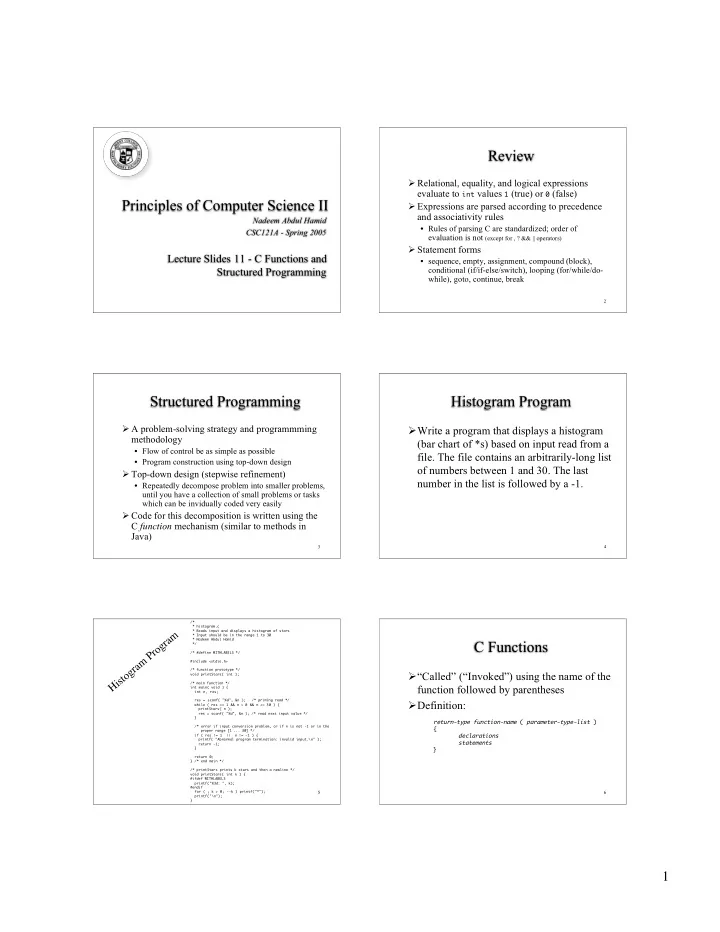
Review Relational, equality, and logical expressions evaluate to int - - PDF document

review
SMART_READER_LITE
LIVE PREVIEW

Review Relational, equality, and logical expressions evaluate to int - - PDF document

Review Relational, equality, and logical expressions evaluate to int values 1 (true) or 0 (false) Principles of Computer Science II Expressions are parsed according to precedence and associativity rules Nadeem Abdul Hamid Rules of


slide-1
SLIDE 1

1

Principles of Computer Science II

Nadeem Abdul Hamid CSC121A - Spring 2005

Lecture Slides 11 - C Functions and Structured Programming

2

Review

  • Relational, equality, and logical expressions

evaluate to int values 1 (true) or 0 (false)

  • Expressions are parsed according to precedence

and associativity rules

  • Rules of parsing C are standardized; order of

evaluation is not (except for , ? && || operators)

  • Statement forms
  • sequence, empty, assignment, compound (block),

conditional (if/if-else/switch), looping (for/while/do- while), goto, continue, break

3

Structured Programming

  • A p

roblem-solving strategy and programmming methodology

  • Flow of control be as simple as possible
  • Program construction using top-down design
  • Top-down design (stepwise refinement)
  • Repeatedly decompose problem into smaller problems,

until you have a collection of small problems or tasks which can be invidually coded very easily

  • Code for this decomposition is written using the

C function mechanism (similar to methods in Java)

4

Histogram Program

  • Write a program that displays a histogram

(bar chart of *s) based on input read from a

  • file. The file contains an arbitrarily-long list
  • f numbers between 1 and 30. The last

number in the list is followed by a -1.

5

/* * histogram.c * Reads input and displays a histogram of stars * Input should be in the range 1 to 30 * Nadeem Abdul Hamid */ /* #define WITHLABELS */ #include <stdio.h> /* function prototype */ void printStars( int ); /* main function */ int main( void ) { int n, res; res = scanf( "%d", &n ); /* priming read */ while ( res == 1 && n > 0 && n <= 30 ) { printStars( n ); res = scanf( "%d", &n ); /* read next input value */ } /* error if input conversion problem, or if n is not -1 or in the proper range [1 ... 30] */ if ( res != 1 || n != -1 ) { printf( "Abnormal program termination: invalid input.\n" ); return -1; } return 0; } /* end main */ /* printStars prints k stars and then a newline */ void printStars( int k ) { #ifdef WITHLABELS printf("%3d: ", k); #endif for ( ; k > 0; --k ) printf("*"); printf("\n"); }

Histogram Program

6

C Functions

  • “Called” (“Invoked”) using the name of the

function followed by parentheses

  • Definition:

return-type function-name ( parameter-type-list ) { declarations statements }

slide-2
SLIDE 2

2

7

Function Prototypes

return-type function-name ( parameter-type-list ) ;

  • Used to declare functions before they are used
  • Identifiers in the type list are for documentation only -

ignored by compiler

  • Variable number of arguments specified using …

(printf function)

  • One of most important improvements of ANSI C
  • ver traditional C
  • Allow compiler to validate function calls
  • Values passed to functions are coerced, as necessary

8 /* try compiling with gcc -Wall … (turns on all warnings) */ #include <stdio.h> int funcB( int ); int funcC( float x ); int main(void) { printf("%f\n", funcA( 3.7 )); printf("%d\n", funcA( 3.7 )); printf("%f\n", funcB( 3.7 )); /* try (float) cast */ printf("%d\n", funcB( 3.7 )); return 0; } int funcA( int n ) { return n * n; } int funcB( int n ) { return n * n; } int funcC( int x ) { return x * x; }

Conflicting prototype and definition results in compilation error Parameter type list allows compiler to coerce (convert) arguments to proper data type By default, C assumes int return type

9

Compiler’s View of Functions

  • Function declarations generated in different ways

by the compiler

  • Function call
  • Compiler assumes default declaration, returning int and no

assumptions about parameters

  • Function definition
  • ANSI C style gives return type and parameter types
  • Function prototype
  • Special case of function declaration
  • Header files mostly contain these prototypes

10

Declarations, Prototypes, Definitions

  • Function declaration specifies interface

between function and rest of world (return type, argument types)

  • Function prototype is an ANSI-style

function declaration

  • Function definition gives same info as

declaration with names for arguments and block of code

11

Other Features of C Functions

  • If no return type is specified for a function,

compiler assumes int

  • but it is better style to always indicate the

return type

  • Similarly, if a parameter’s type is not

specified, the compiler assumes int

12

C Standard Library

  • Be familiar with the functions in the library

(Appendix A)

  • Whenever possible, reuse functions from

the C library

  • Reduces development time
  • Increases program portability
slide-3
SLIDE 3

3

13

Standard Library Headers

  • <assert.h>
  • Macros and information for

diagnostics and debugging

  • <ctype.h>
  • Character test functions,

conversions (upper-to-lowercase)

  • <errno.h>
  • Macros for reporting error

conditions

  • <float.h>
  • Floating point size limits
  • <limits.h>
  • Integral size limits
  • <locale.h>
  • Prototypes and info for modifying

locale of program - date, time format, etc.

  • <math.h>
  • Math library functions
  • <time.h>
  • Functions and types for

manipulating time and date

  • <setjmp.h>
  • Functions allowing bypassing of

usual fn. call and return sequence

  • <signal.h>
  • Functions and macros handling

various program conditions that may arise

  • <stdarg.h>
  • Dealing with variable argument

functions

  • <stddef.h>
  • Common C type definitions
  • <stdio.h>
  • Standard I/O functions and related

information

  • <stdlib.h>
  • Number-text conversion, memory

allocation, random numbers, other utilities

  • <string.h>
  • String processing functions

14

Call-by-Value / Call-by- Reference

  • Two forms of argument passing common in

programming languages

  • By value: a copy of the argument’s value is made

and passed to the called function

  • Changes to copy do not affect original value in calling

function

  • By reference: Caller allows called function to

modify the variable’s value

  • C simulates call-by-reference by passing addresses and

pointers as arguments (arrays are always passed by reference)

15

Java Method Invocation

class Pair { int a; int b; Pair(int aa, int bb) { a = aa; b = bb; } } public class Calls { public static void main(String args[]) { int i = 5; int j = 9; Pair q = new Pair( i, j ); System.out.println( q.a + " ... " + q.b ); System.out.println( i + " ... " + j ); swapA( q ); swapB( i, j ); System.out.println( q.a + " ... " + q.b ); System.out.println( i + " ... " + j ); } static void swapA( Pair p ) { int t = p.a; p.a = p.b; p.b = t; } static void swapB( int a, int b ) { int t = a; b = a; a = t; } }

  • Call-by-value:

primitive type arguments

  • Call-by-reference:
  • bject type

arguments

16

Programming Style

  • Programs should be written as collections of small, well-

designed functions

  • In most (large) programs, main consists of calls to other functions

that perform bulk of the program’s work

  • Each function should be limited to performing a single,

well-defined task

  • Function name should express the task clearly
  • If you cannot choose a concise name for the function, it is

probably trying to do too much - break it up into smaller functions

  • Functions should be no longer than one page
  • Better yet, they should be no longer than half a page (15-20 lines
  • f code)
  • Functions requiring large number of parameters may be

performing too many tasks

  • A value-returning function should have only one (or very

few) return statement

17

Random-Number Generation

  • <stdlib.h>
  • rand()
  • Produces a number between 0 and RAND_MAX
  • srand( int )
  • Seeds (initializes) the random number generator
  • <time.h>
  • time( NULL );
  • Returns the current number of seconds since Jan 1, 1970

#include <stdlib.h> #include <time.h> … srand( time( NULL ) ); … int r = ( rand() % 100 ) + 1; /* 1…100 */

18

The smallest C program to print the biggest prime number

Here it is (479 bytes):

int m=754974721,N,t[1<<24],a,*p,i,e=30295789,j,s,b,c,U;f(d){for(s=1<<23;s;s/=2,d= d*1LL*d%m)if(s<N)for(p=t;p<t+N;p+=s)for(i=s,c=1;i;i--)b=*p+p[s],p[s]=(m+*p-p[s]) *1LL*c%m,*p++=b%m,c=c*1LL*d%m;for(j=0;i<N-1;){for(s=N/2;!((j^=s)&s);s/=2);if(++i <j)a=t[i],t[i]=t[j],t[j]=a;}}main(){*t=2;U=N=1;while(e/=2){N*=2;U=U*1LL*(m+1)/2% m;f(362);for(p=t;p<t+N;)*p++=*p*1LL**p%m*U%m;f(415027540);for(a=0,p=t;p<t+N;)a+= *p<<(e&1),*p++=a%10,a/=10;}while(!*--p);t[0]--;while(p>=t)printf("%d",*p--);}

This program computes 224036583-1, which is the biggest known prime number (more than 7 million digits!). For more

information about how it was found and who found it, look at the GIMPS Project . I compiled it successfully with gcc with i86 Linux. It takes about 2 minutes on a 2.4 GHz Pentium 4. In order to compile it, your C compiler must support the 64 bit long long type. This program basically converts from base 2 to base 10. It is a non trivial task because it deals with numbers of millions of digits. The usual method (with repeated divisions by 10^N) would be far too slow. So I decided to use an Integer Fast Fourier Transform. I believe it is one of the smallest implementation of such an algorithm. A previous version of this program to compute 26972593-1 won the International Obfuscated C Code Contest of Year 2000. This program is Freeware. Fabrice Bellard - http://bellard.org/ last update: Jun 15, 2004