Properties of Matter and Solutions Slide 3 / 142 Slide 4 / 142 - - PDF document

properties of matter and solutions
SMART_READER_LITE
LIVE PREVIEW

Properties of Matter and Solutions Slide 3 / 142 Slide 4 / 142 - - PDF document

Slide 1 / 142 Slide 2 / 142 Properties of Matter and Solutions Slide 3 / 142 Slide 4 / 142 Matter Properties of Matter and Solutions We define matter as anything that has mass and takes up space. Pyrite, otherwise known as "fools


slide-1
SLIDE 1

Slide 1 / 142 Slide 2 / 142

Properties of Matter and Solutions

Slide 3 / 142 Properties of Matter and Solutions

Pyrite, otherwise known as "fools gold" has fooled many a tourist

  • ver the years. Physical and

chemical properties such as density or reactivity help us identify what substances are made of.

Slide 4 / 142

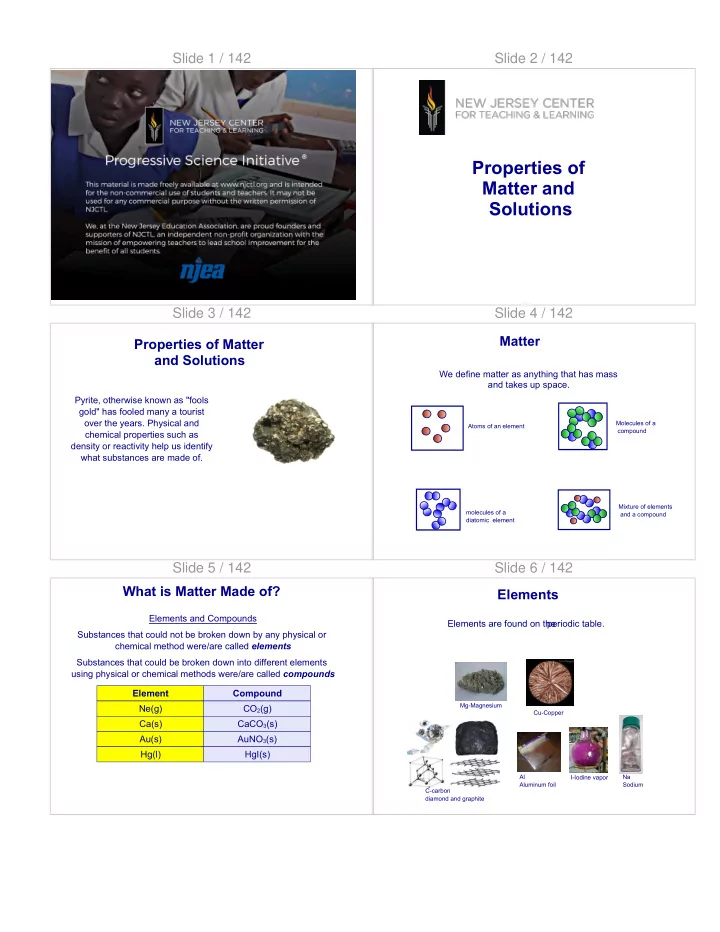
Matter

We define matter as anything that has mass and takes up space.

Atoms of an element molecules of a diatomic element Molecules of a compound Mixture of elements and a compound

Slide 5 / 142 What is Matter Made of?

Elements and Compounds Substances that could not be broken down by any physical or chemical method were/are called elements Substances that could be broken down into different elements using physical or chemical methods were/are called compounds Element Compound Ne(g) CO2(g) Ca(s) CaCO3(s) Au(s) AuNO3(s) Hg(l) HgI(s)

Slide 6 / 142 Elements

Elements are found on the periodic table.

Na Sodium Cu-Copper I-Iodine vapor Al Aluminum foil Mg-Magnesium C-carbon diamond and graphite

slide-2
SLIDE 2

Slide 7 / 142 Compounds

Compounds are formed by combinations of different types of elements.

CAFFEINE

Slide 8 / 142

1 Which of the following would NOT be a

compound?

A HCl B CS2 C H2O D CH4 E I2

Slide 9 / 142

2 Which of the following is FALSE regarding

compounds?

A They consist of more than one element combined B A compound has a set of properties distinct from the individual elements from which it is made C When a compound is separated into its elements, the elements will have the same properties of the compound D Br2 would not be considered a compound E NaCl would be considered a compound

Slide 10 / 142

When electricity is passed through water (a compound), hydrogen and oxygen gas are produced. 100 grams 11.2 grams 88.8 grams When the amounts of gases produced are analyzed, no matter where the water came from or how large the sample, water always consists of exactly 11.2% hydrogen and 88.8% oxygen by mass.

electricity

liquid water ------------> hydrogen gas + oxygen gas

Law of Definite Composition Slide 11 / 142

In fact, each compound had it's own definite composition by mass. Substance % carbon by mass % oxygen by mass carbon dioxide 27.3% 72.7% carbon monoxide 42.8% 57.1% This principle, that a certain substance will have it's

  • wn unique set composition of elements, is known

as the Law of Definite Composition.

Law of Definite Composition Slide 12 / 142

Some matter can be separated by heat, filtering, or boiling into other substances but did NOT obey the law of definite

  • composition. These substances are known as mixtures and are

NOT pure substances. More on mixtures later! Pure Substance Definitive Composition Examples: gold (Au) pure water (H2O) Mixture Non-definitive composition Examples: steel (Fe, C, Mn, Cr, ...) salt water (H2O, Cl-, Na+, ...)

Pure Substances vs. Mixtures

slide-3
SLIDE 3

Slide 13 / 142

3 A sample of material A is collected in Nevada and found to consist of 94% oxygen and 6% hydrogen by

  • mass. Another sample of material A is collected in

Maine and found to contain 94% oxygen and 6%

  • hydrogen. What kind of substance is this?

A Element B Compound C Mixture D B and C E A, B, and C

Slide 14 / 142

4 A sample of a material is found to contain 56%

  • xygen, 32% iron, and 12% sulfur. When another

sample of the same material is collected, the composition was 44% oxygen, 30% iron, and 25%

  • sulfur. What kind of substance is this?

A element B compound C mixture D pure substance E B and D

Slide 15 / 142

Properties of Matter

It was clear, even to the ancients, that not all matter shares the same characteristics/properties. Substance Property gold lustrous, soft metal, non-reactive, solid at room temperature salt water transparent, liquid at room temperature, could be separated by heat, no definite composition pure water transparent, liquid at room temperature, definite composition, could be separated by electrolysis calcium carbonate solid at room temperature, high melting point, non-lustrous, could be separated by heat

Slide 16 / 142

Physical Properties of Matter

A physical property is a characteristic that can be observed WITHOUT altering the identity of the material. Physical Properties of water water melts at 0 Celsius at standard pressure water is transparent water has a density of roughly 1 g/mL at 25 C water is not soluble (does not dissolve) in gasoline water is colorless Notice all of these properties can be observed without changing the identity of the water - it is still water!

Slide 17 / 142

Who doesn't like brick oven pizza! A brick used in an oven is made

  • f a mixture of aluminum oxide and silicon oxide. Think of as many

physical properties of a brick that you can. Feel free to use terms like high and low if you don't know an exact number. high density high melting point reddish color brittle (break not bend) move for answer

Physical Properties of Matter Slide 18 / 142

5 Which of the following IS NOT a physical property?

A copper has a reddish gold color B iron reacts with oxygen to form rust C table salt dissolves easily in water D silver is an excellent conductor of electricity E all of theses are physical properties

slide-4
SLIDE 4

Slide 19 / 142

6 Which of the following IS a physical property?

A acetone has a density of 0.87 g/mL B aluminum will burn in air to make aluminum oxide C water can undergo electrolysis and produce hydrogen and oxygen gas D Both A and C E Both B and C

Slide 20 / 142 Physical and Chemical Changes

Chemical changes result in new substances. Includes combustion,

  • xidation,

decomposition, etc. Changes in matter that don't change the composition of a substance. Includes changes of state, temperature, volume, etc.

Physical Changes Chemical Changes

Slide 21 / 142

These properties can only be observed when we attempt to change the identity of the material. There are a few tell tale signs that a chemical change has taken place:

Chemical Properties

Color change Emission of Light Precipitate formation Production of gas

Slide 22 / 142

Color change - marshmallow burning Emission of Light - wood burning

Chemical Properties Slide 23 / 142

Precipitate formation - solid forming from liquid mixtures Production of gas - when limestone is heated

+

+

heat

Chemical Properties Slide 24 / 142

Compare the chemical properties of a pepperoni pizza with that of the brick oven. The pizza will react with the oxygen in the air and burn. The brick will not burn in the air.

move for answer Chemical Properties Class Discussion

slide-5
SLIDE 5

Slide 25 / 142

7 Which of the following is NOT a chemical

property?

A Silver tarnishing into silver oxide B gasoline burning in air C candle wax burning D candle wax melting E iron rusting

Slide 26 / 142

8 All of the following are physical properties

except….?

A Gold's low reactivity with oxygen B Gasoline's inability to dissolve in water C Water melting at 0 C D Hot knife cutting through ice cream cake E evaporating water away from salt water

Slide 27 / 142

9 In the following list, only __________ is not an example of a chemical change.

A dissolution of a penny in nitric acid B the condensation of water vapor C a burning candle D the formation of polyethylene from ethylene E the rusting of iron

Slide 28 / 142

10 Which of the following are chemical changes?

A 2, 3, 4 B 1, 3, 4 C 1, 3 D 1, 2 E 1, 4

  • 1. rusting of a nail
  • 2. freezing of water
  • 3. decomposition of water into hydrogen and
  • xygen gases
  • 4. compression of oxygen gas

Slide 29 / 142

Properties of Matter

Application When you cook, cheese can be melted or it can be burned. One is a chemical change, the other a physical change. Explain which is which and how you knew! melted burned Melting is a physical change because the cheese has not changed - we know this because we see no evidence of a chemical change (no gas, light, precipitate, color change). However, burning cheese is a chemical change because we clearly see a color change, taste change, production of a gas when you set off the smoke detector!

move for answer

Slide 30 / 142 Extensive Properties of Matter

These are properties in which the value depends on how much of the material is present. Examples The mass of a glass of water is 30 grams. The stick has a length of 12.2 meters The helium balloon has a volume of 14.7 liters

slide-6
SLIDE 6

Slide 31 / 142 Intensive Properties of Matter

These are properties in which the value is independent of the amount of material. Examples The water is transparent and colorless The melting point of an iron chunk is 1538 Celsius The specific heat (amount of energy required to raise 1 gram by 1 degree celsius) of aluminum is 0.89 J/g*C

Slide 32 / 142 Intensive Physical Properties

Density is an excellent example of an intensive property. No matter the size of the sample, the ratio of the mass to the volume for a given substance is the same. The higher the volume of the sample, the higher the mass will be. mass of water volume of water density of water 19.01 grams 19.03 mL 0.999 g/mL 100.43 grams

  • 101. 01 mL

0.994 g/mL 154.67 grams 155.74 mL 0.993 g/mL note that the differences in density are the result of this being actual experimental data!

Slide 33 / 142

Application and Class Discussion

Some meteorites found on the earth's surface are made of solid metal like iron. What kind of property - intensive or extensive - do you think would be most useful in identifying the metal in the meteorite? Explain. Intensive properties are unique to each substance so they are better for identifying. You can have 10 grams of just about anything or 5 mL of of just about anything, but only iron has a density of exactly 7.78 g/mL move for answer

Slide 34 / 142

11 Which of the following would be an intensive

physical property?

A The color of the liquid bromine is reddish brown B The mass of the iron pipe is 25.67 grams C The aluminum block engine has a density of 2.7 g/ mL D Both A and B E Both A and C

Slide 35 / 142

12 Tungsten is a substance with an extremely high

melting point and is used in light bulb filaments. Which of the following would be an extensive property of tungsten?

A Tungsten melts at 3422 C B Tungsten has a silver color C Tungsten has a specific heat of 0.134 J/gC D A tungsten filament is 10 cm long E A tungsten block will have a density of 15.6 g/mL

Slide 36 / 142

13 Of the following, only ________ is an extensive property.

A density B mass C boiling point D freezing point E temperature

slide-7
SLIDE 7

Slide 37 / 142

14 Which one of the following is not an intensive property?

A density B mass C boiling point D freezing point E temperature

Slide 38 / 142

15 Which one of the following is an intensive property?

A density B mass C boiling point D freezing point E temperature

Slide 39 / 142 Properties of Matter Summary

Physical

Chemical

  • bserved without changing identity of

substance

  • bserved by changing

identity of substance melting point, density, color, solubility, hardness, etc. reactivity with other substances Intensive Extensive independent of sample size dependent on sample size color, melting point, density, etc. mass, length, volume, etc.

Slide 40 / 142 Classification of Matter

Earlier in the unit, we discussed that matter was either a pure substance or a mixture based on whether the composition was definite or variable.

Matter

Mixture Pure Substance

definite composition variable composition

Slide 41 / 142 Mixtures

Mixtures are a combination of two or more substances that can vary in composition. A classic example of a mixture would be salt water. Salt water can vary in it's "saltiness" which makes it a mixture and not a pure substance. For example, the Mediterranean sea is roughly 5% more salty around Greece than it is off the coast of Spain. Mixtures can be separated into pure substances by physical means such as heating. Desalinization factories heat salt water to evaporate the water and leave the salt behind.

Slide 42 / 142

Heterogeneous mixtures are different throughout. For instance, a raisin muffin, a chocolate chip cookie are

  • heterogeneous. But so is sand on the beach, since you

can see differences in the sand due to grain size, etc. Homogeneous mixtures are the same throughout. These are also called solutions. Tap water and the air you breathe are excellent examples of solutions.

Types of Mixtures

slide-8
SLIDE 8

Slide 43 / 142 Solutions

The solvent is the substance present in the greatest abundance. All other substances are solutes. Solvent dissolves the solute. Solutions are defined as homogeneous mixtures of two or more pure substances.

Slide 44 / 142

Credit toTom Greebowe

Slide 45 / 142

16 A combination of sand, salt, and water is an example of a __________.

A homogeneous mixture B heterogeneous mixture C compound D pure substance E solid

Slide 46 / 142

17 If matter is uniform throughout and cannot be separated into other substances by physical processes, but can be decomposed into other substances by chemical processes, it is called a (an) _______.

A heterogeneous mixture B element C homogeneous mixture D compound E mixture of elements

Slide 47 / 142

18 Homogeneous mixtures are also known as __________.

A solids B compounds C elements D substances E solutions

Slide 48 / 142 Dissociation

When an ionic substance dissolves in water, the solvent pulls the individual ions from the crystal and solvates them. This process is called dissociation .

_ 2+ _ _ _ _ _ _ 2+ _ _ 2+ _

2+ 2+ 2+ _ _ 2+ _ _ 2+ _ _

slide-9
SLIDE 9

Slide 49 / 142 Electrolytes and Nonelectrolytes

An electrolyte is a substances that dissociates into ions when dissolved in water. A nonelectrolyte may dissolve in water, but it does not dissociate into ions when it does so.

Slide 50 / 142

Soluble ionic compounds tend to be electrolytes. Molecular compounds tend to be nonelectrolytes, except for acids and bases.

Electrolytes and Nonelectrolytes

Strong Weak Nonelectrolyte Ionic All None None Molecular strong acids weak acids All

  • ther

weak bases compounds electrolyte electrolyte

Slide 51 / 142 Electrolytes

A strong electrolyte dissociates completely when dissolved in water. A weak electrolyte only dissociates partially when dissolved in water.

Slide 52 / 142 Electrolytes

Strong Electrolyte Weak Electrolyte Nonelectrolyte HCl HNO3 HClO4 H2SO4 NaOH Ba(OH)2 Ionic Compounds CH2COOH HF HNO2 NH3 H2O (NH2)2CO (urea) CH3OH (methanol) C2H5OH (ethanol) C6H12O6 (glucose) C12H22O11 (sucrose) The following are examples of chemicals that are strong and weak

  • electrolytes. Nonelectrolytes do not dissociate in water.

Slide 53 / 142

19 A strong electrolyte is one that _______ completely in solution.

A reacts B associates C disappears D ionizes(dissociates) E solidifies

Slide 54 / 142

20 A weak electrolyte exists predominantly as __________ in solution.

A atoms B ions C molecules D electrons E an isotope

slide-10
SLIDE 10

Slide 55 / 142

21 Which of the following would make the most effective electrolyte when dissolved in water?

A CO2(g) B NaCl(s) C C6H12O6(s) D C(s) E N2(g)

Slide 56 / 142

22 Which of the following would make the LEAST effective electrolyte when dissolved in water?

A C2H5OH(l) B LiBr(s) C NaNO3(s) D MgCl2(s) E All are effective electrolytes

Slide 57 / 142 Solutions

The intermolecular forces between solute and solvent particles must be strong enough to compete with those between solute particles and those between solvent particles.

_ 2+ _ _

2+

_

Slide 58 / 142 How Does a Solution Form?

As a solution forms, the solvent pulls solute particles apart and surrounds, or solvates, them. The solute is added to the solvent The negative ions are pulled away by the positive pole of the solvent molecule The positive ions are pulled away by the negative pole of the solvent molecule

  • +

+

  • +

solvent water solute

Slide 59 / 142

If an ionic salt is soluble in water, it is because the ion-dipole interactions are strong enough to overcome the lattice energy of the salt crystal.

How Does a Solution Form? Slide 60 / 142

23 The process of solute particles being surrounded by solvent particles is known as _____.

A salutation B agglomeration C solvation D agglutination E dehydration

slide-11
SLIDE 11

Slide 61 / 142 Energy Changes in Solution

∆H1- Separation of solute molecules

∆H2 - Separation of solvent

molecules + ∆H3- Formation of solute-solvent interactions

*

The heat content of a system includes the internal energy of a system and the pressure and temperature and is referred to as ∆H. Three processes affect the energetics of solution: · separation of solute particles · separation of solvent particles · new interactions between solute and solvent

Slide 62 / 142 Energy Changes in Solution

The enthalpy change of the

  • verall process depends
  • n ∆H for each of these

steps. Solution can occur when the process is endothermic

  • r exothermic. When heat

is released or when it is pulled in from the surroundings. Why?

Separated Separated solvent + solute particles particles

Separated

Solvent + solute particles

Solvent + Solute

ΔH1 #H2 ΔH3

Solution

ΔH solution

Net exothermic process

Enthalpy

* Slide 63 / 142 Gibbs Free Energy

Reactions, including solution, will occur spontaneously as long as the change in Gibbs Free Energy is negative. When the process, is endothermic (heat is taken in from the surroundings), the increase in enthalpy is offset by an increase in entropy.

Separated Separated solvent + solute particles particles

Separated

Solvent + solute particles Solvent + Solute

ΔH1 ΔH2 ΔH3

Solution

ΔH solution

Net endothermic process

* Slide 64 / 142

Just because a substance disappears when it comes in contact with a solvent, it doesn’t mean the substance dissolved. Dissolution is a physical change — you can get back the original solute by evaporating the solvent. If you can’t, the substance didn’t dissolve, it reacted.

Solutions Slide 65 / 142 Saturated Solutions

In a saturated solution, the solvent holds as much solute as is possible at that temperature. Dissolved solute is in dynamic equilibrium with solid solute particles.

_

+

_ _+

+

_

+ +

_ _

+ +

_

+

+

_

+

_

Slide 66 / 142

In an unsaturated solution, there is less solute dissolved in the solvent at that temperature. Solid solute is not in dynamic equilibrium with dissolved solute

Unsaturated Solutions

slide-12
SLIDE 12

Slide 67 / 142

In supersaturated solutions, the solvent holds more solute than is normally possible at that temperature. These solutions are unstable; crystallization can usually be stimulated by adding a “seed crystal” or scratching the side of the flask.

Supersaturated Solutions

Click here for a video on Rapid Crystallization

Slide 68 / 142

24 A saturated solution ________.

A contains as much solvent as it can hold B contains no double bonds C contains dissolved solute in equilibrium with undissolved solute D will rapidly precipitate if a seed crystal is added E cannot be attained

Slide 69 / 142

25 An unsaturated solution is one that ______.

A has no double bonds B contains the maximum amount of solute possible, and is in equilibrium with undissolved solute C has less solute dissolved than the maximum solubility at that temperature D contains more dissolved solute than the solubility allows E contains no solute

Slide 70 / 142

26 A solution with a concentration higher than the solubility is _____.

A is not possible B is unsaturated C is supercritical D is saturated E is supersaturated

Slide 71 / 142

27 A supersaturated solution _________.

A is one with more than one solute B is one that has been heated C is one with more amount of solute than its solubility D must be in contact with undissolved solids E exists only in theory and cannot actually be prepared

Slide 72 / 142 Factors Affecting Solubility

Chemists use the axiom “like dissolves like."

Alcohol Solubity in water Solubility in hexane CH

3OH

methanol # 0.12 CH

3CH 2OH

ethanol # # CH

3CH 2CH 2OH

propanol # # CH

3CH 2CH 2CH 2OH

butanol 0.11 # CH

3CH 2CH 2CH 2CH 2OH

pentanol 0.030 # CH

3CH 2CH 2CH 2CH 2CH 2OH

hexanol 0.0058 # solubility expressed in mol/100g solvent # = completely miscible

Polar substances tend to dissolve in polar solvents. Nonpolar substances tend to dissolve in nonpolar solvents.

slide-13
SLIDE 13

Slide 73 / 142

Factors Affecting Solubility

Hydrogen bonding sites Glucose- has hydroxyl groups and is highly soluble in water Cyclobutane-has no polar OH groups and is essentially insoluble in water

The more similar the intermolecular attractions, the more likely

  • ne substance is to be soluble in another. Glucose (which has

hydrogen bonding) is very soluble in water, while cyclobutane (which only has dispersion forces) is not.

Slide 74 / 142 Factors Affecting Solubility

Vitamin C Vitamin A soluble in nonpolar compounds (like fats) soluble in water

Slide 75 / 142

28 The phrase "like dissolves like" refers to the fact that _________.

A gases can only dissolve other gases B polar solvents dissolve polar solutes; nonpolar solvents dissolve nonpolar solutes C solvents can only dissolve solutes of similar molar mass D condensed phases can only dissolve

  • ther condensed phases

E polar solvents dissolve nonpolar solutes and vice versa

Slide 76 / 142

29 Which one of the following is most soluble in water?

A CH3OH B CH3CH2CH2OH C CH3CH2OH D CH3CH2CH2CH2OH E CH3CH2CH2CH2CH2OH

Slide 77 / 142

30 Which one of the following is most soluble in hexane (C6H14)?

A CH3OH B CH3CH2CH2OH C CH3CH2OH D CH3CH2CH2CH2OH E CH3CH2CH2CH2CH2OH

Slide 78 / 142

31 Which of the following substances is more likely to dissolve in CH 3OH?

A CCl4 B Kr C N2 D CH3CH2OH E H2

slide-14
SLIDE 14

Slide 79 / 142

32 Which of the following substances is more likely to dissolve in water?

A HOCH2CH2OH B CHCl3 C CH3(CH2)9 HCO D CH3(CH2)8CH2OH E CCl4

Slide 80 / 142

33 Which one of the following substances is more likely to dissolve in CCl 4?

A CBr4 B HBr C HCl D CH3CH2OH E NaCl

Slide 81 / 142 Temperature and Solubility

A solubility chart can be used to determine the amount of solute that can be dissolved by a particular solvent at a range of temperatures. The line of a solubility chart represents a saturated

  • solution. A point above the

line represents a supersaturated solution at that temperature.

Slide 82 / 142

Temperature and Solubility

A point above the line represents a supersaturated solution at a specific temperature. The line of a solubility chart represents a saturated solution.

Slide 83 / 142

34 The point on the graph represents a solution that is:

A Unsaturated B Saturated C Supersaturated D Cannot be Determined

Slide 84 / 142

35 The point on the graph represents a solution that is:

A Unsaturated B Saturated C Supersaturated D Cannot be Determined

slide-15
SLIDE 15

Slide 85 / 142

36 The point on the graph represents a solution that is:

A Unsaturated B Saturated C Supersaturated D Cannot be Determined

Slide 86 / 142

37 The point on the graph represents a solution that is:

A Unsaturated B Saturated C Supersaturated D Cannot be Determined

Slide 87 / 142

38 The point on the graph represents a solution that is:

A Unsaturated B Saturated C Supersaturated D Cannot be Determined

Slide 88 / 142

39 The point on the graph represents a solution that is:

A Unsaturated B Saturated C Supersaturated D Cannot be Determined

Slide 89 / 142

40 The change in concentration show on the graph below is most likely due to (assume there is no phase change and the amount of water remains constant)

A More solute being added to the solution at constant temperature B No extra solute added and the solution being cooled C The solution heated, more solute added, then the solution is cooled D None of the above

Slide 90 / 142

41 The change in concentration show on the graph below is most likely due to (assume there is no phase change and the amount of water remains constant)

A More solute being added to the solution at constant temperature B No extra solute added and the solution being cooled C The solution heated, more solute added, then the solution is cooled D None of the above

slide-16
SLIDE 16

Slide 91 / 142

42 The change in concentration shown on the graph below is most likely due to (assume there is no phase change and the amount of water remains constant)

A More solute being added to the solution at constant temperature B No extra solute added and the solution being cooled C The solution heated, more solute added, then the solution is cooled D None of the above

Slide 92 / 142

Generally, the solubility

  • f solid solutes

in liquid solvents increases with increasing temperature.

Temperature and Solubility Slide 93 / 142

The opposite is true of gases. Carbonated soft drinks are more “bubbly” if stored in the refrigerator. Warm lakes have less O2 dissolved in them than cool lakes.

Temperature and Solubility of gases Slide 94 / 142

The solubility of liquids and solids does not change appreciably with pressure. The solubility of a gas in a liquid is directly proportional to its pressure.

Gases in Solution

In general, the solubility of gases in water increases with increasing molar mass. Larger molecules have stronger dispersion forces.

Slide 95 / 142

43 Increasing the temperature _____ the solubility of solids and ______ the solubility of gases in a liquid.

A decreases, increases B doesn't affect, increases C increases, decreases D increases, increases E doesn't affect, doesn't affect

Slide 96 / 142

44 Increasing the pressure on a liquid _____ the solubility of solids and ______ the solubility

  • f gases in a liquid.

A decreases, increases B doesn't affect, increases C increases, decreases D increases, increases E doesn't affect, doesn't affect

slide-17
SLIDE 17

Slide 97 / 142

45 Pressure has an appreciable effect on the solubility of __________ in liquids.

A gases B solids C liquids D salts E solids and liquids

Slide 98 / 142

Recall that solutions are homogeneous mixtures of two or more pure

  • substances. In a solution, the solute is dispersed uniformly

throughout the solvent.

Expressing Concentrations of Solutions

State of Solution State of Solvent State of Solute Example Gas Gas Gas Air Liquid Liquid Gas Oxygen in water Liquid Liquid Liquid Alcohol in water Liquid Liquid Liquid Salt in water Solid Solid Gas H2 in Palladium Solid Solid Liquid Hg in Silver Solid Solid Solid Silver in Gold

Slide 99 / 142 Mass Percentage of solute

mass of A in solution total mass of solution Mass % of solute A = x 100%

Slide 100 / 142

46 The concentration of urea in a solution prepared by dissolving 16 g of urea in 39 g of H2O is ______% by mass.

A 29 B 41 C 0.29 D 0.41 E 0.48

Slide 101 / 142

47 A solution contains 11% by mass of sodium chloride. This means that ______.

A there are 11 g of sodium chloride in in 1.0 mL of this solution B 100 g of the solution contains 11 g of sodium chloride C 100 mL of the solution contains 11 g

  • f sodium chloride

D the density of the solution is 11 g/mL E the molality of the solution is 11

Slide 102 / 142

moles of A total moles (A+B) in solution XA =

Mole Fraction (X)

In some applications, one needs the mole fraction of solvent, not solute — make sure you find the quantity you need! Assume a solute A is dissolved in a solvent B

slide-18
SLIDE 18

Slide 103 / 142

48 What is the mole fraction of Nitrogen in a mixture

  • f gas containing 5 moles of Nitrogen and 15

moles of Oxygen.

A 0.25 B 4 C 3 D 0.75

Slide 104 / 142

49 The mole fraction of He in a gaseous solution prepared from 4.0 g of He, 6.5 g of Ar, and 10.0 g

  • f Ne is ______.

A 0.60 B 1.5 C 0.20 D 0.11 E 0.86

Slide 105 / 142

50 The mole fraction of urea (MW = 60.0 g/mol) in a solution prepared by dissolving 16 g of urea in 39 g

  • f H2O is _______.

A 0.58 B 0.37 C 0.13 D 0.11 E 9.1

Slide 106 / 142 Molarity (M)

Two solutions can contain the same compounds but be quite different because the proportions of those compounds are different. Molarity is one way to measure the concentration of a solution.Since volume is temperature-dependent, molarity can change with temperature. moles of the solute volume of solution in liters Molarity (M) =

Slide 107 / 142

51 When 0.500 mol of HC

2H3O2 is combined with

enough water to make a 300.0 mL solution, the concentration of HC2H3O2 is ____ M.

A 3.33 B 1.67 C 0.835 D 0.00167 E 0.150

Slide 108 / 142

52 What is the concentration (M) of CH3OH in a solution prepared by dissolving 11.7 g of CH 3OH in sufficient water to give exactly 230 mL of solution?

A 11.9 B 1.59 x 10⁻³ C 0.0841 D 1.59 E 11.9 x 10⁻³

slide-19
SLIDE 19

Slide 109 / 142

mol of solute kg of solvent m =

Molality (m)

Since both moles and mass do not change with temperature, molality (unlike molarity) is not temperature-dependent.

Slide 110 / 142

53 The concentration of a benzene solution prepared by mixing 12.0 g C6H6 with 38.0 g CCl 4 is __________ molal.

A 4.04 B 0.240 C 0.622 D 0.316 E 0.508

Slide 111 / 142

54 The concentration of HCl in a solution that is prepared by dissolving 5.5 g of HCl in 200g of C2H6O is __________ molal.

A 27.5 B 7.5 x 10⁻⁴ C 3.3 x 10⁻² D 0.75 E 1.3

Slide 112 / 142

55 Which one of the following concentration units varies with temperature?

A molality B mass percent C mole fraction D molarity E all of the above

Slide 113 / 142

56 Which one of the following is a correct expression for molarity?

A mol solute/L solvent B mol solute/mL solvent C mmol solute/mL solution D mol solute/kg solvent E μmol solute/L solution

Slide 114 / 142 Colligative Properties

Colligative properties depend only on the number of solute particles present, not on the identity of the solute particles. Among colligative properties are: Vapor pressure lowering Boiling point elevation Melting point depression Osmotic pressure

slide-20
SLIDE 20

Slide 115 / 142 Vapor Pressure Lowering

Because of solute-solvent intermolecular attraction, higher concentrations of nonvolatile solutes make it harder for solvent to escape to the vapor phase. Therefore, the vapor pressure

  • f a solution is lower than

that of the pure solvent.

Solvent alone Solvent + Solute

Slide 116 / 142 Boiling Point Elevation and Freezing Point Depression

Nonvolatile solute-solvent interactions also cause solutions to have higher boiling points and lower freezing points than the pure solvent. The Boiling point elevation and freezing point depression depend on the number solute particles in the solution( colligative property) TMP TBP Solution Solution Solvent

Pressure Temperature 1 atm

Slide 117 / 142 Colligative Properties and Ionization

We said earlier that colligative properties depend only on the number of solute particles present , not on the identity of the solute particles. However, it's important to note that it's the number of particles in solution, not the number of particles before they are dissolved. If a solute ionizes, you can get more particles in solution than you started with...depending on the substance.

Slide 118 / 142

For instance, 1 mol NaCl becomes 2 moles of particles in solution: 1 mol Na+ + 1 mol Cl- 1 mol CaCl2 becomes 3 moles in solution: 1 mol Ca+ + 2 mol Cl- 1 mol C6H12O6 (glucose) stays 1 mol since it doesn't disassociate, it's stays a single molecule because it is a molecular compound. So in terms of colligative properties; you get about three times the effect with CaCl2 (and two times the effect with NaCl) than you do with C6H6.

Colligative Properties and Ionization Slide 119 / 142

57 Which of the following will have the highest boiling point?

B 0.10 m aqueous glucose C 0.20 m aqueous sucrose ( table sugar) A pure H

2O

E 0.20 m NaCl D 0.20 m CaCl2

Slide 120 / 142

58 Which of the following will have the lowest freezing point?

B 0.20 M Pb(NO

3)2

C 0.20 M KOH A 0.10 m aqueous sucrose (C 12H22O11) E 0.20 M KCl D 0.20 M NaNO

3

slide-21
SLIDE 21

Slide 121 / 142

59 Which of the following will have the lowest vapor pressure?

B 0.20 M Pb(NO

3)2

C 0.20 M AlCl3 A pure H2O E 0.20 M MgF2 D 0.20 M SrCl2

Slide 122 / 142

60 Which of the following aqueous solutions will have the lowest vapor pressure?

A 0.25 M glucose, C

6H12O6

B 0.50 M glucose

C 0.50 sucrose, C12H22O11 D

1.0 M sucrose

E All of these aqueous solutions have equal vapor pressure.

Slide 123 / 142

61 Which of the following aqueous solutions will have the highest vapor pressure?

A 0.75 M glucose, C

6H12O6

B 0.50 M glucose

C 0.25 M sucrose, C12H22O11 D

0.50 M sucrose

E All of these aqueous solutions have equal vapor pressure.

Slide 124 / 142

62 Which of the following will have the highest vapor pressure?

A pure water

B 1.0 m sucrose (aq) C 1.0-m NaCl (aq) D 1.0-m HCl (aq) E 1.0-m CaCl2 (aq)

Slide 125 / 142

63 Which of the following will have the lowest vapor pressure?

A pure water

B 1.0 m sucrose (aq) C 1.0-m CaCl2 (aq) D 1.0-m HCl (aq) E 1.0-m KCl (aq)

Slide 126 / 142

64 Which of the following will have the highest boiling point?

A pure water

B 1.0 m sucrose (aq) C 1.0-m NaCl (aq) D 1.0-m HCl (aq) E 1.0-m CaCl2 (aq)

slide-22
SLIDE 22

Slide 127 / 142

65 Which of the following will have the lowest boiling point?

A pure water B 1.0 m sucrose (aq) C 1.0-m NaCl (aq) D

1.0-m HCl (aq) E 1.0-m CaCl2 (aq)

Slide 128 / 142

66 Which of the following will have the highest freezing point?

A pure water

B 0.20-m glucose (aq) C 0.20-m KBr (aq) D 0.20-m HCl (aq) E 0.20-m AlCl3 (aq)

Slide 129 / 142

67 Which of the following will have the lowest freezing point?

A pure water

B 0.15-m Mg(NO3)2 (aq) C 0.15-m glucose(aq) D 0.15-m NaF (aq) E 0.15-m HBr (aq)

Slide 130 / 142

68 Which of the following aqueous solutions will have the highest boiling point?

A 0.10 m NaCl B 0.15 m NaCl C 0.20 m NaCl D 0.25 m NaCl E pure water

Slide 131 / 142

69 As the concentration of a solute in a solution increases, the freezing point of the solution ______ and the vapor pressure of the solution ______.

A increases, increases B increases, decreases C decreases, increases D unaffected, decreases E decreases, decreases

Slide 132 / 142

70 Which of the following solutions will have the lowest freezing point?

A pure H2O B 0.10 m aqueous glucose C 0.15 m aqueous glucose D 0.20 m aqueous glucose E 0.25 m aqueous glucose

slide-23
SLIDE 23

Slide 133 / 142

71 Colligative properties of solutions include all of the following except __________.

A depression of vapor pressure upon addition of a solute to a solvent B elevation of the boiling point of a solution upon addition of a solute to a solvent C depression of the freezing point of a solution upon addition of a solute to a solvent D an increase in the osmotic pressure

  • f a solution upon the

addition of more solute E the increase of reaction rates with increase in temperature

Slide 134 / 142

Credit to Tom Greenbowe

Colligative properties

Slide 135 / 142 Osmosis

Some substances form semipermeable membranes, allowing some smaller particles to pass through, but blocking other larger particles. In biological systems, most semipermeable membranes allow water to pass through, but solutes are not free to do so.

Slide 136 / 142

In osmosis, there is net movement of solvent from the area

  • f higher solvent concentration

(lower solute concentration ) to the area of lower solvent concentration (higher solute concentration ).

Osmosis Slide 137 / 142 Osmotic Pressure

The pressure required to stop osmosis, known as

  • smotic pressure , P is

PV = nRT P = nRT/V = MRT where M is the molarity of the solution. If the osmotic pressure is the same on both sides of a membrane (i.e., the concentrations are the same), the solutions are isotonic.

Slide 138 / 142 Osmosis in Cells

If the solute concentration outside the cell is greater than that inside the cell, the solution is hypertonic . Water will flow out of the cell, and crenation results.

slide-24
SLIDE 24

Slide 139 / 142 Osmosis in Cells

If the solute concentration

  • utside the cell is less than that

inside the cell, the solution is hypotonic. Water will flow into the cell, and hemolysis results.

Slide 140 / 142

72 Osmosis is best defined as the movement of: A

Molecules from an area of high concentration to an area

  • f lower concentration

B Molecules from an area of low concentration to an area of higher concentration C Water molecules across a membrane from an area of low water to an area of higher concentration D Water molecules across a membrane from an area of high concentration to low area of concentration E Water molecules inside a container

Slide 141 / 142

73 Which of the following will pass through a cell membrane most easily?

A small polar molecules B small nonpolar molecules C large polar molecules D large nonpolar molecules E large neutral molecules

Slide 142 / 142