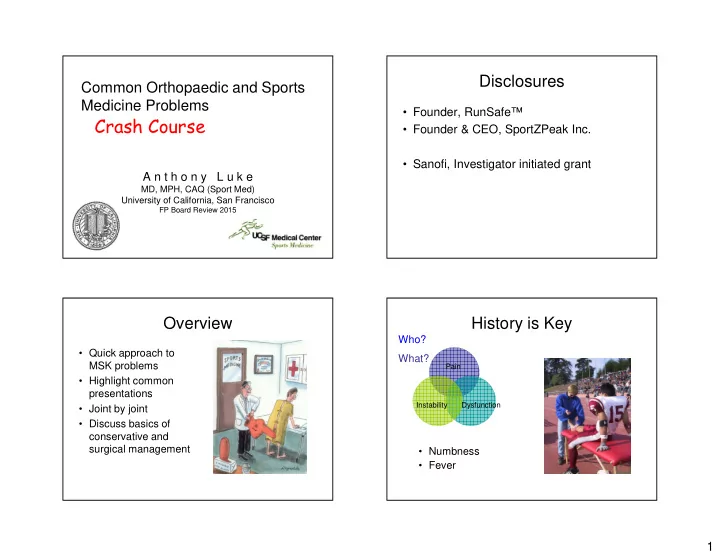
Crash Course Sanofi, Investigator initiated grant A n t h o n y - - PowerPoint PPT Presentation

crash course
SMART_READER_LITE
LIVE PREVIEW

Crash Course Sanofi, Investigator initiated grant A n t h o n y - - PowerPoint PPT Presentation

Disclosures Common Orthopaedic and Sports Medicine Problems Founder, RunSafe Founder & CEO, SportZPeak Inc. Crash Course Sanofi, Investigator initiated grant A n t h o n y L u k e MD, MPH, CAQ (Sport Med) University of


slide-1
SLIDE 1

1 A n t h o n y L u k e

MD, MPH, CAQ (Sport Med) University of California, San Francisco

FP Board Review 2015

Common Orthopaedic and Sports Medicine Problems

Crash Course

Disclosures

  • Founder, RunSafe™
  • Founder & CEO, SportZPeak Inc.
  • Sanofi, Investigator initiated grant

Overview

  • Quick approach to

MSK problems

  • Highlight common

presentations

  • Joint by joint
  • Discuss basics of

conservative and surgical management

History is Key

  • Numbness
  • Fever

Instability Dysfunction Pain

Who? What?

slide-2
SLIDE 2

2

History is Key

When?

  • Acute vs Chronic (2 weeks? 6 weeks?)

Where?

  • Think anatomy
  • One finger test

How?

  • Mechanism of injury

Red Flag Symptoms

  • Severe disability
  • Numbness and tingling
  • Night pain
  • Constitutional symptoms (fever, wt loss)
  • Swelling with no injury
  • Systemic illness
  • Multiple joint injury

Intrinsic Risk Factors

  • Growth
  • Anatomy
  • Muscle/Tendon

imbalance

  • Illness
  • Nutrition
  • Conditioning
  • Psychology

Extrinsic Risk Factors

  • Training
  • Technique
  • Footwear
  • Surface
  • Occupation
  • TO PREVENT

INJURIES!!

Treatment Options

Conservative

  • MICE (Modified activity,

Ice, Compression, Elevation)

  • Medications/Analgesia
  • Rehabilitation therapy
  • Casting/ Braces /

Orthoses

  • Crutches

Surgery

  • Reconstruction
  • Repair
  • Re-align
  • Remove internal

derangement

slide-3
SLIDE 3

3

Ankle Sprains

Mechanism

  • Inversion,

plantarflexion (most common injury)

  • Eversion (Pronation)

Symptoms

  • Localized pain usually
  • ver the lateral aspect
  • f the ankle
  • Difficulty weight

bearing, limping

  • May feel unstable in

the ankle

Physical Exam

LOOK

  • Swelling/bruising

laterally FEEL

  • Point of maximal

tenderness usually ATF MOVE

  • Limited motion due

to swelling

Anterior talofibular ligament Calcaneo fibular ligament

Special Tests Anterior Drawer Test

  • Normal ~ 3 mm
  • Foot in neutral

position

  • Fix tibia
  • Draw calcaneus

forward

  • Tests ATF ligament

van Dijk et al. J Bone Joint Surg-Br, 1996; 78B: 958-962

Sens = 80% Spec = 74% PPV = 91% NPV = 52%

Subtalar Tilt Test

  • Foot in neutral

position

  • Fix tibia
  • Invert or tilt

calcaneus

  • Tests

Calcaneofibular ligament No Sens / Spec Data

slide-4
SLIDE 4

4

Subtalar Tilt test Grading Ankle Sprains

Grade Drawer/Tilt Test results Pathology Functional Recovery in weeks 1 Drawer and tilt negative, but tender Mild stretch with no instability 2 – 4 2 Drawer lax, tilt with good end point ATFL torn, CFL and PTFL intact 4 – 6 3 Drawer and tilt lax ATFL and CFL injured/torn 6 – 12

Ottawa Ankle Rules

  • Inability to weight bear immediately and in the

emergency / office (4 steps)

  • Bone tenderness at the posterior edge of the

medial or lateral malleolus (Obtain Ankle Series)

  • Bone tenderness over the navicular or base of

the fifth metatarsal (Obtain Foot Series)

  • Sens 97%, Spec 31-63%, NPV 99%, PPV <20%

(Am J Emerg Med 1998; 16: 564-67)

Treatment of Ankle Sprains

Acute

  • Rest or modified

activities

  • Ice, Compression,

Elevation

  • Crutches PRN
  • Bracing (Grade 2 and

3)

  • Early Motion is

essential Physical Therapy

  • ROM
  • Strengthening
  • Stretching
  • Proprioception /

Balance exercises (i.e. Wobble Board)

slide-5
SLIDE 5

5

Not Always Only a “Sprain”

Ligaments

  • Subtalar joint sprain
  • Sinus tarsi syndrome
  • Syndesmotic sprain
  • Deltoid sprain
  • Lisfranc injury

Tendons

  • Posterior tibial tendon

strain

  • Peroneal tendon

subluxation Bone

  • Osteochondral talus

injury

  • Lateral talar process

fracture

  • Posterior impingement

(os trigonum)

  • Fracture at the base of

the fifth metatarsal

  • Jones fracture
  • Salter fracture (fibula)
  • Ankle fractures

“High Ankle” Sprains

Mechanism

  • Dorsiflexion, eversion

injury

  • Disruption of the

Syndesmotic ligaments, most commonly the anterior tibiofibular ligament

  • R/O Proximal fibular

fracture

External Rotation Stress Test

  • Fix tibia
  • Foot in neutral
  • Dorsiflex and

externally rotate ankle

No Sens/ Spec Data Kappa = 0.75

Alonso et al. J Orthop Sports Phys Ther, 1998; 27: 276-284

Squeeze test

  • Hold leg at mid calf

level

  • Squeeze tibia and

fibula together

  • Pain located over

anterior tibiofibular ligament area

slide-6
SLIDE 6

6

Treatment for Syndesmosis Injury

Conservative

  • Cast or walking boot
  • Protected

weightbearing with crutches must be painfree

  • PT

Surgery

  • May needs ORIF if

unstable

Maisonneuve Fracture

Ankle Sprain Prevention

  • Ankle braces, tape and

proprioceptive training help reduce the risk of lateral ankle sprains

Verhagen EALM, van Mechelen W, de Vente

  • W. Clin J Sport Med,

2000

  • Significant reduction in

the number of ankle sprains in people allocated to an external ankle support (RR 0.53, 95% CI 0.40 to 0.69).

Handoll et al. Cochrane Database Rev, 2005

Acute Hemarthrosis

1) ACL (almost 50% in children, >70% in adults) 2) Fracture (Patella, tibial plateau, Femoral supracondylar, Physeal) 3) Patellar dislocation

  • Unlikely meniscal lesions

Emergencies

  • 1. Neurovascular injury
  • 2. Knee Dislocation

– Associated with multiple ligament injuries (posterolateral) – High risk of popliteal artery injury – Needs arteriogram

  • 3. Fractures (open, unstable)
  • 4. Septic Arthritis
slide-7
SLIDE 7

7

Urgent Orthopedic Referral

  • Fracture
  • Patellar Dislocation
  • “Locked Joint” - unable to fully extend the

knee (OCD or Meniscal tear)

  • Tumor

Anterior Cruciate Ligament (ACL) Tear

Mechanism

  • Landing from a

jump, pivoting or decelerating suddenly

  • Foot fixed, valgus

stress

Anterior Cruciate Ligament (ACL) Tear

Mechanism

  • Landing from a jump,

pivoting or decelerating suddenly

  • Foot fixed, valgus stress

Symptoms

  • Audible pop heard or felt
  • Pain and tense swelling in

minutes after injury

  • Feels unstable (bones

shifting or giving way)

Double fist sign

ACL physical exam

LOOK

  • Effusion (if acute)

FEEL

  • “O’Donaghue’s Unhappy Triad”

= Medial meniscus tear, MCL injury, ACL tear

  • Lateral meniscus tears more

common than medial

  • Lateral joint line tender -

femoral condyle bone bruise MOVE

  • Maybe limited due to effusion
  • r other internal derangement
slide-8
SLIDE 8

8

Special Tests ACL

  • Lachman's test – test at

20°

  • Anterior drawer – test at

90°

  • Pivot shift

Malanga GA, Nadler SF. Musculoskeletal Physical Examination, Mosby, 2006

* - denotes under anesthesia

Sens 81.8%, Spec 96.8% Sens 35 - 98.4%*, Spec 98%* Sens 22 - 41%, Spec 97%*

X-ray

  • Usually non-

diagnostic

  • Can help rule in or
  • ut injuries
  • Segond fracture –

avulsion over lateral tibial plateau

MRI

  • Sens 94%, Spec 84%

for ACL tear ACL tear signs

  • Fibers not seen in

continuity

  • Edema on T2 films
  • PCL – kinked or

Question mark sign

MRI

  • Sens 94%, Spec 84%

for ACL tear ACL tear signs

  • Lateral femoral corner

bone bruise on T2

  • May have meniscal

tear (Lateral > medial)

slide-9
SLIDE 9

9

Initial Treatment

  • Referral to Orthopaedics/Sports Medicine
  • Consider bracing, crutches
  • Begin early Physical Therapy
  • Analgesia usually NSAIDs

ACL Tear Treatment

Conservative

  • No reconstruction
  • Physical therapy
  • Hamstring

strengthening

  • Proprioceptive training
  • ACL bracing

controversial

  • Patient should be

asymptomatic with ADL’s Surgery

  • Reconstruction
  • Depends on activity

demands

  • Reconstruction allows

better return to sports

  • Reduce chance of

symptomatic meniscal tear

  • Less giving way

symptoms

  • Recovery ~ 6 months

Meniscus Tear

Mechanism

  • Occurs after twisting

injury or deep squat

  • Patient may not recall

specific injury Symptoms

  • Catching
  • Medial or lateral knee

pain

  • Usually posterior

aspects of joint line

  • Swelling

Special Tests: Meniscus

Fowler PJ, Lubliner JA. Arthroscopy 1989; 5(3): 184-186.

Test Sensitivity Specificity Joint line tender 85.5% 29.4% Hyperflexion 50% 68.2% Extension block 84.7% 43.75% McMurray Classic (Med Thud) 28.75% 95.3% McMurray Classic (Lat pain) 50% 29% Appley (Comp/Dist) 16% / 5%

slide-10
SLIDE 10

10

Modified McMurray Testing

  • Flex hip to 90

degrees

  • Flex knee
  • Internally or externally

rotate lower leg with rotation of knee

  • Fully flex the knee

with rotations

Courtesy of Keegan Duchicella MD

X-ray

  • May show joint space

narrowing and early

  • steoarthritis changes
  • Rule out loose bodies

MRI

  • MRI for specific exam
  • Look for fluid (linear

bright signal on T2) into the meniscus

Meniscal Tear Treatment

Conservative

  • Often if degenerative

tear in older patient

  • Similar treatment to

mild knee

  • steoarthritis
  • Analgesia
  • Physical therapy
  • General Leg

Strengthening

Surgery

  • Operate if internal

derangement symptoms

  • Meniscal repair if

possible

slide-11
SLIDE 11

11

Medial Collateral Ligament (MCL) Injury

Mechanism

  • Valgus stress to

partially flexed knee

  • Blow to lateral leg

Symptoms

  • Pain medially
  • May feel unstable

with valgus

Medial Collateral Ligament (MCL) Injury

Physical Exam

  • Tender medially over

MCL (often proximally)

  • May lack ROM

“pseudolocking”

  • Valgus stress test

MRI

  • X-ray non-diagnostic

(rarely avulsion)

  • MRI not usually

necessary

  • Rule out meniscal

tear

MCL Treatment

Conservative

  • Analgesia
  • Protected motion

+/- hinged brace +/- crutches

  • Early physical therapy

Surgery

  • Rarely needs surgery
slide-12
SLIDE 12

12

Posterior Cruciate Ligament (PCL) Injury

Mechanism

  • Fall directly on knee

with foot plantarflexed

  • “Dashboard injury”

Symptoms

  • Pain with activities
  • “Disability” >

“Instability”

Posterior Cruciate Ligament (PCL) Injury

Physical Exam

  • Sag sign
  • Posterior drawer test

Rubenstein et al., Am J Sports Med, 1994; 22: 550-557

X-ray- often non-diagnostic MRI is test of choice

Sens 79%, Spec 100% Sens 90%, Spec 99%

PCL Treatment

Conservative

  • Acute: hinged

post-op brace in extension (0-10° flexion)

  • Crutches
  • Early physical

therapy Surgery

  • May require surgery

if complete Grade 3 tear and symptomatic

  • Needs urgent surgery

if lateral side is unstable postero- lateral corner injury Early and urgent referral!!

Patellofemoral Pain

  • Excessive

compressive forces

  • ver articulating

surfaces of PFP joint Mechanism

  • Too

loose/hypermobile

  • Too tight – XS

pressure Symptoms

  • Anterior knee pain
  • Worse with bending

(5x body wt), stairs (3x body wt)

  • Crepitus under

kneecap

  • May sublux if loose
slide-13
SLIDE 13

13

PFP Syndrome

  • Tender over facets of

patella

  • Apprehension sign

suggests possible instability

  • X-rays may show

lateral deviation or tilt

Treatment Options

Too Loose/Weak

  • Strengthen quads (Vastus

Medialis Obliquus)

  • Correct alignment (+/-orthotics)
  • Support (McConnell Taping,

Bracing) Too Tight

  • Stretch hamstring, quadriceps,

hip flexor

  • Strengthen quads, hip abductors
  • Correct alignment (+/-orthotics)

Surgical (RARE)

  • Last resort
  • Lateral release
  • Patellar

realignment

What’s Hip?

Shoulder Impingement Syndrome

Mechanism

  • Impingement under

acromion with flexion and internal rotation

  • f the shoulder
  • Rotator cuff,

subacromial bursa and biceps tendon Symptoms

  • Pain with

– Overhead activities – Sleep (Internal rotation) – Putting on a jacket

slide-14
SLIDE 14

14

Shoulder Pain Differential Diagnosis

  • Rotator cuff tendinopathy
  • Rotator cuff tears
  • SLAP Lesion
  • Calcific tendinopathy
  • “Frozen” shoulder (adhesive capsulitis)
  • Acromioclavicular joint problems
  • Scapular weakness
  • Cervical radiculopathy

Shoulder Impingement Syndrome

LOOK

  • May have posterior

shoulder atrophy if chronic or RC tear

  • Poor posture

FEEL

  • Tender over anterolateral

shoulder structures MOVE

  • May lack full active ROM

Shoulder Impingement Syndrome

LOOK

  • May have posterior

shoulder atrophy if chronic or RC tear

  • Poor posture

FEEL

  • Tender over anterolateral

shoulder structures MOVE

  • May lack full active ROM

Rotator Cuff strength testing

Supraspinatus

  • Empty can
  • Thumbs down abducted

to 90º

  • Horizontally adduct to 30º

For tendonitis Sens = 77 % Spec = 38 % For tears, Sens = 19 % Spec = 100 %

Naredo et al. Ann Rheum Dis, 2002; 61: 132-136.

30° ° ° °

slide-15
SLIDE 15

15

Rotator Cuff strength testing

Infraspinatus/teres minor - External rotation

  • Keep elbows at 90º
  • Patte’s test at 90º

shoulder abduction For tendonitis, Sens = 57 % Spec = 71 % For tears, Sens = 36 % Spec = 95 %

Naredo et al. Ann Rheum Dis, 2002; 61: 132-136.

Rotator Cuff strength testing

Subscapularis – Internal rotation / Lift-off test

For lesions, Sens = 50 % Spec = 84 % For tears, Sens = 50 % Spec = 95 %

Naredo et al. Ann Rheum Dis, 2002; 61: 132-136.

Impingement Signs

Neer

  • Passive full flexion
  • Positive is

reproduction of shoulder pain Sens = 83 % Spec = 51 % PPV = 40 % NPV = 89 %

MacDonald et al. J Shoulder Elbow Surg, 2000; 9: 299-301.

Impingement Signs

Hawkin’s test

  • Flex shoulder to 90º
  • Flex elbow to 90º
  • Internally rotate
  • Positive - reproduce

shoulder pain Sens = 88 % Spec = 43 % PPV = 38 % NPV = 90 %

MacDonald et al. J Shoulder Elbow Surg, 2000; 9: 299-301.

slide-16
SLIDE 16

16

Impingement Signs

  • Spurling’s test for

cervical radiculopathy Sens = 64% Spec = 95% PPV = 58% NPV = 96%

X-ray AP Scapula

  • Avulsion
  • Calcific tendinosis
  • Enthesopathy

(traction spurs)

  • Alignment

Normal Large acromial spur

X-ray Lateral Scapula Ultrasound

  • Dynamic test
  • Operator dependent
  • Areas of tendinosis

hypoechoic

  • Tears
slide-17
SLIDE 17

17

MRI

  • MRI not needed for

conservative treatment

  • Use it to rule out

significant pathology How good for full thickness tears?

  • 69 to 100 percent

sensitive

  • 88 to 100 percent

specific

SIS Treatment

Conservative

  • Education
  • Modify Activities
  • Alter Biomechanics /

Decrease tendon load

  • Ice/NSAIDs (no evidence)
  • Eccentric exercise

programs

  • Steroid injection

– slightly better than placebo (Cochrane Database, 2004

Surgery

  • If patient fails

conservative treatment for > 6-12 months

  • If rotator cuff tear > 1 cm
  • Subacromial

decompression +/- bursectomy +/- rotator cuff repair

Adhesive Capsulitis “Frozen Shoulder”

  • Women greater than

men (70%)

  • Age > 40 years
  • Affects 2-5 % of

population

  • 20-30% develop

symptoms in opposite shoulder

Frozen Shoulder

  • Gradual loss of range of

motion

  • May have had initial trauma
  • Pain at the extremes of

motion

  • May have history of

diabetes, hypothyroidism, rheumatoid arthritis

slide-18
SLIDE 18

18

Diagnosis

  • Limited range of

motion (usually lose external rotation, abduction and flexion)

  • Investigations (X-ray,

Ultrasound) usually negative

Natural History

  • 0-3 months “gradual onset” - painful
  • 2-9 months “ freezing”
  • 4-12 months “ frozen”
  • 5-26 months “thawing”
  • Usually self-limited

Hannafin & Chiaia, Clin Orthop Rel Res, 2000

Treatment

  • Pain management (+/- sling)
  • Education and reassurance
  • Active home stretching

program

  • Physiotherapy
  • Oral NSAIDs (or steroids)
  • Glenohumeral injection

capsular distension

  • Rarely needs surgery

(examination under anesthesia or Arthroscopic release)

Shoulder Dislocation

Mechanism Anterior (>95%)

  • Force applied with

shoulder in external rotation/ abduction

slide-19
SLIDE 19

19

Shoulder Dislocation

Mechanism Anterior (>95%)

  • Force applied with

shoulder in external rotation/ abduction Posterior (<5%)

  • Posterior force with

shoulder in internal rotation/ adduction

  • EtOH (alcohol),

Electrocution, Epilepsy

Diagnosis

Physical Exam

  • Tender anterior

shoulder

  • May have decreased

sensation to army patch (axillary nerve)

  • Apprehension test
  • Sulcus sign (MDI)

X-ray and MRI

Hill Sachs Lesion – compression fracture of posterior humerus Bankart Lesion – Avulsion of capsular attachment to the glenoid

Complications after Dislocation

Acute rotator cuff tear

  • 40 to 60% incidence of in patients > 40 years old

Frozen shoulder

  • Older the patient the stiffer they get

mobilize early within 2-3 weeks

Recurrent dislocation

  • >90% recurrence < 20 years; 14% > 40 yrs

Rowe CR. Prognosis in dislocation of the shoulder. J Bone Joint Surg Am, 1956.

  • Early surgical stabilization still controversial
slide-20
SLIDE 20

20

Initial Treatment

  • Sling x 2-4 weeks

with pendulum exercises

  • Early physical therapy
  • Modification of

activities

Treatment for Shoulder Instability

  • T – Traumatic
  • U – Unilateral
  • B – Bankart lesion
  • S – Surgical

treatment

(refer for consultation)

  • A – Atraumatic
  • M – Multidirectional
  • B – Bilateral
  • R – Rehabilitation
  • I – Inferior capsular

shift

Acromioclavicular Joint “Separation”

Mechanism

  • Direct fall on the

shoulder

  • Common biking,

contact sports (hockey, football etc.)

  • May tear #1

acromioclavicular ligament; #2 coracoclavicular ligament Symptoms

  • Pain directly over AC

joint

  • Difficulty lifting

weights

  • Difficulty reaching
  • verhead and across

body

Diagnosis

Physical Exam

  • Swelling, tenderness

+/- step deformity

  • ver AC joint
  • Early limited motion

actively due to pain

  • Cross over sign +
slide-21
SLIDE 21

21

Investigations

  • AC joint views
  • Weighted views rarely
  • rdered

Classifying AC Separations

Type Ligaments affected Exam 1

Acromioclavicular (AC) lig strain; Coracoclavicular (CC) lig OK Tender over AC joint, no step

2

AC lig torn CC lig partially torn Mild step < width

  • f clavicle

3

AC and CC ligs torn Obvious step => width of clavicle

Treatment

Conservative

  • Sling as good as figure eight
  • Physiotherapy – taping, restore ROM,

maintain strength

  • Modify activities

Refer to Surgery

  • Type 4 – Posterior dislocation
  • Type 5 – High riding distal clavicle (tenting

the skin)

  • Type 6 – Posterior-inferior dislocation
slide-22
SLIDE 22

22

Lateral and Medial Epicondylitis

Mechanism

  • Repetitive overuse

causing microtrauma at the tendon insertion

  • Lateral epicondylitis

wrist extensors

  • Medial epicondylitis

wrist flexors and pronator teres Symptoms

  • Pain shaking hands,

lifting objects Lateral

  • Tennis, using

“computer mouse” Medial

  • Golf, turning hand
  • ver

Clinical Diagnosis

Physical Exam

  • Tender almost directly over the epicondyle
  • Lateral – pain reproduced with resisted

wrist extension and third digit extension

  • Medial – pain reproduced with resisted

wrist flexion and wrist pronation

  • Check ulnar nerve (posteromedial elbow)

Investigations usually unnecessary

Epicondylitis Treatment

Conservative Step 1

  • Education
  • Activity modification!
  • Stretching and

strengthening exercises

  • Counterforce brace (no

evidence) Step 2

  • Physiotherapy in

persistent cases

  • Steroid injection

Aggressive (Step 3)

  • Extracorporeal

Shockwave therapy (no clear evidence)

  • Surgical debridement

Causes of Back Pain

(Micheli, Wood. Arch Pediatr Adolesc Med 1995; 149:15- 18.)

Lesion Youth Adult

P value

Discogenic

11 48 0.05

Spondylolytic lesion

47 5 0.05

Lumbosacral strain

6 27 0.05

Hyperlordotic mechanical back pain

26

Osteoarthritis

4

slide-23
SLIDE 23

23

Disk Herniation

Mechanism

  • L5-S1 most common

90%

  • Compression of

neural structures such as sciatic nerve causes radicular pain

  • Compression of

cauda equina = EMERGENCY Symptoms

  • Acute herniation

usually 30-50 years

  • Pain worse with

flexion

  • May have “Sciatica”

– Pain with sitting too long (i.e. driving)

  • Rule out bowel or

bladder symptoms

Treatment

  • Education
  • Activity modifications
  • Physical Therapy
  • Medications

– NSAIDs should be recommended (Strength: Strong) – Opioids may be considered but should be avoided if possible (Strength: Weak) – Antidepressants should not be routinely used (Strength: Strong)

White et al. Spine, 2011

Treatment Mean differences Reported

  • Medications

– Corticosteroids pooled results of two trials (overall and leg pain -12.2, 95% C.I. -20.9 to -3.4) – Single trial of gabapentin (pain -26.6, -38.3 to -14.9) but only short term benefits

Pinto et al. BMJ, 2012

– Epidural corticosteroid injections vs placebo for leg pain (mean difference, -6.2 [95% CI, -9.4 to -3.0]) and also for disability (-3.1 [CI, -5.0 to -1.2]) in the short term

Pinto et al. Ann Intern Med, 2012

Surgery better than Non-operative (SPORT) – Disk (SE: A)

  • In patients with a herniated disk confirmed by

imaging and leg symptoms persisting for at least six weeks, surgery was superior to non-

  • perative treatment in relieving symptoms

(15.0 (95% C.I.’s, 11.8 - 18.1)) and improving function (14.9 (95% C.I.’s, 12.0 - 17.8))

  • 4-year rate of reoperation was 10%

Weinstein et al., Spine, 2008

slide-24
SLIDE 24

24

Spinal Stenosis

Mechanism

  • Osteoarthritis causes

narrowing of spinal canal

  • Large disk herniation can

also cause stenosis

  • Can compress neural

structures

  • Can cause compression
  • f spinal artery

Symptoms

  • Usually older patients
  • Pain worse with

extension

  • “Neurogenic

claudication”

– Reproducible leg symptoms worse with walking – Relieved by sitting

  • Rule out bowel or bladder

symptoms

Physical Exam

  • Assess if pain reproduced by flexion vs

extension

  • Perform neurological exam

Criteria for Acute Disk herniation 1. Leg symptoms dominant (Leg > back) 2. Pain in dermatomal distribution 3. Positive straight leg raise 4. Neurologic signs

Diagnosis

X-ray

  • Assess alignment (scoliosis,

lordosis)

  • Disk space narrowing
  • Osteoarthritis
  • Spondylolisthesis (translation
  • f vertebral bodies)

CT Scan

  • Can assess disk and bony

structures MRI

  • Can assess soft tissue

structures, bone and nerves

Conservative Treatment

  • Modified activities
  • NSAID and other analgesics
  • Physical therapy – core stabilization

exercises, McKenzie exercises

  • Others: Traction, braces
  • Consider spinal injections
slide-25
SLIDE 25

25

Surgical Treatment

  • Cauda equina needs emergency

decompression Surgical Indications

  • Sufficient morbidity
  • Failure of conservative treatment
  • Anatomic lesion that can be corrected
  • Complications usually neurologic

Concussion Update Concussion 2013

  • Concussion is defined as a traumatically

induced transient disturbance of brain function and involves a complex pathophysiological process.

  • Concussion is a subset of mild traumatic

brain injury (MTBI) which is generally self- limited and at the less-severe end of the brain injury spectrum.

AMSSM Position Statement, Br J Sports Med, 2013

Symptoms & Signs

  • 1. Symptoms - somatic (e.g. headache), cognitive

(e.g. feeling like in a fog) and/or emotional symptoms (e.g. lability)

  • 2. Physical signs (e.g. loss of consciousness,

amnesia)

  • 3. Behavioural changes (e.g. irritablity)
  • 4. Cognitive impairment (e.g. slowed reaction

times)

  • 5. Sleep disturbance (e.g. drowsiness)
slide-26
SLIDE 26

26

Physical Examination

  • Use the SCAT3 card (free on the web)
  • Clear C-spine
  • Rule out soft tissue and bony injury to

head

  • Balance Error Scoring System
  • Mental status testing
  • Orientation
  • Concentration (numbers backwards)
  • Short and long term memory

Diagnostic Imaging

Neuroimaging (CT, MRI)

  • Most patients do not require imaging
  • Use when suspicion of intracerebral

structural lesion exists:

– prolonged loss of consciousness – focal neurologic deficit – worsening symptoms – Deterioration in conscious state

Symptom resolution after sport concussion

  • 7-10 days avg. symptom resolution (3rd International

Conference on Concussion in Sport (2008). Clin J Sport Med, 2009.)

  • 50% recovered and returned to play in 1 week;

90% in 3 weeks (Collins et al. Neurosurgery, 2006.)

  • High schoolers take longer to recover based on

neuropsychological testing compared to college athletes (Field et al, J Pediatr, 2003.)

Management

  • All student athletes need to have an MD or

qualified health professional to clear to play

  • School-aged athletes will be out at least 1 week

most likely 2 (check your area for legal requirements)

  • Check new guidelines for returning to learn –

cognitive rest recommended for students

  • Use SCAT 3 as a good simple evaluation (on

line)

slide-27
SLIDE 27

27

Can the Athlete Play Safely?

  • Make a working diagnosis
  • Is there potential for worsening injury?

A new secondary injury?

  • MD or trainer decides: CAN THE

ATHLETE PLAY SAFELY ?

  • Coach and MD decide: Can the athlete

play effectively?

  • Player, coach and MD decide: Can the

athlete play pain free? AVOID STRESS 9th UCSF Primary Care Sports Medicine Conference San Francisco, Dec 5-6, 2014 Hotel Intercontinental San Francisco