Coupling Procedure of a Cold Rolling Lubrication Model with Finite - - PowerPoint PPT Presentation
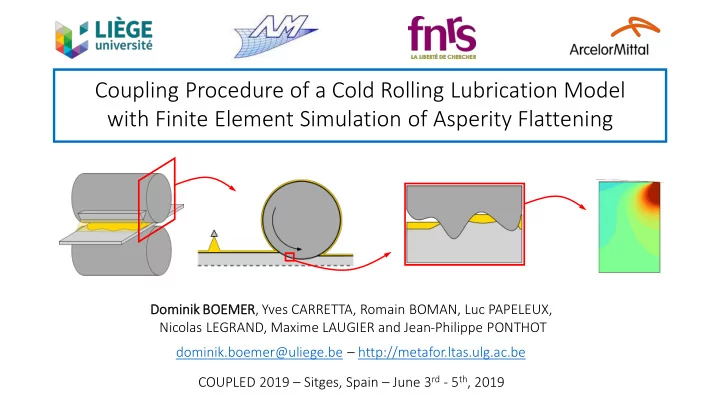
Coupling Procedure of a Cold Rolling Lubrication Model with Finite Element Simulation of Asperity Flattening Domini nik BOEMER, Yves CARRETTA, Romain BOMAN, Luc PAPELEUX, Nicolas LEGRAND, Maxime LAUGIER and Jean-Philippe PONTHOT
2
1. Context 2. Metalub 3. Metalub – Metafor coupling 4. Conclusion Outline
3
- 1. Context
Cold ld rolli lling [Roberts, 1978]
- Thickness reduction of steel strips at 25 - 150°C to satisfy strict geometrical tolerances
- Process is strongly dependent on friction created by speed difference between roll and strip
- Friction increases important process parameters like the rolling force and the forward slip
4
- 1. Context
Mixed lubr ubric icatio ion
- Challenges due to friction:
- Mill capacity for Advanced High-Strength Steel (harder, thinner)
- Rolling energy consumption
- …
- Introduction of a lubricant, and more recently, flexible lubrication
- Control of friction level by adjusting oil concentration in emulsion
- Interacting solid asperity tops in the presence of a lubricant, which partially supports the load
1 mm 1 µm 100 µm Roll Strip [Laugier et al., 2011]
Strip Nozz Nozzles es Rolling ng direc ection
- n
Stat atic mixer er
Roll bite (20 mm)
- Predict rolling force and forward slip numerically
- To minimize friction by choosing optimal process parameters
- Include micro-plasto-hydrodynamic and hydrostatic effects [Laugier et al., 2014] in the model
- This talk: coupling of cold rolling model with the finite element (FE) simulation of asperity flattening
5
- 1. Context
Mot
- tiv
ivatio ion
6
1. Context 2. Metalub 3. Metalub – Metafor coupling 4. Conclusion Outline
7
- 2. Metalub
Cold ld rolli lling mod model l wi with th mi mixed lubr ubric icatio ion
- Over 20 years of development: [Marsault, 1998], [Boman et al., 2002], [Stephany, 2008], [Carretta, 2014]
- Numerous features:
- Conservation laws: slab method, adiabatic thermal model, Reynolds equation with flow factors
- Material laws: thermoviscoplastic (strip), thermopiezoviscous (lubricant)
- Additional features: non-circular elastic roll flattening, lubricant starvation
- Implemented in C++ with Python interface and GUI
- Method:
Roll profile Entry strip speed Is the roll profile coherent with the stresses that act on it? Is the strip thickness at the exit equal to the imposed one? Is the front tension equal to the imposed one? Is the lubricant pressure zero at the exit? Roll position Lubricant flow rate
8
- 2. Metalub
Num Numeric ical l results lts
- Excellent predictions in some cases (scenario A)
- But more significant deviations in others (scenario B)
- With respect to measurements of pilot mill [Legrand et al., 2015]
Scenario A Scenario B
- Relation between:
- Relative contact area
- Pressure on the asperity tops
- Lubricant pressure
- Plastic substrate deformation
- Currently implemented: Wilson & Sheu, Sutcliffe & Marsault, Korzekwa et al.
- Shortcomings:
- Simplified geometry: flat indenters
- Simplified material law: rigid perfectly plastic
- Approximate method: upper-bound method
- No micro-plasto-hydrodynamic or hydrostatic effect
9
- 2. Metalub
Anal nalyt ytic ic asperit ity y fla lattenin ing law
with
Strip Strip Roll
10
1. Context 2. Metalub 3. Metalub – Metafor coupling 4. Conclusion Outline
- Metafor: in-house non-linear implicit FE solver for large deformations
- FE asperity flattening in normal plane to the rolling direction
- Direct simulation of lubricant by Arbitrary Lagrangian Eulerian formulation
- Problematic due to co-existence of hydrostatic and hydrodynamic models
11
- 3. Metalub – Metafor coupling
Carretta’s micro-model l of f asp sperit ity y fla lattenin ing wi with th lub ubric icant
- Roll modeled by rigid fixed contact tool
- Strip modeled by FEM
- Interface pressure pushes strip against roll
- Strip can not deform laterally
12
- 3. Metalub – Metafor coupling
New New mi micro-model l of asp sperity ty flattenin ing
Rolling direction
- Generalized plane strain state
- Elongation of strip due to its deformation
- Lubricant pressure applied where no contact
exists between roll and strip
Interface pressure Lubricant pressure Out-of-plane length
13
- 3. Metalub – Metafor coupling
Full ull cou
- uplin
ling pr proc
- cedure
14
- 3. Metalub – Metafor coupling
Num Numeric ical l results lts (1)
Animation [MPa]
- Mesh-dependence in FE model, when the lubricant pressure becomes equal to the interface pressure
- Tentative solution: slight reduction of the lubricant pressure
- Insufficient strength/tightness of the coupling
- Tentative solution: different criterion in adjustment loop of the lubricant flow rate
15
- 3. Metalub – Metafor coupling
Shor
- rtcomings
ny,1 nz ny,2
16
- 3. Metalub – Metafor coupling
Num Numeric ical l results lts (2)
- Procedure converges but this required relatively strong hypotheses
- Wilson & Sheu’s law seems to overestimates the relative contact area
Convergence history Comparison with experimental data and classical Metalub results
17
1. Context 2. Metalub 3. Metalub – Metafor coupling 4. Conclusion Outline
18
- 4. Conclusion
This his pr presentatio tion Futu uture resear arch
- Coupling procedure of Metalub and Metafor
- Analytic asperity flattening equation replaced by FE model: no oversimplified geometry, material, method
- Results: similar to classical Metalub model but Wilson & Sheu seem to overestimate the real contact area
- Limitations: strength of the coupling, identity of lubricant and interface pressure
- Focus on micro-plasto-hydrodynamic and hydrostatic effects
- Smoothed particle hydrodynamics (SPH)
Animation
19
References
- Boman, R. and Ponthot, J.-P. (2002). Numerical simulation of lubricated contact in rolling processes. Journal of Material Processing Technology,
125-126: 405-411.
- Carretta, Y. (2014). Modélisation des conditions d’apparition du micro-hydrodynamisme via la méthode des éléments finis dans la perspective
d’intégrer ce phénomène dans un modèle numérique de laminage à froid. PhD thesis, Université de Liège, In French.
- Korzekwa, D. A., Dawson P. R. and Wilson, W. R. D. (1992). Surface asperity deformation during sheet forming. International Journal of
Mechanical Sciences, 34(1): 521-539.
- Laugier, M., Tornicelli, M., Leligois, C. S., Bouquegneau, D., Launet, D., and Alvarez, J. A. (2011). Flexible lubrication concept. The future of cold
rolling lubrication. Proceedings of the Institution of Mechanical Engineers, Part J: Journal of Engineering Tribology, 225(9): 949-958.
- Laugier, M., Boman, R., Legrand, N., Ponthot J.-P., Tornicelli, M., and Bech, J. I. (2014). Micro-plasto-hydrodynamic lubrication. A fundamental
mechanism in cold rolling. Advanced Material Research, 966-967: 228-241.
- Legrand, N., Patrault, D., Labbe, N., Gade, D., Piesak, D., Jonsson, N. G., Nilsson, A., Horsky, J., Luks, T., Montmitonnet, P., Canivenc, R., Joyce, R.
D., Hunter, A., Pinna, C. and Maurin, L. (2015). Advanced roll gap sensors for enhanced hot and cold rolling processes (rollgap sensors). Technical
- report. Research Fund for Coal and Steel, European Commission.
- Marsault, N. (1998). Modélisation du régime de lubrification mixte en laminage à froid. PhD thesis, Ecole Nationale Supérieure des Mines de
- Paris. In French.
- Roberts, W. L. (1978). Cold rolling of steel. Marcel Dekker, New York.
- Stephany, A. (2008). Contribution à l’étude numérique de la lubrification en régime mixte en laminage à froid. PhD thesis, Université de Liège. In
French.
- Wilson, W. R. D. and Sheu, S. (1988). Real area of contact and boundary friction in metal forming. International Journal of Mechanical Sciences,
30(7): 475-489.
20