SLIDE 1
INTRODUCTION OF WOODLAND PLANTS INTO BROADLEAVED WOODLAND FOR CONSERVATION PURPOSES
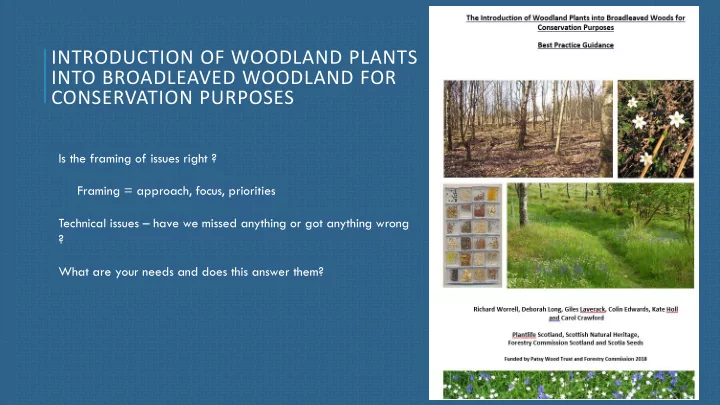
Is the framing of issues right ? Framing = approach, focus, priorities Technical issues – have we missed anything or got anything wrong ? What are your needs and does this answer them?
SLIDE 2
FRAMING
Focus is on existing woods – also covers woodland creation Only some woods need interventions - many don’t
Introductions needed where natural colonisation likely to fail Planted woods on former arable and improved pasture Some secondary birchwoods Conifer restock sites destined for broadleaves Carry out conservation management first – grazing control, strengthen FHN, thinning/gap creation
SLIDE 3 FRAMING
Low cost approach Small numbers of plants of multiple species
- left to colonise naturally over long time period
- slow increase in conservation value
Hopefully has natural process gives natural looking results ?
SLIDE 4 WHICH SPECIES CAN BE REGARDED AS “MISSING”?
Need to carefully find out:
- which species are already in the wood / adjacent habitats
- which species would occur naturally in the wood
- which species are “missing” and are therefore fair targets for introduction
SLIDE 5
SLIDE 6
SLIDE 7
SLIDE 8
SLIDE 9
HOW TO TREAT THE INTRODUCTION SITE
a) Areas of bare soil and sparse vegetation b) More or less continuous cover of non-competitive vegetation c) More or less continuous cover of competitive agricultural weeds. Ground treatments = raking, strimming, treatment of small patches with herbicide and / or cultivation; or more widespread cultivation / herbicide use; thinning & gap creation Plant where shade levels are high enough to inhibit weedy ground cover, but light enough to allow woodland plants to thrive.
SLIDE 10
SLIDE 11
SLIDE 12
SEED AND GENETIC ISSUES
Good practice in seed collection. Genetic issues: Collect seed and plants as locally as possible to the planting site. maintain the genetic diversity plants are well adapted to local growing conditions. If seed is bought in from a seed supplier, source from same general region as the planting site. The need for quality seed is stressed Lots of unanswered issues here…..
SLIDE 13
HOW TO ESTABLISH PLANTS
Sowing seed Planting plant fragments, “divided” plants, runners, bulbs and cuttings Potted plants The best methods depend on: plant species condition of the woodland floor budget and scale operations how tightly the manager wishes to control outcomes
SLIDE 14
OVER TO YOU !
Is the framing of issues right ? Framing = approach, focus, priorities Technical issues – have we missed anything or got anything wrong ? What are your needs and does this answer them?