Conductivity and Semi-Conductors J = current density = I/A E = - - PowerPoint PPT Presentation

conductivity and semi conductors
SMART_READER_LITE
LIVE PREVIEW

Conductivity and Semi-Conductors J = current density = I/A E = - - PowerPoint PPT Presentation

Conductivity and Semi-Conductors J = current density = I/A E = Electric field intensity = V/l where l is the distance between two points Metals: Semiconductors: Many Polymers and Glasses 1 Electrical Conduction (motion of


slide-1
SLIDE 1

Conductivity and Semi-Conductors

1
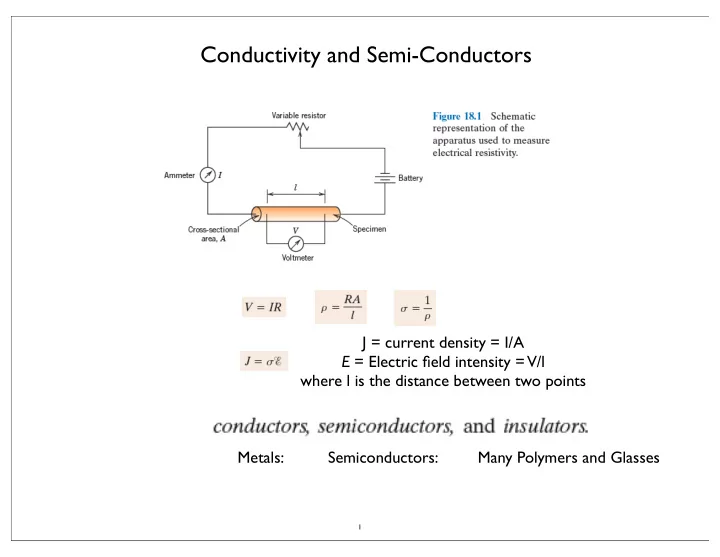
J = current density = I/A E = Electric field intensity = V/l where l is the distance between two points Metals: Semiconductors: Many Polymers and Glasses

slide-2
SLIDE 2

2

Electrical Conduction (motion of electrons) Ionic Conduction (motion of ions)

slide-3
SLIDE 3

3

slide-4
SLIDE 4

4

slide-5
SLIDE 5

5

Free Electron Model

Drude-Sommerfeld Model Drude Model (kinetic theory of gasses) Include quantum mechanics (wave nature of electron) For AC

slide-6
SLIDE 6

6

4 Quantum Numbers: Size, Shape, Spatial Orientation, Magnetically Determined Energy State Principle Quantum Number = n = Distance from Nucleus (Bohr number) K, L, M, N or 1, 2, 3, 4 Second quantum number = l = Shape s, p, d, f n restricts the number of these Third quantum number = ml = magnetically distinguishable energy states Fourth quantum number = ms = spin moment +1/2 or - 1/2 = up or down orientation

slide-7
SLIDE 7

7

slide-8
SLIDE 8

8

slide-9
SLIDE 9

9

Primary quantum numbers distinguished by energy Different primary quantum number states can have overlapping energy levels.

slide-10
SLIDE 10

10

slide-11
SLIDE 11

11

Density of States Z(E)

slide-12
SLIDE 12

12

slide-13
SLIDE 13

13

slide-14
SLIDE 14

14

Fermi Energy = EF

slide-15
SLIDE 15

15

Fermi Energy = EF

Drude Model

Quantum Mechanics Model Fermi drift velocity vF

slide-16
SLIDE 16

16

slide-17
SLIDE 17

17

slide-18
SLIDE 18

18

Semiconductors

Number of Electrons in the Conduction Band

slide-19
SLIDE 19

19

Semiconductors

Holes left in the valence band are positive charge carriers Intrinsic Conduction in an Intrinsic Semiconductor

slide-20
SLIDE 20

20

Silicon has 4 valence electrons, Group V elements have 5 For Phosphorous the binding energy for the donor electron is 0.045 eV (small/weakly bound) 0.0001 % P

n-Type Semiconductors

slide-21
SLIDE 21

21

Extra conducting electrons contributed by P

n-Type Semiconductors

slide-22
SLIDE 22

22

Group III impurities (B, Al, Ga, In) are deficient in one electron Acceptor Impurities Positive Charge Carriers (Holes) in the valence band

p-Type Semiconductors

At room temperature only the majority carriers need be considered (intrinsic effects are ignored)

slide-23
SLIDE 23

23

IV III V Compound Semiconductors GaAs VI II III & V II & VI ZnO ZnS ZnSe CdTe For LED’s Solar Cells

slide-24
SLIDE 24

24

Hall Effect

Are the Charge Carriers Positive or Negative? Metals Negative RH = Hall Coefficient

slide-25
SLIDE 25

25

Rectifier or Diode

slide-26
SLIDE 26

26

Rectifier or Diode

slide-27
SLIDE 27

27

Rectifier or Diode

slide-28
SLIDE 28

28

Rectifier or Diode

On contact a potential is setup between p and n materials due to flow of electrons from n to p and holes from p to n This barrier potential opposes flow of electrons. If electrons are added to the p side the potential barrier drops (Forward Bias). If electrons are added to n the potential barrier increases (Reverse Bias). So current can only flow from p to n under normal circumstances. A slight time lag occurs due to motion of minority carriers in a p-n junction and there is energy loss due to this motion.

slide-29
SLIDE 29

29

Rectifier or Diode

slide-30
SLIDE 30

30

Rectifier or Diode

slide-31
SLIDE 31

31

Solar Cell

slide-32
SLIDE 32

32

Solar Cell

Photo Detector Photo-Diode Solar Cell

slide-33
SLIDE 33

33

Solar Cell

slide-34
SLIDE 34

34

Solar Cell

slide-35
SLIDE 35

35

Schottky Diode

Work Function of a metal in vacuum Energy qΦm is required to remove an electron at the Fermi level to the vacuum 4.3 V for Al, 4.8 V for Au if negative charges (n-Si) is brought near the metal surface the work function is reduced due to induced positive charges: Schottky Effect. Semi-conductor work function qΦs Charge transfer leads to adjustment of Fermi levels A positive depletion layer occurs in the semiconductor if the metal work function is larger than the semiconductor work function.

slide-36
SLIDE 36

36

Schottky Diode

slide-37
SLIDE 37

37

Schottky Diode

Metal work function is less than p-semiconductor for a p-type

slide-38
SLIDE 38

38

Ohmic Contact

For an n-type semiconductor if Φm < Φs the electrons (majority carriers) from the metal flow to the semiconductor For a p-type semiconductor if Φm > Φs the electrons from the semiconductor flow to the metal So Ohmic contacts, needed for normal electrical connections, involve the

  • pposite condition as a Schottky contact
slide-39
SLIDE 39

39

Hetero-Junctions

Image of a nanoscale heterojunction between iron oxide (Fe3O4 — sphere) and cadmium sulfide (CdS — rod) taken with aTEM. This staggered gap (type II) offset junction was synthesized by Hunter McDaniel and Dr. Moonsub Shim at the University

  • f Illinois in Urbana-Champaign in 2007.
slide-40
SLIDE 40

40

Transistor

Three terminal device in which current through two terminals is controlled by a small current or voltage through the third terminal Transistors are used for Amplification and Switching Transistor is a control device

slide-41
SLIDE 41

41

Bipolar Junction Transistor

Emitter (E) Base (B) Collector (C)

slide-42
SLIDE 42

42

Bipolar Junction Transistor

Acts like a valve. You have a gate controlled by a small voltage That controls a large current. It can act as an amplifier or as a switch. Base more positive than the Emitter Collector more positive than Base Number of electrons in base control flow Emitter more positive than the Base Base more positive than Collector Number of holes in base control flow PNP NPN

slide-43
SLIDE 43

43

Bipolar Junction Transistor

slide-44
SLIDE 44

44

Metal Oxide Semiconductor Field Effect Transistor MOSFET

slide-45
SLIDE 45

45

slide-46
SLIDE 46

46

slide-47
SLIDE 47

47

slide-48
SLIDE 48

48

Indirect versus Direct Band Gap Semiconductors

Energy vs. crystal momentum for a semiconductor with an indirect band gap, showing that an electron cannot shift from the lowest-energy state in the conduction band (green) to the highest-energy state in the valence band (red) without a change in momentum. Here, almost all of the energy comes from a photon (vertical arrow), while almost all of the momentum comes from a phonon (horizontal arrow). Energy vs. crystal momentum for a semiconductor with a direct band gap, showing that an electron can shift from the lowest-energy state in the conduction band (green) to the highest-energy state in the valence band (red) without a change in crystal momentum. Depicted is a transition in which a photon excites an electron from the valence band to the conduction band.

Silicon or Germanium GaAs, InP , CdT e Photovoltaics LEDs

slide-49
SLIDE 49

49

Light Emitting Diode (LED)

When a hole meets an electron the electron falls into a lower energy level releasing a photon with energy related to the band gap This can be IR, visible or near UV

slide-50
SLIDE 50

50

Light Emitting Diode (LED)

slide-51
SLIDE 51

51

Laser Diode

Stimulated Emission Optical Cavity formed by parallel sided crystal that forms a waveguide with reflective ends

slide-52
SLIDE 52

52

Laser Diode

slide-53
SLIDE 53

53

Laser Diode

slide-54
SLIDE 54

54

Laser Diode

slide-55
SLIDE 55

55

slide-56
SLIDE 56

56

slide-57
SLIDE 57

57

slide-58
SLIDE 58

58

slide-59
SLIDE 59

59