Development of Semi-empirical Thermal Conductivity Model of U-Mo/Al - - PDF document

β–Ά
development of semi empirical thermal conductivity model
SMART_READER_LITE
LIVE PREVIEW

Development of Semi-empirical Thermal Conductivity Model of U-Mo/Al - - PDF document

Transactions of the Korean Nuclear Society Virtual Spring Meeting July 9-10, 2020 Development of Semi-empirical Thermal Conductivity Model of U-Mo/Al Dispersion Fuel Tae Won Cho*, Yong Jin Jeong, Kyu Hong Lee, Sung Hwan Kim, Ki Nam Kim, Jong Man


slide-1
SLIDE 1

Development of Semi-empirical Thermal Conductivity Model of U-Mo/Al Dispersion Fuel

Tae Won Cho*, Yong Jin Jeong, Kyu Hong Lee, Sung Hwan Kim, Ki Nam Kim, Jong Man Park Research Reactor Fuel Development Division, Korea Atomic Energy Research Institute, 111, Daedeok-daero 989beon-gil, Yuseong-gu, Daejeon, Republic of Korea

*Corresponding author: twcho@kaeri.re.kr

  • 1. Introduction

U-Mo/Al dispersion fuel has been developed for a candidate high-performance fuel of high-power research and test reactors worldwide. U-Mo/Al dispersion fuel shows conspicuous microstructure changes during irradiation, which is dependent on the fuel temperature. In this respect, it is important to estimate temperature distribution in the fuel. In our previous works, the thermal properties of U- Mo/Al dispersion fuel were measured and investigated some microstructure effects [1, 2]. However, it is difficult to apply the measured data to fuel performance analysis since it is applicable only to limited fuel

  • conditions. Therefore, it is necessary to develop a semi-

empirical model, which is conveniently applicable to various fuel conditions.

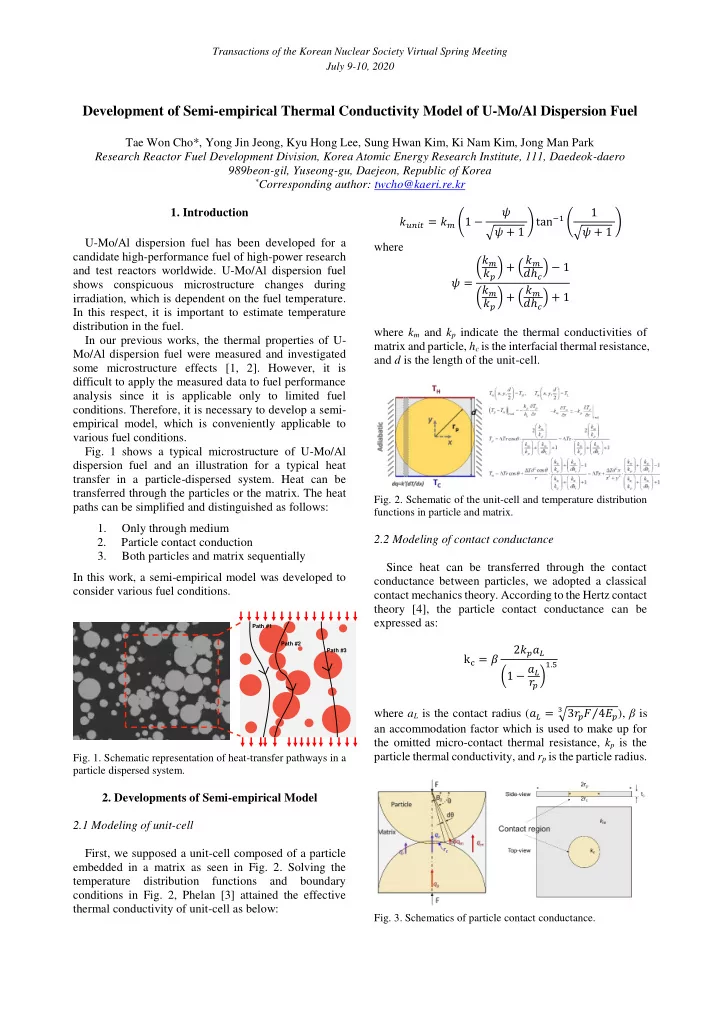
  • Fig. 1 shows a typical microstructure of U-Mo/Al

dispersion fuel and an illustration for a typical heat transfer in a particle-dispersed system. Heat can be transferred through the particles or the matrix. The heat paths can be simplified and distinguished as follows: 1. Only through medium 2. Particle contact conduction 3. Both particles and matrix sequentially In this work, a semi-empirical model was developed to consider various fuel conditions.

  • Fig. 1. Schematic representation of heat-transfer pathways in a

particle dispersed system.

  • 2. Developments of Semi-empirical Model

2.1 Modeling of unit-cell First, we supposed a unit-cell composed of a particle embedded in a matrix as seen in Fig. 2. Solving the temperature distribution functions and boundary conditions in Fig. 2, Phelan [3] attained the effective thermal conductivity of unit-cell as below: π‘™π‘£π‘œπ‘—π‘’ = 𝑙𝑛 (1 βˆ’ πœ” βˆšπœ” + 1 ) tanβˆ’1 ( 1 βˆšπœ” + 1 ) where πœ” = (𝑙𝑛 π‘™π‘ž ) + ( 𝑙𝑛 π‘’β„Žπ‘‘) βˆ’ 1 (𝑙𝑛 π‘™π‘ž ) + ( 𝑙𝑛 π‘’β„Žπ‘‘) + 1 where km and kp indicate the thermal conductivities of matrix and particle, hc is the interfacial thermal resistance, and d is the length of the unit-cell.

  • Fig. 2. Schematic of the unit-cell and temperature distribution

functions in particle and matrix.

2.2 Modeling of contact conductance Since heat can be transferred through the contact conductance between particles, we adopted a classical contact mechanics theory. According to the Hertz contact theory [4], the particle contact conductance can be expressed as: kc = 𝛾 2π‘™π‘žπ‘π‘€ (1 βˆ’ 𝑏𝑀 𝑠

π‘ž ) 1.5

where aL is the contact radius (𝑏𝑀 = √3𝑠

π‘žπΊ 4πΉπ‘ž

⁄

3

), Ξ² is an accommodation factor which is used to make up for the omitted micro-contact thermal resistance, kp is the particle thermal conductivity, and rp is the particle radius.

  • Fig. 3. Schematics of particle contact conductance.

Path #1 Path #2 Path #3

Transactions of the Korean Nuclear Society Virtual Spring Meeting July 9-10, 2020

slide-2
SLIDE 2

The contact conductance increases as the particle contact

  • increases. In general, the particle contact increases as the

particle packing fraction increases or the particle size

  • decreases. Since the U-Mo particles have a random

particle distribution, the effect of particle size was assumed to be negligible. To estimate the ratio of contact, a contiguity ratio was measured in ANL and an empirical equation was suggested as follows [5]: 𝐷𝑠 = 0.054 βˆ’ 0.2779 Γ— 𝑀𝑑 + 0.8083 Γ— 𝑀𝑑

2

where vc is the total volume fraction of fuel and interaction layer (IL) phases. 2.3 Modeling of a composite particle The thermal conductivity of IL-formed particle was derived by solving the heat transfer equation for a layer- structured particle as seen in Fig. 4. The temperature conditions at the boundaries were given as in Fig. 4. Combining the temperature conditions, the effective thermal conductivity of the layer-structured particle, kcp can be obtained so that: π‘™π‘‘π‘ž = 1 𝑠

π‘ž + π‘’π‘š

𝑠

π‘ž 2

( 𝑠

π‘ž

𝑙𝑉𝑁𝑝 + 𝑆1) + 1 𝑠

π‘ž + π‘’π‘š ( π‘’π‘š

𝑙𝐽𝑀 + 𝑆2) where rp and tl denote is the radius of particle and layer thickness, R1 and R2 are the interfacial thermal resistances between U-Mo-IL, and IL-Al, respectively.

  • Fig. 4. An illustration of layer-structured particle and its

temperature at the boundaries.

2.4 Homogenization For a randomly distributed system, heat transfer paths are mixed randomly. Therefore, the effective thermal conductivity can be expressed in non-dimensionless form using a geometric mean equation as follows [6]

   

* mode=1

1 1

n eff i i

k v k

 

ο€½  ο€­

οƒ₯

where Ξ± is the empirical constant indicating the mixed ratio of parallel and series mode. Note that when Ξ± =1: parallel model; Ξ± =-1: series model. Therefore, the Ξ± indicates a heterogeneity factor for the system mixing. As the Ξ± is close to 1, it means the heat transfer modes are mostly mixed parallel while the system has a more serially mixed composition as the Ξ± is close to -1. In this respect, Ξ± is dependent on the microstructures of a fuel such as particle packing fraction, particle size distribution, and material properties. Therefore, the Ξ± should be obtained as an empirical constant from the measured data. 2.5 Prediction of thermal conductivity of U-Mo/Al dispersion fuel Using the semi-empirical model, thermal conductivity of IL-formed U-Mo/Al dispersion fuel was estimated. The analyses were performed for the cases when U-Mo volume fraction is 0.50. Three average particle sizes of 50, 55, and 60 ΞΌm were considered to investigate and verify the effects of particle size. Fig. 5 shows the IL volume fraction and thermal conductivity variations with IL thickness. As the particle size is smaller, the IL growth is faster, and the thermal conductivity decreases more

  • rapidly. This overall trend is consistent with the

measured data. Therefore, it seems that the semi- empirical model successfully predicts the thermal conductivity of U-Mo/Al dispersion fuel considering the IL growth as well as the particle size effect.

2 4 6 8 10 0.0 0.1 0.2 0.3 0.4 0.5 0.6 0.7 Particle Size 50 m 55 m 60 m

IL volume fraction IL thickness (m)

(a) IL volume fraction

2 4 6 8 10 12 20 40 60 80 100

Thermal conductivity (Wm

  • 1K
  • 1)

IL thickness (m)

(b) Effective thermal conductivity

  • Fig. 5. Model prediction for IL volume fraction and its thermal

conductivity as a function of IL thickness Transactions of the Korean Nuclear Society Virtual Spring Meeting July 9-10, 2020

slide-3
SLIDE 3
  • 3. Conclusions

The thermal conductivity of U-Mo/Al dispersion fuel is dependent on the microstructure characteristics such as uranium loadings, materials, IL thickness, and particle size and distribution. In this work, we developed a semi- empirical model, which can consider the microstructure

  • effects. The semi-empirical model was developed based
  • n the unit-cell model. Three heat transfer mechanisms

were assumed: fully through matrix, particle-matrix conduction, and particle contact conduction. The model prediction showed consistent results as a function of U- Mo volume fraction and IL thickness, which successfully proved a good reproducibility and reliability. In addition, the model considered particle size effects. In the future, the model will be applied to a fuel performance code and its applicability will be proved. REFERENCES

[1] T.W. Cho, Y.S. Kim, J.M. Park, K.H. Lee, S.H. Kim, C.T. Lee, J.H. Yang, J.S. Oh, J.J. Won, D.S. Sohn, Thermal properties of U-7Mo/Al dispersion fuel, J. Nucl. Mater., 496, (2017), 274. [2] T.W. Cho, Y.S. Kim, J.M. Park, K.H. Lee, S.H. Kim, C.T. Lee, J.H. Yang, J.S. Oh, D.S. Sohn, Thermophysical properties

  • f heat treated U-7Mo/Al fuel, J. Nucl. Mater., 501, (2018), 31.

[3] P.E. Phelan, R. Prasher, An Effective Unit Cell Approach to Compute the Thermal Conductivity of Composites with Cylindrical Particles, J. Heat Transfer, 127, (2005), 554. [4] X. Zhu, Tutorial on Hertz Contact Stress, In: Opti., 521, (2012), 1. [5] ANL unpublished data [6] J. Mo, H. Ban, Measurements and theoretical modeling of effective thermal conductivity of particle beds under compression in air and vacuum, Case Studies in Thermal Engineering, 10, (2017), 423. Transactions of the Korean Nuclear Society Virtual Spring Meeting July 9-10, 2020