SLIDE 1
Composition and mapping
Program music to Sonification
SLIDE 2
Jatyantara-Parinamah, for large ensemble (1st movement)
SLIDE 3
– based on an acoustic analysis and transcription of a stream – understanding of any sound (a stream in this case) as music – technology: recording equipment filtering music notation
Jatyantara-Parinamah
SLIDE 4
background (1st component) background (2nd component) background (3rd component) foreground (4th component)
Jatyantara-Parinamah
SLIDE 5
Program music Transcription Sonification Audification Soundscape composition
SLIDE 6
Program music
SLIDE 7
Janequin Le chant des oiseaux
SLIDE 8
Beethoven, Symphony no. 6 “Pastoral” (4th movement –the storm)
SLIDE 9
Transcription
SLIDE 10
SLIDE 11
Olivier Messiaen, Petites Esquisses D’Oiseaux
(European robin)
SLIDE 12
Re-definition of “Music”
SLIDE 13
- “Wherever we are, what we hear is mostly
- noise. When we ignore it, it disturbs us. When
we listen to it, we find it fascinating. The sound
- f a truck at fifty miles per hour. Static between
the stations. Rain. We want to capture and control these sounds, to use them not as sound effects but as musical instruments.” John Cage, in The Future of Music, Credo (1937)
John Cage, The Future of Music, Credo (1937)
SLIDE 14
John Cage introducing Water Walk in the show “I’ve got a secret”
SLIDE 15
John Cage, Water Walk
SLIDE 16
Mapping
SLIDE 17 excerpt from Mappings and entrainment, by David Dunn “I tentatively term the possibility of (…) eco- systemic mental
- structures. The suggestion is that some sort of primal
separation from such structures rendered mankind both individually conscious and with a deep sense of loss. The religious impulse is evidence for the vestigial need of the individual to reconnect with some larger systemic complexity”.
SLIDE 18
John Cage, Atlas eclipticalis (1961-1962) for open instrumentation Atlas eclipticalis 1950.0 by astronomer Antonín Bečvár (1957)
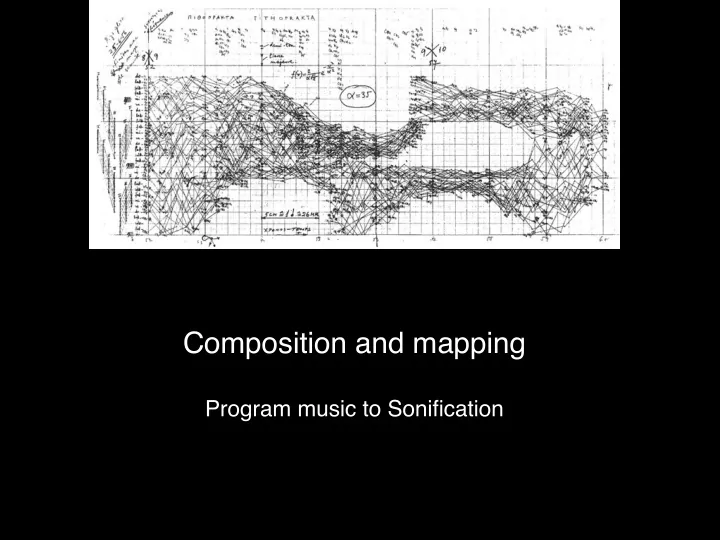
SLIDE 19 Iannis Xenakis, Pithoprakta (1958)
– based on the statistical mechanics of gases, Gauss's law,
- r Brownian motion. Each instrument is conceived as a
- molecule. This theory states that "the temperature of a gas
derives from the independent movement of its molecules” for 2 trombones, 46 strings, xylophone and woodblock
SLIDE 20
Sonification
Conversion of data into audio. Its use may be didactic or artistic.
SLIDE 21
Matthew Burtner, Iceprints (Ecoacoustics)
SLIDE 22
Audification
Process of taking a vibration signal outside the range of normal human hearing and shifting it into the audible range
SLIDE 23 "Electrical Walks is a public walk with custom-made sensitive wireless headphones by which aboveground and underground electromagnetic fields are detected, amplified and made audible. While the sounds were mixed, they were not altered at all electronically or by any other means.”
Christina Kubisch, Security (from “Electrical Walks”)
SLIDE 24
Soundscape composition
SLIDE 25
Hildegard Westerkamp, Cricket voice
SLIDE 26
David Dunn The sound of light in trees
SLIDE 27
Geysir, for 7 pianists and electronics
SLIDE 28
Frequency analysis
Re-synthesis / removal of the partials with the lowest amplitude (SPEAR)
SLIDE 29
Notation
From re-synthesis to text file (Orchids)
SLIDE 30
From text file to XML file, quantization (Max MSP)
Notation
SLIDE 31
Notation
Pitch classification code: removing complexity (BASE X)
SLIDE 32
Dynamics (loudness)
Amplitude contour from the DAW
SLIDE 33
Score
Indeterminate notation
SLIDE 34
Under the sea ice, for string quartet
SLIDE 35
Under the sea ice, for string quartet