
SLIDE 1
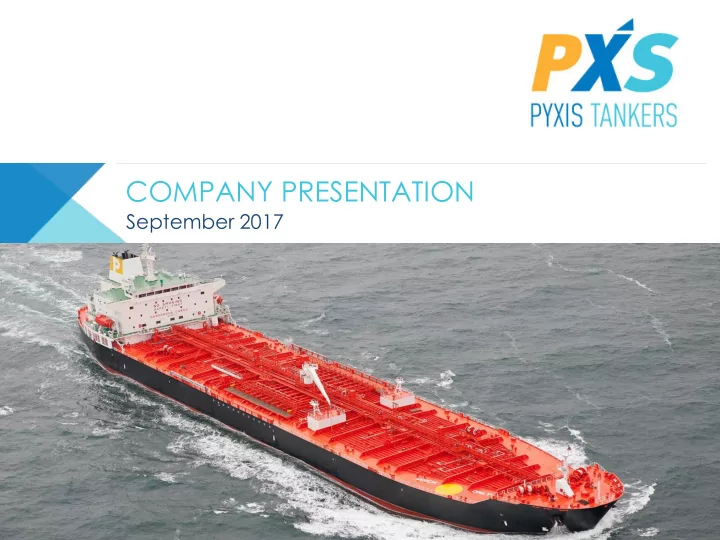
COMPANY PRESENTATION September 2017 DISCLAIMER FORWARD-LOOKING - - PowerPoint PPT Presentation
COMPANY PRESENTATION September 2017 DISCLAIMER FORWARD-LOOKING STATEMENTS & INFORMATION This presentation contains forward-looking statements and forward-looking information within the meaning of applicable securities laws. The words
This presentation contains forward-looking statements and forward-looking information within the meaning of applicable securities laws. The words “expected'', “estimated”, “scheduled”, “could”, “anticipated”, “long-term”, “opportunities”, “potential”, “continue”, “likely”, “may”, “will”, “positioned”, “possible”, “believe”, “expand” and variations of these terms and similar expressions, or the negative of these terms or similar expressions, are intended to identify forward-looking information or statements. But the absence of such words does not mean that a statement is not forward-looking. Forward-looking information is based on the opinions, expectations and estimates of management
assumptions and subject to a variety of risks and uncertainties and other factors that could cause actual events or results to differ materially from those projected in the forward-looking information. Although we believe that the expectations and assumptions on which such forward-looking statements and information are based are reasonable, you should not place undue reliance on the forward-looking statements and information because we cannot give any assurance that they will prove to be correct. Since forward-looking statements and information address future events and conditions, by their very nature they involve inherent risks and uncertainties and actual results and future events could differ materially from those anticipated or implied in such information. Factors that might cause or contribute to such discrepancy include, but are not limited to, the risk factors described in our Annual Report on Form 20-F for the year ended December 31, 2016 and our other filings with the Securities and Exchange Commission (the “SEC”). The forward-looking statements and information contained in this presentation are made as of the date hereof. We do not undertake any obligation to update publicly or revise any forward-looking statements or information, whether as a result
applicable securities laws. This presentation and any oral statements made in connection with it are for informational purposes only and do not constitute an offer to buy or sell our securities. For more complete information about us, you should read the information in this presentation together with our filings with the SEC, which may be accessed at the SEC’s website (http://www.sec.gov).
►Focus on modern medium range (“MR”) product tankers with “eco” features ►Young tanker fleet of six IMO-certified vessels - weighted average age of ~6.5 years ►Management may pursue a sale or other long-term strategy relating to small tankers Growth Oriented with Attractive, Modern Fleet ►Long-standing relationships with first-class customers worldwide ►As of September 15, 2017, 38% of remaining chartering days in 2017 are covered ►Positioned to capitalize when spot rates improve Reputable Customer Base & Diversified Chartering Strategy ►Disciplined fixed cost structure creates greater earnings power when rates improve ►Competitive total daily operational costs to peer group ►Moderate capitalization with low cost, long-lived bank debt Competitive Cost Structure & Moderate Capitalization ►Strong mgmt. team with 100+ years of combined industry and capital markets experience ►Founder/CEO has proven track record and is a major shareholder ►Board members consist of respected industry figures and/or with significant experience Experienced, Incentivized Management & Prominent Board ►Demand expected to outpace supply starting Q4 2017 through 2019 ►Lowest MR2 orderbook since 2000 ►Increased scrapping expected – 6.4% of the MR2 fleet greater than 20 years old ►New environmental regulations affecting older vessels could lead to further scrapping Favorable Industry Fundamentals Create Attractive Entry Point
Our mixed chartering strategy provides upside opportunities through spot trading when rates improve and stable, visible cash flows from time charters
Vessel Shipyard Vessel Type Carrying Capacity (dwt) Year Built Type of Charter Anticipated Redelivery Date (1) Pyxis Epsilon SPP / S.Korea MR 50,295 2015 Time
Pyxis Theta SPP / S.Korea MR 51,795 2013 Time
Pyxis Malou SPP / S.Korea MR 50,667 2009 Spot N/A Pyxis Delta Hyundai / S.Korea MR 46,616 2006 Time
Northsea Alpha (2) Kejin / China Small Tanker 8,615 2010 Spot N/A Northsea Beta (2) Kejin / China Small Tanker 8,647 2010 Spot N/A Total 216,635
6.5 Years
(1) These tables are dated as of September 15, 2017 and show gross rates and do not reflect commissions payable. (2) Management may pursue sale or other long-term strategy for small tankers.
As of September 15, 2017, 38% of anticipated available days for remainder of 2017 covered, excluding
Vessel Remainder of 2017 from September 15 September October November December Pyxis Epsilon $13,350 / Day Pyxis Theta $13,625 / Day Pyxis Malou N/A Pyxis Delta $13,000 / Day Northsea Alpha N/A Northsea Beta N/A Fixed Employment Charterers Optional Period Open Days
CUSTOMERS SENIOR LENDERS SHIPYARDS
► Joined Pyxis affiliates in 2013; 19+ years experience in strategic corporate shipping transactions ► Previous 5 years securities and M&A partner at Watson Farley & Williams with particular focus in shipping industry ► Advised on complex international corporate shipping transactions in New York offices of Orrick, Herrington & Sutcliffe LLP and Healy & Baillie, LLP and in New York and London offices of Weil, Gotshal & Manges LLP since 1997 ► Former member of Board of Governors & Vice President of the Connecticut Maritime Association ► Joined Pyxis affiliates in 2008; 25+ years of experience in the shipping industry ► Co-founder of Navbulk Shipping S.A., a start-up dry bulk company ► 5 years as Financial Director of Neptune Lines, a car carrier company ► 16 years in various financial and operational positions for other ship owning and services companies ► 25+ years of experience in owning, operating and managing within various shipping sectors, including product, dry bulk, chemical, as well as salvage and towage ► Founder of Pyxis in 2015 and Pyxis Maritime Corp. in 2007 ► For the last 16 years, Managing Director & Principal of KONKAR SHIPPING AGENCIES S.A., an Athens- based dry bulk owner-operator established in 1968 ► Joined Pyxis affiliates in 2015; 35 years of commercial, investment and merchant banking experience ► Previous investment banking positions include Nordea Markets (Oslo & NY)–Global Sector Head- Shipping, and Oppenheimer (NY)–Head of Energy & Transportation
Antonios “Tony” Backos SVP for Corporate Development, General Counsel & Secretary Konstantinos “Kostas” Lytras Chief Operating Officer Valentios “Eddie” Valentis Chairman & CEO Henry Williams CFO & Treasurer
Administrative, Commercial & Ship Management Services (1) Administrative, Commercial & Ship Management Fees
(1) As an affiliate, provides the commercial management for the fleet and supervises the crewing and technical management performed by ITM for all our vessels (2) Provides technical management for all our vessels
Technical Management (2)
►Expand fleet by targeting balanced capital structure of debt and equity ►Maintain commercial lending and expand capital markets relationships ►Meet charterers’ preference for modern and eco tankers, which offer more
►Maintain high standards ensuring high level of safety, customer service and support ►Continue solid margins and ship level financial discipline within Pyxis ►Focus on acquisition of IMO II and III MR2 class product tankers of eight years of age or less built in Tier 1 Asian shipyards ►Prudently grow company size as soon as practical
Grow the Fleet Opportunistically Maintain Financial Flexibility Focus on the Needs
►Employ mixed chartering strategy between time and spot ►Maintain optionality – spot exposure offers upside during periods of market strength ►Diversify charters by customer and staggered duration
Utilize Portfolio Approach to Commercial Management
Source: Drewry, May 2017
Dirty Products Clean Products
Crude
Most products tankers can switch between clean and dirty products when the tanks are carefully cleaned. Gasoil is a good clean up cargo when switching from dirty to clean products. More sophisticated product tankers work at this end of the market, some with the ability to carry products and certain chemicals. Crude tankers carry only crude oil and fuel oils. Non-oil substances now covered by revised IBC Code. To carry chemicals, an IMO Certificate of Fitness is required.
Veg Oil/Light Chemicals
Source: Drewry, May 2017 * Compound annual growth rate
1,500 1,700 1,900 2,100 2,300 2,500 2,700 2,900 3,100 3,300 600 650 700 750 800 850 900 950 1,000 1,050 2006 2007 2008 2009 2010 2011 2012 2013 2014 2015 2016 Seaborne Product Trade - Million Tons (Left Hand Scale) Ton Mile Demand - Billion Ton Miles (Right Hand Scale)
Source: Drewry, May 2017
Million Barrels per Day
(0.5) 0.0 0.5 1.0 1.5 2.0 2.5 2017 2018 2019 2020 2021 2022
Source: Drewry, May 2017
New Refineries R
Source: Drewry, May 2017
Million Barrels per Day
0.0 1.0 2.0 3.0 4.0 5.0 6.0 United States Saudi Arabia India
vessels) of the worldwide fleet, lowest since 2000
at shipyards, limited availability of capital and would-be buyers exposure to weaker shipping segments
without giving effect to scrapping of older vessels and slippage of deliveries
Source: Drewry, May 2017
Number of Vessels
10 20 30 40 50 Medium Range 2 (MR2) Medium Range 1 (MR1) 2017 2018 2019 2020+
Source: Drewry, May 2017
replacement ability
0% 5% 10% 15% 20% 25% 30% 35% 40% < 5 Yrs 5-10 Yrs 10-15 Yrs 15-20 Yrs 20-25 Yrs 25+ Yrs MR1 MR2
Source: Drewry, May 2017
Source: Drewry, May 2017 * Please see Exhibit I - Non-GAAP Measures and Definitions
USD per Day
5,000 10,000 15,000 20,000 25,000 30,000 Jan-08 Jan-09 Jan-10 Jan-11 Jan-12 Jan-13 Jan-14 Jan-15 Jan-16 Jan-17 10 Year Average MR2 5,000 10,000 15,000 20,000 25,000 30,000 35,000 Jan Feb Mar Apr May Jun Jul Aug Sep Oct Nov Dec 2014 2015 2016 2017YTD 2008 - May 2017 Average
USD per Day
2008-2016 MR2 Avg. Rate Average $13,006 Low $1,800 High $32,400 May 2017 $11,200 2008-2016 MR2 Avg. Rate Average $15,374 Low $10,800 High $25,000 May 2017 $13,250
USD Million
0.0 10.0 20.0 30.0 40.0 50.0 60.0 2006 2007 2008 2009 2010 2011 2012 2013 2014 2015 2016 2017 NB Price SH Price NB Price Average 06-17 SH Price Average 06-17
* Source: Average shipbroker indications as of mid September 2017 ** Exclusive of higher design specifications, yard supervision costs and spares
Six Months ended June 30, Three Months ended June 30, 2016 2017 2016 2017 In ‘000 USD except for daily TCE rates Time / spot charter revenue mix 84% / 16% 31% / 69% 82% / 18% 35% / 65% Voyage revenues $16,341 $16,170 $7,893 $8,455 Voyage related costs & commissions (1,680) (5,590) (875) (2,584) Time charter equivalent revenues * $14,661 $10,580 $7,018 $5,871 Net income / (loss) $1,482 ($2,471) $407 ($768) Earnings / (loss) per share (basic & diluted) ** $0.08 ($0.14) $0.02 ($0.04) EBITDA *,** $5,881 $1,746 $2,608 $1,359 Total operating days 1,052 984 519 504 Daily time charter equivalent rate * $13,936 $10,752 $13,523 $11,648 Fleet Utilization 96.3% 90.6% 95.1% 92.3%
* Subject to rounding; Please see Exhibit I – Non-GAAP Measures and Definitions ** Includes write-off of terminated F-1 offering costs of $329; excluding same, EBITDA and Loss/share would have been $2,075 and ($0.12), respectively for 6M17, and $1,688 and ($0.02), respectively for Q217
(amounts in $) Six Months Ended June 30, Three Months Ended June 30, 2016 2017 2016 2017 Eco-Efficient MR2: (2 of our vessels)
Average TCE * 15,741 13,151 15,783 12,354 Opex * 5,885 5,818 5,437 6,012 Utilization % 99.7% 89.0% 100.0% 93.4%
Eco-Modified MR2: (1 of our vessels)
TCE 15,839 13,475 13,920 16,046 Opex 6,628 6,669 6,703 6,989 Utilization % 97.3% 94.5% 94.5% 91.2%
Standard MR2: (1 of our vessels)
TCE 18,207 11,483 17,678 12,788 Opex 6,977 5,778 7,509 5,628 Utilization % 99.5% 98.3% 98.9% 100.0%
Small Tankers: (2 of our vessels)
Average TCE 8,605 6,380 8,433 7,969 Opex 5,341 4,942 5,364 5,171 Utilization % 90.9% 86.5% 88.5% 87.9%
Fleet: (6 of our vessels)
TCE 13,936 10,752 13,523 11,648 Opex 6,010 5,661 5,969 5,830 Utilization % 96.3% 90.6% 95.1% 92.3%
* Please see Exhibit I – Non-GAAP Measures and Definitions
Six Months Ended June 30, 2017 Three Months Ended June 30, 2017 Eco Eco Modified Efficient Modified Efficient (amounts in $/day) Opex * $6,669 $5,818 $6,989 $6,012 Technical & commercial management fees 753 753 751 751 G&A expenses ** 1,553 1,553 1,681 1,681 Total daily operational costs per vessel ** $8,975 $8,124 $9,421 $8,444
* Please see Exhibit I - Non-GAAP Measures and Definitions ** Includes write-off of terminated F-1 offering costs of $329K; excluding same, daily G&A expenses for 6M17 and Q217, would have been $1,250 and $1,078, respectively. For Q217, total daily
At June 30, 2017 In ‘000 USD Cash and cash equivalents, including restricted cash $ 5,556 Bank debt, net of deferred financing fees 69,787 Promissory note 2,500 Total funded debt $ 72,287 Stockholders' equity 46,282 Total capitalization $ 118,569 Net funded debt $ 66,731 Total funded debt / total capitalization 61.0% Net funded debt / total capitalization 56.3%
loans to September 2022 under the same applicable margin, but with an extended amortization schedule.
▪
Growth Oriented with Attractive, Modern Fleet Reputable Customer Base & Diversified Chartering Strategy Competitive Cost Structure & Moderate Capitalization Experienced, Incentivized Management & Prominent Board Favorable Industry Fundamentals Create Attractive Entry Point
(in thousands of U.S. Dollars) Six Months Ended June 30, Three Months Ended June 30, 2016 2017 2016 2017 Reconciliation of Net income / (loss) to EBITDA Net income / (loss) $ 1,482 $ (2,471) $ 407 $ (768) Depreciation 2,869 2,761 1,434 1,388 Amortization of special survey costs 124 36 62 18 Interest and finance costs, net 1,406 1,420 705 721 EBITDA $ 5,881 $ 1,746 $ 2,608 $ 1,359
we terminated in July 2017. If we were to exclude these costs, our EBITDA for the six and three-month periods ended June 30, 2017, would have been $2,075 and $1,688, respectively.
Earnings before interest, taxes, depreciation and amortization (“EBITDA”) represents the sum of net income / (loss), interest and finance costs, depreciation and amortization and, if any, income taxes during a period. EBITDA is not a recognized measurement under U.S. GAAP. EBITDA is presented as we believe that it provides investors with a means of evaluating and understanding how
substitutes for, or superior to financial measures prepared in accordance with U.S. GAAP. In addition, this non-GAAP measure does not have standardized meaning, and is therefore, unlikely to be comparable to similar measures presented by other companies. Daily time charter equivalent (“TCE”) is a shipping industry performance measure of the average daily revenue performance of a vessel on a per voyage basis. TCE is not calculated in accordance with U.S. GAAP. We utilize TCE because we believe it is a meaningful measure to compare period-to-period changes in our performance despite changes in the mix of charter types (i.e., spot charters, time charters and bareboat charters) under which our vessels may be employed between the periods. Our management also utilizes TCE to assist them in making decisions regarding employment of the vessels. We calculate TCE by dividing voyage revenues after deducting voyage related costs and commissions by operating days for the relevant period. Voyage related costs and commissions primarily consist of brokerage commissions, port, canal and fuel costs that are unique to a particular voyage, which would otherwise be paid by the charterer under a time charter contract. Vessel operating expenses (“Opex”) per day are our vessel operating expenses for a vessel, which primarily consist of crew wages and related costs, insurance, lube oils, communications, spares and consumables, tonnage taxes as well as repairs and maintenance, divided by the ownership days in the applicable period. We calculate fleet utilization (“Utilization”) by dividing the number of operating days during a period by the number of available days during the same period. We use fleet utilization to measure our efficiency in finding suitable employment for our vessels and minimizing the amount of days that our vessels are off-hire for reasons other than scheduled repairs or repairs under guarantee, vessel upgrades, special surveys and intermediate dry-dockings or vessel positioning. Ownership days are the total number of days in a period during which we owned each of the vessels in our fleet. Available days are the number of ownership days in a period, less the aggregate number of days that our vessels were off-hire due to scheduled repairs or repairs under guarantee, vessel upgrades or special surveys and intermediate dry-dockings and the aggregate number of days that we spent positioning our vessels during the respective period for such repairs, upgrades and surveys. Operating days are the number of available days in a period, less the aggregate number of days that our vessels were off-hire or out of service due to any reason, including technical breakdowns and unforeseen circumstances.