Biomolecular Interaction Analysis (BIA) Core Facility Applications - - PDF document

biomolecular interaction analysis bia core facility
SMART_READER_LITE
LIVE PREVIEW

Biomolecular Interaction Analysis (BIA) Core Facility Applications - - PDF document

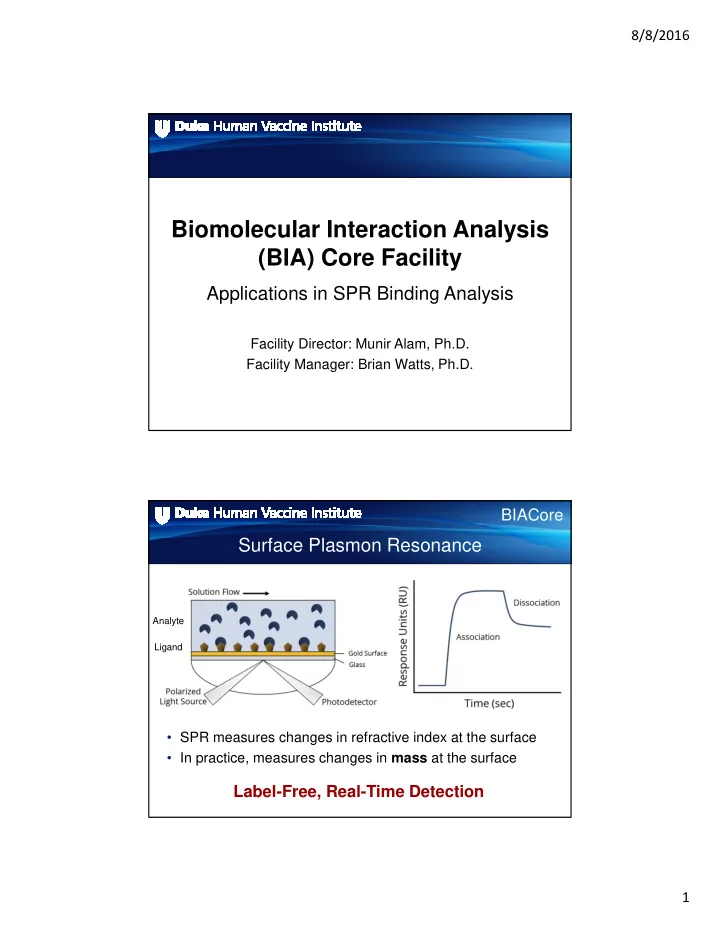
8/8/2016 Biomolecular Interaction Analysis (BIA) Core Facility Applications in SPR Binding Analysis Facility Director: Munir Alam, Ph.D. Facility Manager: Brian Watts, Ph.D. BIACore Surface Plasmon Resonance Analyte Ligand SPR measures


slide-1
SLIDE 1

8/8/2016 1

Biomolecular Interaction Analysis (BIA) Core Facility

Facility Director: Munir Alam, Ph.D. Facility Manager: Brian Watts, Ph.D.

Applications in SPR Binding Analysis

  • SPR measures changes in refractive index at the surface
  • In practice, measures changes in mass at the surface

Surface Plasmon Resonance

BIACore Label-Free, Real-Time Detection

Ligand Analyte

slide-2
SLIDE 2

8/8/2016 2

Surface Plasmon Resonance

BIACore

KD = koff kon

PDB: 1CJ1

BIACore

Biomolecular Systems

  • Can measure protein interactions with
  • Proteins and peptides
  • DNA and RNA
  • Small molecules
  • Lipid membranes, micelles, and vesicles
  • Carbohydrates
  • Synthetic polymers
  • Viruses
  • Whole cells
  • Samples can be purified or complex
  • For affinity/kinetics – SEC purified (>95%)
  • Cell culture medium
  • Clinical sera or bodily fluids
slide-3
SLIDE 3

8/8/2016 3

5

Experimental Considerations

BIACore

  • How to functionalize a binding partner to the sensor chip?
  • 1. Immobilization
  • 2. Binding
  • What type of assay/design?
  • 3. Regeneration
  • How to remove bound analyte without damaging ligand?

6

SPR Sensor Chips

BIACore

Glass Gold CM-Dextran

  • Carboxymethylated Dextran
  • Biocompatible and Robust
  • Low non-specific binding
  • Available in varying dextran lengths

and CM density

  • CM3, CM4, CM5, CM7
  • C1 – Carboxylated gold (no dextran)
  • Direct Immobilization
  • Reactive carboxyl handle
  • Amine Coupling – EDC/NHS
  • Thiol Coupling – Disulfide
  • Thiol Coupling – Maleimide
  • Aldehyde Coupling

CM Dextran C1

slide-4
SLIDE 4

8/8/2016 4

7

SPR Sensor Chips

BIACore

  • High-Affinity Ligand Capture
  • Modify CM dextran w/ capture molecule
  • Streptavidin-Biotin (SA chip)
  • α-Fc or Protein A (Prot A chip)
  • α-His or NTA (NTA chip)
  • α-GST
  • α-FLAG
  • Applicable to any high affinity tag
  • Hydrophobic Adsorption
  • Sensor Chip HPA – Alkanethiol gold
  • Lipid bilayers or monolayers
  • Sensor Chip L1 - Lipophilic residues on CM5
  • Captured vesicles or micelles

8

Direct vs. Capture

BIACore

Immob. Binding Regeneration

Direct Immobilization

Immob. Capture Binding Regeneration

Ligand Capture

slide-5
SLIDE 5

8/8/2016 5

9

Direct vs. Capture

BIACore

  • Direct Immobilization
  • Simple and Robust
  • Immob. level less flexible
  • Requires less ligand
  • Requires regeneration scouting
  • Ligand Capture
  • More complex design
  • Can fine-tune ligand immob. level
  • Takes advantage of affinity tags
  • Regen. conditions may be known
  • Each cycle requires fresh ligand

10

Regeneration

BIACore

  • Injection of a buffer designed to disrupt bound complex
  • Often a trial and error process to identify ideal conditions
  • Acidic: 10 mM Glycine-HCl (pH 1.5-3.0)
  • Basic: 1-100 mM NaOH
  • Ionic: 4 M MgCl2, 5 M NaCl
  • Chaotropic: 2 M Guanidine-HCl, 1 M Urea
  • Detergent: ≤ 0.5% SDS, ≤ 0.5% Tween 20
  • Chelating: 20 mM EDTA
slide-6
SLIDE 6

8/8/2016 6

11

Regeneration

BIACore

  • Regeneration too weak
  • Incomplete analyte removal
  • Increasing baseline
  • Reduced binding response
  • Regeneration too strong
  • Complete analyte removal
  • Loss of ligand activity
  • Reduced binding capacity

12

Experimental Considerations

BIACore

  • Direct Immobilization vs. High Affinity Capture
  • Immobilization level
  • Low (Kinetics) vs. High (Screening or LMW Affinity)
  • 1. Immobilization
  • 2. Binding
  • Desired experimental outcome
  • Assay design
  • Protein purity and concentration
  • Protein quantity (~100 µg)
  • 3. Regeneration
  • Mildest conditions necessary
  • Complex and surface ligand stability
slide-7
SLIDE 7

8/8/2016 7

BIACore

SPR Experiments

  • Specificity and Screening
  • Yes/No Binding
  • Ranking of binding response
  • Kinetics and Affinity
  • Multi-cycle or single-cycle
  • Direct binding
  • Steady-State Affinity
  • Solution-based Affinity
  • Concentration
  • Surface Competition
  • Solution Inhibition
  • Epitope Mapping
  • Conformational Changes
  • Thermodynamics

KD = koff kon

BIACore

BIA Core Facility

Biacore 3000 Biacore T200

gehealthcare.com/biacore, fortebio.com

Biacore 4000 Biacore S200 ForteBio Octet-RED96

slide-8
SLIDE 8

8/8/2016 8

BIACore

BIA Core Facility

Biacore 3000

  • Two (2) 3000s available
  • Four (4) serial flow cells
  • Simultaneous detection of

up to 4 interactions per injection cycle

  • Autosampler
  • Senstivity down to 10 RU

gehealthcare.com/biacore

µ-fluidic cartridge Serial Flow Cells

BIACore

BIA Core Facility

Biacore 4000

  • Four (4) independent flow cells

each equipped with 5 detection spots

  • Simultaneous detection of up

to 16 interactions per injection cycle

  • Autosampler supports 96- and

384-well plates in 10-plate hotel

  • Designed for high-throughput

analyses

  • Approved for clinically derived

and/or infectious samples

gehealthcare.com/biacore

Independent Flow Cells with detection spots

slide-9
SLIDE 9

8/8/2016 9

BIACore

BIA Core Facility

Biacore T200

  • Four (4) serial flow cells
  • Simultaneous detection of

up to 4 interactions per injection cycle

  • Autosampler supports 96-

and 384-well plates

  • Integrated degasser
  • Sensitivity down to 1 RU

allows detection of small molecule analytes

gehealthcare.com/biacore

BIACore

BIA Core Facility

Biacore S200

  • Four (4) serial flow cells
  • Autosampler supports 96- and

384-well plates

  • Integrated degasser
  • Increased sensitivity below 1 RU

allows for improved detection of small molecule analytes

  • Specifically designed for high

throughput screening of LMW analytes

gehealthcare.com/biacore

slide-10
SLIDE 10

8/8/2016 10

BIACore

BIA Core Facility

ForteBio Octet-RED96

  • Biolayer Interferometry (BLI)
  • Generates similar results as SPR
  • Ligand-coated biosensor tips

submerged in a 96-well plate

  • Parallel processing of up to 96

interactions

  • No need for regeneration
  • Crude sample compatibility

fortebio.com

BIACore

BIA Core Facility

How to Utilize the BIA Core

  • Sample Submission
  • Available for the 3000, 4000, S200,

and BLI

  • Trained technicians will optimize

experiments and complete data analysis.

  • Independent Use
  • Available for the T200
  • Specialized training and support
  • Reserve T200 through

CoreResearch@Duke

  • Available to researchers 24/7

gehealthcare.com/biacore