Combinational Circuits Bit Equality Acyclic Network Bit equal a - - PDF document

combinational circuits bit equality
SMART_READER_LITE
LIVE PREVIEW

Combinational Circuits Bit Equality Acyclic Network Bit equal a - - PDF document

Overview of Logic Design Fundamental Hardware Requirements Communication Computer Architecture: Logic Design How to get values from one place to another Computation Storage CSci 2021: Machine Architecture and Organization March


slide-1
SLIDE 1

– 1 – CS:APP3e

Computer Architecture: Logic Design

CSci 2021: Machine Architecture and Organization March 20th-23rd, 2018 Your instructor: Stephen McCamant Based on slides originally by: Randy Bryant and Dave O’Hallaron

– 2 – CS:APP3e

Overview of Logic Design

Fundamental Hardware Requirements

◼ Communication ⚫ How to get values from one place to another ◼ Computation ◼ Storage

Bits are Our Friends

◼ Everything expressed in terms of values 0 and 1 ◼ Communication ⚫ Low or high voltage on wire ◼ Computation ⚫ Compute Boolean functions ◼ Storage ⚫ Store bits of information – 3 – CS:APP3e

Digital Signals

◼ Use voltage thresholds to extract discrete values from

continuous signal

◼ Simplest version: 1-bit signal ⚫ Either high range (1) or low range (0) ⚫ With guard range between them ◼ Not strongly affected by noise or low quality circuit elements ⚫ Can make circuits simple, small, and fast

Voltage Time 1

– 4 – CS:APP3e

Computing with Logic Gates

◼ Outputs are Boolean functions of inputs ◼ Respond continuously to changes in inputs ⚫ With some, small delay

a b

  • ut

a b

  • ut

a

  • ut
  • ut = a && b
  • ut = a || b
  • ut = !a

And Or Not

Voltage Time a b a && b Rising Delay Falling Delay

– 5 – CS:APP3e

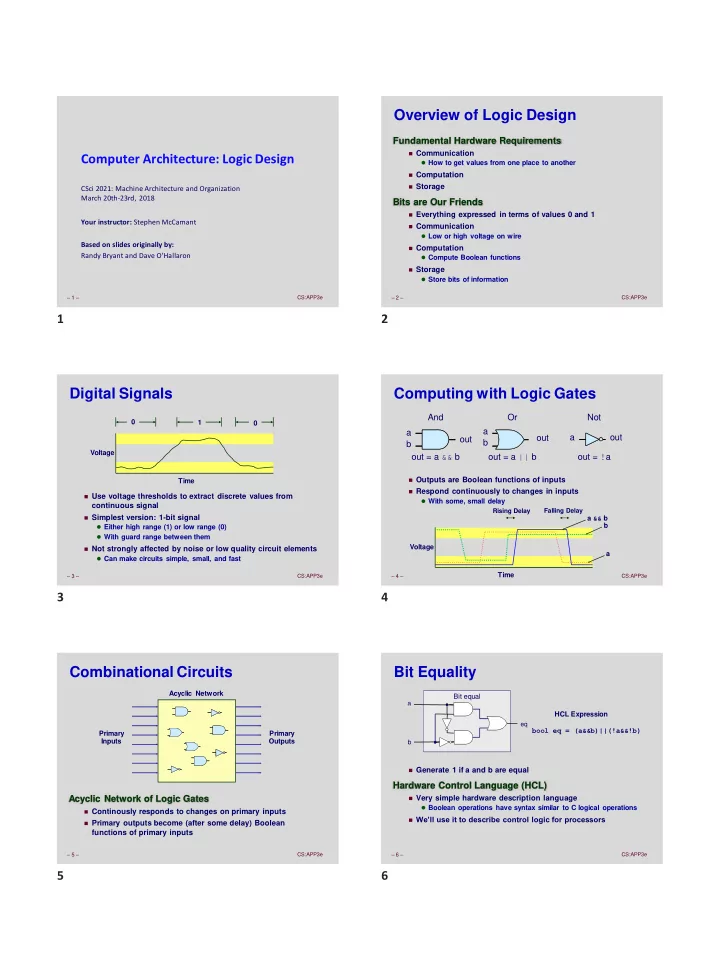
Combinational Circuits

Acyclic Network of Logic Gates

◼ Continously responds to changes on primary inputs ◼ Primary outputs become (after some delay) Boolean

functions of primary inputs Acyclic Network Primary Inputs Primary Outputs

– 6 – CS:APP3e

Bit Equality

◼ Generate 1 if a and b are equal

Hardware Control Language (HCL)

◼ Very simple hardware description language ⚫ Boolean operations have syntax similar to C logical operations ◼ We’ll use it to describe control logic for processors

Bit equal a b eq bool eq = (a&&b)||(!a&&!b) HCL Expression

1 2 3 4 5 6

slide-2
SLIDE 2

– 7 – CS:APP3e

Word Equality

◼ 64-bit word size ◼ HCL representation ⚫ Equality operation ⚫ Generates Boolean value b63 Bit equal a63 eq63 b62

Bit equal a62 eq62 b1 Bit equal a1 eq1 b0 Bit equal a0 eq0 Eq

=

B A Eq Word-Level Representation bool Eq = (A == B) HCL Representation

– 8 – CS:APP3e

Bit-Level Multiplexor

◼ Control signal s ◼ Data signals a and b ◼ Output a when s=1, b when s=0

Bit MUX b s a

  • ut

bool out = (s&&a)||(!s&&b) HCL Expression

– 9 – CS:APP3e

Exercise Break: 4-input Mux

  • Suppose we want to choose between 4 signals, D0,

D1, D2, and D3, using two selector bits S0 and S1

  • Can you build this out of 2-input muxes?

D0 D1 D2 D3 S0 S1

  • ut

MUX MUX MUX

– 10 – CS:APP3e

Word Multiplexor

◼ Select input word A or B

depending on control signal s

◼ HCL representation ⚫ Case expression ⚫ Series of test : value pairs ⚫ Output value for first

successful test Word-Level Representation HCL Representation b63 s a63

  • ut63

b62 a62

  • ut62

b0 a0

  • ut0

int Out = [ s : A; 1 : B; ]; s B A Out

MUX – 11 – CS:APP3e

HCL Word-Level Examples

◼ Find minimum of three

input words

◼ HCL case expression ◼ Final case guarantees

match A Min3

MIN3

B C int Min3 = [ A < B && A < C : A; B < A && B < C : B; 1 : C; ]; D0 D3 Out4 s0 s1

MUX4

D2 D1

◼ Select one of 4 inputs

based on two control bits

◼ HCL case expression ◼ Simplify tests by

assuming sequential matching int Out4 = [ !s1&&!s0: D0; !s1 : D1; !s0 : D2; 1 : D3; ]; Minimum of 3 Words 4-Way Multiplexor

– 12 – CS:APP3e OF ZF CF OF ZF CF OF ZF CF OF ZF CF

Arithmetic Logic Unit

◼ Combinational logic ⚫ Continuously responding to inputs ◼ Control signal selects function computed ⚫ Corresponding to 4 arithmetic/logical operations in Y86-64 ◼ Also computes values for condition codes A L U Y X X + Y A L U Y X X - Y 1 A L U Y X X & Y 2 A L U Y X X ^ Y 3

A B A B A B A B

7 8 9 10 11 12

slide-3
SLIDE 3

– 13 – CS:APP3e

V1 0.1 0.2 0.3 0.4 0.5 0.6 0.7 0.8 0.9 1 0.1 0.2 0.3 0.4 0.5 0.6 0.7 0.8 0.9 1

Vin

V1

Storing 1 Bit

Bistable Element Q+ Q– q !q q = 0 or 1 Vin V1 V2

0.1 0.2 0.3 0.4 0.5 0.6 0.7 0.8 0.9 1 0.1 0.2 0.3 0.4 0.5 0.6 0.7 0.8 0.9 1

Vin

V1 V2

– 14 – CS:APP3e

0.1 0.2 0.3 0.4 0.5 0.6 0.7 0.8 0.9 1 0.1 0.2 0.3 0.4 0.5 0.6 0.7 0.8 0.9 1

Vin

V1 V2

0.1 0.2 0.3 0.4 0.5 0.6 0.7 0.8 0.9 1 0.1 0.2 0.3 0.4 0.5 0.6 0.7 0.8 0.9 1

Vin

Vin V2

Storing 1 Bit (cont.)

Bistable Element Q+ Q– q !q q = 0 or 1 Vin V1 V2 Vin V1 V2 Vin = V2 Stable 0 Stable 1 Metastable

– 15 – CS:APP3e

Physical Analogy

0.1 0.2 0.3 0.4 0.5 0.6 0.7 0.8 0.9 1 0.1 0.2 0.3 0.4 0.5 0.6 0.7 0.8 0.9 1

Vin

V1 V2

0.1 0.2 0.3 0.4 0.5 0.6 0.7 0.8 0.9 1 0.1 0.2 0.3 0.4 0.5 0.6 0.7 0.8 0.9 1

Vin

Vin V2

Stable 0 Stable 1 Metastable Stable left Stable right Metastable

– 20 – CS:APP3e

Registers

◼ Stores word of data ⚫ Different from program registers seen in assembly code ◼ Collection of edge-triggered latches ◼ Loads input on rising edge of clock

I O Clock

D C Q+ D C Q+ D C Q+ D C Q+ D C Q+ D C Q+ D C Q+ D C Q+

i7 i6 i5 i4 i3 i2 i1 i0

  • 7
  • 6
  • 5
  • 4
  • 3
  • 2
  • 1

Clock Structure

– 21 – CS:APP3e

Register Operation

◼ Stores data bits ◼ For most of time acts as barrier between input and output ◼ As clock rises, loads input

State = x Rising clock

Output = x Input = y x

State = y Output = y y

– 22 – CS:APP3e

State Machine Example

◼ Accumulator

circuit

◼ Load or

accumulate on each cycle

  • Comb. Logic

A L U Out

MUX 1

Clock In Load

x0 x1 x2 x3 x4 x5 x0 x0+x1 x0+x1+x2 x3 x3+x4 x3+x4+x5

Clock Load In Out

13 14 15 20 21 22

slide-4
SLIDE 4

– 23 – CS:APP3e

Random-Access Memory

◼ Stores multiple words of memory ⚫ Address input specifies which word to read or write ◼ Register file ⚫ Holds values of program registers ⚫ %rax, %rsp, etc. ⚫ Register identifier serves as address

» ID 15 (0xF) implies no read or write performed

◼ Multiple Ports ⚫ Can read and/or write multiple words in one cycle

» Each has separate address and data input/output

Register file

A B W dstW srcA valA srcB valB valW

Read ports Write port Clock – 24 – CS:APP3e

Register File Timing

Reading

◼ Like combinational logic ◼ Output data generated based on

input address

⚫ After some delay

Writing

◼ Like register ◼ Update only as clock rises Register file

A B srcA valA srcB valB

y 2

Register file

W dstW valW

Clock

x 2 Rising clock

 

Register file

W dstW valW

Clock

y 2 x 2 x 2

– 25 – CS:APP3e

Hardware Control Language

◼ Very simple hardware description language ◼ Can only express limited aspects of hardware operation ⚫ Parts we want to explore and modify

Data Types

◼ bool: Boolean ⚫ a, b, c, … ◼ int: words ⚫ A, B, C, …

⚫ Does not specify word size---bytes, 64-bit words, …

Statements

◼ bool a = bool-expr ; ◼ int A = int-expr ; – 26 – CS:APP3e

HCL Operations

◼ Classify by type of value returned

Boolean Expressions

◼ Logic Operations ⚫ a && b, a || b, !a ◼ Word Comparisons ⚫ A == B, A != B, A < B, A <= B, A >= B, A > B ◼ Set Membership ⚫ A in { B, C, D }

» Same as A == B || A == C || A == D

Word Expressions

◼ Case expressions ⚫ [ a : A; b : B; c : C ] ⚫ Evaluate test expressions a, b, c, … in sequence ⚫ Return word expression A, B, C, … for first successful test – 27 – CS:APP3e

Summary

Computation

◼ Performed by combinational logic ◼ Computes Boolean functions ◼ Continuously reacts to input changes

Storage

◼ Registers ⚫ Hold single words ⚫ Loaded as clock rises ◼ Random-access memories ⚫ Hold multiple words ⚫ Possible multiple read or write ports ⚫ Read word when address input changes ⚫ Write word as clock rises

23 24 25 26 27