Introduction CPU performance factors Instruction count - - PDF document

introduction
SMART_READER_LITE
LIVE PREVIEW

Introduction CPU performance factors Instruction count - - PDF document

Morgan Kaufmann Publishers 22 March, 2012 4.1 Introduction Introduction CPU performance factors Instruction count Determined by ISA and compiler CPI and Cycle time Determined by CPU hardware


slide-1
SLIDE 1

Morgan Kaufmann Publishers 22 March, 2012 Chapter 4 — The Processor 1

  • Chapter 4 — The Processor — 2

Introduction

CPU performance factors

Instruction count

Determined by ISA and compiler

CPI and Cycle time

Determined by CPU hardware

We will examine two MIPS implementations

A simplified version A more realistic pipelined version

Simple subset, shows most aspects

Memory reference: , Arithmetic/logical: , , , , Control transfer: ,

§4.1 Introduction

Chapter 4 — The Processor — 3

Instruction Execution

PC → instruction memory, fetch instruction Register numbers → register file, read registers Depending on instruction class

Use ALU to calculate

Arithmetic result Memory address for load/store Branch target address

Access data memory for load/store PC ← target address or PC + 4 Chapter 4 — The Processor — 4

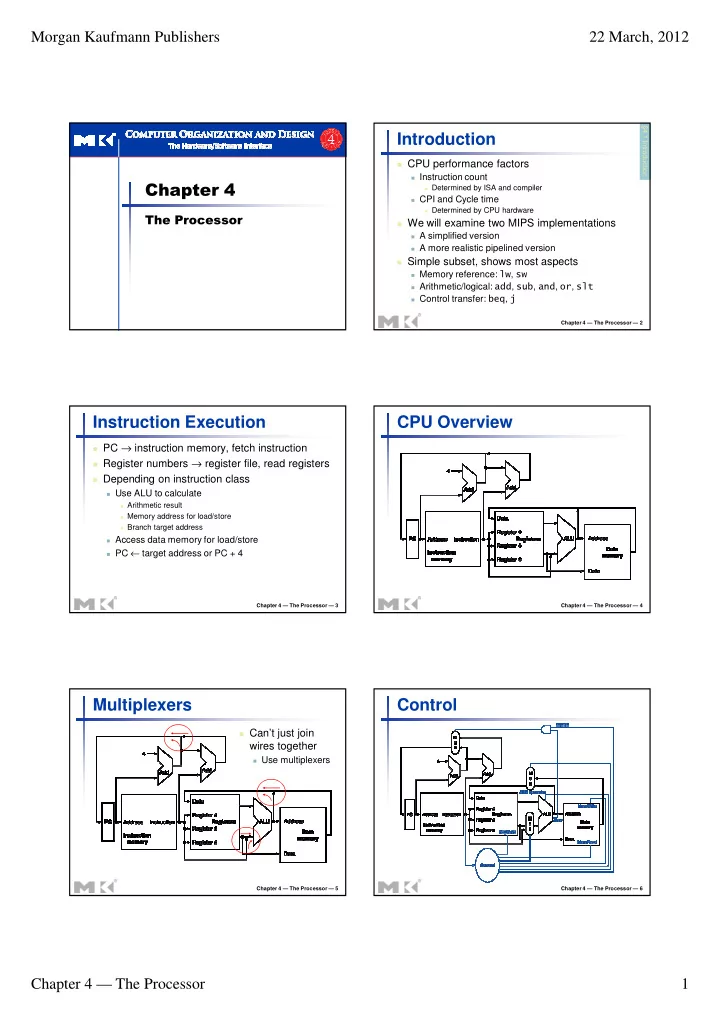
CPU Overview

Chapter 4 — The Processor — 5

Multiplexers

Can’t just join

wires together

Use multiplexers Chapter 4 — The Processor — 6

Control

slide-2
SLIDE 2

Morgan Kaufmann Publishers 22 March, 2012 Chapter 4 — The Processor 2

Chapter 4 — The Processor — 7

Logic Design Basics

§4.2 Logic Design Conventions Information encoded in binary

Low voltage = 0, High voltage = 1 One wire per bit Multi-bit data encoded on multi-wire buses

Combinational element

Operate on data Output is a function of input

State (sequential) elements

Store information Chapter 4 — The Processor — 8

Combinational Elements

AND-gate

Y = A & B

A B Y I0 I1 Y

M u x

S Multiplexer

Y = S ? I1 : I0

A B Y + A B Y ALU F Adder

Y = A + B

Arithmetic/Logic Unit

Y = F(A, B) Chapter 4 — The Processor — 9

Sequential Elements

Register: stores data in a circuit

Uses a clock signal to determine when to

update the stored value

Edge-triggered: update when Clk changes

from 0 to 1

D Clk Q

Clk D Q

Chapter 4 — The Processor — 10

Sequential Elements

Register with write control

Only updates on clock edge when write

control input is 1

Used when stored value is required later

D Clk Q Write

Write D Q Clk

Chapter 4 — The Processor — 11

Clocking Methodology

Combinational logic transforms data during

clock cycles

Between clock edges Input from state elements, output to state

element

Longest delay determines clock period Chapter 4 — The Processor — 12

Building a Datapath

Datapath

Elements that process data and addresses

in the CPU

Registers, ALUs, mux’s, memories, …

We will build a MIPS datapath

incrementally

Refining the overview design

§4.3 Building a Datapath

slide-3
SLIDE 3

Morgan Kaufmann Publishers 22 March, 2012 Chapter 4 — The Processor 3

Chapter 4 — The Processor — 13

Instruction Fetch

32-bit register Increment by 4 for next instruction

Chapter 4 — The Processor — 14

R-Format Instructions

Read two register operands Perform arithmetic/logical operation Write register result

Chapter 4 — The Processor — 15

Load/Store Instructions

Read register operands Calculate address using 16-bit offset

Use ALU, but sign-extend offset

Load: Read memory and update register Store: Write register value to memory

Chapter 4 — The Processor — 16

Branch Instructions

Read register operands Compare operands

Use ALU, subtract and check Zero output

Calculate target address

Sign-extend displacement Shift left 2 places (word displacement) Add to PC + 4

Already calculated by instruction fetch

Chapter 4 — The Processor — 17

Branch Instructions

Just re-routes wires Sign-bit wire replicated

Chapter 4 — The Processor — 18

Composing the Elements

First-cut data path does an instruction in

  • ne clock cycle

Each datapath element can only do one

function at a time

Hence, we need separate instruction and data

memories

Use multiplexers where alternate data

sources are used for different instructions

slide-4
SLIDE 4

Morgan Kaufmann Publishers 22 March, 2012 Chapter 4 — The Processor 4

Chapter 4 — The Processor — 19

R-Type/Load/Store Datapath

Chapter 4 — The Processor — 20

Full Datapath

Chapter 4 — The Processor — 21

ALU Control

ALU used for

Load/Store: F = add Branch: F = subtract R-type: F depends on funct field

§4.4 A Simple Implementation Scheme ALU control Function 0000 AND 0001 OR 0010 add 0110 subtract 0111 set-on-less-than 1100 NOR

Chapter 4 — The Processor — 22

ALU Control

Assume 2-bit ALUOp derived from opcode

Combinational logic derives ALU control

  • pcode

ALUOp Operation funct ALU function ALU control lw 00 load word XXXXXX add 0010 sw 00 store word XXXXXX add 0010 beq 01 branch equal XXXXXX subtract 0110 R-type 10 add 100000 add 0010 subtract 100010 subtract 0110 AND 100100 AND 0000 OR 100101 OR 0001 set-on-less-than 101010 set-on-less-than 0111

Chapter 4 — The Processor — 23

The Main Control Unit

Control signals derived from instruction rs rt rd shamt funct

31:26 5:0 25:21 20:16 15:11 10:6

35 or 43 rs rt address

31:26 25:21 20:16 15:0

4 rs rt address

31:26 25:21 20:16 15:0

R-type Load/ Store Branch

  • pcode

always read read, except for load write for R-type and load sign-extend and add

Chapter 4 — The Processor — 24

Datapath With Control

slide-5
SLIDE 5

Morgan Kaufmann Publishers 22 March, 2012 Chapter 4 — The Processor 5

Chapter 4 — The Processor — 25

R-Type Instruction

Chapter 4 — The Processor — 26

Load Instruction

Chapter 4 — The Processor — 27

Branch-on-Equal Instruction

Chapter 4 — The Processor — 28

Implementing Jumps

Jump uses word address Update PC with concatenation of

Top 4 bits of old PC 26-bit jump address 00

Need an extra control signal decoded from

  • pcode

2 address

31:26 25:0

Jump

Chapter 4 — The Processor — 29

Datapath With Jumps Added

Chapter 4 — The Processor — 30

Performance Issues

Longest delay determines clock period

Critical path: load instruction Instruction memory → register file → ALU →

data memory → register file

Not feasible to vary period for different

instructions

Violates design principle

Making the common case fast

We will improve performance by pipelining

slide-6
SLIDE 6

Morgan Kaufmann Publishers 22 March, 2012 Chapter 4 — The Processor 6

Chapter 4 — The Processor — 31

Pipelining Analogy

Pipelined laundry: overlapping execution

Parallelism improves performance

§4.5 An Overview of Pipelining Four loads:

Speedup

= 8/3.5 = 2.3

Non-stop:

Speedup

= 2n/0.5n + 1.5 4 = number of stages

Chapter 4 — The Processor — 32

MIPS Pipeline

  • Five stages, one step per stage
  • 1. IF: Instruction fetch from memory
  • 2. ID: Instruction decode & register read
  • 3. EX: Execute operation or calculate address
  • 4. MEM: Access memory operand
  • 5. WB: Write result back to register

Chapter 4 — The Processor — 33

Pipeline Performance

Assume time for stages is

100ps for register read or write 200ps for other stages

Compare pipelined datapath with single-cycle

datapath

Instr Instr fetch Register read ALU op Memory access Register write Total time lw 200ps 100 ps 200ps 200ps 100 ps 800ps sw 200ps 100 ps 200ps 200ps 700ps R-format 200ps 100 ps 200ps 100 ps 600ps beq 200ps 100 ps 200ps 500ps

Chapter 4 — The Processor — 34

Pipeline Performance

Single-cycle (T

c= 800ps)

Pipelined (T

c= 200ps)

Chapter 4 — The Processor — 35

Pipeline Speedup

If all stages are balanced

i.e., all take the same time Time between instructionspipelined

= Time between instructionsnonpipelined Number of stages

If not balanced, speedup is less Speedup due to increased throughput

Latency (time for each instruction) does not

decrease

Chapter 4 — The Processor — 36

Pipelining and ISA Design

MIPS ISA designed for pipelining

All instructions are 32-bits

Easier to fetch and decode in one cycle c.f. x86: 1- to 17-byte instructions

Few and regular instruction formats

Can decode and read registers in one step

Load/store addressing

Can calculate address in 3rd stage, access memory

in 4th stage

Alignment of memory operands

Memory access takes only one cycle

slide-7
SLIDE 7

Morgan Kaufmann Publishers 22 March, 2012 Chapter 4 — The Processor 7

Chapter 4 — The Processor — 37

Hazards

Situations that prevent starting the next

instruction in the next cycle

Structure hazards

A required resource is busy

Data hazard

Need to wait for previous instruction to

complete its data read/write

Control hazard

Deciding on control action depends on

previous instruction

Chapter 4 — The Processor — 38

Structure Hazards

Conflict for use of a resource In MIPS pipeline with a single memory

Load/store requires data access Instruction fetch would have to stall for that

cycle

Would cause a pipeline “bubble”

Hence, pipelined datapaths require

separate instruction/data memories

Or separate instruction/data caches Chapter 4 — The Processor — 39

Data Hazards

An instruction depends on completion of

data access by a previous instruction

  • Chapter 4 — The Processor — 40

Forwarding (aka Bypassing)

Use result when it is computed

Don’t wait for it to be stored in a register Requires extra connections in the datapath Chapter 4 — The Processor — 41

Load-Use Data Hazard

Can’t always avoid stalls by forwarding

If value not computed when needed Can’t forward backward in time! Chapter 4 — The Processor — 42

Code Scheduling to Avoid Stalls

Reorder code to avoid use of load result in

the next instruction

C code for

  • !

"

  • "#

stall stall

  • !
  • "
  • "#

11 cycles 13 cycles

slide-8
SLIDE 8

Morgan Kaufmann Publishers 22 March, 2012 Chapter 4 — The Processor 8

Chapter 4 — The Processor — 43

Control Hazards

Branch determines flow of control

Fetching next instruction depends on branch

  • utcome

Pipeline can’t always fetch correct instruction

Still working on ID stage of branch

In MIPS pipeline

Need to compare registers and compute

target early in the pipeline

Add hardware to do it in ID stage Chapter 4 — The Processor — 44

Stall on Branch

Wait until branch outcome determined

before fetching next instruction

Chapter 4 — The Processor — 45

Branch Prediction

Longer pipelines can’t readily determine

branch outcome early

Stall penalty becomes unacceptable

Predict outcome of branch

Only stall if prediction is wrong

In MIPS pipeline

Can predict branches not taken Fetch instruction after branch, with no delay Chapter 4 — The Processor — 46

MIPS with Predict Not Taken

Prediction correct Prediction incorrect

Chapter 4 — The Processor — 47

More-Realistic Branch Prediction

Static branch prediction

Based on typical branch behavior Example: loop and if-statement branches

Predict backward branches taken Predict forward branches not taken

Dynamic branch prediction

Hardware measures actual branch behavior

e.g., record recent history of each branch

Assume future behavior will continue the trend

When wrong, stall while re-fetching, and update history

Chapter 4 — The Processor — 48

Pipeline Summary

Pipelining improves performance by

increasing instruction throughput

Executes multiple instructions in parallel Each instruction has the same latency

Subject to hazards

Structure, data, control

Instruction set design affects complexity of

pipeline implementation

slide-9
SLIDE 9

Morgan Kaufmann Publishers 22 March, 2012 Chapter 4 — The Processor 9

Chapter 4 — The Processor — 49

MIPS Pipelined Datapath

§4.6 Pipelined Datapath and Control

WB MEM

Right-to-left flow leads to hazards

Chapter 4 — The Processor — 50

Pipeline registers

Need registers between stages

To hold information produced in previous cycle Chapter 4 — The Processor — 51

Pipeline Operation

Cycle-by-cycle flow of instructions through

the pipelined datapath

“Single-clock-cycle” pipeline diagram

Shows pipeline usage in a single cycle Highlight resources used

c.f. “multi-clock-cycle” diagram

Graph of operation over time

We’ll look at “single-clock-cycle” diagrams

for load & store

Chapter 4 — The Processor — 52

IF for Load, Store, …

Chapter 4 — The Processor — 53

ID for Load, Store, …

Chapter 4 — The Processor — 54

EX for Load

slide-10
SLIDE 10

Morgan Kaufmann Publishers 22 March, 2012 Chapter 4 — The Processor 10

Chapter 4 — The Processor — 55

MEM for Load

Chapter 4 — The Processor — 56

WB for Load

Wrong register number

Chapter 4 — The Processor — 57

Corrected Datapath for Load

Chapter 4 — The Processor — 58

EX for Store

Chapter 4 — The Processor — 59

MEM for Store

Chapter 4 — The Processor — 60

WB for Store

slide-11
SLIDE 11

Morgan Kaufmann Publishers 22 March, 2012 Chapter 4 — The Processor 11

Chapter 4 — The Processor — 61

Multi-Cycle Pipeline Diagram

Form showing resource usage

Chapter 4 — The Processor — 62

Multi-Cycle Pipeline Diagram

Traditional form

Chapter 4 — The Processor — 63

Single-Cycle Pipeline Diagram

State of pipeline in a given cycle

Chapter 4 — The Processor — 64

Pipelined Control (Simplified)

Chapter 4 — The Processor — 65

Pipelined Control

Control signals derived from instruction

As in single-cycle implementation Chapter 4 — The Processor — 66

Pipelined Control

slide-12
SLIDE 12

Morgan Kaufmann Publishers 22 March, 2012 Chapter 4 — The Processor 12

Chapter 4 — The Processor — 67

Data Hazards in ALU Instructions

Consider this sequence:

  • "

# "

We can resolve hazards with forwarding

How do we detect when to forward?

§4.7 Data Hazards: Forwarding vs. Stalling

Chapter 4 — The Processor — 68

Dependencies & Forwarding

Chapter 4 — The Processor — 69

Detecting the Need to Forward

Pass register numbers along pipeline

e.g., ID/EX.RegisterRs = register number for Rs

sitting in ID/EX pipeline register

ALU operand register numbers in EX stage

are given by

ID/EX.RegisterRs, ID/EX.RegisterRt

Data hazards when

  • 1a. EX/MEM.RegisterRd = ID/EX.RegisterRs
  • 1b. EX/MEM.RegisterRd = ID/EX.RegisterRt
  • 2a. MEM/WB.RegisterRd = ID/EX.RegisterRs
  • 2b. MEM/WB.RegisterRd = ID/EX.RegisterRt

Fwd from EX/MEM pipeline reg Fwd from MEM/WB pipeline reg

Chapter 4 — The Processor — 70

Detecting the Need to Forward

But only if forwarding instruction will write

to a register!

EX/MEM.RegWrite, MEM/WB.RegWrite

And only if Rd for that instruction is not

$zero

EX/MEM.RegisterRd 0,

MEM/WB.RegisterRd 0

Chapter 4 — The Processor — 71

Forwarding Paths

Chapter 4 — The Processor — 72

Forwarding Conditions

EX hazard

if (EX/MEM.RegWrite and (EX/MEM.RegisterRd 0)

and (EX/MEM.RegisterRd = ID/EX.RegisterRs)) ForwardA = 10

if (EX/MEM.RegWrite and (EX/MEM.RegisterRd 0)

and (EX/MEM.RegisterRd = ID/EX.RegisterRt)) ForwardB = 10

MEM hazard

if (MEM/WB.RegWrite and (MEM/WB.RegisterRd 0)

and (MEM/WB.RegisterRd = ID/EX.RegisterRs)) ForwardA = 01

if (MEM/WB.RegWrite and (MEM/WB.RegisterRd 0)

and (MEM/WB.RegisterRd = ID/EX.RegisterRt)) ForwardB = 01

slide-13
SLIDE 13

Morgan Kaufmann Publishers 22 March, 2012 Chapter 4 — The Processor 13

Chapter 4 — The Processor — 73

Double Data Hazard

Consider the sequence:

  • Both hazards occur

Want to use the most recent

Revise MEM hazard condition

Only fwd if EX hazard condition isn’t true Chapter 4 — The Processor — 74

Revised Forwarding Condition

MEM hazard

if (MEM/WB.RegWrite and (MEM/WB.RegisterRd 0)

and not (EX/MEM.RegWrite and (EX/MEM.RegisterRd 0) and (EX/MEM.RegisterRd = ID/EX.RegisterRs)) and (MEM/WB.RegisterRd = ID/EX.RegisterRs)) ForwardA = 01

if (MEM/WB.RegWrite and (MEM/WB.RegisterRd 0)

and not (EX/MEM.RegWrite and (EX/MEM.RegisterRd 0) and (EX/MEM.RegisterRd = ID/EX.RegisterRt)) and (MEM/WB.RegisterRd = ID/EX.RegisterRt)) ForwardB = 01

Chapter 4 — The Processor — 75

Datapath with Forwarding

Chapter 4 — The Processor — 76

Load-Use Data Hazard

Need to stall for one cycle

Chapter 4 — The Processor — 77

Load-Use Hazard Detection

Check when using instruction is decoded

in ID stage

ALU operand register numbers in ID stage

are given by

IF/ID.RegisterRs, IF/ID.RegisterRt

Load-use hazard when

ID/EX.MemRead and

((ID/EX.RegisterRt = IF/ID.RegisterRs) or (ID/EX.RegisterRt = IF/ID.RegisterRt))

If detected, stall and insert bubble

Chapter 4 — The Processor — 78

How to Stall the Pipeline

Force control values in ID/EX register

to 0

EX, MEM and WB do $ (no-operation)

Prevent update of PC and IF/ID register

Using instruction is decoded again Following instruction is fetched again 1-cycle stall allows MEM to read data for

Can subsequently forward to EX stage

slide-14
SLIDE 14

Morgan Kaufmann Publishers 22 March, 2012 Chapter 4 — The Processor 14

Chapter 4 — The Processor — 79

Stall/Bubble in the Pipeline

Stall inserted here

Chapter 4 — The Processor — 80

Stall/Bubble in the Pipeline

Or, more accurately…

Chapter 4 — The Processor — 81

Datapath with Hazard Detection

Chapter 4 — The Processor — 82

Stalls and Performance

Stalls reduce performance

But are required to get correct results

Compiler can arrange code to avoid

hazards and stalls

Requires knowledge of the pipeline structure

  • Chapter 4 — The Processor — 83

Branch Hazards

If branch outcome determined in MEM §4.8 Control Hazards

PC

Flush these instructions (Set control values to 0)

Chapter 4 — The Processor — 84

Reducing Branch Delay

Move hardware to determine outcome to ID

stage

Target address adder Register comparator

Example: branch taken

#% ! %& %" !%# "% "#%"#& ''' &% "&

slide-15
SLIDE 15

Morgan Kaufmann Publishers 22 March, 2012 Chapter 4 — The Processor 15

Chapter 4 — The Processor — 85

Example: Branch Taken

Chapter 4 — The Processor — 86

Example: Branch Taken

Chapter 4 — The Processor — 87

Data Hazards for Branches

If a comparison register is a destination of

2nd or 3rd preceding ALU instruction

(

IF ID EX MEM WB IF ID EX MEM WB IF ID EX MEM WB IF ID EX MEM WB

"#

  • )

Can resolve using forwarding

Chapter 4 — The Processor — 88

Data Hazards for Branches

If a comparison register is a destination of

preceding ALU instruction or 2nd preceding load instruction

Need 1 stall cycle

  • IF

ID EX MEM WB IF ID EX MEM WB IF ID ID EX MEM WB

"#

  • )

Chapter 4 — The Processor — 89

Data Hazards for Branches

If a comparison register is a destination of

immediately preceding load instruction

Need 2 stall cycles

  • IF

ID EX MEM WB IF ID ID ID EX MEM WB

  • )

Chapter 4 — The Processor — 90

Dynamic Branch Prediction

In deeper and superscalar pipelines, branch

penalty is more significant

Use dynamic prediction

Branch prediction buffer (aka branch history table) Indexed by recent branch instruction addresses Stores outcome (taken/not taken) To execute a branch

Check table, expect the same outcome Start fetching from fall-through or target If wrong, flush pipeline and flip prediction

slide-16
SLIDE 16

Morgan Kaufmann Publishers 22 March, 2012 Chapter 4 — The Processor 16

Chapter 4 — The Processor — 91

1-Bit Predictor: Shortcoming

Inner loop branches mispredicted twice! %( ( *%( ( ((* ( ((

Mispredict as taken on last iteration of

inner loop

Then mispredict as not taken on first

iteration of inner loop next time around

Chapter 4 — The Processor — 92

2-Bit Predictor

Only change prediction on two successive

mispredictions

Chapter 4 — The Processor — 93

Calculating the Branch Target

Even with predictor, still need to calculate

the target address

1-cycle penalty for a taken branch

Branch target buffer

Cache of target addresses Indexed by PC when instruction fetched

If hit and instruction is branch predicted taken, can

fetch target immediately

Chapter 4 — The Processor — 94

Exceptions and Interrupts

“Unexpected” events requiring change

in flow of control

Different ISAs use the terms differently

Exception

Arises within the CPU

e.g., undefined opcode, overflow, syscall, …

Interrupt

From an external I/O controller

Dealing with them without sacrificing

performance is hard

§4.9 Exceptions

Chapter 4 — The Processor — 95

Handling Exceptions

In MIPS, exceptions managed by a System

Control Coprocessor (CP0)

Save PC of offending (or interrupted) instruction

In MIPS: Exception Program Counter (EPC)

Save indication of the problem

In MIPS: Cause register We’ll assume 1-bit

0 for undefined opcode, 1 for overflow

Jump to handler at 8000 00180

Chapter 4 — The Processor — 96

An Alternate Mechanism

Vectored Interrupts

Handler address determined by the cause

Example:

Undefined opcode:

C000 0000

Overflow:

C000 0020

…:

C000 0040

Instructions either

Deal with the interrupt, or Jump to real handler

slide-17
SLIDE 17

Morgan Kaufmann Publishers 22 March, 2012 Chapter 4 — The Processor 17

Chapter 4 — The Processor — 97

Handler Actions

Read cause, and transfer to relevant

handler

Determine action required If restartable

Take corrective action use EPC to return to program

Otherwise

Terminate program Report error using EPC, cause, … Chapter 4 — The Processor — 98

Exceptions in a Pipeline

Another form of control hazard Consider overflow on add in EX stage

  • Prevent $1 from being clobbered

Complete previous instructions Flush and subsequent instructions Set Cause and EPC register values Transfer control to handler

Similar to mispredicted branch

Use much of the same hardware Chapter 4 — The Processor — 99

Pipeline with Exceptions

Chapter 4 — The Processor — 100

Exception Properties

Restartable exceptions

Pipeline can flush the instruction Handler executes, then returns to the

instruction

Refetched and executed from scratch

PC saved in EPC register

Identifies causing instruction Actually PC + 4 is saved

Handler must adjust

Chapter 4 — The Processor — 101

Exception Example

Exception on in

  • "

! #

  • "

"#& " #"& (

Handler

!! " !! # (

Chapter 4 — The Processor — 102

Exception Example

slide-18
SLIDE 18

Morgan Kaufmann Publishers 22 March, 2012 Chapter 4 — The Processor 18

Chapter 4 — The Processor — 103

Exception Example

Chapter 4 — The Processor — 104

Multiple Exceptions

Pipelining overlaps multiple instructions

Could have multiple exceptions at once

Simple approach: deal with exception from

earliest instruction

Flush subsequent instructions “Precise” exceptions

In complex pipelines

Multiple instructions issued per cycle Out-of-order completion Maintaining precise exceptions is difficult! Chapter 4 — The Processor — 105

Imprecise Exceptions

Just stop pipeline and save state

Including exception cause(s)

Let the handler work out

Which instruction(s) had exceptions Which to complete or flush

May require “manual” completion

Simplifies hardware, but more complex handler

software

Not feasible for complex multiple-issue

  • ut-of-order pipelines

Chapter 4 — The Processor — 106

Instruction-Level Parallelism (ILP)

Pipelining: executing multiple instructions in

parallel

To increase ILP

Deeper pipeline

Less work per stage shorter clock cycle

Multiple issue

Replicate pipeline stages multiple pipelines Start multiple instructions per clock cycle CPI < 1, so use Instructions Per Cycle (IPC) E.g., 4GHz 4-way multiple-issue 16 BIPS, peak CPI = 0.25, peak IPC = 4 But dependencies reduce this in practice

§4.10 Parallelism and Advanced Instruction Level Parallelism

Chapter 4 — The Processor — 107

Multiple Issue

Static multiple issue

Compiler groups instructions to be issued together Packages them into “issue slots” Compiler detects and avoids hazards

Dynamic multiple issue

CPU examines instruction stream and chooses

instructions to issue each cycle

Compiler can help by reordering instructions CPU resolves hazards using advanced techniques at

runtime

Chapter 4 — The Processor — 108

Speculation

“Guess” what to do with an instruction

Start operation as soon as possible Check whether guess was right

If so, complete the operation If not, roll-back and do the right thing

Common to static and dynamic multiple issue Examples

Speculate on branch outcome

Roll back if path taken is different

Speculate on load

Roll back if location is updated
slide-19
SLIDE 19

Morgan Kaufmann Publishers 22 March, 2012 Chapter 4 — The Processor 19

Chapter 4 — The Processor — 109

Compiler/Hardware Speculation

Compiler can reorder instructions

e.g., move load before branch Can include “fix-up” instructions to recover

from incorrect guess

Hardware can look ahead for instructions

to execute

Buffer results until it determines they are

actually needed

Flush buffers on incorrect speculation Chapter 4 — The Processor — 110

Speculation and Exceptions

What if exception occurs on a

speculatively executed instruction?

e.g., speculative load before null-pointer

check

Static speculation

Can add ISA support for deferring exceptions

Dynamic speculation

Can buffer exceptions until instruction

completion (which may not occur)

Chapter 4 — The Processor — 111

Static Multiple Issue

Compiler groups instructions into “issue

packets”

Group of instructions that can be issued on a

single cycle

Determined by pipeline resources required

Think of an issue packet as a very long

instruction

Specifies multiple concurrent operations Very Long Instruction Word (VLIW) Chapter 4 — The Processor — 112

Scheduling Static Multiple Issue

Compiler must remove some/all hazards

Reorder instructions into issue packets No dependencies with a packet Possibly some dependencies between

packets

Varies between ISAs; compiler must know!

Pad with nop if necessary Chapter 4 — The Processor — 113

MIPS with Static Dual Issue

Two-issue packets

One ALU/branch instruction One load/store instruction 64-bit aligned

ALU/branch, then load/store Pad an unused instruction with nop

Address Instruction type Pipeline Stages n ALU/branch IF ID EX MEM WB n + 4 Load/store IF ID EX MEM WB n + 8 ALU/branch IF ID EX MEM WB n + 12 Load/store IF ID EX MEM WB n + 16 ALU/branch IF ID EX MEM WB n + 20 Load/store IF ID EX MEM WB Chapter 4 — The Processor — 114

MIPS with Static Dual Issue

slide-20
SLIDE 20

Morgan Kaufmann Publishers 22 March, 2012 Chapter 4 — The Processor 20

Chapter 4 — The Processor — 115

Hazards in the Dual-Issue MIPS

More instructions executing in parallel EX data hazard

Forwarding avoided stalls with single-issue Now can’t use ALU result in load/store in same packet

  • Split into two packets, effectively a stall

Load-use hazard

Still one cycle use latency, but now two instructions

More aggressive scheduling required

Chapter 4 — The Processor — 116

Scheduling Example

Schedule this for dual-issue MIPS +$%,-. ,/* , *0 ,/.$* 1+$,/23

ALU/branch Load/store cycle +$% $

  • *0

$

  • $
  • 1+$

IPC = 5/4 = 1.25 (c.f. peak IPC = 2) Chapter 4 — The Processor — 117

Loop Unrolling

Replicate loop body to expose more

parallelism

Reduces loop-control overhead

Use different registers per replication

Called “register renaming” Avoid loop-carried “anti-dependencies”

Store followed by a load of the same register Aka “name dependence” Reuse of a register name

Chapter 4 — The Processor — 118

Loop Unrolling Example

IPC = 14/8 = 1.75

Closer to 2, but at cost of registers and code size

ALU/branch Load/store cycle +$% *0#

  • $
  • !
  • #

"

  • #

$ ! & 1+$ !

Chapter 4 — The Processor — 119

Dynamic Multiple Issue

“Superscalar” processors CPU decides whether to issue 0, 1, 2, …

each cycle

Avoiding structural and data hazards

Avoids the need for compiler scheduling

Though it may still help Code semantics ensured by the CPU Chapter 4 — The Processor — 120

Dynamic Pipeline Scheduling

Allow the CPU to execute instructions out

  • f order to avoid stalls

But commit result to registers in order

Example

  • *"

Can start while is waiting for lw

slide-21
SLIDE 21

Morgan Kaufmann Publishers 22 March, 2012 Chapter 4 — The Processor 21

Chapter 4 — The Processor — 121

Dynamically Scheduled CPU

Results also sent to any waiting reservation stations Reorders buffer for register writes Can supply

  • perands for

issued instructions Preserves dependencies Hold pending

  • perands

Chapter 4 — The Processor — 122

Register Renaming

Reservation stations and reorder buffer

effectively provide register renaming

On instruction issue to reservation station

If operand is available in register file or

reorder buffer

Copied to reservation station No longer required in the register; can be

  • verwritten

If operand is not yet available

It will be provided to the reservation station by a

function unit

Register update may not be required

Chapter 4 — The Processor — 123

Speculation

Predict branch and continue issuing

Don’t commit until branch outcome

determined

Load speculation

Avoid load and cache miss delay

Predict the effective address Predict loaded value Load before completing outstanding stores Bypass stored values to load unit

Don’t commit load until speculation cleared Chapter 4 — The Processor — 124

Why Do Dynamic Scheduling?

Why not just let the compiler schedule

code?

Not all stalls are predicable

e.g., cache misses

Can’t always schedule around branches

Branch outcome is dynamically determined

Different implementations of an ISA have

different latencies and hazards

Chapter 4 — The Processor — 125

Does Multiple Issue Work?

Yes, but not as much as we’d like Programs have real dependencies that limit ILP Some dependencies are hard to eliminate

e.g., pointer aliasing

Some parallelism is hard to expose

Limited window size during instruction issue

Memory delays and limited bandwidth

Hard to keep pipelines full

Speculation can help if done well

  • Chapter 4 — The Processor — 126

Power Efficiency

Complexity of dynamic scheduling and

speculations requires power

Multiple simpler cores may be better

Microprocessor Year Clock Rate Pipeline Stages Issue width Out-of-order/ Speculation Cores Power i486 1989 25MHz 5 1 No 1 5W Pentium 1993 66MHz 5 2 No 1 10W Pentium Pro 1997 200MHz 10 3 Yes 1 29W P4 Willamette 2001 2000MHz 22 3 Yes 1 75W P4 Prescott 2004 3600MHz 31 3 Yes 1 103W Core 2006 2930MHz 14 4 Yes 2 75W UltraSparc III 2003 1950MHz 14 4 No 1 90W UltraSparc T1 2005 1200MHz 6 1 No 8 70W

slide-22
SLIDE 22

Morgan Kaufmann Publishers 22 March, 2012 Chapter 4 — The Processor 22

Chapter 4 — The Processor — 127

The Opteron X4 Microarchitecture

§4.11 Real Stuff: The AMD Opteron X4 (Barcelona) Pipeline

72 physical registers

Chapter 4 — The Processor — 128

The Opteron X4 Pipeline Flow

For integer operations

FP is 5 stages longer Up to 106 RISC-ops in progress

Bottlenecks

Complex instructions with long dependencies Branch mispredictions Memory access delays Chapter 4 — The Processor — 129

Fallacies

Pipelining is easy (!)

The basic idea is easy The devil is in the details

e.g., detecting data hazards

Pipelining is independent of technology

So why haven’t we always done pipelining? More transistors make more advanced techniques

feasible

Pipeline-related ISA design needs to take account of

technology trends

e.g., predicated instructions

§4.13 Fallacies and Pitfalls

Chapter 4 — The Processor — 130

Pitfalls

Poor ISA design can make pipelining

harder

e.g., complex instruction sets (VAX, IA-32)

Significant overhead to make pipelining work IA-32 micro-op approach

e.g., complex addressing modes

Register update side effects, memory indirection

e.g., delayed branches

Advanced pipelines have long delay slots

Chapter 4 — The Processor — 131

Concluding Remarks

ISA influences design of datapath and control Datapath and control influence design of ISA Pipelining improves instruction throughput

using parallelism

More instructions completed per second Latency for each instruction not reduced

Hazards: structural, data, control Multiple issue and dynamic scheduling (ILP)

Dependencies limit achievable parallelism Complexity leads to the power wall

§4.14 Concluding Remarks