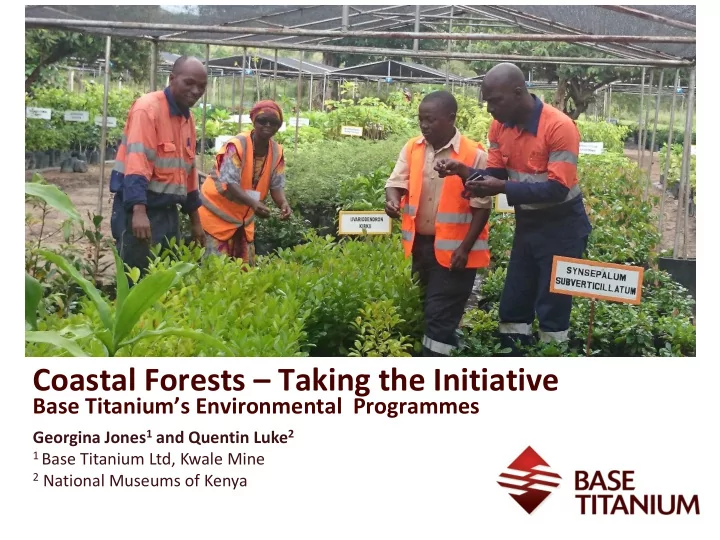
SLIDE 1 Coastal Forests – Taking the Initiative
Base Titanium’s Environmental Programmes
Georgina Jones1 and Quentin Luke2
1 Base Titanium Ltd, Kwale Mine 2 National Museums of Kenya
SLIDE 2 Base Titanium’s Kwale Mine
Project Overview ♦ Located within Kwale County, 50km south of Mombasa and about 8km inland. ♦ Target minerals include: ♦ Ilmenite (titanium-iron oxide) – raw material for pigment and paint. ♦ Rutile (titanium oxide) – raw material for titanium sponge, titanium metal and pigment. ♦ Zircon (zirconium silicate) – raw material used in refractory and ceramic industries. ♦ Products exported from Base’s shiploading facility in Likoni (bulk ilmenite and rutile) and container facilities in Mombasa (containerised zircon). ♦ Comprehensive environmental policy, management plans and programmes in place and being implemented. ♦ Restoration and rehabilitation is an integral component of Base’s
SLIDE 3
Base Titanium’s Environmental Programmes
Biodiversity and Conservation Programme ♦ Established to exploit opportunities for improving conservation. ♦ Improving our understanding of the regions rich biodiversity. Rare and Threatened Flora Propagation Research Programme ♦ Targeting species of conservation interest. ♦ Identifying suitable species and techniques for use in restoration and rehabilitation. ♦ Establishment of a Restoration Programme Indigenous Tree Nursery.
SLIDE 4
Base Titanium’s Environmental Programmes
Re-establishing and Restoring Wetlands ♦ Re-established a wetland which had been dry for many years prior to the commencement of operations. ♦ Now providing a habitat for both flora and faunal species of conservation importance. ♦ Collaboration with specialists from the National Museums of Kenya. Establishing a Biodiversity Corridor ♦ Part of our commitment to achieving a net positive biodiversity and maintaining ecosystem services. ♦ Work commenced in December 2013. ♦ Bridges several remnant patches of indigenous forest within the mine lease to the Gongoni Forest.
SLIDE 5 Base Titanium’s Environmental Programmes
Waste Recycling Programme ♦ Founded on the principal of Reduce-Reuse- Recycle. ♦ Aims to create a culture of reducing waste, reusing resources and recycling in our
- rganisation and neighbouring
communities. Environmental Education Programme ♦ Encouraging everyone to take responsibility for the environment. ♦ In collaboration with our host communities, partner organisations, conservation groups and environmental experts. ♦ Delivery of messages and creating awareness on the importance of protecting the environment, pollution prevention, protecting and conserving biodiversity and environmentally responsible development.
SLIDE 6
Rare and Threatened Flora Propagation Research Programme
Indigenous Tree Nursery ♦ Nursery also functions as a training and educational facility for local community projects and visitors. ♦ All species in nursery are identified by their botanical names. ♦ IUCN Red List of Threatened Species classification recognised.
SLIDE 7 Coastal Forests of Eastern Africa Biodiversity Hotspot
Number Total Number of Species Kenya
7,252
Coastal Kenya
3,650
Total Tree Taxa Coastal Kenya
670
Threatened Species Coastal Kenya
83
Kwale
71
Base Titanium Nursery
60
Base Titanium Indigenous Tree Nursery Target Actual IUCN Threatened Species Critical (CR)
3 3
Endangered (EN)
29 22
Vulnerable (VU)
56 35
SLIDE 8 Biodiversity and Conservation Programme
Objective ♦ Exploits opportunities for improving conservation
- utcomes provided by Kwale Mine.
Some of our Successes ♦ Euphorbia tanaensis ♦ Gigasiphon macrosiphon
SLIDE 9 Restoration Programme Indigenous Tree Nursery
Species IUCN Red List Status April – June 2015 To Date In Planted In Stock Planted Total Species of Conservation Significance (IUCN Threatened Species) Critically Endangered
134 187 544 419 963
Endangered
1,947 580 3,693 1,374 5,067
Vulnerable
1,049 380 4,431 429 4,860
Potential IUCN Threatened Species Yet to be classified
314 64 1,408 435 1,843
Other Species (IUCN Lower Risk Species) Various
3,764 9,198 14,600 16,412 31,012
Total All Species Various
7,208 10,409 24,676 19,069 43,745
Number of species currently in stock = 208
SLIDE 10
Restoration and Rehabilitation
Phase 1 Rehabilitation and Restoration Activities ♦ Comprises activities ahead of rehabilitation of mined areas. ♦ Includes establishment of a biodiversity corridor. ♦ Incorporates re-established wetland.
SLIDE 11
Restoration and Rehabilitation
Phase 2 Rehabilitation and Restoration Activities ♦ Expansion of Biodiversity Corridor to incorporate areas around the Mukurumudzi Dam. ♦ Rehabilitation and land-use suitability trials. ♦ Initial activities to commence in late 2015. Phase 3 Rehabilitation and Restoration Activities ♦ Preparation of mined Central Dune for rehabilitation. ♦ Rehabilitation of the Central Dune, incorporating backfilling of mining void, laying of topsoil, contouring of land and planting of primary and end-use vegetation. ♦ Planned to commence 2018. Phase 4 Rehabilitation and Restoration Activities ♦ Preparation of mined South Dune for rehabilitation. ♦ Rehabilitation of South Dune. Phase 5 Rehabilitation and Restoration Activities ♦ Preparation of TSF for rehabilitation. ♦ Rehabilitation of TSF. ♦ Closure and rehabilitation of infrastructure sites.
SLIDE 12 Indigenous Tree Nursery Establishment Costs
Restoration Programme Indigenous Tree Nursery Establishment Costs ♦ Nursery established in December 2012. ♦ Opportunities utilised: ♦ Specialist and regional knowledge available amongst Base’s environmental specialists. ♦ Utilises land available within the mine lease. ♦ Mine lease land predominantly previously smallholder farmland with cashew, mango and coconut crops. ♦ Earth moving equipment on site utilised to prepare land. ♦ Ready supply of topsoil from stockpiled stocks. ♦ Use of indigenous tree species. ♦ Remnant forest patches within mine lease protected and used as a seed source. ♦ Rescuing of important species ahead of land clearing.
Direct Costs
Direct Cost Estimates (USD) FY2012/2013 Infrastructure
20,000
Consumables
5,000
Soil conditioning material
500
SLIDE 13 Indigenous Tree Nursery Operating Costs
Restoration Programme Indigenous Tree Nursery Operating Costs ♦ Workforce – recruited from surrounding communities, necessary skills and training provided by Base environmental specialists and collaborating organisations. ♦ Opportunities utilised: ♦ Partnerships with NMK, KWS, KFS, Kaya elders and community forest associations. ♦ iCIPE collaboration – testing of organic pesticides. ♦ Collection of seed material from protected remnant forest patches on mine site. ♦ Cost saving initiatives: ♦ Minimal soil conditioning material costs, purchase only manure and coir dust from local suppliers, prepare own compost and utilise stockpile topsoil. ♦ Recycling and re-use of consumables eg seedling bags. ♦ No fertilizers or chemical pesticides utilised in nursery.
Direct Costs
Direct Cost Estimates (USD) FY2013/2014 FY2014/2015 Infrastructure
25,000 10,000
Consumables
15,000 5,000
Soil conditioning material
1,500 1,500
SLIDE 14 basetitanium.com
14