Coaching Use Name Be Concise Communication Brevity is the - - PDF document

coaching
SMART_READER_LITE
LIVE PREVIEW

Coaching Use Name Be Concise Communication Brevity is the - - PDF document

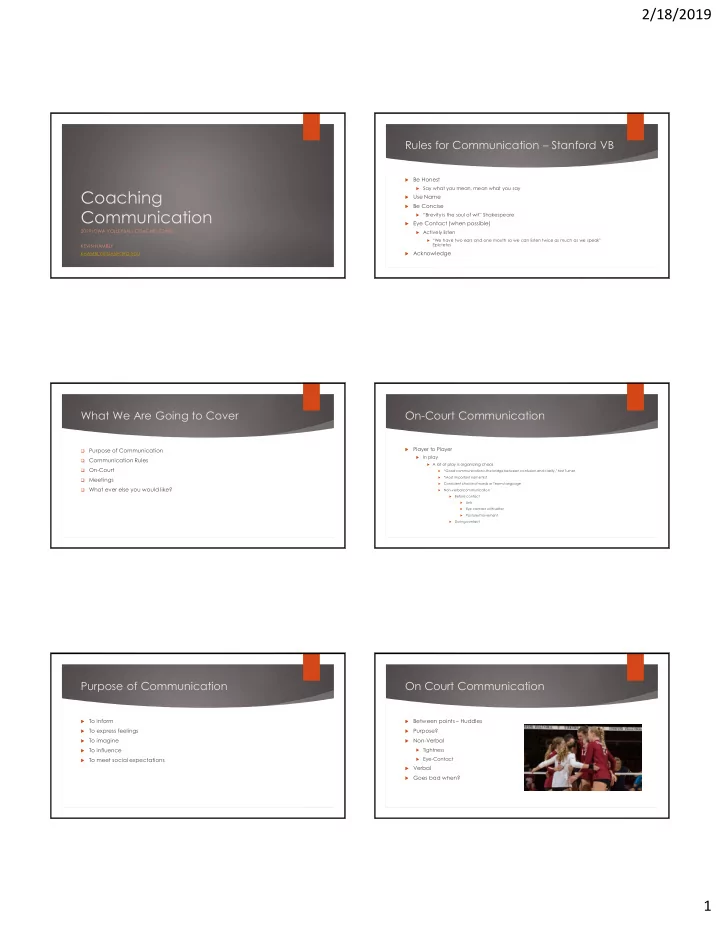
2/18/2019 Rules for Communication Stanford VB Be Honest Say what you mean, mean what you say Coaching Use Name Be Concise Communication Brevity is the soul of wit Shakespeare Eye Contact (when possible)


slide-1
SLIDE 1

2/18/2019 1

Coaching Communication

2019 IOWA VOLLEYBALL COACHES CLINIC KEVIN HAMBLY KHAMBLY@STANFORD.EDU

What We Are Going to Cover

Purpose of Communication

Communication Rules

On-Court

Meetings

What ever else you would like?

Purpose of Communication

To inform

To express feelings

To imagine

To influence

To meet social expectations

Rules for Communication – Stanford VB

Be Honest

 Say what you mean, mean what you say 

Use Name

Be Concise

 “Brevity is the soul of wit” Shakespeare 

Eye Contact (when possible)

 Actively listen  “We have two ears and one mouth so we can listen twice as much as we speak” Epictetus 

Acknowledge

On-Court Communication

Player to Player

 In play  A lot of play is organizing chaos

“Good communication is the bridge between confusion and clarity.” Nat Turner

*Most important name first

Consistent choice of words or Teams language

Non-verbal communication

Before contact

Link

Eye contact with setter

Posture/movement

During contact

On Court Communication

Between points – Huddles

Purpose?

Non-Verbal

 Tightness  Eye-Contact 

Verbal

Goes bad when?

slide-2
SLIDE 2

2/18/2019 2

Systems of Communication for Players

Assignments

Setter

Offense  Libero

Passing

Defense

Changes

 Mo

Middle

Blocking

Dorn 

OH’s absent

Player to Player

Struggle with Confrontation

 Carefrontation 

Bigger Conflicts

 Created Rules

Conflict Resolution

Face each other

No raising of the voice

 Emotions good – yelling counter productive 

One person speaks other listens

Let 30 seconds pass (feels like a long time)

Receiver repeats what they heard

 If agreed message was the same move on to 6 

Then offers opinion/rebuttal/insight/etc…

3 – 7 are repeated until both sides have expressed opinions and talked through issues

No longer than 20 mins. After 20 mins leave and come back to it the next day.

 This came from a psychologist – not always followed 

If someone gets too emotional both walk away come back to it 24 hours later

After opinions are expressed and a resolution is determined both parties repeat resolution/solution

Check back in 24 hours later

Get to know each other meetings

Rules

 Meal  Face each other  No phones  No TV’s  Has to last on hour 

What happens?

Coach to Player

Importance of being one-self

 Eliminate Sarcasm attempt 

Feedback

 Name first  Concise  Space for questions  No Rhetorical Questions

Coach to Player

Feedback Principles

 Positive v. Negative  Instructive 

Find language that works

 Efficiency is key  Needs to hit home quick and strong  Needs to work for athletes 

External Focus

 Cueing  Examples

slide-3
SLIDE 3

2/18/2019 3

Coach to Player

When I am frustrated

I ask myself some questions

Who am I frustrated with?

Players

Me

 Remove identity from performance of players

Are their intentions good?

Is their effort where we want it?  Communication I choose is based on these questions

No effort = Crazy person

Others mean I need to change drill or how I am communicating skill/system

Back to playing with the language

Bad Design

Timeouts

What I used to do

What I do now

 Break into groups  Positional  Erin  Staff  Whole Group Together

Team Meetings

Everyone willing to speak

Safe Environment

No judgment

On Task

Honest!

 5 Dysfunction discussion example

Team Meeting

Listen!

Watch!

 Meet in a circle  Watch reactions

Players and Coaches

Uncomfortable silence

 Coaches like to talk/want to fill time 

Players wanting to share ideas as someone else is talking

 Example  Volleyball

Individual Meetings

My meetings with players

They pick the spot

We have the same rules as players do in their meeting

What I do

Listen

Ask questions

Set Expectations

Define Roles  Most important thing I do!

Conclusion

Communication is more than just give speeches

Need to treat it as you do any other system

There is a lot of research on communication

Players want and need communication as much as anything else

Questions?