Coaching Families Suzanne Kucharczyk and Matt Brock Development of - - PDF document

coaching families
SMART_READER_LITE
LIVE PREVIEW

Coaching Families Suzanne Kucharczyk and Matt Brock Development of - - PDF document

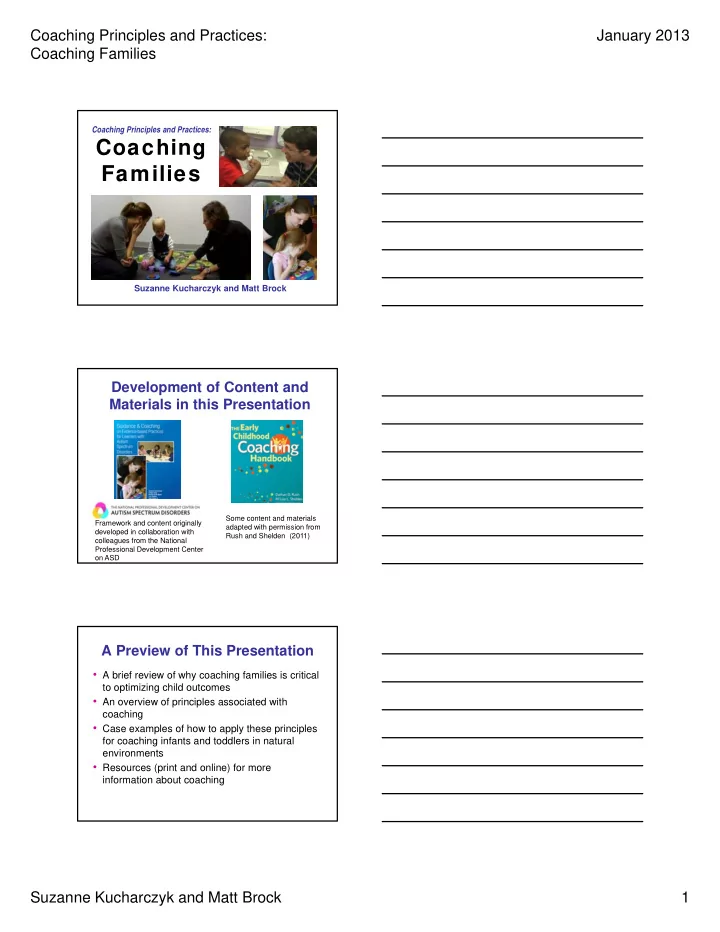
Coaching Principles and Practices: January 2013 Coaching Families Coaching Principles and Practices: Coaching Families Suzanne Kucharczyk and Matt Brock Development of Content and Materials in this Presentation Some content and materials


slide-1
SLIDE 1

Coaching Principles and Practices: Coaching Families January 2013 Suzanne Kucharczyk and Matt Brock 1

Coaching Principles and Practices:

Coaching Families

Suzanne Kucharczyk and Matt Brock

Some content and materials adapted with permission from Rush and Shelden (2011) Framework and content originally developed in collaboration with colleagues from the National Professional Development Center

  • n ASD

Development of Content and Materials in this Presentation A Preview of This Presentation

  • A brief review of why coaching families is critical

to optimizing child outcomes

  • An overview of principles associated with

coaching

  • Case examples of how to apply these principles

for coaching infants and toddlers in natural environments

  • Resources (print and online) for more

information about coaching

slide-2
SLIDE 2

Coaching Principles and Practices: Coaching Families January 2013 Suzanne Kucharczyk and Matt Brock 2

What Will You Need?

  • Handouts (directions of how to get these here)
  • A partner for role-play
  • 90 minutes
  • An open mind

The Coach

http://www.youtube.com/watch?v=q4880PJnO2E

What We Know

“Research has shown that parent participation in intervention is key and that supporting parents in competently and confidently interacting responsively with young children during daily routines may be more critical to intervention effectiveness than the time children spend with practitioners”

(Rush and Shelden, 2011)

slide-3
SLIDE 3

Coaching Principles and Practices: Coaching Families January 2013 Suzanne Kucharczyk and Matt Brock 3

What We Know

  • Rigorous research studies support the efficacy
  • f parent-implemented interventions:
  • [insert screenshots of NPDC evidence base for

parent-implemented interventions]

What We Know

Parent training and the use of coaching to support parents has been found to be effective and feasible (NRC, 2001, Brookman-Frazee et. al., 2009).

What We Do

“…early interventionists spend 51% of the home visit time directly teaching the infant and toddler; less than 1% of the time is spent in supporting parent-child interactions and coaching the parent.”

(NECTAC, 2008, Sandall, Hemmeter, Smith, & McLean, 2005), (Peterson, et al, 2007) Time Spent Coaching Parents

slide-4
SLIDE 4

Coaching Principles and Practices: Coaching Families January 2013 Suzanne Kucharczyk and Matt Brock 4

Forms of Adult Learning Support

  • Consultation
  • Mentoring
  • Supervision
  • Counseling
  • Direct Training
  • Coaching

Who is Coaching Whom?

EI Providers Coaching Families Technical Assistance Providers Coaching EI Providers

Overview of Coaching

  • Principles of coaching
  • The Communicative Coach
  • Diversity & Coaching
  • The Coaching Process
slide-5
SLIDE 5

Coaching Principles and Practices: Coaching Families January 2013 Suzanne Kucharczyk and Matt Brock 5

Coaching Assumptions

  • Practitioners and caregivers have good skills but

can increase their skills.

  • Practitioners and caregivers establish new skills
  • r refine existing skills through reflection and self

evaluation.

  • Practices can change based on observation,

data and feedback.

  • Coaching is a cyclical and dynamic process.

10 Key Elements of Coaching in Early Childhood

  • 1. Consistent with principles of adult learning
  • 2. Capacity building
  • 3. Nondirective
  • 4. Goal oriented
  • 5. Solution focused
  • 6. Performance based
  • 7. Reflective
  • 8. Collaborative
  • 9. Context driven

10.As hands-on as it needs to be

Individual Activity

slide-6
SLIDE 6

Coaching Principles and Practices: Coaching Families January 2013 Suzanne Kucharczyk and Matt Brock 6

The Communicative Coach Potential Barriers to Communication

  • Advising
  • Anticipating
  • Avoiding
  • Cross-Examining
  • Denying Others’

Reality

  • Diagnosing
  • Directing
  • Judging
  • Lecturing
  • Moralizing
  • Praising
  • Reassuring
  • Teasing

Communication Strategies for Collaboration

  • The power of questions
  • Open ended
  • Reflective
  • Leveling statements
  • Nonverbal techniques
  • Active Listening
slide-7
SLIDE 7

Coaching Principles and Practices: Coaching Families January 2013 Suzanne Kucharczyk and Matt Brock 7

Small Group Activity

INSERT VIDEO: Mom talking about challenges

  • Direct viewers to pose questions to ask Mom.
  • Follow-up w/ posing typical questions and

analyzing open/closed questions and directing viewers to analyze their own list

Open vs. Closed Questions

Open Question Starters

  • Tell
  • How
  • Describe
  • What
  • Why

Closed Question Starters

  • Are
  • Do
  • Have
  • Should
  • Will
  • Would
  • Can

Open questions are incompatible with closed questions

slide-8
SLIDE 8

Coaching Principles and Practices: Coaching Families January 2013 Suzanne Kucharczyk and Matt Brock 8

Active Listening

Seek first to understand and then to be understood!

Stephen Covey

Active Listening Components

FO C USED L IST ENING PRO BING PA RA PHRA SING

Conventions for Communication

  • Nonverbal Skills
  • Attention cues
  • Response cues
  • Focus on content of

verbal statements

  • Focus on the

speaker’s feelings

  • Social Conventions
  • Turn-taking
  • Appropriate

distance

  • Encouragers
slide-9
SLIDE 9

Coaching Principles and Practices: Coaching Families January 2013 Suzanne Kucharczyk and Matt Brock 9

Cultural Diversity Cultural Continua

  • Extended Family and Kinship networks ->

Small unit families with little reliance on the extended families

  • Interdependence -> Individuality
  • Nurturance of young children -> Independence of young children
  • Time is given -> Time is measured
  • Respect for age, ritual, tradition ->

Emphasis on youth, future, technology

  • Ownership defined in broad terms ->

Ownership is individual and specific

  • Differentiated rights and responsibilities ->

Equal rights and responsibilities

  • Harmony -> Control

Your stance…

Learner Judge

slide-10
SLIDE 10

Coaching Principles and Practices: Coaching Families January 2013 Suzanne Kucharczyk and Matt Brock 10

Developing Cross – Cultural Competence

  • Family Structure & Child-Rearing Practices
  • Family Structure
  • Child-rearing Practices
  • Family Perceptions and Attitudes
  • Perceptions of child’s disability
  • Perception of health & healing
  • Perception of help-seeking and intervention
  • Language and Communication Styles

Learner Stance

  • Reflect on…
  • How is the family similar or different to mine?
  • How open am I to exploring my comfort level

with these similarities and differences?

  • What have I learned about myself as I

examine my comfort level with situations that differ from my own culture and life experience?

Common Challenges

Every family has its own dynamics – some are universal.

slide-11
SLIDE 11

Coaching Principles and Practices: Coaching Families January 2013 Suzanne Kucharczyk and Matt Brock 11

Common Challenge One Approach

Parent agrees to co- developed plan but doesn’t not follow through Upfront the problem – “Before we talk about a plan, I’d like to ask what seems to be getting in the way of putting our plans into action”. When parent changes topics frequently Park it – “I understand that this is something you want to talk about. How about we put it on our list to discuss as we plan for next week? Will that work? Parent insists on you telling her what to do Return to the Why – Remind family that we know that their input and participation is what will help you be effective. Provide your expertise and remind them of theirs and its importance. Another provider to the family doesn’t take a coaching perspective Name it – “I understand that Sarah works differently with you. I have found this approach to be effective in my work with families. In what ways are the different approaches a concern to you?”

If in doubt… Choose relationship over control The Coaching Process

slide-12
SLIDE 12

Coaching Principles and Practices: Coaching Families January 2013 Suzanne Kucharczyk and Matt Brock 12

The Coaching Process

The Family

Pre-

  • bservation

Initiation Observation & Action Post-

  • bservation

Reflection & Feedback

The Family

  • Understanding the family context - resources
  • Asset – Based Context (ABC) Matrix
  • Interest – Based Everyday Activity Checklist
  • Parent Implemented Intervention Brief
  • Additional Resources
  • Understanding family needs and priorities
  • Aligning interventions with IFSP outcomes

Case Study

Meet Joey

slide-13
SLIDE 13

Coaching Principles and Practices: Coaching Families January 2013 Suzanne Kucharczyk and Matt Brock 13

Coaching Processes

  • Initiation (Pre-observation)
  • Joint Planning
  • Observation & Action
  • Observation
  • Action
  • Reflection & Evaluation (Post-observation)
  • Reflection
  • Feedback
  • Joint Planning

Purpose of Initiation

  • Joint Planning
  • Review what has happened
  • Discuss current situation
  • Create plan for support

Initiation

Coach focuses on parent’s goals by helping

  • Specify relationship and

parent’s priorities

  • Clarify child’s and/or parents

abilities and desired outcomes

  • Pair developmental outcomes

to particular intervention strategies

  • Determine evidence for child’s

and parent’s progress

Examples of questions to ask

  • What would help you?
  • What supports would be

helpful for you/your child?

  • What have you thought about

doing (or tried)?

  • What will show to you that your

child is learning?

slide-14
SLIDE 14

Coaching Principles and Practices: Coaching Families January 2013 Suzanne Kucharczyk and Matt Brock 14

Joey’s Priority Goal

During family dinners, Joey will sit at the dining room table either eating or quietly playing with a toy for at least 10 min for 2/3 dinners.

Purpose of Observation

  • Examining inviting partner’s current actions with

the aim of developing new skills, strategies or ideas

  • Opportunity to teach and practice in safe,

learning environment

  • Opportunity to promote reflection and provide

feedback

Observation & Action

Coach gathers data by soliciting information about

  • Child development and

behavior

  • Parent’s interactions,

strategies, and decisions

Coach may use

  • First-hand observation,

audiotapes, videotapes, and progress reports

  • Storytelling, dialogue and

interviews, inventories

  • Instruction, demonstration,

guided practice, modeling

slide-15
SLIDE 15

Coaching Principles and Practices: Coaching Families January 2013 Suzanne Kucharczyk and Matt Brock 15

Modeling

Spontaneous and Planned

Modeling - Planned

  • 1. Joint discussion of what

will be modeled and why

  • 2. Give parent something

specific to observe or do

  • 3. Model while parent
  • bserves
  • 4. Debrief what worked, what

didn’t, what coach could have done differently, and what parent might want to try

  • 5. Parent tries to

implement if comfortable

  • 6. Parent and coach reflect
  • n the activity
  • 7. Develop a plan for how

the strategy or activity will happen when the coach is not present

A Role Play Opportunity

slide-16
SLIDE 16

Coaching Principles and Practices: Coaching Families January 2013 Suzanne Kucharczyk and Matt Brock 16

Activity Timeline

  • Read Activity
  • Decide on Roles
  • Coach
  • Parent
  • Joey/observer
  • Coach & Observer determine reflective questions and

Coach asks parent (10-15min)

  • Coach plans for modeling (5min)
  • Planned Modeling Process (5-10min)

Purpose of Reflection/Evaluation (Postobservation)

  • Reflection
  • Parent’s review and analysis
  • Coach builds capacity by promoting ongoing self-

assessment, planning and acquisition of new knowledge and behavior

  • Feedback
  • Informative
  • Affirmative
  • Evaluative – awareness of use
  • Directive – to be used infrequently
  • Joint Planning

Reflection

Coach enhances learner’s perception and actions by helping

  • Summarize impressions of

actions/events

  • Compare planned-for and
  • btained results
  • Analyze relationships between

child behavior and parent decisions/behavior

  • Apply new information and

reflect on coaching process

Questions to ask

  • What happened when you…?
  • What did you do to influence

what happened? How is this different?

  • What changes would you

make, if any, the next time?

  • What have you learned from

this process?

slide-17
SLIDE 17

Coaching Principles and Practices: Coaching Families January 2013 Suzanne Kucharczyk and Matt Brock 17

Evaluation

Coach reviews the effectiveness of the coaching sessions, either alone or with the IP to

  • Review the strengths and

weaknesses of the coaching session

  • Analyze the effectiveness of

the coaching relationship

  • Determine whether progress is

being made to achieve intended outcomes, resulting in continuation or resolution of the coaching process

Questions to ask

  • Do I need to make any

changes in the coaching process?

  • Am I assisting the learner to

achieve the intended

  • utcomes?
  • Should I continue as the

coach, or will another team member have the specialized experience/skills needed at this time?

Critiquing Coaching Techniques Observe for the following:

  • Reflects partner's words
  • Uses open questions
  • Clarifies words and feelings
  • Takes turns; no interrupting
  • Checks for understanding
  • Uses verbal and nonverbal encouragement

How might you handle the conversation differently if you were the coach?

slide-18
SLIDE 18

Coaching Principles and Practices: Coaching Families January 2013 Suzanne Kucharczyk and Matt Brock 18

Coaching Log: Documenting Change

slide-19
SLIDE 19

Coaching Principles and Practices: Coaching Families January 2013 Suzanne Kucharczyk and Matt Brock 19

slide-20
SLIDE 20

Coaching Principles and Practices: Coaching Families January 2013 Suzanne Kucharczyk and Matt Brock 20

Remember

  • Coaching is a mutual conversation based on specific,

mutually-agreed-on outcomes

  • Coaching is a reciprocal process between the coach and

inviting partner

  • Coaching relationships can be developed with families,

child caregivers, and early childhood practitioners

  • Every conversation is a potential opportunity for

coaching

  • Coaching may be planned or occur spontaneously
  • Reflection is the most important component
slide-21
SLIDE 21

Coaching Principles and Practices: Coaching Families January 2013 Suzanne Kucharczyk and Matt Brock 21

Resources… Online Resources

(include tools used in this presentation)

  • NPDC on ASD Coaching Resources
  • http://autismpdc.fpg.unc.edu/coaching-

resources

  • Fippcase
  • http://www.fippcase.org/index.php
  • Rush and Shelden
  • http://www.coachinginearlychildhood.org/inde

x.php

Contact Information

  • Suzanne Kucharczyk
  • Suzanne.kucharczyk@unc.edu
  • (919) 843-6525
  • Matthew Brock
  • Matthew.e.brock@vanderbilt.edu
  • (615) 669-1789
slide-22
SLIDE 22

Coaching Principles and Practices: Coaching Families January 2013 Suzanne Kucharczyk and Matt Brock 22

Some content and materials adapted with permission from Rush and Shelden (2011) Framework and content originally developed in collaboration with colleagues from the National Professional Development Center

  • n ASD

Development of Content and Materials in this Presentation