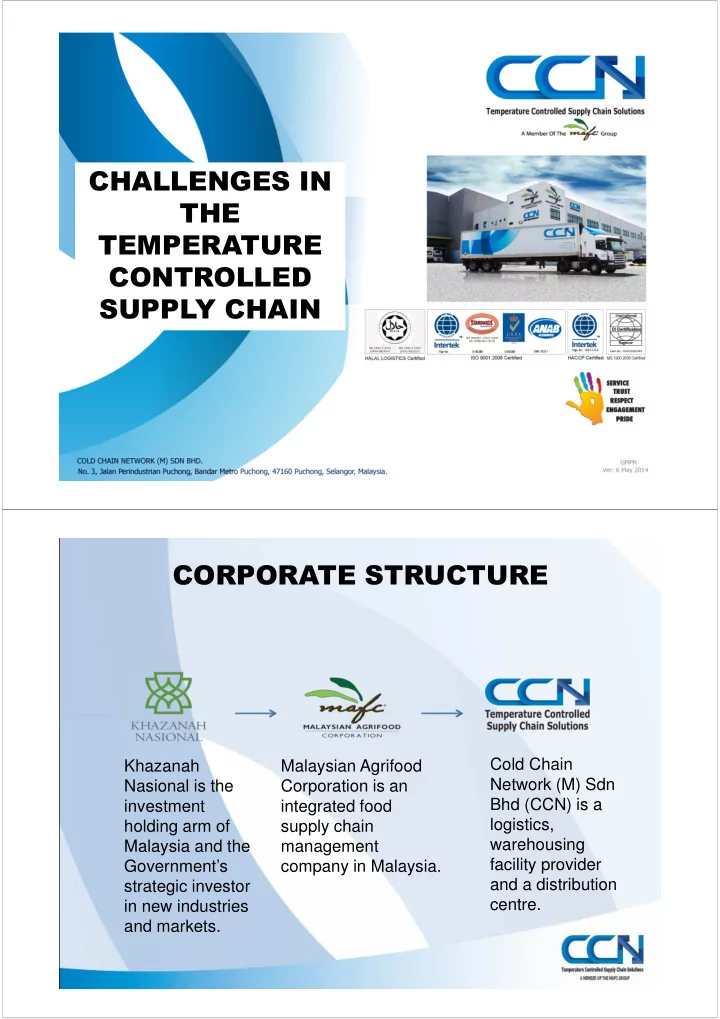
CHALLENGES IN THE TEMPERATURE CONTROLLED SUPPLY CHAIN CORPORATE - - PDF document
CHALLENGES IN THE TEMPERATURE CONTROLLED SUPPLY CHAIN CORPORATE STRUCTURE Cold Chain Khazanah Malaysian Agrifood Network (M) Sdn Nasional is the Corporation is an Bhd (CCN) is a investment integrated food logistics, holding arm of
Multi-compartment Fleet
- Equipped with GPS
- On-board temperature
monitoring
- Online temperature
monitoring FLEET Fleet Type
- No. of Units
40 Footers 23 18 Tonner 10 8.5 Tonner 16 5 Tonner 5 TOTAL 54
MS 2400:2010-1 Halalan-Toyyiban Assurance Pipeline Part 1: Management System Requirements For Transportation of Goods And/or Cargo Chain Services MS 2400:2010-2
Halalan-Toyyiban Assurance Pipeline Part 2: Management System Requirements For Warehousing And Related Activities
Other Certifications
- MS 1900:2005
Quality Management Systems- Requirements From Islamic Perspectives
- MS 1480:2007
Food Safety According To Hazard Analysis And Control Point (HACCP) System
- ISO 9001:2008
Quality Management Systems-requirements
Temperature Controlled Warehouse
- 198,195 ft2 floor space.
- 18,828 pallet positions.
- 39 loading bays with dock
shelters.
- 15 cold rooms
- 4 chillers
- 4 freezers
- 2 multi-temperature cold-
rooms
- 5 dedicated picking
chambers
- Flexible cold room
temperatures -30⁰C to 18⁰C.
- Sub-zero (-10⁰C) capable
receiving/ante rooms
CCN FAST FACTS COLD CHAIN KEY CHALLENGES
- 1. Maintaining temperature integrity throughout the
delivery chain. We sell temperature.
- 2. Ensuring Transports and deliveries are IFOT, and at the
right temperature.
- 3. Securing “The Bank” – security, inventory integrity
and accuracy.
- 4. Timely and accurate information – on deliveries, to
customer complaints.
- 5. Managing labour – cold working conditions
- Electrical Consumption is rising.
- A slightest change in the activities such as the door
- pening frequency due to activities has an impact on
the condensation rate in the chambers.
- Over a period of time, the refrigeration system is less
efficient or malfunctioning.
- Generally outside temperature is recorded higher
than normal, sometime up to 35O C – 38O C, has forced the Refrigeration System to work harder to maintain the temperature requirement.
MAINTAINING TEMPERATURE INTEGRITY TO ENSURE PRODUCT QUALITY & COST OPTIMISATION
Like all supply chains, cold chain operators must continually upgrade technology to ensure efficiency, integrity, and safety. This includes both back-end IT infrastructure and front-end devices to gather and report key data such as temperature reading in real time.
WINNING WITH INNOVATIONS
Cold chain carriers have invested considerably in on- board equipment built into refrigeration units to track temperature and location,
- ffering increased visibility
and the opportunity to prevent or mitigate loss. We are also exploring “rapid cooling” systems.
- A dedicated team was formed to look into BIC strategies. The structure of
the team mainly Sponsors, Project Leader & Team Member.
- Leaders normally are people not involved in the Operations or SME
(Subject Matter Expert) At CCN, a project called BIC (Best In Class) was launched in 2015, mainly looking into COMPLIANCE, SAFETY & PROFITABILITY. One of the key deliverables of the Project is to review all the SOPs involving temperature integrity. A team was also formed to explore the latest technology and new innovations to keep us abreast with our competitors.
GOING THE NEXT LEVEL - BIC
- Operating a cold chain net work is extremely
challenging and competitive.
- In order to sustain business one has to be efficient and
cost effective. The main focus will be on control of energy usage, manpower and facilities (warehousing and fleet) utilisation.
SUMMARY
MS 1900:2005 Quality Management Systems- Requirements From Islamic Perspectives MS 1480:2007 Food Safety According To Hazard Analysis And Control Point (HACCP) System ISO 9001:2008 Quality Management Systems- requirements
Quality Certifications - CCN
MS 2400:2010-1 Halalan-Toyyiban Assurance Pipeline Part 1: Management System Requirements For Transportation of Goods And/or Cargo Chain Services MS 2400:2010-2 Halalan-Toyyiban Assurance Pipeline Part 2: Management System Requirements For Warehousing And Related Activities