Lecture 8: Designing the Supply Chain Network Chain Network - - PDF document

lecture 8
SMART_READER_LITE
LIVE PREVIEW

Lecture 8: Designing the Supply Chain Network Chain Network - - PDF document

Lecture 8: Designing the Supply Lecture 8: Designing the Supply Chain Network Chain Network Quality Assurance in Supply Chain Management (INSE 6300/4-UU) Winter 2011 INSE 6300/4- -UU UU INSE 6300/4 Quality Assurance In Supply


slide-1
SLIDE 1

Lecture 8: Lecture 8: Designing the Supply

Designing the Supply Chain Network Chain Network

Quality Assurance in Supply Chain Management (INSE 6300/4-UU) Winter 2011

INSE 6300/4 INSE 6300/4-

  • UU

UU

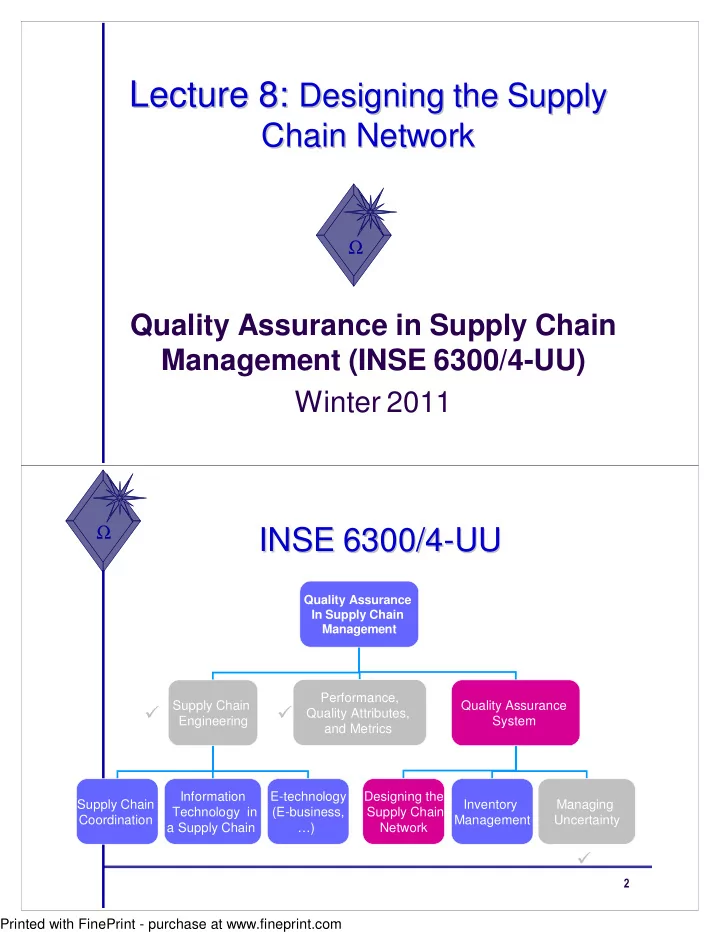
Quality Assurance In Supply Chain Management Supply Chain Engineering Performance, Quality Attributes, and Metrics Quality Assurance System Designing the Supply Chain Network Inventory Management Supply Chain Coordination Information Technology in a Supply Chain E-technology (E-business, …) Managing Uncertainty

  • Printed with FinePrint - purchase at www.fineprint.com
slide-2
SLIDE 2

Key Quality Issues Key Quality Issues

Supply Chain Quality Issues

Network Planning Inventory Control Distribution Strategies Product Design Outsourcing Strategies Integration & Partnering Information Technology Decision- Support Sys

Overview Overview

Factors Influencing Distribution Network

Design

Design Options for a Distribution Network

Printed with FinePrint - purchase at www.fineprint.com

slide-3
SLIDE 3

The Supply Chain Network The Supply Chain Network

The Role of Distribution The Role of Distribution in the Supply Chain in the Supply Chain

Distribution: the steps taken to move and store a

product from the supplier stage to the customer stage in a supply chain

Distribution directly affects cost and therefore drives

profitability

Choice of distribution network can achieve supply

chain objectives from low cost to high responsiveness

Examples: Wal-Mart, Dell, Proctor & Gamble,

Grainger

Printed with FinePrint - purchase at www.fineprint.com

slide-4
SLIDE 4

Factors Influencing Factors Influencing Distribution Network Design Distribution Network Design

Distribution network performance evaluated

along two dimensions at the highest level:

Customer needs that are met Cost of meeting customer needs

Distribution network design options must

therefore be compared according to their impact on customer service and the cost to provide this level of service

Factors Influencing Factors Influencing Distribution Network Design Distribution Network Design

Elements of customer service influenced by network structure: Response time Product variety Product availability Order visibility Returnability Supply chain costs affected by network structure: Inventories Transportation Facilities and handling Information

Printed with FinePrint - purchase at www.fineprint.com

slide-5
SLIDE 5

Relationship between Number of Relationship between Number of Facilities and Response Time Facilities and Response Time

Number of Facilities Response Time

Relationship between Inventory Costs Relationship between Inventory Costs and Number of Facilities and Number of Facilities

Inventory Costs Number of Facilities

Printed with FinePrint - purchase at www.fineprint.com

slide-6
SLIDE 6

Relationship between Transportation Relationship between Transportation Costs and Number of Facilities Costs and Number of Facilities

Transportation Costs Number of Facilities

Relationship between Relationship between Facility Costs

Facility Costs and Number of Facilities and Number of Facilities

Facility Costs Number of Facilities

Printed with FinePrint - purchase at www.fineprint.com

slide-7
SLIDE 7

Relationship between Total Logistics Relationship between Total Logistics Costs, Response Time and Number of Costs, Response Time and Number of facilities facilities

Number of Facilities

Total Logistics Costs Response Time

Overview Overview

Factors Influencing Distribution

Network Design

Design Options for a Distribution Network

Printed with FinePrint - purchase at www.fineprint.com

slide-8
SLIDE 8

Classification of Distribution Classification of Distribution Networks Networks

  • 1. Manufacturer Storage with Direct Shipping
  • 2. Manufacturer Storage with Direct Shipping

and In-Transit Merge

  • 3. Distributor Storage with Carrier Delivery
  • 4. Distributor Storage with Last Mile Delivery
  • 5. Manufacturer or Distributor Storage with

Consumer Pickup

  • 6. Retail Storage with Consumer Pickup
  • 1. Manufacturer Storage with
  • 1. Manufacturer Storage with

Direct Shipping (drop Direct Shipping (drop-

  • shipping)

shipping)

Manufacturer Retailer Customers Product Flow Information Flow

Printed with FinePrint - purchase at www.fineprint.com

slide-9
SLIDE 9
  • 1. Manufacturer Storage with
  • 1. Manufacturer Storage with

Direct Shipping (drop Direct Shipping (drop-

  • shipping)

shipping)

Product is shipped directly from the manufacturer to

the end user

The retailer takes the order and initiates the delivery

request (information flow)

The retailer does not hold the inventory, which is

centralized at the manufacturer

The supply chain can provide a high level of product

availability with lower levels of inventories

  • 1. Manufacturer Storage with
  • 1. Manufacturer Storage with

Direct Shipping (drop Direct Shipping (drop-

  • shipping)

shipping)

The manufacturer can allocate at least a

portion of the available inventory across retailers on an as-needed basis

Postponement-based drop-shipping allows

the inventory to be low

Dell strategy: build-to-order

Used for high-value, low and unpredictable

demand items

Printed with FinePrint - purchase at www.fineprint.com

slide-10
SLIDE 10
  • 1. Manufacturer Storage with
  • 1. Manufacturer Storage with

Direct Shipping (drop Direct Shipping (drop-

  • shipping)

shipping)

Inventory costs are low (thanks to aggregation) Transportation costs are high:

The outbound distance to the customer is large Package carriers have high shipping costs compared to truckloads

Lower facility costs thanks to aggregation Response time is long: order transmission + shipping distances The handling of returns is expensive: each order may involve

shipment from different manufacturers

Significant investment in information infrastructure

  • 1. Manufacturer Storage with Direct
  • 1. Manufacturer Storage with Direct

Shipping (drop Shipping (drop-

  • shipping)

shipping)

Printed with FinePrint - purchase at www.fineprint.com

slide-11
SLIDE 11
  • 2. In
  • 2. In-
  • Transit Merge Network

Transit Merge Network

Factories Retailer Product Flow Information Flow In-Transit Merge by Carrier Customers

  • 2. In
  • 2. In-
  • Transit Merge Network

Transit Merge Network

Combining pieces of the order coming from

different locations:

The customer gets a single delivery: Dell strategy Transportation costs are lower than with drop-

shipping

A coordination between manufacturers is needed

Suitable for high value items with low to

medium demand

Can be used when the number of

manufacturers is limited

Printed with FinePrint - purchase at www.fineprint.com

slide-12
SLIDE 12
  • 2. In
  • 2. In-
  • Transit Merge Network

Transit Merge Network

  • 3. Distributor Storage with Carrier
  • 3. Distributor Storage with Carrier

Delivery Delivery

Factories Customers Product Flow Information Flow Warehouse Storage by Distributor/Retailer

Printed with FinePrint - purchase at www.fineprint.com

slide-13
SLIDE 13
  • 3. Distributor Storage with Carrier
  • 3. Distributor Storage with Carrier

Delivery Delivery

Inventory is not held by manufacturers but by

distributors/retailers

Package carriers are used to transport products from the

distributor/retailer to the customer

Can be combined with drop-shipping: Amazon strategy High level of inventory because of demand uncertainty Suitable for medium to fast moving products with high

demand

  • 3. Distributor Storage with Carrier
  • 3. Distributor Storage with Carrier

Delivery Delivery

Transportation costs are lower compared to

manufacturer storage:

Warehouses are closer to the customer

and package carriers are used

Facility costs are higher Response time is better because warehouses

are closer to customers

Returnability is easier Printed with FinePrint - purchase at www.fineprint.com

slide-14
SLIDE 14
  • 3. Distributor Storage with Carrier
  • 3. Distributor Storage with Carrier

Delivery Delivery

  • 4. Distributor Storage with Last
  • 4. Distributor Storage with Last

Mile Delivery Mile Delivery

Factories Customer’s home Product Flow Information Flow Distributor/Retailer Warehouse

Printed with FinePrint - purchase at www.fineprint.com

slide-15
SLIDE 15
  • 4. Distributor Storage with Last
  • 4. Distributor Storage with Last

Mile Delivery Mile Delivery

Distributors/retailers deliver the product to the

customer’s home

The warehouse must be closer to the

customer compared to the package carrier delivery

More warehouses are required

Higher levels of inventories Suitable for fast moving items

  • 4. Distributor Storage with Last
  • 4. Distributor Storage with Last

Mile Delivery Mile Delivery

Transportation costs are the highest

compared to the other options

Facility costs are very high Response time is very quick Returnability is easier to implement

Printed with FinePrint - purchase at www.fineprint.com

slide-16
SLIDE 16
  • 4. Distributor Storage with Last
  • 4. Distributor Storage with Last

Mile Delivery Mile Delivery

  • 5. Manufacturer or Distributor Storage
  • 5. Manufacturer or Distributor Storage

with Customer Pickup with Customer Pickup

Factories Retailer Pickup Sites Product Flow Information Flow Cross Dock DC Customer Flow Customers

Printed with FinePrint - purchase at www.fineprint.com

slide-17
SLIDE 17
  • 5. Manufacturer or Distributor
  • 5. Manufacturer or Distributor

Storage with Customer Pickup Storage with Customer Pickup

Inventory is stored at the manufacturer or

distributor warehouse

Customers place their orders online and

travel to designated pickup points

Orders are shipped from the storage site to

pickup points as needed

7dream.com strategy (seven-eleven Japan)

Suitable for Low demand products

  • 5. Manufacturer or Distributor
  • 5. Manufacturer or Distributor

Storage with Customer Pickup Storage with Customer Pickup

Inventory Costs depend on the location of inventory

Fast moving items can be kept at pickup locations, and slow

moving items can be stocked at a central warehouse

Transportation cost is lower than the use of package

carriers thanks to possible aggregation when delivering to a pickup site

Facility costs are high if new facilities have to be built Response time is similar to package delivery Returnability is somewhat easier since pickup

locations can handle returns

Printed with FinePrint - purchase at www.fineprint.com

slide-18
SLIDE 18
  • 5. Manufacturer or Distributor Storage
  • 5. Manufacturer or Distributor Storage

with Customer Pickup with Customer Pickup

  • 6. Retail Storage with Customer
  • 6. Retail Storage with Customer

Pickup Pickup

Traditional type of supply chain:

Inventory stored locally Customers pickup products at the retail store

Inventory and facility costs are higher than all

  • ther options

Transportation is lower than all other options Very good response time can be achieved Suitable for high demand products Printed with FinePrint - purchase at www.fineprint.com

slide-19
SLIDE 19
  • 6. Retail Storage with Customer
  • 6. Retail Storage with Customer

Pickup Pickup

Comparative Performance of Delivery Network Designs Comparative Performance of Delivery Network Designs

Information Facility & Handling Transportation Inventory Returnability Order Visibility Product Availability Product Variety Response Time

Manufacturer storage with pickup Distributor storage with last mile delivery Distributor Storage with Package Carrier Delivery Manufacturer Storage with In- Transit Merge Manufacturer Storage with Direct Shipping Retail Storage with Customer Pickup

1 1 4 1 1 1 1 1 1 1 1 1 1 1 4 1 2 2 2 3 2 2 2 6 2 3 3 3 3 3 3 2 3 3 4 4 4 4 4 5 4 1 4 4 1 4 5 5 5 4 5 5 6 2

Printed with FinePrint - purchase at www.fineprint.com

slide-20
SLIDE 20

Linking Product Characteristics and Customer Linking Product Characteristics and Customer Preferences to Network Design Preferences to Network Design

Low customer effort High product variety Quick desired response High product value Many product sources Very low demand product Low demand product Medium demand product High demand product

Manufacturer storage with pickup Distributor storage with last mile delivery Distributor Storage with Package Carrier Delivery Manufacturer Storage with In-Transit Merge Manufacturer Storage with Direct Shipping Retail Storage with Customer Pickup

+2 +2 +2 +2 +2 +2 +2 +2 +2 +2 +1 +1 +1 +1 +1 +1 +1 +1 +1 +1 +1 +1 +1 +1 +1

  • 1
  • 1
  • 1
  • 1
  • 1
  • 1
  • 1
  • 1
  • 1
  • 1
  • 1
  • 2
  • 2
  • 2
  • 2
  • 2
  • 2
  • 2
  • 2

Printed with FinePrint - purchase at www.fineprint.com