
SLIDE 1
Chall llenges of Urmia Lake and Restoration Program
By: Hossein Shahbaz ulrp@sharif.edu
In the name of God
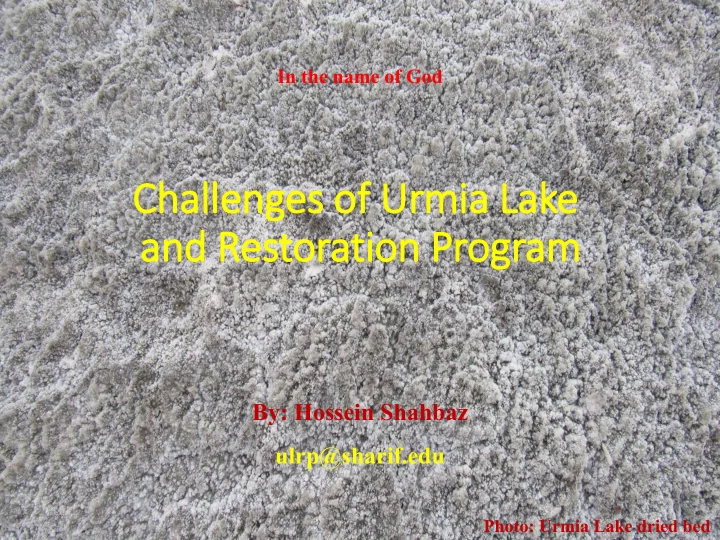
Photo: Urmia Lake dried bed
Chall llenges of Urmia Lake and Restoration Program By: Hossein - - PowerPoint PPT Presentation
In the name of God Chall llenges of Urmia Lake and Restoration Program By: Hossein Shahbaz ulrp@sharif.edu Photo: Urmia Lake dried bed IRAN: 6 main hydrological Basins; Area of the Basin:52,000 Sq.Km Area of the Urmia Lake
Chall llenges of Urmia Lake and Restoration Program
By: Hossein Shahbaz ulrp@sharif.edu
In the name of God
Photo: Urmia Lake dried bed
2
Lake Urmia Basin
IRAN: 6 main hydrological Basins; Area of the Basin:52,000 Sq.Km Area of the Urmia Lake (original size): 5,000 Sq.Km Population: 5,000,000 (2011) Provinces: West Azerbaijan, East Azerbaijan, Kurdistan
Different sectors contribution in Urmia basin’s GDP and employment 2007
3
sector Proportion in Urmia basin’s GDP Employment percentage Water consumption percentage service
58 36.5 1
industry
27 34.2 1.4
agriculture
15 29.3 89
source: Studies of the National Water Master Plan- update
Ecological Values of the wetlands in Lake Urmia Basin
Lake Urmia
Urmia and some of satellite wetlands.
Lake Urmia and satellite wetlands.
4
5
Ulrp.sharif.ir
White Pelican breading in Lake Urmia islands –
Ecological Values (continue):
6
Ecological Values (continue):
Artemia urmiana Endemic species in Lake Urmia
7
Levels of Urmia Lake 1965 - 2015
9
1344 1348 1352 1356 1360 1364 1368 1372 1376 1380 1384 1388 1392 1269 1270 1271 1272 1273 1274 1275 1276 1277 1278 1279
YEAR
LEVEL (M)
1965 1989 1995 2001 2015
8 meters declined Highest level: 1278.1m in 1995 Lowest level: 1270.06m in 2015
Ecological Level
Lake Urmia
bed of Urmia Lake – Summer 2013
Challenges (continue):
and Migration of Wildlife to out of the lake
Date: Dec. 2010
12
Challenges :
Salt Density: 400 g/L - Date: Dec. 2010
13
Agricultural lands around the dried lake are drying out
Had been Urmia lake dry up during its history?
Except from last decades observations, do geological evidences confirm natural lake dry up due to the global warming?
200000 years hydrological fluctuation in Urmia lake
Urmia lake 2014
16
Main reasons in drying up Urmia lake
Urmia lake status variation during last 100 years ago
18
Weather variation in Urmia lake basin
Long-term mean precipitation series in Urmia lake basin
1951 1961 1971 1981 1991 1995 2001 2006 2012
19
Mean temperature fluctuation in Urmia lake basin
Weather variation in Urmia lake basin
1951 1961 1971 1981 1991 1995 2001 2006 2012
20
The variation of runoff entering the lake
1951 1961 1971 1981 1991 1995 2001 2006 2012
21
Province Utilized Under construction No. Water Reservoir MCM No . Water Reservoir MCM
63 616.2 2 32.3
14 1751.8 5 696 Kurdistan 1 86 Total 77 2368 8 814.3
Shahar Chai Declined 71% Nazloo River Declined 57% Rozeh Chai Delined 56% Zola river Declined 66%
Reference: Management of Water Resources of Iran Company Declining of surface water runoff to the lake comparing two periods: Before crisis 1966-1996 After crisis 1997- 2012
Location of the wells in three provinces
Wells located in East Azerbaijan
Wells located in Kurdistan
Wells located in West Azerbaijan 107000 wells are available in the basin which are consuming surface water then no water can reach the lake.
Year 2002 2007 2012
Number
64400 88900 107000
24
5000 10000 15000 20000 25000 30000 35000 40000 45000 50000 55000 60000 65000 70000 75000 80000 85000 90000
Number
يبآ لاس
Trend of number of the wells
1971 1975 1980 1985 1990 1995 2005 2010 2014
Shallow wells
Total
Deep wells
Irrigated Area Changes
25 Ref.: Fatahian (2012)
Orchards increased %33 and irrigated lands increased %105
26
100 200 300 400 500 600 1353 1358 1363 1368 1373 1378 1383 1388 1393
1000 ha
1978 1985 1995 2005 2010 2014 Trend of irrigation lands changes
27
2013-2014
27عبنم :ش یتعنص هاگشناد رود زا شجنس زکرمفیر
Crop Pattern changes
2006 1994 Crop 511926 381751
Total Irrigation Land
36 % 43 %
Grains
20 % 25 %
Fodder
1.5 % 2.6 %
Cereals
0.24 % 1.6 %
Oil Seeds
4.4 % 1.9 %
Sugar beet
%
Vegetables
3.5 % 3.8 %
Potato
30 % 16 %
Orchards
30
Challenges (continue):
causeway
يكشخ موادت زا يشان ياه بيسآ و تارطخ مها هيمورا هچايرد
ررگزير ديلوت ياه نوناك هعسوت زا يشان يكمن ياهدرگزير داجيا رد د نآ رواجم راز هروش قطانم و هيمورا هچايرد ينوكسم و يزرواشك ياه هدودحم هب نآ هعسوت و يياز نابايب هقطنم رد جلبعلا بعص ياه يراميب داجيا يزرواشك يضارا نتفر نيب زا ياهاترسور هيلخت هژيو هب و هچايرد رواجم قطانم زا ترجاهم شيازفا هچايرد كيدزن هقطنم رد يميلقا تاناسون و رييغت ديدشت
33
Introducing Urmia lake as one of the main centers in the Middle East
( Ginoux et al., 2012 )
Zone number Maximum
(km2) Repetition number 1 39 1
2
88 6 3 23 1 4 23 4 5 44 4
Dust production cores
36
Fluent sand on west margin of Urmia Lake (Jebel-Kandy region) January 2015
37
HYSPLIT4 simulation results for August 2012
38
Dust trajectories will get altitude up to 1000 m over the ground surface and will distribute northward to more than latitude of 41 N. It means the situation of Lake Urmia is not a national problem and it will affect a region with a radius of more than 250 km
Changes in the area of the Urmia lake and the Albedo
500 1,000 1,500 2,000 2,500 3,000 3,500 4,000 4,500 5,000 0.02 0.04 0.06 0.08 0.1 0.12 0.14 0.16 0.18 AREA OF URMIA LAKE (SQ.KM) َ ALBEDO YEAR
Albedo of U.L Area of the U.L
From 2007 to 2013, Urmia lake’s albedo has improved fourth fold and total lake and dried up regions Albedo has grown as many 2.5 times as its previous value.
40
Urmia Lake water level before crisis: 1277.69 masl
Annual evaporation and consequent salt/minerals sedimentation added layer on layer to fill the deep parts causing significant changes in geomorphology of the lake
Current water level: 1270.30 masl Lake salinity before crisis: 160 ppt Amount of salt in Lake water: 33 bm3 * 240 kg/m3 = 8 Billion tons Where the salt has gone?
Minerals are sedimented mostly in deep zones
40
Threats
– Skin – Eyes – Lungs
– Salt – Desertification – Migrant Birds – Wildlife
– Farms – Tourism –
– Leave their land – Unemployment
41
Health Threats
A Pilot on Health Issue Subject: The Epidemiology
diseases from dust Objective: Assessment
dust impacts on Lungs of School Children Study area; 3 schools, 88 students
42
Probable disease due to continuing the status quo
44
1 2 3 4 5 7 8 9 11 10 12 13 14 15 6
45
Socio-cultural council of West Azerbaijan Socio-cultural council of East Azerbaijan
Econ
ical l Com
ittee
Urm rmia ia La Lake Res estor
ion Na Nation
Committee
Sec Secretary and and Ex Executive Dir Director
West Azerbaij ijan Prov
incia ial l Offic ice Urmia ia Lak Lake Restoratio ion Prog
supe pervis ised by by Shar harif if Univ niversit ity y of f Tec Eas ast Azerbaij ijan Prov
incia ial l Offic ice Coo
inatin ing Com
ittee Techn hnical l Com
ittee Steering Committee Urmia ia Univ niversity ity Tabriz iz Univ niversity ty Pl Plan annin ing and nd Resource Mob
ilizatio tion Unit nit (PRM RMU) Soc
io-cu cult ltural l Com
ittee Ex Executi tive Man anagement t Offic ice Research Offic ice Internatio ional l Coo
tion Div Div
Solutions (5 out of 26)
intervention of Ministry of Energy
water demand by the government.
preventing new developments with a particular focus on agricultural sector
Shahid Madani and Cheragh Veis Dams) along with all downstream water supply and irrigation networks throughout Lake Urmia Basin in Shahid Madani Dam water storage and release for the sole purpose of serving the Lake Urmia Basin
Lake Urmia Basin using smart metering technology in order to thoroughly quantify, control and increase the inflow from the rivers to the Lake.
Main Objectives
Reduction of 40% water in Agriculture sector Providing water from new resources Software activities: Policy, Research, Knowledge generation Precaution
Monitoring and control of surface and ground water withdrawal Facilitating Water supply to the lake by new Infrastructure
Main
solutions
48
2014 2015 2016 2017 2018 2019 2020 2021 2022 2023
1270/5 1271/0 1271/5 1272/0 1272/5 1273/0 1273/5 1274/0 1274/5 1275/0 Restoration Period
Stabilization Period
Final Restoration
Ecologic Level Lake level will approach the ecological level Vision in 2023
Inter-Sectoral Coordination and Synergy of Different Stakeholders
Integrated Management Plan of Lake Urmia watershed sustainable agriculture practices
Trust Building and Participatory Rural Assessment
Challenges (continue):
Water transport for wildlife of Lake Urmia Islands
51
52
Challenges (continue):
Fodder transport for wildlife of Lake Urmia Islands
Supplying adequate needed seed to perform biological fixation by public participation
53
54
May 2016
Some Examples
Before Plantation in semi salt lands After
Before waste water management After
Grazing management and protection in the 5500 hectare
Releasing water from Dams
Saroogh Bookan
Noroozloo diversion dam
Connectivity Channel between Zarinehrood and Siminehrood
Water Release
from Saroogh and Bookan dams until 28th of February 2015, is equal to 75 million cubic meters.
cubic meters. future plan
cubic meters (includes 116 million cubic meters from Bookan dam and 20 million cubic meters from Saroogh dam) over 40 days period with dischrge rate of 40 cubic meters per second
Hasanloo Hasanloo dam is located out of
water from Hasanloo dam until April 2015, is equal to 40 million cubic meters.
Saroogh Bookan
Noroozloo diversion dam
Connectivity Channel between Zarinehrood and Siminehrood
Dredging rivers
The map of Dredging rivers poured into the south of Urmia Lake
End Show
End Show Mahabadchai and Godarchai joint point Progress percentage: 12% Progress percentage: 20% joint point of Mahabadchai, Godarchai and zarinehrood to siminehrood
60
Release water from Bookan dam has entered main channel
Released water has enter Siminehrood and reached to the lake body Join the flow of released water from dams, transferred water from Zarinehrood, and Siminehrood base flow at Great Bridge Siminehrood location
Opening and dredging Ajichai river
Connecting Zarinehrood to Siminehrood
Blue line: had been implemented Red line: not implemented yet Images of dredging Zarinehrood
64
Waste water Treatment
Tabriz, Azar
Maragheh, Ajab Shir Urmia, Golman, Miandoab, Bookan, Mahabad, Shahin Dezh, Oshnaviyeh, Naghadeh, Salmas
Implemented actions for dust control
65
Recent progress of Silveh building process
66
Recent progress of Jaldian channel building process
67
68
Oct. 2015
Dec. 2015
Sept. 2016
69
70
71
هام تشهبيدرا1395 زارت :1271.01رتم September 2015 Level: 1270.08 asl September 2016 Level: 1270.54 asl
Current Status of the Urmia Lake ( Source: Water Research Center, MoE )
1270 1270.2 1270.4 1270.6 1270.8 1271 1271.2 1271.4 0.00 30.00 60.00 90.00 120.00 150.00 180.00 210.00 240.00 270.00 300.00 330.00 360.00
Sea level (m) March September February level in 2012-13 level in 2013-14 level in 2014-15 level in 2015-16 level in 2016-17
Precipitation of 20.09.2015- 20.08.2016
Date Above sea level (m) Volume (BM3) Area (km2) 1 Sep 2016 1270.70 1.84 2196 1 Sep 2015 1270.12 0.81 1473 1 Sep 2014 1270.21 0.95 1629 1 Sep 2013 1270.54 1.53
2047
Ecological Level 1274.1 14.4 4333
73 Basin Year 2015-16
Year 2014-15
Average (last 47 years)
2015-16/2014-215
Changes of 2015-16 against long term
Urmia lake 324 301 263
% 8 + % 23 +
Status of Urmia Lake during last four years
Date Above sea level (m) Volume (BM3) Area (km2) 1 Oct 2016 1270.50 1.47 2001 1 Oct 2015 1270.05 0.72 1369 1 Oct 2014 1270.10 0.78 1439 1 Oct 2013 1270.37 1.23
1844
Ecological Level 1274.1 14.4 4333
Water body of the lake- 2015 and 16
74
25 Aug 2015 24 Aug 2016
International Collaboration
75
Signing agreement on third phase of project “Contribution to Lake Urmia Restoration via local community participation in sustainable agriculture and biodiversity conservation”
Italy
USA
wicked problem)
Australia
Turkey
econtrol and record of water withdrawal of the wells (Tayfur)
enrichment, 20 Hectares by Organiksa Company Bangladesh
countries of a regional organization named Center on Integrated Rural Development for Asia and the Pacific Finland Geological Survey of Finland
security Germany
(ZEF)
Japan
The Netherlands University of Wageningen
Dust stabilizing
Halophytes
Engagement with Overseas
International Organizations
78
World’s help required to save Urmia Lake