
SLIDE 1
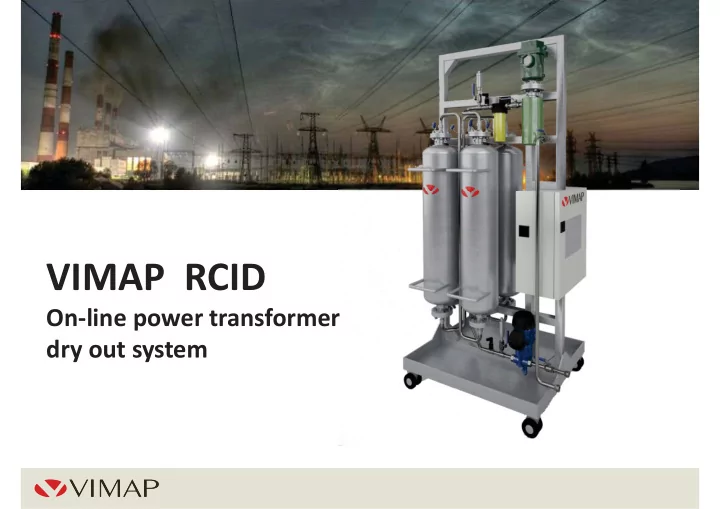
VIMAP RCID On-line power transformer dry out system What is VIMAP - - PowerPoint PPT Presentation
VIMAP RCID On-line power transformer dry out system What is VIMAP RCID? VIMAP RCID is on-line system designed for: continuous unattended dehydration of transformers insulating system VIMAP RCID working principle Dehydration is preformed
VIMAP RCID is on-line system designed for: continuous unattended dehydration of transformers insulating system
Dehydration is preformed by means of precisely selected granulated synthetic adsorbents, ie. molecular sieves which attract water molecules and permanently hold them in the pores of their active surface. Pump draws insulating oil from the lowest point
with granulated synthetic adsorbents and sends it back to the tank.
Illustration - Siemens AG
Circulating transformer oil through columns with granulated adsorbents (molecular sieves) transformer oil is dried in a matter of hours or days. Oil-cellulose insulating system tends to create state
maximum entropy. Disturbing moisture equilibrium by continuous oil drying, diffusion of water from the wet cellulose insulation to already dried oil is achieved, thus slowly removing the moisture from solid insulation. Cellulose insulation drying is far slower process than
Oil dehydration has only short term effect on dielectric properties of oil and none on dielectric properties of cellulose
Preventive maintenance New or previously dried power transformers- continual maintenance
and cellulose insulation Corrective maintenance Transformers with increased content
complete insulation, improvement of insulation characteristics, increase of power transformers safety and its lifetime
No oil heating - no undesired effects from oil heating on overall oil quality No oil vacuuming - no other parts to maintain
No oil inhibitor removed No dissolved gasses removed for continuous trending of important fault diagnostic gasses
Designed for safe continual unattended
transformers Hanging frame, bolt down stand, cabinet
Various numbers of columns Water holding capacity – appx. 5 kg each column Particle filter 10 μm
Sensors mounted on both inlet and outlet lines of the system display moisture contents (ppm) and oil temperature (°C) and indicate adsorbents saturation level Oil leakage, air ingress and high/low pressure sensors shut the system off, isolating it from the transformer, in the event of any malfunction Sound and visual alarm Optional: Ethernet module– working parameters are available via web browser or via email (SCADA compatible) GSM module sends SMS notification
Depth on line drying of solid insulation High on line oil drying efficiency No dissolved gasses removing No antioxidant additives removing No oil vacuuming No oil heating Environmently safe process
Remote monitoring of working parameters Safe transformer operation No transformer operation interruption Simple handling and maintenance Low investment costs Low operation costs
AIP – Air Ingress Prevention AIP consist of deaerating vessel and gas relay. Oil enters the deaerator in the upper zone and exits it from the lower zone. Unwanted air will therefore remain in the upper zone of the deaerator and will stream further upward to the gas relay wherein is collected. When volume of accumulated air in gas relay reaches 100 ml, electrical signal will stop the motor pump and trigger the alarm. Appropriate warning information will be displayed on the HMI. Solenoid valve will close immediately if installed. This way transformer will be disengaged from VIMAP RCID.
AIP is the last element of VIMAP RCID discharge line
High / Low Pressure Detection Pressure transmitter monitors pressure change throughout the discharge line of the Unit. It will turn the unit off and start the sound alarm when pressure reaches previously set high / low limits. Appropriate warning information will be displayed on the HMI. Solenoid valve will close immediately if installed. This way transformer will be disengaged from VIMAP RCID.
Pressure transmitter is installed immediately after the pump.
Oil Leak Detection Capacitive sensors mounted on dual containment hoses (between inner and outer hose) provide information in case of loose connections or hose break. When VIMAP RCID is installed in the cabinet additional capacitive sensor is located at the bottom of the unit and will detect any oil that is collected in the drip pan in case of leak. In both cases signal from capacitive sensors will turn the unit off and start the sound. Appropriate warning information will be displayed on the HMI. Solenoid valve will close immediately if installed. This way transformer will be disengaged from VIMAP RCID.
Particle filter saturation Pressure switch – installed in front of particle filter. When pressure on particle filter reaches 1.7 bar appropriate information will be displayed on the HMI. Particle filter bypass valve - integral part of filter head and will be opened when differential pressure
Two moisture sensors are installed in the Unit -
them continuously measure moisture contents (ppm) and oil temperature (°C). It is recommended to replace dehydration cylinders when the inlet reading is above 10 ppm and outlet reading is very close or same for a period of minimum 48 hours.
Outlet moisture & temperature transmitter installed in front of deaerator
VIMAP RCID F is frame mounted system for continuous dehydration of transformer insulating system. Can be equipped with one or more vessels. Water retaining capacity from 5 liters and more, depending on number of vessels. Pump flow from 90 l/h and more, optionally regulated by frequency converter. Moisture management system SCADA
Sensors mounted on both inlet and outlet lines of the system display moisture contents (ppm) and oil temperature (°C) and indicate adsorbents saturation level. Ethernet board– working parameters are available via web browser or via email. CMGSM module sends SMS notification in case of unit malfunction.
VIMAP RCID M is mobile trolley system for continuous dehydration of transformer insulating system. Can be equipped with one or more vessels. Water retaining capacity from 5 liters and more, depending on number of vessels. Pump flow from 90 l/h and more, optionally regulated by frequency converter. Moisture management system SCADA
Sensors mounted on both inlet and outlet lines of the system display moisture contents (ppm) and oil temperature (°C) and indicate adsorbents saturation level. Ethernet board– working parameters are available via web browser or via email. CMGSM module sends SMS notification in case of unit malfunction.