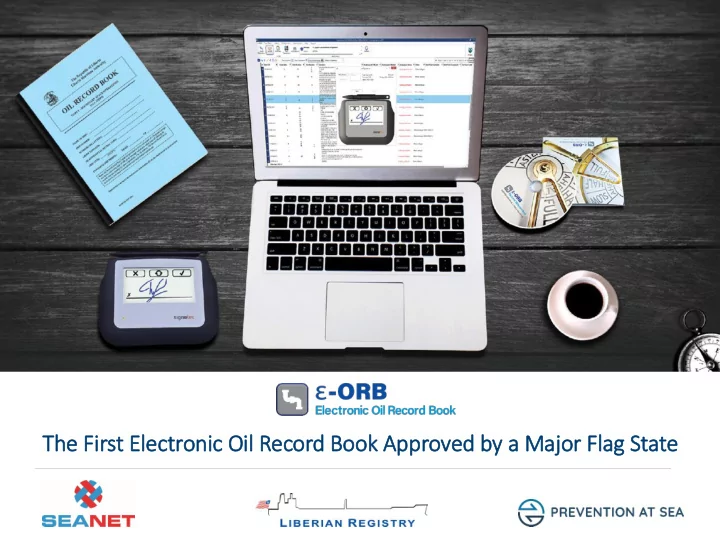
SLIDE 1
The Fir irst Ele lectronic Oil il Record Book Approved by a Major Fla lag State
SLIDE 2 -ORB
MARPOL, the ISM code, flag State and Port State Control authorities have become more strict and are emphasizing the recording of every event
- nboard a vessel. As a result, this affects crew efficiency, adds
administrative work, and calls for a more effective and efficient system. Challenges of the Paper ORB: ➢Inaccurate recordkeeping of operations ➢Erroneous entries ➢Failure to properly maintain adequate records onboard ➢False statements which cannot be verified ➢Time consuming and inefficient process ➢Heavy paperwork and administrative burden
Chall llenges of Usin ing Paper Oil il Record Books
SLIDE 3
-ORB
Consequences of Deficiencies in an Oil Record Book: ➢Criminal and civil action by the U.S. Department of Justice against shipowners and crew (is this Just U.S?) ➢Costly and lengthy court battles ➢Fines for vessel managers and owners ➢Career damage and seafarer criminalization ➢Vessel detentions ➢Potential pollution through illegal actions onboard ➢Adverse effect on fleet trading abilities ➢Damage to ship operator reputation
Consequences of Defic icie iencie ies in in an Oil il Record Books
SLIDE 4
-ORB
An electronic oil record book is a software application designed to replace the traditional paper oil record books (ORB) (Part I and Part II) and facilitate accurate ORB entries into an efficient electronic format, while complying with international conventions and flag State requirements. ➢The ε-ORB is designed in accordance with the MARPOL Annex I regulations 17 & 36 as well as IMO Circ 736/Rev 2. The software is tested in order to establish:
Solu lutio ion: Ele lectronic ic Oil il Record Book (-ORB) efficiency, traceability & credibility
SLIDE 5 -ORB
Features Advantages Benefits
✓ Automated calculations ✓ Prevent vague entries and mistakes ✓ Ease of mind pulling into ports knowing your vessel maintains accurate information ✓ Prevent detentions, avoid delays at ports ✓ Prevent law suits and criminal charges ✓ User friendly software ✓ Recordkeeping is efficient and effortless ✓ Paperless solution assists seafarers in their duties ✓ Save man hours onboard and saving on
✓ No chance of having oil record books go missing onboard ✓ Secured access ✓ Ensured transparency and accountability ✓ Prevents unauthorized access or making copies without permission ✓ Unique e-signature required ✓ Recordkeeping is only performed by authorized personnel ✓ Ensure traceability of operations ✓ Peace of mind that only authorized
- fficers are recording oil record book
entries onboard ✓ Maintenance and support plan available ✓ Mandatory software updates provided in a timely manner and ensure compliance with regulations ✓ IT technical support to user in less than 24 hours ✓ Always have the Liberian Registry and Prevention at Sea in your corner to step in at any time should an issue arise
- nboard regarding the software
Advantages of -ORB
SLIDE 6 -ORB
Features Advantages Benefits
✓ Compliance with IMO regulations and requirements ✓ Software designed using MARPOL and the MEPC 66/7, as guidance, dated 20 December 2013 “Report of the correspondence group on the use of electronic record books under MARPOL” ✓ Software meets flag State and international regulatory requirements ✓ A ‘piping diagram’ module ✓ User is assisted in designing the ship’s piping diagram, and recording operational entries by simply dragging/dropping icons ✓ Ship owner is confident in the authenticity of a vessel specific piping diagram ✓ Easy and fast to make ORB entries without errors ✓ A ‘sounding tables’ module ✓ User is assisted in the rapid calculation of the current content inside a tank by simply inserting the height measurement, trim and list ✓ Save man hours onboard ✓ ε-ORB cloud portal ✓ Ship owners are able to access all their vessels’ ε- ORBs from ashore, run reports, search and benchmark data across their fleet ✓ Save time during internal audits by pre-checking logbooks ✓ Compare one vessel’s activities against others in your fleet ✓ Backup system ✓ It is easy to archive and retrieve past data ✓ Data security ✓ Convenient access to ε-ORB data ashore and at sea upon need
Advantages of -ORB (Contin inued)
SLIDE 7
-ORB
Attendees were requested to insert an ORB operation 5 times under the same ORB code with different figures each time. They performed this task for five different ORB operations in total. The results in the follow pages are the averages the total participants. The following survey conditions applied... Condition 1: Materials for entries was provided by the software developer (Prevention at Sea Ltd) Condition 2: The ε-ORB software was already customized Condition 3: Sounding tables were used to calculate the content inside the tanks Condition 4: A brief introduction was provided for the traditional paper ORB and the ε-ORB
Tim ime Savings Study
SLIDE 8 -ORB
The following operations were recorded:
- 1. Weekly inventory
- 2. Transfer of sludge from tank listed in section 3.1 (Supplement) to a
tank listed in 3.1 (Supplement)
- 3. Delivery of sludge ashore
- 4. Discharge bilge from 3.3 via 15 ppm
- 5. Manual collection
Operatio ions Performed
SLIDE 9 -ORB
Weekly Inventory entry paper ORB eORB 1 7:32 3:06 2 6:58 2:03 3 6:36 1:55 4 6:33 1:47 5 6:30 1:46
Study Results
SLIDE 10 -ORB
Study Results Cont.
Discharge of bilges from tank listed in section 3.3 (suppl) overboard via 15 ppm entry paper ORB eORB 1 5:03 1:54 2 4:47 1:36 3 4:50 1:48 4 4:42 1:42 5 4:46 1:38 Manual Collection entry paper ORB eORB 1 6:33 2:22 2 5:47 1:58 3 5:59 1:44 4 6:12 1:50 5 5:43 1:40 Delivery of sludge ashore entry paper ORB eORB 1 4:38 1:58 2 4:30 1:34 3 4:22 1:33 4 4:24 1:35 5 4:17 1:30 Transfer of sludge from tank listed in 3.1 (Suppl) to tank listed in 3.1 entry paper ORB eORB 1 5:34 2:38 2 5:03 2:04 3 4:50 1:56 4 4:38 1:50 5 4:37 1:48
SLIDE 11 -ORB
The savings by using ε-ORB vs, paper ORB: 17 mins 20 seconds Per entry: 3 min 28 sec Per day: 27 mins (assuming an average of 8 entries are entered per day) Per Year: 164.25 hours Assuming a seafarer works 14 hours per day: 11.7 working days It’s important to note that this is 11.7 + days where engineers can be preforming other tasks
Estim imatio ion of Savings (Tim ime)
Time required to insert 5 different ORB entries entry paper ORB eORB 1 25:05 07:45
SLIDE 12
-ORB
Assumption: a second engineer earns approximately $4,500 (USD) per month 4500 / 30 = 150 $ / working day $150 x 11.7 / day = $1,755 per year in employee wages per vessel per year $1,755 x 50 ships= $87,750 Savings per year License cost of $589 x 50 ships = $29,450 per year Cost a traditional ORB: $120 x 50 vessels = $7,500 per year $87,750 + $7,500 - $29,450 = $ 65,800 of total saving per year
Estim imatio ion of Savings ($)
SLIDE 13 -ORB
✓ The learning curve indicates that the more ε-ORB entries are recorded and the user gets familiar with the software, the less time is required for such recording. Usually 2-3 days are adequate for full familiarization with the software functionalities ✓ It is roughly estimated that time savings will increase by 20-30% after the 1st month as the users will be fully familiar with the ε-ORB software ✓ The indicative saving are based on only one engineer, while more are usually involved in ORB recordings ✓ No need to spend manhours at the office to review paper ORB copies for mistakes ✓ Illegible entries are no longer an issue ✓ During a period of 5 years, over $300,000 can be saved for a fleet of 50 ships. ✓ The time does not include the drafting process and other preparations to input a formal ORB entry Time through paid salaries which costs over $300,000 in 5 years can be directed to
- ther complex/maintenance tasks
-ORB Stu tudy Conclu lusio ion
SLIDE 14
-ORB
In Inserting an Operatio ion
SLIDE 15
-ORB
-ORB Tab
SLIDE 16
-ORB
-Book Tab
SLIDE 17
-ORB
Config iguring the Software
SLIDE 18
-ORB
Config iguratio ion Tab
SLIDE 19
-ORB
Tank Table les Tab
SLIDE 20
-ORB
The e-Signature pad provides extra security
-Sig ignature
SLIDE 21
-ORB
-ORB Clo loud Portal l
SLIDE 22
-ORB
Software Pric icin ing Pla lans
SLIDE 23
-ORB
Additio ional l Optio ions
SLIDE 24
-ORB
➢We provide assistance at 3 different levels:
❖ Updates to the software (IT and regulatory) ❖ Customization guidance ❖ Technical assistance on MARPOL regulations
Assis istance & Support
SLIDE 25
-ORB
➢Minimum Ram 2 GB. For remote stations on board min. ram 1 GB ➢Recommended screen: 15” ➢Resolution: 1280 x 768 (recommended) ➢Windows platform: Minimum Windows 7, Service Pack 1 ➢Storage Size: 2 GB ➢CPU 1 GHz
Min inim imum Requir irements for the Software In Install llatio ion
SLIDE 26
-ORB
Stand Alone: ➢Microsoft .NET Framework 4.0 Full ➢Microsoft Visual C++ 2010 SPI Redistributable Package x86 ➢Microsoft Visual C++ 2013 Redistributable Package x86 ➢Signotec Biometric API (Optional) Database Instillation: ➢Microsoft .NET Framework 3.5 SPI ➢Powershell 2.0 ➢Microsoft SQL Server 2008 R2 x86 (or higher)
Pre-requir ired Downlo loads
SLIDE 27
Thank you for your time!
Additional Information and trial version available: www.liscr.com/eorb Email eorb@liscr.com
SLIDE 28
SLIDE 29
-ORB
PC SOPEP
Our Panama Canal SOPEP & Authorized Person service is designed to simplify and streamline adherence to Panama Canal’s environmental regulations ➢ Local SeaNet offices in Panama ➢ Service Available 24 hours a day/365 days a year ➢ Knowledgeable and qualified personnel experienced with pollution containment and recovery activities
SLIDE 30
-ORB
In Internal l Audits
We offer professional and cost effective internal service assessing: ➢ International Safety Management (ISM) ➢ International Ship and Port facility Security (ISPS) ➢ Maritime Labor Convention (MLC) ➢ Environmental Impacts
SLIDE 31
-ORB
Computer Based Train ining