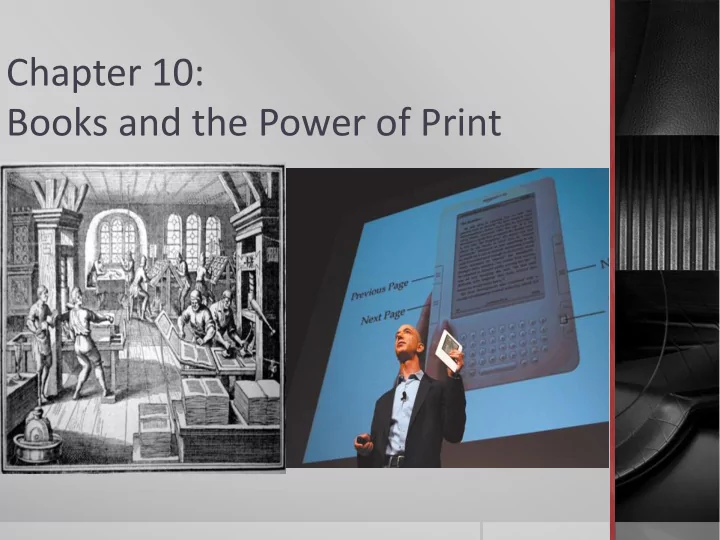
Chapter 10: Books and the Power of Print BOOKS Our oldest mass - - PowerPoint PPT Presentation
Chapter 10: Books and the Power of Print BOOKS Our oldest mass medium is still our most influential and our most diverse. The portability and compactness of books make them a preferred medium in many situations, including relaxing at
BOOKS
- Our oldest mass medium is still our most influential and our most
diverse.
- The portability and compactness of books make them a preferred
medium in many situations, including relaxing at the beach or in the park, resting in bed, and traveling to work on buses or commuter trains.
- Most important, books and print culture enable individuals and nations
to store knowledge from the past.
- In their key social role, books are still the main repository of history and
everyday experience, passing along stories, knowledge, and wisdom from generation to generation.
Excerpt from Print History P90S8262005 v.2
Manuscript Culture
- manuscript culture - period
during the Middle Ages when priests and monks advanced the art of bookmaking.
- illuminated manuscripts -
books from the Middle Ages that featured decorative, colorful designs and illustrations on each page.
- Pre-Gutenberg Revolution
- block printing
- a printing technique developed by
early Chinese printers, who hand- carved characters and illustrations into a block of wood, applied ink to the block, and then printed copies
- n multiple sheets of paper.
- Movable type
- Invented in China around 1000
- Made creating block pages faster
- Developed independently in Europe in
the 1400s
The Gutenberg Revolution
- between 1453 and 1456, Johannes Gutenberg used movable type to
develop a printing press
- printing press - a fifteenth-century invention whose movable metallic
type technology spawned modern mass communication by creating the first method for mass production;
- it reduced the size and cost of books, made them the first mass medium
affordable to less affluent people, and provided the impetus for the Industrial Revolution, assembly-line production, modern capitalism, and the rise of consumer culture.
Excerpt from Print History P90S8262005 v.2
- The social and cultural transformations ushered in by the
spread of printing presses and books.
- this permitted them to challenge the traditional wisdom and
customs of their tribes and leaders
The Gutenberg revolution
- Inestimable
influence on Western culture
- Permitted information
and knowledge to spread outside local jurisdictions
- Permitted individuals
to challenge traditional wisdom and customs
- when people could learn for
themselves by using maps, dictionaries, Bibles, and the writings
- f others, they could differentiate
themselves as individuals;
- their social identities were no longer
solely dependent on what their leaders told them or on the habits of their families, communities, or social class.
Excerpt from Print History P90S8262005 v.2
- paperback books - books made with
cheap paper covers, introduced in the United States in the mid-1800s.
- dime novels - sometimes identified as
pulp fiction, these cheaply produced and low-priced novels were popular in the United States beginning in the 1860s.
- pulp fiction - a term used to describe
many late nineteenth-century popular paperbacks and dime novels, which were constructed of cheap machinemade pulp material.
- The printing process also became quicker
and more mechanized.
- linotype - a technology introduced in the
nineteenth century that enabled printers to set type mechanically using a typewriter- style keyboard.
- offset lithography - a technology that
enabled books to be printed from photographic plates rather than metal casts, reducing the cost of color and illustrations and eventually permitting computers to perform typesetting.
Excerpt from Print History P90S8262005 v.2
Trends in Book Publishing
- A number of technological changes in the publishing industry
demonstrate the blurring of print and electronic cultures.
- The book industry has adapted successfully in the digital age by
using computer technology to effectively lower costs: Everything from an author’s word-processing program to printing and distribution is digitized.
- e-books - electronic books that can be downloaded to
portable e-book reading devices.
Convergence: Books in the Digital Age
- E-books
- Project Gutenberg
Offers more than 40,000 public domain books for free
- Print books move online
First e-readers were too heavy, expensive, and/or difficult to read Amazon produced the first popular device (Kindle) and e-book store Best-selling adult fiction book format in the United States by 2012
Convergence: Books in the Digital Age (cont.)
- The future of e-books
- Printing books on demand
Reviving books that would otherwise go out of print Avoiding the inconvenience of carrying unsold books
- Reimagining what a book can be
Hosting embedded video, hyperlinks, and dynamic content Tailoring books to specific readers
Books and the Future of Democracy
- A 2004 National Endowment
for the Arts (NEA) study, Reading at Risk,
- reading literature had declined
10 percent among all age groups over the past decade, especially among eighteen to twenty-four year olds.
- Nineteen percent of seventeen
year olds said they never or hardly ever read—up from just 9 percent in 1992.
- Four of ten college-aged people
reported they read literature on a regular basis, compared to six of ten in 1982.
- Of seventeen thousand adults
surveyed, nearly two-thirds of the men said they did not read literature at all (the study did not ask about biography and nonfiction).
- Among all adults surveyed, 96
percent favored watching TV, 60 percent preferred attending a movie, and 55 percent liked exercising—all activities ranking higher than reading literature.