Causes of goiter Iodine deficiency Surgery for thyroid goiter 50% - - PowerPoint PPT Presentation

causes of goiter
SMART_READER_LITE
LIVE PREVIEW

Causes of goiter Iodine deficiency Surgery for thyroid goiter 50% - - PowerPoint PPT Presentation

11/7/2014 Causes of goiter Iodine deficiency Surgery for thyroid goiter 50% decrease after implementation of universal salts idealization program in mainland China ( Zhao et al. PLOS One. 2014 ) Genetic predisposition Autosomal


slide-1
SLIDE 1

11/7/2014 1

Surgery for thyroid goiter

Bhuvanesh Singh, MD, PhD

Attending Surgeon Memorial Sloan-Kettering Cancer Center

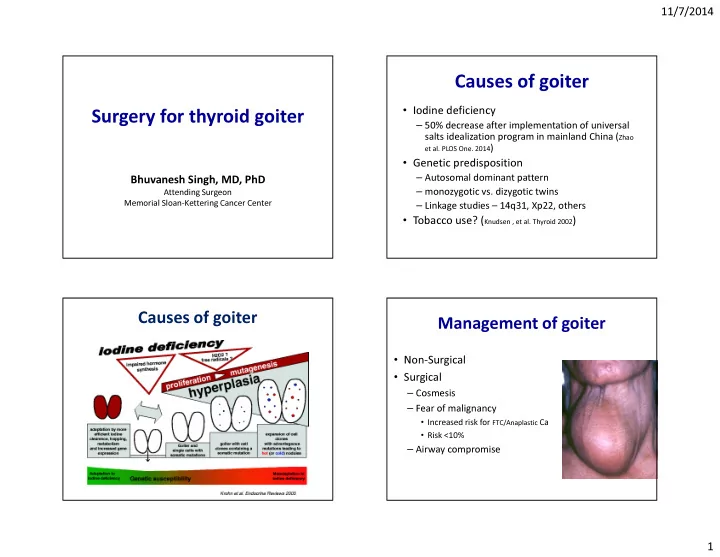
Causes of goiter

  • Iodine deficiency

– 50% decrease after implementation of universal salts idealization program in mainland China (Zhao

et al. PLOS One. 2014)

  • Genetic predisposition

– Autosomal dominant pattern – monozygotic vs. dizygotic twins – Linkage studies – 14q31, Xp22, others

  • Tobacco use? (Knudsen , et al. Thyroid 2002)

Causes of goiter Management of goiter

  • Non-Surgical
  • Surgical

– Cosmesis – Fear of malignancy

  • Increased risk for FTC/Anaplastic Ca
  • Risk <10%

– Airway compromise

slide-2
SLIDE 2

11/7/2014 2

Airway issues in goiter Airway Compromise in Goiter

lessons4medicos.blogspot.com/2009/01/what-is-this-pemberton-sign.html

Evaluation-Physical Findings

  • Respiratory insufficiency/stridor
  • Laryngoscopy
  • Thyroid – consistency, texture,

relationship to clavicles

  • Lateral neck

Evaluation Evaluation

  • Chest x-ray
  • Pulmonary function tests – flow volume

loop studies

  • Computerized tomography/MRI
  • Barium swallow
slide-3
SLIDE 3

11/7/2014 3

Indications for Surgery in Substernal Goiters Indications for Surgery in Substernal Goiters

Compression effects: Up to 22% develop acute airway

  • bstruction requiring emergent

intervention Fear of malignancy: Malignancy reported in 5-15% Cosmesis: The majority of cases of SSG are visible in the neck offering

  • bvious cosmetic significance

Emergency airway management

slide-4
SLIDE 4

11/7/2014 4

Surgical technique: Setup Surgical technique: Setup

  • Non-traumatic intubation
  • Discuss intubation with anesthesiologist
  • ET tube well below the vocal cords
  • tendency for the tube to slide up
  • Paralysis during surgery
  • Role of monitoring

Surgical technique: Approach Surgical technique: Approach

  • A wide skin excision
  • Transection of sternothyroid
  • Open Joll’s triangle
  • Work on surface gland
  • Ligate feeding vessels
  • Finger dissection

Surgical technique: key points Surgical technique: key points

  • Ligate several inferior thyroid veins carefully
  • Use Bipolar cautery or Ligasure
  • The RLN best identified after delivering substernal

portion of gland

  • In difficult cases- retrograde technique dissect

RLN near the ligament of Berry

  • Parathyroids

Role of finger dissection

slide-5
SLIDE 5

11/7/2014 5

Role sternotomy

  • Pre-operative consent
  • Median sternotomy, clam shell

thoracotomy, lateral thoracotomy

  • Indications
  • Recurrent/isolated mediastinal

goiter

  • Superior vena cava syndrome
  • Thyroid cancer
  • direct extension or metastatic

disease

Management of RLN

slide-6
SLIDE 6

11/7/2014 6

Perioperative management Perioperative management

  • Placement of suction drain recommended
  • Most of the patients can be extubated in OR
  • Traceomalacia rarely an issue
  • If concern- keep intubated for 24 hrs