
SLIDE 1
Andreas Zeller
Isolating Failure Causes
2
Alternate world Actual world
Isolating Causes
Mixed world
✔ ✘
Test
?
3
Alternate world Actual world
Isolating Causes
Mixed world
✔ ✘
Test
?
+1.0
How can we automate this?
1 2 3
Isolating Failure Causes Andreas Zeller 1 Isolating Causes Actual - - PDF document
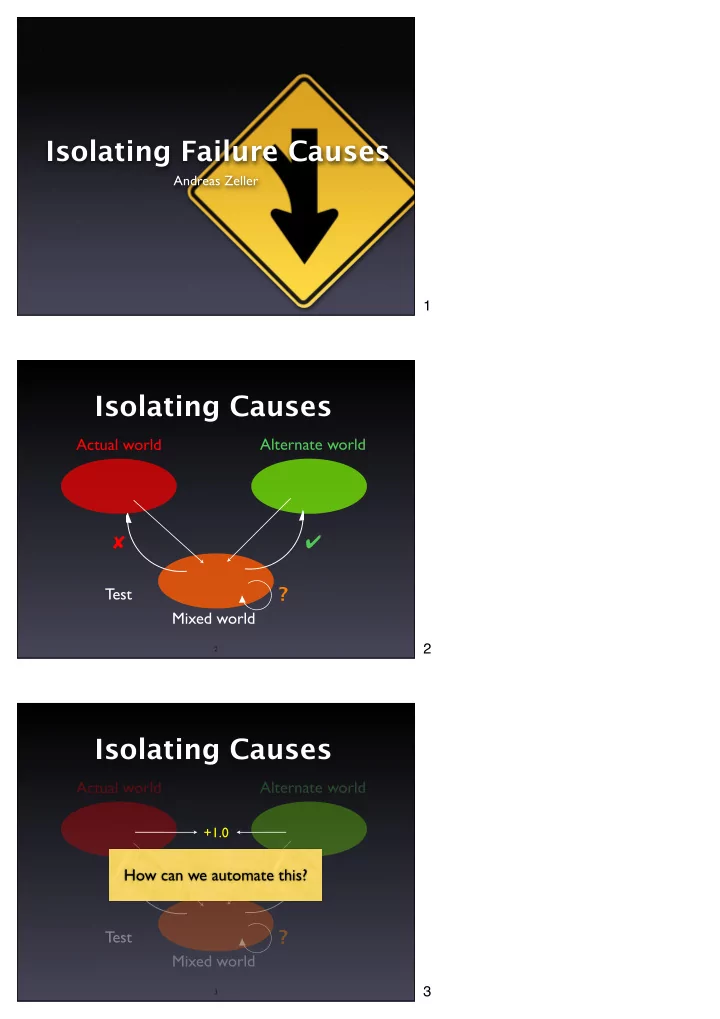
Isolating Failure Causes Andreas Zeller 1 Isolating Causes Actual world Alternate world ? Test Mixed world 2 2 Isolating Causes Alternate world Actual world +1.0 How can we automate this? ? Test Mixed world 3
Andreas Zeller
2
Alternate world Actual world
Mixed world
✔ ✘
Test
?
3
Alternate world Actual world
Mixed world
✔ ✘
Test
?
+1.0
How can we automate this?
1 2 3
4
<SELECT NAME="priority" MULTIPLE SIZE=7> <SELECT NAME="priority" MULTIPLE SIZE=7> <SELECT NAME="priority" MULTIPLE SIZE=7>
<SELECT NAME="priority" MULTIPLE SIZE=7> ✔
<SELECT NAME="priority" MULTIPLE SIZE=7> <SELECT NAME="priority" MULTIPLE SIZE=7> <SELECT NAME="priority" MULTIPLE SIZE=7>
5
Input
… Failure Cause
6
<SELECT NAME="priority" MULTIPLE SIZE=7> <SELECT NAME="priority" MULTIPLE SIZE=7> ✔
<SELECT NAME="priority" MULTIPLE SIZE=7>
Difference narrowed down
4 5 6
7
<SELECT NAME="priority" MULTIPLE SIZE=7> <SELECT NAME="priority" MULTIPLE SIZE=7>
<SELECT NAME="priority" MULTIPLE SIZE=7> <SELECT NAME="priority" MULTIPLE SIZE=7> <SELECT NAME="priority" MULTIPLE SIZE=7> <SELECT NAME="priority" MULTIPLE SIZE=7> <SELECT NAME="priority" MULTIPLE SIZE=7> ✔
Failure Cause
8
Input
… … Failure Cause
9
5Simplifying " !
Input
! ! !
… Failure Cause
7Isolating " !
Input
! " ! "
… … Failure Cause
7 8 9
10
All circumstances
C = {δ1, δ2, . . . }
Configuration
c = {δ1, δ2, . . . δn} c ⊆ C
Circumstance
δ
11
Testing function Initial configurations
test(c✔) = ✔ test(c✘) = ✘ test(c) ∈ {✔, ✘, ?}
12
Goal: Subsets
∅ = c✔ ⊆ c
✔ ⊂ c ✘ ⊆ c✘
c
✘ and c ✔
∆ = c
✘ \ c ✔
Difference Difference is 1-minimal
∀δi ∈ ∆ · test(c
✔ ∪ {δi}) = ✔ ∧ test(c ✘ \ {δi}) = ✘
10 11 12
Input
… … Failure Cause
test(c✘) = ✘ test(c✔) = ✔ ∆ = c
✘ \ c ✔
at a time – and
14
c
✘
c
✔
c
✘ \ ∆i
c
✔ ∪ ∆i
∆1 ∪ ∆2 ∪ · · · ∪ ∆n = ∆ = c
✘ \ c ✔
increase gra e granularity
15
most valuable outcomes
13 14 15
16
(c
✔, c ✘)
if |∆| = 1 dd(c
✘ \ ∆i, c ✘, 2)
if ∃i ∈ {1..n} · test(c
✘ \ ∆i) = ✔
dd(c
✔, c ✔ ∪ ∆i, 2)
if ∃i ∈ {1..n} · test(c
✔ ∪ ∆i) = ✘
dd c
✔ ∪ ∆i, c ✘, max(n − 1, 2)
✔ ∪ ∆i) = ✔
dd c
✔, c ✘ \ ∆i, max(n − 1, 2)
✘ \ ∆i) = ✘
dd c
✔, c ✘, min(2n, |∆|)
(c
✔, c ✘)
dd(c✔, c✘) = dd(c✔, c✘, 2) dd(c
✔, c ✘, n) =
dd(c✔, c✘) = (c
✔, c ✘)
∆ = c
✘ \ c ✔ is 1-minimal 17
def dd(c_pass, c_fail): n = 2 while 1: delta = listminus(c_fail, c_pass) deltas = split(delta, n); offset = 0; j = 0 while j < n: i = (j + offset) % n next_c_pass = listunion(c_pass, deltas[i]) next_c_fail = listminus(c_fail, deltas[i]) if test(next_c_fail) == FAIL and n == 2: c_fail = next_c_fail; n = 2; offset = 0; break elif test(next_c_fail) == PASS: c_pass = next_c_fail; n = 2; offset = 0; break elif test(next_c_pass) == FAIL: c_fail = next_c_pass; n = 2; offset = 0; break elif test(next_c_fail) == FAIL: c_fail = next_c_fail; n = max(n - 1, 2); offset = i; break elif test(next_c_pass) == PASS: c_pass = next_c_pass; n = max(n - 1, 2); offset = i; break else: j = j + 1 if j >= n: if n >= len(delta): return (delta, c_pass, c_fail) else: n = min(len(delta), n * 2)
number of tests t – worst case:
18
number of tests t – best case (no unresolved outcomes):
t ≤ log2(∆)
size of difference – no unresolved outcomes
|c
✘ \ c ✔| = 1
t = |∆|2 + 7|∆| where ∆ = c✘ \ c✔
16 17 18
19
Input Code Changes Schedules
20
Input Code Changes Schedules
21
<SELECT NAME="priority" MULTIPLE SIZE=7> <SELECT NAME="priority" MULTIPLE SIZE=7>
<SELECT NAME="priority" MULTIPLE SIZE=7> <SELECT NAME="priority" MULTIPLE SIZE=7> <SELECT NAME="priority" MULTIPLE SIZE=7> <SELECT NAME="priority" MULTIPLE SIZE=7> <SELECT NAME="priority" MULTIPLE SIZE=7> ✔
Failure Cause Isolation: 5 tests Simplification: 48 tests
19 20 21
22
23
Input Code Changes Schedules
24
Input Code Changes Schedules
22 23 24
25
From: Brian Kahne <bkahne@ibmoto.com> To: DDD Bug Report Address <bug-ddd@gnu.org> Subject: Problem with DDD and GDB 4.17 When using DDD with GDB 4.16, the run command correctly uses any prior command-line arguments, or the value of "set args". However, when I switched to GDB 4.17, this no longer worked: If I entered a run command in the console window, the prior command- line options would be lost. [...]
26
Wie finden wir die alternative Welt?
Old version Program works New version Program fails Causes
27
$ diff -r gdb-4.16 gdb-4.17 diff -r gdb-4.16/COPYING gdb-4.17/COPYING 5c5 < 675 Mass Ave, Cambridge, MA 02139, USA
282c282 < Appendix: How to Apply These Terms to Your New Programs
…and so on for 178,200 lines (8,721 locations)
25 26 27
28
be combined to produce testable code Delta debugging handles all this
(= 8,721 individual changes)
unresolved test outcome
29 30
1 10 100 1000 10000 100000 50 100 150 200 250 300 Changes left Tests executed Delta Debugging Log GDB with ddmin algorithm ... with dd algorithm ... plus scope information
28 29 30
31
diff -r gdb-4.16/gdb/infcmd.c gdb-4.17/gdb/infcmd.c 1239c1278 < "Set arguments to give program being debugged when it is started.\n
it is started.\n
but GDB outputs Argument list
32
33
for possibly missing changes
31 32 33
34
Input Code Changes Schedules
35
Input Code Changes Schedules
36
read(...) modify(...) write(...) close(...)
read(...) modify(...) write(...) close(...) Schedule Thread A Thread B
!
Thread Switch
read(...) modify(...) read(...) write(...) close(...) modify(...) write(...) close(...) Thread A Thread B Schedule
"
A’s updates get lost!
34 35 36
37
DEJAVU recorded schedule record replay
x = 45 y = 39 z = 67 x = 45 y = 39 z = 67 x = 45 y = 39 z = 67 x = 45 y = 39 z = 67
38
replay
!
replay
"
The schedule difference causes the failure!
39
! "
t1 t2 t3
∆i between thread switches ti: – t1 occurs in ! at “time” 254 – t1 occurs in " at “time” 278 – The difference ∆1 = |278 − 254| induces a statement interval: the code executed between “time” 254 and 278 – Same applies to t2, t3, etc.
37 38 39
40
" ! ?
41
! " ? " !
Dejavu replays the generated schedule Test outcome
42
thread switch by ±1 yield point (time unit)
40 41 42
43
1e+11 1e+12 1e+13 1e+14 5 10 15 20 25 30 35 40 45 50 Deltas Tests executed Delta Debugging Log cpass cfail
no unresolved outcomes: complexity is O(log2 n)
44
25 public class Scene { … 44
private static int ScenesLoaded = 0;
45
(more methods…)
81
private
82
int LoadScene(String filename) {
84
int OldScenesLoaded = ScenesLoaded;
85
(more initializations…)
91
infile = new DataInputStream(…);
92
(more code…)
130
ScenesLoaded = OldScenesLoaded + 1;
131
System.out.println("" + ScenesLoaded + " scenes loaded.");
132
…
134
}
135
…
733 }
45
43 44 45
46
To isolate failure causes automatically, use
One possible strategy is Delta Debugging.
47
Delta Debugging can isolate failure causes
Every such cause implies a fix – but not necessarily a correction.
48 This work is licensed under the Creative Commons Attribution License. To view a copy of this license, visit http://creativecommons.org/licenses/by/1.0
46 47 48