Pediatric Obesity: To Treat or Not To Treat? Jamie Jeffrey, MD, - - PDF document

pediatric obesity to treat or not to treat
SMART_READER_LITE
LIVE PREVIEW

Pediatric Obesity: To Treat or Not To Treat? Jamie Jeffrey, MD, - - PDF document

WVDA 4-29-2010 Pediatric Obesity: To Treat or Not To Treat? Jamie Jeffrey, MD, FAAP Medical Director HealthyKids Pediatric Weight Management Program & Childrens Medicine Center WVU Associate Clinical Professor Pediatrics Project


slide-1
SLIDE 1

1

WVDA 4-29-2010 WVDA 4-29-2010
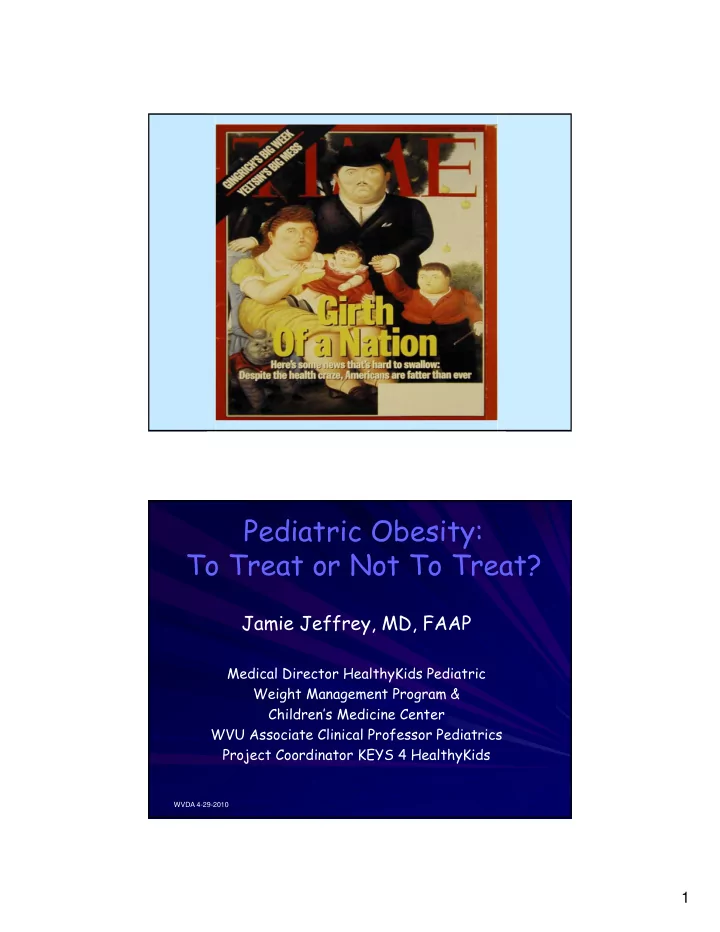
Pediatric Obesity: To Treat or Not To Treat?

Jamie Jeffrey, MD, FAAP

Medical Director HealthyKids Pediatric Weight Management Program & Children’s Medicine Center WVU Associate Clinical Professor Pediatrics Project Coordinator KEYS 4 HealthyKids

slide-2
SLIDE 2

2

WVDA 4-29-2010

Objectives

Overview Pediatric Obesity Epidemic Clinical Practice Guidelines for Pediatric Obesity Medical Co- Morbidities of Pediatric Obesity Treatment vs. Prevention

WVDA 4-29-2010

Obesity Trends Among U.S. Adults between 1985 and 2006 Obesity Trends Among U.S. Adults between 1985 and 2006

Definitions: Obesity: having a very high amount of body fat in relation to lean body mass or BMI >/= 30 Body Mass Index (BMI): a measure of an adult’s weight in relation to height, specifically the adult’s weight in kilograms divided by the square

  • f his/her height in meters.

BMI = Wt / Ht2 Definitions: Obesity: having a very high amount of body fat in relation to lean body mass or BMI >/= 30 Body Mass Index (BMI): a measure of an adult’s weight in relation to height, specifically the adult’s weight in kilograms divided by the square

  • f his/her height in meters.

BMI = Wt / Ht2

slide-3
SLIDE 3

3

WVDA 4-29-2010

1 9 9 8

Obesity Trends* Am ong U.S. Adults BRFSS, 1 9 9 0 , 1 9 9 8 , 2 0 0 6

( * BMI 3 0 , or about 3 0 lbs. overw eight for 5 ’4 ” person) 2 0 0 6 1 9 9 0 No Data <10% 10%–14% 15%–19% 20%–24% 25%–29% ≥30%

WVDA 4-29-2010

Obesity Trends-Pediatrics

National Health & Nutrition Exam Survey (NHANES) BMI >95% on gender specific BMI-for-age growth charts

slide-4
SLIDE 4

4

WVDA 4-29-2010

Normal BMI Underweight BMI Overweight BMI Obese BMI

WVDA 4-29-2010

Obesity Trends-Pediatrics

slide-5
SLIDE 5

5

WVDA 4-29-2010

NHANES Prevalence Data

WVDA 4-29-2010

0% 5% 10% 15% 20% 25% 30% 35% 2 3 4 5 6 7 8 9 10 11 12 13 14

Overweight and Obesity BMI in CMC

Overweight Obese

slide-6
SLIDE 6

6

WVDA 4-29-2010

0.00% 5.00% 10.00% 15.00% 20.00% 25.00% 30.00% 1 2 Age Ranges in Years

Comparison Obesity Prevalence CMC to NHANES

NHANES CMC

2-5 6-11

WVDA 4-29-2010

Age of Onset of Pediatric BMI Shifting

  • 5

5 10 15 20 25 2 3 4 5 6 7 8 9 10 11 12 13 14

Age

Normal to Overweight Overweight to Obese Normal to Obese

slide-7
SLIDE 7

7

WVDA 4-29-2010 WVDA 4-29-2010

Bogalusa Heart Study

Cohort Based 1973-1996 2,610 Children 2-17 years followed to ages 18-37 years Mean follow-up 17.6 years BMI-for-age & Skinfold (SF) thickness in childhood compared to adult mean SF (subscapular & triceps SF)

slide-8
SLIDE 8

8

WVDA 4-29-2010

Bogalusa: Proportion of Children Who Become Obese Adults

10 20 30 40 50 60 70 80 90 100 2-5 years 6-8 years 9-11 years 12-14 years 15-17 years

< 50% BMI >95% BMI

WVDA 4-29-2010

American Heart Association Meeting, 11-2008

70 Children Ages 10-16 with abnormal cholesterol and most obese

– Ultrasound determined “vascular age” by wall thickness of carotid – The group age was 30 years old than their actual age – Indicative of increased risk of heart disease

slide-9
SLIDE 9

9

WVDA 4-29-2010

Complications of Pediatric Obesity

Diabetes, Type II Hypertension Dyslipidemia Metabolic Syndrome Sleep Apnea NASH Gallbladder Disease Asthma Depression/Anxiety Bullying PCOS Blount’s Disease Symptomatic Pes Planus Chronic Knee Pain Pseudotumor Cerebri Osteoarthritis

WVDA 4-29-2010

Etiologies

Nature

Vs

Nuture

slide-10
SLIDE 10

10

WVDA 4-29-2010

Expert Committee Recommendations (June, 2007)

www.ama-assn.org/ama/pub/category/11759.html

WVDA 4-29-2010

Maine “Keep Me Healthy”

www.aap.org

slide-11
SLIDE 11

11

WVDA 4-29-2010

Let’s Move and 5210

WVDA 4-29-2010

UNIVERSAL ASSESSMENT OF OBESITY RISK

Identification: Calculate and plot BMI at every WCC Assessment: Identify medical risk, problem behaviors, and attitudes about healthy lifestyle Prevention: Make a plan based

  • n patients motivation, BMI

category and risk factors

slide-12
SLIDE 12

12

WVDA 4-29-2010

BASIC DEFINITIONS

Body Mass Index (BMI)= Weight (kg)/Height (m)2 BMI <5th %ile - Underweight BMI 5-84th %ile - Healthy Weight BMI 85-95th %ile, Overweight BMI >95th %ile or older adolescents with BMI > 30 kg/m2, Obese

WVDA 4-29-2010

Obese Overweight Healthy Weight

slide-13
SLIDE 13

13

WVDA 4-29-2010 WVDA 4-29-2010

Healthy

slide-14
SLIDE 14

14

WVDA 4-29-2010

Overweight

WVDA 4-29-2010

Overweight

slide-15
SLIDE 15

15

WVDA 4-29-2010

Obese

WVDA 4-29-2010

Medical Screening By BMI

BMI Percentile Review of Systems Family History Physical Examination Laboratory Tests 5th‐84th Normal BMI Obesity, DM‐ 2, HTN, Lipids, CAD BP (correct cuff) 85th‐ 94th Overweight Snoring/sleep abdominal pain; HA; menstrual irregularities; hip, knee, leg pain; polyuria; thirst; depression Same as above BP, acanthosis nigricans, tonsils, goiter, tender abdomen, liver, bowing of legs, limited hip ROM,

  • ptic discs, acne,

hirsutism Fasting Lipid Profile (FLP) If other risk factors fasting glucose, ALT, AST every 2 years 95th‐ 99th Obese Same as above Same as above Same as above FLP,Fasting glucose, ALT, AST every 2 years

slide-16
SLIDE 16

16

WVDA 4-29-2010

Blood Pressure

Correct Cuff Size

– Cuff width cover ¾ between acromion &

  • lecranon

– Cuff bladder length 80-100% of arm circumference

Manual vs Dynamap

WVDA 4-29-2010

Blood Pressure-4th Report

Pre-HTN Stage I Stage II 90%-<95% 95%- 99% >99% + 5

slide-17
SLIDE 17

17

WVDA 4-29-2010

Acanthosis Nigricans

WVDA 4-29-2010

Acanthosis Nigricans

slide-18
SLIDE 18

18

WVDA 4-29-2010

Acanthosis Nigricans

WVDA 4-29-2010

? Acanthosis Nigricans?

10

slide-19
SLIDE 19

19

WVDA 4-29-2010

INSULIN RESISTANCE AND FAT DEPOSITION

Insulin resistance Free Fatty Acids Insulin resistance Insulin resistance insulin Liver Muscle

WVDA 4-29-2010

LABORATORY WORK-UP

  • 1. Fasting Lipid Profile (FLP)
  • 2. CMP (FBS, ALT/AST)
slide-20
SLIDE 20

20

WVDA 4-29-2010

Diabetes Work-Up

Pre-DM Impaired Fasting Glucose

– FBS 100-125 mg/dl

Impaired Glucose Tolerance

– 2 hr post 75g glucose – 140-199 mg/dl

DM Random BS >/=200 with symptoms

– Polyuria – Polydipsia – Weight loss

FBS >/= 126 mg/dl GTT 2 hr >/= 200 mg/dl

WVDA 4-29-2010

STAGE 1-PREVENTION PLUS

Dietary Habits & Physical Activity

– Review 5 2 1 0

Behavioral Counseling

– Eating breakfast daily – Limiting meals outside the home – Family meals 5-6 times a week – Allow child to self regulate at meals without overly restrictive behavior

.

slide-21
SLIDE 21

21

WVDA 4-29-2010

5 2 1 0

5 Eat at least 5 servings of fruits and vegetables daily 2 Limit screen time to <2 hours/day 1 Get 1 hour or more of physical activity daily 0 “Zero” sugar sweetened drinks

WVDA 4-29-2010

STAGE 1- PREVENTION PLUS

Goal

– Weight maintenance with growth resulting in decreased BMI – Monthly Follow-up – After 3-6 months, no BMI change, advance to Stage 2 Treatment

slide-22
SLIDE 22

22

WVDA 4-29-2010

American Feast's Sustainable Food Blog

WVDA 4-29-2010

STAGE 2 STRUCTURED WEIGHT MANAGEMENT

Dietary Habits and Physical Activity

– Plan for balanced diet, emphasizing low amounts

  • f energy dense foods.

– Increased structured daily meals and snacks – Supervised active play at least 60 min/day – Screen time 1 hour or less a day – Increased monitoring by provider, patient and/or family

slide-23
SLIDE 23

23

WVDA 4-29-2010

STAGE 2 STRUCTURED WEIGHT MANAGEMENT

Goal:

– Weight Maintenance with decreasing BMI – Weight loss not to exceed 1 lb/mo in ages 2-11 – Average weight loss of 2 lb/week in older children and adolescents – Monthly Follow-up – If no BMI improvement, advance Stage 3

WVDA 4-29-2010

STAGE 3-MULTIDISCIPLINARY INTERVENTION

Dietary habits and physical activity – Same as stage 2. Behavioral Counseling

– Structured behavioral modification with food and activity monitoring. Short term diet and activity goals. – Involvement of families for behavioral modification in children < 12 years

slide-24
SLIDE 24

24

WVDA 4-29-2010

STAGE 3-MULTIDISCIPLINARY INTERVENTION

Goals

  • Weight maintenance or gradual weight loss until

BMI <85th %

  • Not to exceed 1lb/month in 2-5 year olds
  • 2 lbs/week children >5 years old

WVDA 4-29-2010

STAGE 4-TERTIARY CARE INTERVENTION

Hospital setting with expertise in childhood

  • besity

Multidisciplinary team under designated protocol

– Includes meal replacement, VLCD, meds & surgery

For BMI > 95% & significant co-morbidities unsuccessful with stages 1-3 and BMI>99% who have shown no improvement with stage 3

slide-25
SLIDE 25

25

WVDA 4-29-2010

Shift in Treatment Paradigm

Educate, Educate, Educate Pick issues important to patient- Educate, Educate, Educate

WVDA 4-29-2010

Shift in Treatment Paradigm

COLLABORATE!! Patients Make agenda when ready to change

slide-26
SLIDE 26

26

WVDA 4-29-2010

SMART Goals

S-specific M-measurable A-attainable R-realistic T-time bound

WVDA 4-29-2010

The 15 minute Obesity Prevention Protocol

Step 1-Assessment

– BMI – Ask permission to discuss weight – Elicit parents concern – Reflect/Probe – 5210 Questionnaire (Short vs Long) – Reflect/Probe Cycle

slide-27
SLIDE 27

27

WVDA 4-29-2010

The 15 minute Obesity Prevention Protocol

Step 2- Agenda Setting

– Target behavior willing to change – 5210 with Goal – Goal Trackers

WVDA 4-29-2010

The 15 minute Obesity Prevention Protocol

Step 3-Assess Motivation & Confidence

– Importance/Confidence Ruler – Pocket Guide

Step 4-Summarize and Clarify Goal

slide-28
SLIDE 28

28

WVDA 4-29-2010

Importance/Confidence Ruler

Confidence?

On a scale of 0—10, how confident are you that you can succeed?

0—–—1—–—2—–—3—–—4—–—5—–—6—–—7—–—8—–—9—–—10

Not Confident Somewhat Very Confident Willingness/ I mportance ?

On a scale of 0—10, how willing/ important is it to you to make a change toward a healthier lifestyle? 0—–—1—–—2—–—3—–—4—–—5—–—6—–—7—–—8—–—9—–—10

Not I mportant Somewhat Very I mportant

WVDA 4-29-2010

The 15 minute Obesity Prevention Protocol

Schedule Follow-up Office Visit

– F/U 1-3 months depending on level of commitment – Remember Chronic Care Model

slide-29
SLIDE 29

29

WVDA 4-29-2010

MOTIVATIONAL INTERVIEWING

Patient centered care approach Nonjudgmental, empathetic and encouraging Behavior change influenced more by motivation than by information. Core principle: People are more likely to accept and act on opinions that they voice themselves.

WVDA 4-29-2010

MOTIVATIONAL INTERVIEWING-”OARS”

O = Open ended questions (start with asking permission) A = Affirmation R = Reflective Listening (Repeat and summarize) S = Summarize

slide-30
SLIDE 30

30

WVDA 4-29-2010

MI: OPEN THE ENCOUNTER

Ask permission: Would you be willing to spend

a few minutes talking about Suzy’s weight? Are you interested in ways to stay healthy and energized?

Ask open ended question – Listen – Summarize

– What do you think? How do you feel about your lifestyle? What have you tried so far to work towards a healthier lifestyle?

WVDA 4-29-2010

MI Continued

Share BMI/Weight Information

– Your BMI is 95nd percentile, the recommended level for your age <85th. Your current weight puts you at risk for developing heart disease and diabetes. – Ask for patient’s interpretation, what do you make of this? – Add your own interpretation/advice as needed after eliciting the response of the patient/parent.

slide-31
SLIDE 31

31

WVDA 4-29-2010

MI: NEGOTIATE THE AGENDA

Some ideas for staying healthy include… What are your ideas for working toward a healthy weight? Introduce 5 2 1 0 and ask if the patient is interested in discussing one of these further, ask if they have other ideas Goal Oriented

WVDA 4-29-2010

MI: ASSESS READINESS & TAILOR THE INTERVENTION

Stage of Readiness Key Questions Not ready 0—3 *Raise awareness *Elicit “change talk” *Advise and Encourage ‐Would you be interested in knowing more about ways to stay healthy? ‐How can I help? ‐What might need to be different for you to consider a change in the future? Unsure 4—6 *Evaluate Ambivalence *Elicit “change talk” *Build readiness ‐Where does that leave you now? ‐What do you see as your next step? ‐What are you thinking/feeling at this point? ‐Where does ______ fit into your future? Ready 7—10 *Strengthen commitment *Elicit “change talk” ‐Why is this important to you now? ‐What are your ideas for making this work? ‐What might get in the way? How might you work around these barriers?

slide-32
SLIDE 32

32

WVDA 4-29-2010

EXPLORE AMBIVALENCE

Step 1: Ask a pair of questions to help patient explore the pros and cons.

– What are the advantages of keeping things the same? AND What are the advantages of making a change?

WVDA 4-29-2010

Step 2: Summarize ambivalence

–Let me see if I understand what you’ve told me so far… (start with reasons for maintaining status quo end with reasons to make a change)

EXPLORE AMBIVALENCE

slide-33
SLIDE 33

33

WVDA 4-29-2010

CLOSE THE ENCOUNTER

Summarize: Our time is almost up, let’s review what you have worked on today. Show appreciation for willingness to discuss change. Offer advise, emphasize choices, express confidence Confirm next steps and schedule follow up.

WVDA 4-29-2010

Prevention is Key

slide-34
SLIDE 34

34

WVDA 4-29-2010

Let’s Move and 5210

www.aap.org

WVDA 4-29-2010

Chronic Care Model

Wegner, 1998

slide-35
SLIDE 35

35

WVDA 4-29-2010

Any Questions