Hypothyroidism Therapeutics 1. The metabolically active thyroid - - PowerPoint PPT Presentation

hypothyroidism therapeutics
SMART_READER_LITE
LIVE PREVIEW

Hypothyroidism Therapeutics 1. The metabolically active thyroid - - PowerPoint PPT Presentation

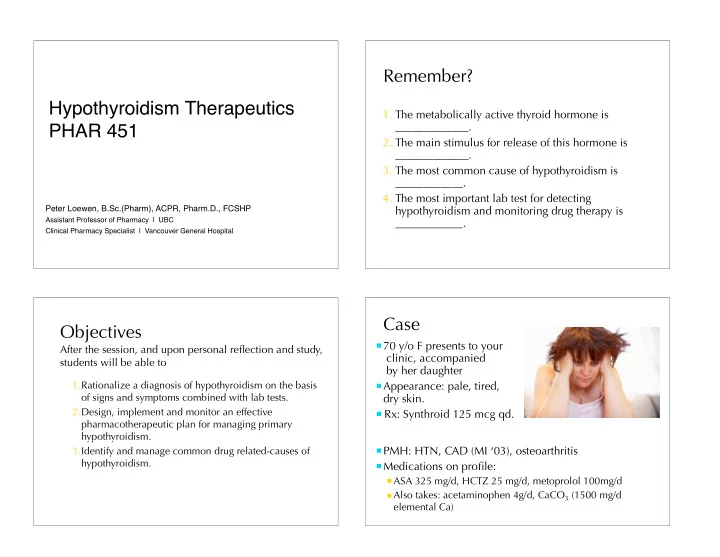
Remember? Hypothyroidism Therapeutics 1. The metabolically active thyroid hormone is _____________. PHAR 451 2. The main stimulus for release of this hormone is _____________. 3. The most common cause of hypothyroidism is ____________.


slide-1
SLIDE 1

Hypothyroidism Therapeutics
 PHAR 451

Peter Loewen, B.Sc.(Pharm), ACPR, Pharm.D., FCSHP

Assistant Professor of Pharmacy | UBC Clinical Pharmacy Specialist | Vancouver General Hospital

Remember?

  • 1. The metabolically active thyroid hormone is

_____________.

  • 2. The main stimulus for release of this hormone is

_____________.

  • 3. The most common cause of hypothyroidism is

____________.

  • 4. The most important lab test for detecting

hypothyroidism and monitoring drug therapy is ____________.

Objectives

After the session, and upon personal reflection and study, students will be able to

1.Rationalize a diagnosis of hypothyroidism on the basis

  • f signs and symptoms combined with lab tests.

2.Design, implement and monitor an effective pharmacotherapeutic plan for managing primary hypothyroidism. 3.Identify and manage common drug related-causes of hypothyroidism.

Case

n70 y/o F presents to your


clinic, accompanied
 by her daughter

nAppearance: pale, tired, 


dry skin.

n Rx: Synthroid 125 mcg qd. nPMH: HTN, CAD (MI ‘03), osteoarthritis nMedications on profile:

n ASA 325 mg/d, HCTZ 25 mg/d, metoprolol 100mg/d n Also takes: acetaminophen 4g/d, CaCO3 (1500 mg/d

elemental Ca)

slide-2
SLIDE 2

Case

n Labs: nTSH 56 (0.5 - 5.0 μU/mL) nfT3 1.4 (3.5-7.7 pmol/L) nfT4 5.0 (9-25 pmol/L) nLytes: Na 131, others N n Vitals: nHR 50, BP 135/90, Temp N, RR 25

Symptoms of Hypothyroidism

www.peterloewen.com/made

nWhat do you think this lady has? nWhat signs & symptoms are consistent with

that diagnosis?

nWhat are some possible causes?
 nDo you see any potential drug-related issues?

Hypothyroidism - Goals of therapy

nNormalize TSH, fT4, fT3 levels nEliminate symptoms nAvoid over-supplementation

slide-3
SLIDE 3

Thyroid replacement options

nSynthetic L-thyroxine (T4) (Synthroid, Eltroxin,

Gen-levothyroxine, Soloxine, Euthyrox, NV-Thyro, Levo-T)

nLiothyronine (T3) (Cytomel) nThyroid hormone extract (Thyroid USP) nT4/T3 Combinations (Thyrolar, Liotrix) - N/A in

Canada

Therapeutic principles

nInitiating therapy

nUse L-thyroxine monotherapy (JAMA 2003;290:2952-8)

nT4+T3 replacement not superior to T4 alone on body

weight, lipids, symptoms, cognition, QOL

nInitial dosing:

nYoung adults: 75 mcg/d nElderly: 50 mcg/d nCAD: 12.5-25 mcg/d & monitor for angina

nBetter absorption when taken @HS (Clinical

Endocrinology 2007;66:43–48; Arch Intern Med. 2010;170(22):1996-2003)

nBetter absorption when taken on empty

stomach (J Clin Endocrinol Metab 2009;94:3905–3912)

Therapeutic principles

Titrating / monitoring therapy

n Re-measure TSH (+/- T3/fT4) 3-6 weeks after dose

change

n Once on appropriate dose, measure TSH annually n Adjust doses in 25 mcg/d increments, sometimes

smaller, rarely larger

n Mean required dose 1.5 mcg/kg/d (100-125 mcg/d) n No clinical advantage (QOL, Sx, cognition) to aiming for

low half (<2) of normal TSH range vs. upper end (>2)

(Walsh et al. J Clin Endocrinol Metab 2006:91: 2624 –2630)

n No routine role for T3, combinations

Drug-related causes of hypothyroidism

Thyroiditis

interferon, interleukin-2, amiodarone, sunitinib

Inhibited T4 ➜ T3 conversion

propranolol, atenolol, alprenolol, PTU, dexamethasone, prednisone, iopanoic acid, amiodarone

Inhibited T3/T4 production

iodine, amiodarone, lithium, PTU, methimazole (MMI), I131, aminoglutethimide

Inhibited TSH release

dopamine, dobutamine, octreotide (>100 mcg/d), prednisone (>20mg/d), metformin? carbamazepine?

Displacement from TBG

carbamazepine, phenytoin

Unknown

valproic acid, phenobarbital, rifampin

adapted from B.R. Haugen BR. Best Pract & Research Clin Endocrinol & Metab 2009;23:793–800

Absorption interference

calcium, iron, aluminum supplements, sucralfate, cholestyramine, PPI?, coffee?

Increased TBG levels

estrogen, tamoxifen, raloxifene, methadone, fluorouracil, mitotane

slide-4
SLIDE 4

L-thyroxine: adverse effects

nHyperthyroidism

nLow TSH nSigns & Symptoms

nAtrial fibrillation

nOsteoporosis

nTSH <0.1 → 3.6 x ↑ in hip fracture risk & 4.5 x ↑ in

vertebral fracture risk vs. normal TSH in women >65y/

  • . (Bauer et al. Ann Intern Med 2001;134:561-568; Arch Intern Med

2010;170:1876-83)

Case

n70 y/o F presents to your


clinic, accompanied
 by her daughter

nAppearance: pale, tired, 


dry skin.

n Rx: Synthroid 125 mcg qd. nPMH: HTN, CAD (MI ‘03), osteoarthritis nMedications on profile:

n ASA 325 mg/d, HCTZ 25 mg/d, metoprolol 100mg/d n Also takes: acetaminophen 4g/d, CaCO3 (1500 mg/d

elemental Ca)

Case

nLabs:

n TSH 56 (0.5 - 5.0 μU/mL) n fT3 1.4 (3.5-7.7 pmol/L) n fT4 5.0 (9-25 pmol/L) n Lytes: Na 131, others N

nVitals:

nHR 50, BP 135/90, Temp N, RR 25

nWhat do you think this


lady has?

nWhat signs & 


symptoms are consistent with that diagnosis?

nWhat are some possible causes?
 nDo you see any potential DRPs?

slide-5
SLIDE 5

Case

n ID&CC: 76 y/o M admitted to hospital 4SEP for FTT. n HPI: weakness, lethargy, anhedonia n PMH: seizure disorder, schizophrenia, asthma/COPD, HTN, PVD,

DM2, Graves' disease (I131 thyroidectomy)

n MPTA: several, including phenytoin 300mg HS, levothyroxine 150

mcg/d.


n Course in hospital: TSH 4SEP: 43. PHT 4SEP: 119 mg/dL (N

40-80).

n L-thyroxine ordered at 50mg/d on day of admission. n You see the patient on your unit on 18SEP. Still weak, lethargic. Na

131.


WHAT DO YOU DO?

Case

n20 y/o F attends your family practice 


clinic today. 


nCC: None. Regular followup 


  • visit. She advises that she is trying to become

pregnant and wonders if there are any implications because of her thyroid condition.


nPMH: primary hypothyroidism nMedications on profile:

n levothyroxine 37.5 mcg.
 n Normal labs as of 1 month ago.

Primary hypothyroidism & Pregnancy

nEpidemiology

n1-2% of pregnant women receive L-thyroxine for primary

hypothyroidism

n2.5% of pregnant women have TSH >6, 10% of these

have symptomatic hypothyroidism

nPathophysiology

nT4 & T3 fall normally throughout pregnancy n Estrogen → ↑TBG → ↓fT4 & T3

nConcern: impaired fetal cognitive development and ↑

fetal mortality

Bungard & Hurlburt CMAJ 2007;176: 1077-8 Toft A. NEJM 2004;351:292-4 Alexander EK et al. NEJM 2004;351:241-9 Alexander EK et al. NEJM 2004;351:241-9 n N=22 pregnancies in

hypothyroid women

n q2 weekly lab tests n 17 required increased

thyroxine dose to maintain target TSH

n Mean 47% ↑ thyroxine

dose needed

n First needed ~8 weeks

slide-6
SLIDE 6

Primary hypothyroidism & Pregnancy

nCounsel women with primary hypothyroidism before

pregnancy

nTreat if TSH >2.5 mIU/L nOptions:

nIncrease L-thyroxine dose by 25-50 mcg/d immediately nTake an extra L-thyroxine dose twice weekly beginning

immediately

nMeasure TSH & T4 as soon as pregnancy detected nMeasure TSH & T4 every 4 weeks during first half of

pregnancy, then at 26-32 weeks

nTarget TSH: <2.5 + normal T4 in trimester 1 then

3.0-3.5 in trimesters 2&3 (AACE/ATA 2012 guideline)

AACE/ATA Guidelines. Endocrine Pract 2012;18:989–1027.

n n=48 newly pregnant hypothyroid patients. Unblinded

RCT.

n Group A: 2 extra doses/week. Group B: 3 extra doses/

week.

n Results n94% kept their TSH <5. nTSH <0.5: Group A: 32%. Group B: 65% (p<0.05) nRisk factors for 3 being too much: prepregnancy

TSH<1.5, prepregnancy dose >100mcg

nq4 weekly TSH monitoring identified 92% of

abnormal values

Yassa L, et al. J Clin Endocrinol Metab 2010;95: 3234–3241.

Increase by 2 or 3 tablets per week when first pregnant?