Obesity in the U.S. Figure 1. Trends in Overweight, Obesity, - - PDF document

obesity in the u s
SMART_READER_LITE
LIVE PREVIEW

Obesity in the U.S. Figure 1. Trends in Overweight, Obesity, - - PDF document

4/13/2018 Drugs to Treat Obesity: Do They Work? Sarah Kim, MD Associate Clinical Professor Division of Endocrinology UCSF Diabetes Updates 4/12/18 Obesity in the U.S. Figure 1. Trends in


slide-1
SLIDE 1

4/13/2018 1

Drugs to Treat Obesity: Do They Work?

Sarah Kim, MD Associate Clinical Professor Division of Endocrinology UCSF Diabetes Updates 4/12/18

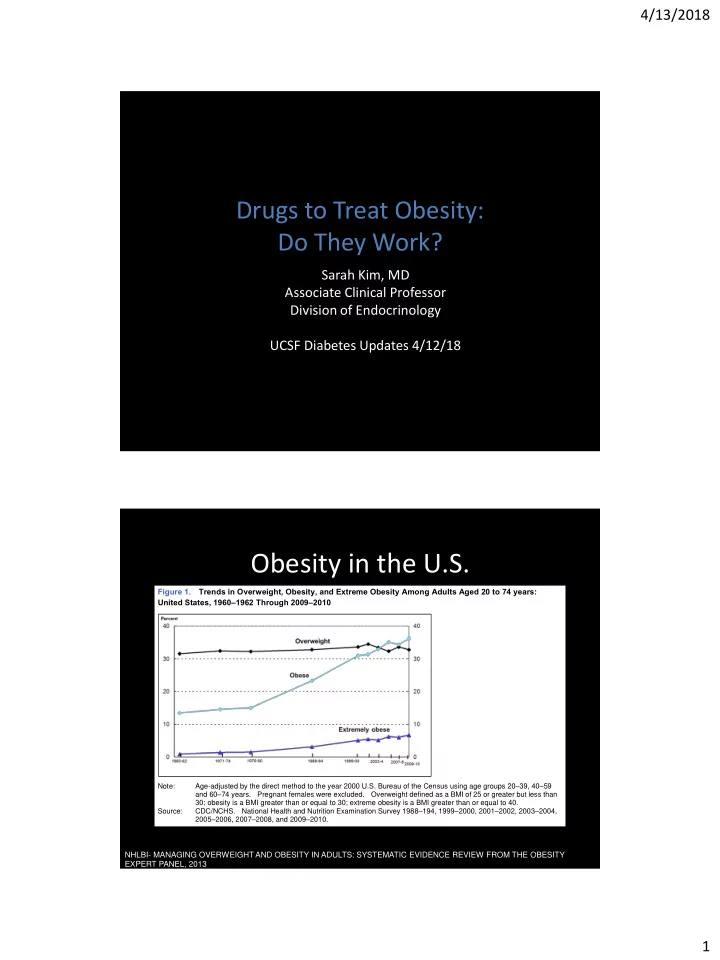
Obesity in the U.S.

” ฀ – – ฀ – – ฀ –

Figure 1. Trends in Overweight, Obesity, and Extreme Obesity Among Adults Aged 20 to 74 years: United States, 1960–1962 Through 2009–2010

Note: Age-adjusted by the direct method to the year 2000 U.S. Bureau of the Census using age groups 20–39, 40–59 and 60–74 years. Pregnant females were excluded. Overweight defined as a BMI of 25 or greater but less than 30; obesity is a BMI greater than or equal to 30; extreme obesity is a BMI greater than or equal to 40. Source: CDC/NCHS. National Health and Nutrition Examination Survey 1988–194, 1999–2000, 2001–2002, 2003–2004, 2005–2006, 2007–2008, and 2009–2010.

NHLBI- MANAGING OVERWEIGHT AND OBESITY IN ADULTS: SYSTEMATIC EVIDENCE REVIEW FROM THE OBESITY EXPERT PANEL, 2013

slide-2
SLIDE 2

4/13/2018 2

Classification of Overweight and Obesity by BMI

Weight Class BMI kg/m2 Underweight <18.5 Normal 18.5-24.9 Overweight 25.0-29.9 Obesity I 30.0-34.9 Obesity II 35.0-39.9 Obesity III/Severe ≥ 40 Clinical trials: BMI 27-45kg/m2 Max BMI in 16 yr span HR Death <18.5 1.47 18.5-24.9 (normal)

  • 25-29.9 (overweight)

1.06 30-34.9 (grade 1) 1.24 ≥35 (grade 2/3) 1.73

Mortality and Obesity

  • 3 prospective cohort studies (Nurses Health Study I and II,

Health Professionals Follow Up Study) N>225,000 and >32,000 deaths

Yu et al, Ann Intern Medicine 2017

slide-3
SLIDE 3

4/13/2018 3

Complications of Obesity

60% of the prevalence of type 2 diabetes in the US can be attributed to obesity

NEUROLOGIC/PSYCHOLOGIC

Stroke, depression, idiopathic intracranial hypertension disordered eating

RESPIRATORY

Hypoventilation (Pickwickian) syndrome, OSA, asthma, respiratory failure

CARDIOVASCULAR

Congestive heart failure, hypertension, myocardial infarction, dyslipidemia

GASTROINTESTINAL

GERD, NAFLD, NASH, gastroparesis, gallstones, biliary tract disease, pancreatitis, hernias

ENDOCRINE

Diabetes mellitus (type 2), metabolic syndrome, PCOS, hypothyroidism, infertility, male hypogonadism

HEMATOLOGIC

Deep vein thrombosis, hypercoagulable state, chronic venous stasis

CANCERS

Breast, uterus, cervix, colon, esophagus, pancreas, kidney, prostate

MUSCULOSKELETAL

Degenerative joint disease, Chronic back pain Port, Curr Opin Clin Nutr Metab Care 2010

Medical Cost of Obesity in US

  • ~$147 billion medical spending attributable to obesity in 2008
  • Compared to non-obese, obese patients incur:

– 46% increased inpatient costs – 27% more physician visits and outpatient costs – 80% percent increased spending on prescription drugs

1.Health Aff (Millwood). 2009;28(5):w822-31

slide-4
SLIDE 4

4/13/2018 4

Causes of Obesity? Seems simple…

“I get exercise. I mean I walk, I this, I that"

slide-5
SLIDE 5

4/13/2018 5

Obesity Drug Failures

  • 1800’s- use of sheep thyroid extract cardiac arrhythmias &

death

  • 1930’s- DNP, an uncoupling agent  fatal hyperthermia
  • 1940-1960’s- widespread use of amphetamines  cardiac

death, pulmonary hypertension w/50% mortality

  • 1970-1980’s- PPA, a sympathomimetic amine stroke
  • 2008-rimonabant, cannabinoid receptor antagonist 

depression and suicidality

Clin Pharmacol Ther. 2010 June; 87(6):652-662

Orlistat

  • Xenical 120mg TID, Alli 60 mg TID
  • FDA approved 1999
  • Pancreatic lipase inhibitor with GI side effects in >90%
  • Placebo subtracted weight loss of ~2-3% with long term use,

diabetes prevention

  • 13 cases of severe hepatotoxicity, including 2 deaths (in a

background of millions of users worldwide).

  • Approved in children ≥12 yo
slide-6
SLIDE 6

4/13/2018 6

Orlistat

2.8kg more weight loss at 4 years with Orlistat Diabetes Onset 4 year RCT, n=3305 BMI 30+, nondiabetic or IGT 51% dropout in treatment arm: 14% refused treatment 8% cited ineffective therapy Diabetes Care 27:155–161, 2004

Regulation of Hunger and Satiety

Nature Reviews Neuroscience 2011 12, 638-651

slide-7
SLIDE 7

4/13/2018 7

Regulation of Hunger and Satiety

Nature Reviews Drug Discovery 2012, 11, 675-691 Hormonal Influences Leptin Insulin GLP-1 Peptide YY Ghrelin Other CNS influences: Dopaminergic, adrenergic, serotonergic, endocannabinoid, opioid pathways

POMC Mutations Cause Human Obesity

  • Obesity: due to lack of alpha-MSH in the hypothalamus
  • Adrenal insufficiency: due to lack of ACTH in the anterior pituitary
  • Red Hair Pigmentation: due to lack of α-MSH activating MC1-R signaling

Nat Genet. 1998 Jun;19(2):155-7

slide-8
SLIDE 8

4/13/2018 8

MC4R Deficiency is the Commonest Monogenic Form of Obesity

9-year-old boy homozygous for a mutation in MC4R 16-year-old brother with normal genotype

N Engl J Med 2003; 348:1085-1095

Leptin Deficiency in Humans

O’Rahilly, Endocrin 2003. Endocrinology 2003. 144:3757-3764 Leptin

slide-9
SLIDE 9

4/13/2018 9

Plasma Leptin Levels are Elevated in Obesity

J Clin Endocrinol Metab 86: 1199-1205, 2001

Majority of obese individuals are leptin resistant

Molecular Targets of Anti-Obesity Drugs

Clin Pharmacol Ther 2014 95: 53-66

slide-10
SLIDE 10

4/13/2018 10

Lorcaserin

  • Belviq
  • FDA approved for weight loss June 2012 in
  • bese (BMI ≥30) or overweight (BMI ≥27) +

comorbidities

  • Activates serotonin receptors in the

hypothalamus

Serotonin and Energy Balance

  • Since 1970s, it's been recognized that serotonin (5-HT)

action serves as a satiety signal leading to reduced food intake

  • Role in energy expenditure via thermogenesis?
  • More recent research links seratonin signaling to the

modification of impulse and reward signaling in the brain

Neuron 2006, 51; 239-249 J Psychopharmacology 2017, 31(11)1403-1418

slide-11
SLIDE 11

4/13/2018 11

Fenfluramine/Phentermine

  • Fenfluramine is a potent 5HT2c receptor

agonist

– Metabolite norfenfluramine is a non-selective 5HT receptor agonist1

  • 5HT2b receptors are found on mitral & aortic valves

+mitotic activity  valve thickening

  • Fen/Phen withdrawn from market in 1997 due

to severe valvulopathy

1 Mol Interv. 2005 Oct;5(5):282-91.

Sibutramine

  • Meridia- FDA approved in 1997 for weight loss
  • Suppressed appetite and increased energy

expenditure by central regulation of serotonin and norepinephrine

  • 2003-2009 multi-national MACE trial of 10K high risk

subjects: 16% increased risk of major CV event or death (mean exposure 3.5 years)

  • In 2010, FDA requested the voluntary withdrawal of

the drug

International Journal of Obesity (2001) 25, Suppl 4, S8–S11 https://www.fda.gov/Drugs/DrugSafety/ucm228746.htm

slide-12
SLIDE 12

4/13/2018 12

Lorcaserin

  • 5HT2c receptor agonist

– Binds 5HT2c receptor in hypothalamus with 105x’s more affinity than 5HT2b on cardiac valves

  • No effect on metabolic rate

Appetite Reduction with Lorcaserin

JCEM 2011 Mar; 96(3): 837–845. Blinded RCT of 57 obese adults taking Lorcaserin 10mg BID vs placebo PFC=Prospective Food Consumption using visual analog scale of hunger before and after meals

slide-13
SLIDE 13

4/13/2018 13

Lorcaserin

  • 2 year RCT designed to assess weight loss efficacy and

valvulopathy risk

  • 3182 subjects with BMI 30-45 kg/m2 or 27-45 kg/m2 with

comorbidity (HTN, dyslipidemia, OSA, glucose intolerance, CVD)

  • Lorcaserin 10mg BID vs. placebo
  • All arms instructed to exercise 30 minutes per day and reduce

food intake by 600 kcal

  • ECHO at baseline and q6 months

Lorcaserin

Last observation carried forward Mean BMI 36 kg/m2 Mean weight 100kg Drop Out: 55% Placebo 45% Lorcaserin Placebo subtracted wt loss 3.6% 

slide-14
SLIDE 14

4/13/2018 14

Responders vs. Non-responders

*P<0.01 Postgraduate Medicine, 126:6, 7-18

Lorcaserin did not increase valvulopathy at 2 years

  • Rate of valvulopathy in year 1:

– 2.3% placebo – 2.6% lorcaserin

  • Rate of valvulopathy in year 2:

– 2.7% placebo – 2.6% lorcaserin

  • No difference in BP reduction or lipids vs. placebo
slide-15
SLIDE 15

4/13/2018 15

Lorcaserin

  • Prescribing considerations

– Most common AE: headaches, dizziness, nausea – Risk for serotonin syndrome (do not use with

  • ther serotonergic agents)

– Valvular heart disease, heart block – Pregnancy class X

Clinical pharmacology & Therapeutics 2014;95(1) 53-66 https://www.belviq.com/pdf/Belviq_Prescribing_information.pdf

Lorcaserin Phase III Clinical Trials

Placebo subtracted A1c drop = 0.6% Dose Placebo subtracted weight loss ≥5% Weight Loss @ 1 yr BLOOM 104 weeks N=3182 10mg BID Placebo

  • 3.65%
  • 47.5%

20.3% BLOOM-DM 52 weeks N=604 10mg Daily 10mg BID Placebo

  • 3.5%
  • 3%
  • 37.5%

44.7% 16.1% BLOSSOM 52 weeks N=4008 10mg Daily 10mg BID Placebo

  • 1.9%
  • 3%
  • 40.2%

47.2% 25% Ann Pharmacother 2013;47:1007-16

slide-16
SLIDE 16

4/13/2018 16

Phentermine/Topiramate ER

  • Qsymia
  • FDA approved July 2012 for obesity or overweight

(BMI ≥27 kg/m2) with comorbidities

Phentermine

  • Sympathomimetic amine

similar to amphetamine

  • Causes a release of

norepinephrine and dopamine in the hypothalamus satiety

International Journal of Obesity (1998) 22, 325±328

slide-17
SLIDE 17

4/13/2018 17

Phentermine

  • FDA approved for short-term monotherapy for

weight loss since 1959 (#1 prescribed drug)

  • 15mg, 30mg, 37.5mg dosed daily
  • Concern for dependency, abuse potential though no

good data to support this

Topiramate

  • Observed to have anorectic effect
  • ~3% weight loss at 6-months when

used alone

  • Topiramate has many effects in the

CNS but weight loss mechanism unclear

Ann Pharmacother 2013;47:340-9 Obesity Res 2003; 11(6):722-33

slide-18
SLIDE 18

4/13/2018 18

Phentermine/Topiramate ER

  • CONQUER- 56 week RCT, n=2487, BMI 27-45 kg/m2 with 2+
  • comorbidities. No BMI limit if DM.

– 52% hypertension – 36% hypertriglyceridemia – 60% glucose intolerance – 16% DM2 – 98% abdominal obesity

  • Randomized to PHEN 7.5mg/TOP 46mg, PHEN 15mg/TOP

92mg, or placebo

  • All arms received monthly lifestyle counseling and asked to

reduce intake by 500 kcal

Phentermine/Topiramate ER

Dropout: 43% 31% 36%

Placebo subtracted weight loss:  6.6%  8.6%

*p<0.0001

Lancet 2011;377:1341-52

86% White 70% Female Mean BMI 36 Mean Weight 103 kg

slide-19
SLIDE 19

4/13/2018 19

Phentermine/Topiramate ER

Placebo 7.5/46mg 15/92 mg d/c BP meds 5% 11% 15% ΔA1c

  • 0.1%
  • 0.4%
  • 0.4%

pre-DM  DM

  • 0.78

(0.4-1.5) 0.47 (0.22-0.88)

Lancet 2011;377:1341-52

1-Year Extension

Placebo subtracted weight loss:  7.5%  8.7%

Am J Clin Nutr 2012;95:297-308

slide-20
SLIDE 20

4/13/2018 20

Phentermine/Topiramate ER

  • Adverse events: 15-20% constipation, paresthesias,

dry mouth, 2-8% worsening depression or anxiety

  • Transient reduction in serum bicarbonate in ~15%

treatment arm

  • Pregnancy class X (oral clefts)
  • Avoid in those with substance abuse, uncontrolled

hypertension, CVD, tachyarrhythmia, glaucoma

Phentermine/Topiramate ER

Arms Placebo Subtracted Weight Loss ≥5% Weight Loss EQUIP1 56 weeks N=1267 PHEN 3.75/TOP 23mg PHEN 15/TOP 92mg Placebo 3.5% 9.3%

  • 44.9%

66.7% 17.3% CONQUER2 56 weeks N=2487 PHEN 7.5/TOP 46mg PHEN 15/TOP 92mg Placebo 6.6% 8.6%

  • 62.1%

70.0% 21.0% SEQUEL3 108 weeks N=676 PHEN 7.5/TOP 46mg PHEN 15/TOP 92mg Placebo 7.5% 8.7%

  • 75.2%

79.3% 30.0% 1 Obesity. 2012 Feb;20(2):330-42 2 Lancet 2011;377:1341-52 3 Am J Clin Nutr 2012;95:297-308

slide-21
SLIDE 21

4/13/2018 21

Naltrexone/Bupropion ER

  • Contrave
  • FDA approved in 9/2014 for weight loss in
  • bese or overweight with co-morbidities

Naltrexone

  • Opioid receptor antagonist

– Naltrexone + 6β-naltrexol competitively antagonize opioid receptors in CNS

  • Noted since 1979 to reduce food intake in

rats1

– Opioid antagonists decrease appetite for palatable food

  • Clinical trials in 1980’s showed no/minimal

weight loss with monotherapy2

1 Life Sci. 1979; 24(3):219-226 2 Expert Opin Pharmacother. 2009; 94(12):4898-4906

slide-22
SLIDE 22

4/13/2018 22

Bupropion ER

  • Dopamine +

norepinephrine reuptake inhibitor

  • Modest placebo

subtracted weight loss w/monotherapy (-2 to -5%)1

  • Mouse studies show

enhanced effect of bupropion with naltrexone2

1 Obes Res. 2002; 10(7):633-642 2 Obesity 2009;17(1):30-39

Naltrexone/Bupropion ER

  • COR-I, n=1742, BMI 30-45 kg/m2 or 27-45

kg/m2 + HTN or dyslipidemia

  • Randomized to:

– Naltrexone 16mg+Bupropion 360mg – Naltrexone 32mg+Bupropion 360mg or – Placebo

  • All subjects asked to reduce food intake by

500 kcal/day and exercise more

slide-23
SLIDE 23

4/13/2018 23

Naltrexone/Bupropion ER

Baseline Characteristics:

  • BMI 36
  • Wt 99 kg
  • 85% Female
  • 75% White
  • 20% HTN
  • 50% dyslipidemia

Placebo subtracted weight loss:

  • 3.7%
  • 4.8%

50% drop out Lancet 2010;376:595-605

Naltrexone/Bupropion ER

  • Compared to placebo, LDL unchanged

and HDL up ~3.4 mg /dL

  • In 505 subjects with T2DM, placebo

subtracted A1c reduction of 0.5%2

  • 2. Diabetes Care. 2013 Dec;36(12):4022-9
  • 1. Lancet 2010;376:595-605
slide-24
SLIDE 24

4/13/2018 24

Naltrexone/Bupropion ER

  • 40% drop out due to AE in treatment arms (vs.

23% placebo)

  • 30% of AE = nausea
  • No increase in mood-related adverse events

including suicidality

  • No seizures

Naltrexone/Bupropion ER

  • Effects on blood pressure across trials:

– SBP change: -0.1 to +0.3 in treatment arm vs -1.9 in placebo – DBP change: 0 to +0.1 in treatment arm vs. -0.9 placebo

  • And heart rate:

– Increase of 1.5-2.5 BPM in treatment arms vs. no change in placebo

slide-25
SLIDE 25

4/13/2018 25

Naltrexone/Bupropion ER

  • 3 cardiovascular events:

– Placebo arm: pericardial effusion – High dose arm: fatal MI, non-fatal cardiac failure

  • 2012 “Light Study” MACE study

– 2013 interim analysis showed no increase in MACE1 – Manufacturer leaked these interim findings though only 25% of the study had been completed- study terminated – Results published at 50% completion did not show increased CV risk. Study had high dropout.

  • New MACE trial required
  • JAMA. 2016;315:984-986

Naltrexone/Bupropion ER

  • Other prescribing considerations

– Black box warning for 1) suicidality especially in young patients with depression, 2) “neuropsychiatric events” (behavior change, hostility, etc) – Bupropion can lower seizure threshold – Naltrexone contraindicated in those on chronic

  • pioid therapy

– Not recommended with anti-retrovirals that induce CYP2B6

slide-26
SLIDE 26

4/13/2018 26

Phase III Clinical Trials

Drug Dose Placebo Subtracted Weight Loss ≥ 5% weight loss Greenway et al1 56 weeks n=1742 N16+B360 N32+B360 Placebo

  • 3.7%
  • 4.8%
  • 39%

48% 16% Apovian et al2 56 weeks n=1496 N32+B360 Placebo

  • 5.2%
  • 50.5%

17.1% Wadden et al3 56 weeks n=793 N32+B360 Placebo

  • 4.2%
  • 66.4%

42.5% 1 Lancet 2010; 376:595 2 Obesity 2013; 21:935 3 Obesity 2011;19:110

Liraglutide

  • Saxenda
  • GLP-1 agonist
  • Endogenous GLP-1 is released by the L cells of

the small intestine when exposed to glucose

  • GLP-1 receptors in the hypothalamus 

satiety effect

The American Journal of Medicine (2010) 123, S28–S37

slide-27
SLIDE 27

4/13/2018 27 Liraglutide Obesity and Prediabetes Trial

Pi-Sunyer X et al. N Engl J Med 2015;373:11-22

Liraglutide 3.0 mg (N = 2487) Placebo (N = 1244) ‐5.4% placebo subtracted weight loss 36% drop out

Liraglutide and Glucose Levels during Oral Glucose-Tolerance Test and Glycemic Status.

Pi-Sunyer X et al. N Engl J Med 2015;373:11-22

slide-28
SLIDE 28

4/13/2018 28

Large Phase III Clinical Trials

Drug Dose Placebo Subtracted Weight Loss ≥ 5% weight loss Pi‐Sunyer et al1 56 weeks N=3731 3.0mg daily Placebo ‐5.4%

  • 63.2%

27.1% Davies et al SCALE Diabetes2 56 wks N=846 3.0mg daily 1.8mg Daily Placebo

  • 4.0%
  • 54.3%

21.4% Wadden et al SCALE Maintenance 56 wks N=422 3.0mg daily Placebo

  • 6.1%
  • 50.5%

21.8% 1 N Engl J Med 2015; 373: 11–22 2 JAMA 2015; 314: 687–699 3 Int J Obes 2013; 37: 1443–1451

Cost

Drug Usual Dose Placebo subtracted weight loss @ 1 yr Monthly out of pocket on GoodRx (coupon site) Orlistat: Xenical Alli 120mg TID 60mg TID 2-3% $200 $60 Lorcaserin 10 mg BID 1.9-3.6% $280 Phentermine/ Topiramate ER 7.5/46 to 15/92mg Daily 6.6-9.3% $200 (for high dose) Naltrexone/Bupropion ER 16/180mg BID 3.7-5.2% $240 Liraglutide 3.0mg Daily 6% $1200 www.Goodrx.com

slide-29
SLIDE 29

4/13/2018 29

Do these new drugs work?

  • Compare to:

– Popular diets (Zone, Atkins, Ornish, Weight Watchers): 2.1-3.3 kg loss in 1 yr, 35-50% drop out1 – DPP and Look AHEAD: 5-7% weight loss (intensive lifestyle programs with high retention) – Bariatric 14 to 37% placebo subtracted weight loss at 2-3 years depending

  • n procedure2

1 JAMA 2005;293:43-53 2 MANAGING OVERWEIGHT AND OBESITY IN ADULTS: SYSTEMATIC EVIDENCE REVIEW FROM THE OBESITY EXPERT PANEL, 2013

Do these new drugs work?

  • Unlike bariatric surgery, no evidence that medication induced

weight loss reduces CV events or mortality

  • There is short term data to show that these medications reduce
  • nset of diabetes and have small reductions in CV risk factors

like blood pressure and lipids

slide-30
SLIDE 30

4/13/2018 30

Diabetes Prevention Program

N Engl J Med 346:393-403, 2002 NNT Lifestyle: 6.9 people x 3 yrs NNT Metformin 13.9 people x 3 yrs N=3234 92% completion rate Lost 7% body weight with diet and moderate exercise

Follow up: 10 yrs post randomization

Lancet 374:1677-86, 2009 Initial BMI 34, Wt 94 kg Yr 1 2 3 4 5 6 7 8 9 10 68% completion rate

slide-31
SLIDE 31

4/13/2018 31

10 years post randomization

Lancet 374:1677-86, 2009 Yr 1 2 3 4 5 6 7 8 9 10 35% DM w/lifestyle

Look AHEAD

  • RTC of intensive lifestyle intervention vs. diabetes support and

education for the prevention of major cardiovascular events in

  • verweight/obese T2DM
  • Intervention: 7% weight loss with a reduced calorie, low fat

diet and 175 min of mod-strenuous exercise per week

  • >90% retention in both arms

https://www.lookaheadtrial.org/public/LookAHEADProtocol.pdf

slide-32
SLIDE 32

4/13/2018 32

Look AHEAD Results

Improvement in CV risk factors: ↓ 3 kg → ↓ TG by 15 mg/dL ↓ 5-8 kg → ↓ LDL by 5 mg/dL ↑ HDL by 2-3 mg/dL ↓ 5% → ↓ SBP by 3 mmHg ↓ DBP by 3 mmHg Year

The Look AHEAD Research Group. Ann Intern Med. 2010:170:1566-75

Diabetes Remission in Look AHEAD

Higher rates of remission in those with:

  • Less than 2 yr diabetes duration
  • Baseline lower A1c
  • Baseline not on insulin
  • More weight loss in year 1
  • Highest fitness change during study

Gregg et a. JAMA 2012;308:2489-2496

slide-33
SLIDE 33

4/13/2018 33

Take Home Points

  • Medication induced weight loss is on the range of 3-

10% and variable between individuals

  • Modest weight loss improves CV risk factors and may

prevent future diabetes

  • Unknown yet if they can prevent CV outcomes or

mortality

  • Side effects and cost can limit use
  • No long term data on safety and efficacy

Thank You