HCLs and HCL2D thought that you might have given us a bye for one - - PowerPoint PPT Presentation

hcls and hcl2d
SMART_READER_LITE
LIVE PREVIEW

HCLs and HCL2D thought that you might have given us a bye for one - - PowerPoint PPT Presentation

HCLs and HCL2D thought that you might have given us a bye for one need to discuss amongst ourselves 3 selected anonymous feedback (2) It seems that the quizzes were added to the page MUCH later than usual instead of coming up at least one


slide-1
SLIDE 1

HCLs and HCL2D

1

logistics — exam

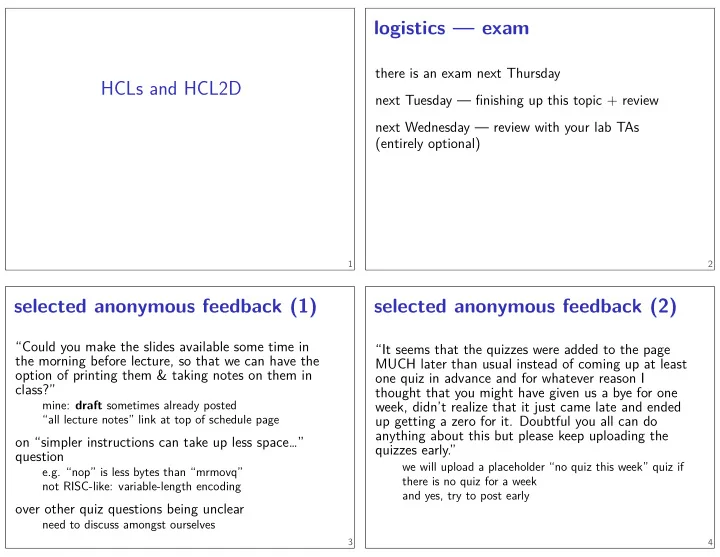
there is an exam next Thursday next Tuesday — fjnishing up this topic + review next Wednesday — review with your lab TAs (entirely optional)

2

selected anonymous feedback (1)

“Could you make the slides available some time in the morning before lecture, so that we can have the

  • ption of printing them & taking notes on them in

class?”

mine: draft sometimes already posted “all lecture notes” link at top of schedule page

  • n “simpler instructions can take up less space…”

question

e.g. “nop” is less bytes than “mrmovq” not RISC-like: variable-length encoding

  • ver other quiz questions being unclear

need to discuss amongst ourselves

3

selected anonymous feedback (2)

“It seems that the quizzes were added to the page MUCH later than usual instead of coming up at least

  • ne quiz in advance and for whatever reason I

thought that you might have given us a bye for one week, didn’t realize that it just came late and ended up getting a zero for it. Doubtful you all can do anything about this but please keep uploading the quizzes early.”

we will upload a placeholder “no quiz this week” quiz if there is no quiz for a week and yes, try to post early

4

slide-2
SLIDE 2

selected anonymous feedback (3)

“Why do labs and homeworks have nothing to do with what we’re learning in lecture? It’s incredibly stressful to be handed these assignments when we’re not talking about them (nor are we learning anything about C) in lecture.”

can’t really give you Y86-64 assignment yet mostly delay between lecture and HW and/or “things we thought were taught on 2150” scheduling constraint: avoided HW before strsep

5

selected anonymous feedback (4)

  • n the homework:

“Maybe don’t recommend coding in the assignment area because it can ”lose contact with the server” and, even though it assures you that your code is saved when the save button is pressed, it loses it when you refresh the page. Nice.”

bug fjxed Monday — very sorry about this

6

selected anonymous feedback (5)

“For the hw, the directions are not clear enough, and the online simulator is miserable to use. I would like to see the test cases that are being run, and the output form that is expected of the

  • functions. It is very hard to understand what to do when we dont

know what you are testing the functions for.”

probably should’ve given refresher on pointers-to-pointers still want held-out test cases (no hard-coding answers) would like to give AddressSanitizer output (or similar), but logistically hard “normal” assignment: no student-accessible autograder

7

selected anonymous feedback (6)

  • ffice hour problems late Tuesday

primary problem: TA missed their OH but queue not closed

8

slide-3
SLIDE 3

describing hardware

how do we describe hardware? pictures?

add 1

count

9

circuits with pictures?

yes, something you can do such commercial tools exist, but… not commonly used for processors

10

hardware description language

programming language for hardware (typically) text-based representation of circuit

  • ften abstracts away details like:

how to build arithmetic operations from gates how to build registers from transistors how to build memories from transistors how to build MUXes from gates …

those details also not a topic in this course

11

  • ur tool: HCL2D

built for this course assumes you’re making a processor somewhat difgerent from textbook’s HCL

12

slide-4
SLIDE 4

nop CPU

thePc

Instr. Mem.

add 1 “pc” “i10bytes”

Stat STAT_AOK register pF { thePc : 64 = 0; } p_thePc = F_thePc + 1; pc = F_thePc;

built-in component use is mandatory

Stat = STAT_AOK;

built-in component: AOK: continue HLT: stop

13

nop CPU

thePc

Instr. Mem.

add 1 “pc” “i10bytes”

Stat STAT_AOK register pF { thePc : 64 = 0; } p_thePc = F_thePc + 1; pc = F_thePc;

built-in component use is mandatory

Stat = STAT_AOK;

built-in component: AOK: continue HLT: stop

13

nop CPU

thePc

Instr. Mem.

add 1 “pc” “i10bytes”

Stat STAT_AOK register pF { thePc : 64 = 0; } p_thePc = F_thePc + 1; pc = F_thePc;

built-in component use is mandatory

Stat = STAT_AOK;

built-in component: AOK: continue HLT: stop

13

nop CPU

thePc

Instr. Mem.

add 1 “pc” “i10bytes”

Stat STAT_AOK register pF { thePc : 64 = 0; } p_thePc = F_thePc + 1; pc = F_thePc;

built-in component use is mandatory

Stat = STAT_AOK;

built-in component: AOK: continue HLT: stop

13

slide-5
SLIDE 5

nop CPU

thePc

Instr. Mem.

add 1 “pc” “i10bytes”

Stat STAT_AOK register pF { thePc : 64 = 0; } p_thePc = F_thePc + 1; pc = F_thePc;

built-in component use is mandatory

Stat = STAT_AOK;

built-in component: AOK: continue HLT: stop

13

nop CPU

thePc

Instr. Mem.

add 1 “pc” “i10bytes”

Stat STAT_AOK register pF { thePc : 64 = 0; } p_thePc = F_thePc + 1; pc = F_thePc;

built-in component use is mandatory

Stat = STAT_AOK;

built-in component: AOK: continue HLT: stop

13

nop CPU

thePc

Instr. Mem.

add 1 “pc” “i10bytes”

Stat STAT_AOK register pF { thePc : 64 = 0; } p_thePc = F_thePc + 1; pc = F_thePc;

built-in component use is mandatory

Stat = STAT_AOK;

built-in component: AOK: continue HLT: stop

13

nop CPU: running

need a program in memory

.yo fjle

tools/yas — convert .ys to .yo tools/yis — reference interpreter for .yo fjles

if your processor doesn’t do the same thing…

can build tools by running make

14

slide-6
SLIDE 6

nop CPU: creating a program

create assemby fjle: nops.ys: nop nop nop nop nop assemble using tools/yas nops.ys or make nops.yo

15

nop.yo

more readable/simpler than normal executables: 0x000: 10 | nop 0x001: 10 | nop 0x002: 10 | nop 0x003: 10 | nop 0x004: 10 | nop | loaded into data and program memory parts left of | just comments

16

building a simulator

put HCL2D code in nop_cpu.hcl run make nop_cpu.exe then, ./nop_cpu.exe:

USAGE: ./nop_cpu.exe [options] somefile.yo Options: [a number] : time out after that many steps (default: 10000)

  • i --interactive : pause every clock cycle
  • q --quiet

: only show final state

  • d --debug

: show every action during simulation

17

running simulator

$ nop_cpu.exe nops.yo +------------------- between cycles 0 and 1 ----------------------+ | RAX: RCX: RDX: 0 | | RBX: RSP: RBP: 0 | | RSI: RDI: R8: 0 | | R9: R10: R11: 0 | | R12: R13: R14: 0 | | register pF(N) thePc=0000000000000000 | | used memory: _0 _1 _2 _3 _4 _5 _6 _7 _8 _9 _a _b _c _d _e _f | | 0x0000000_: 10 10 10 10 10 | +-----------------------------------------------------------------------+ pc = 0x0; loaded [10 : nop] +------------------- between cycles 1 and 2 ----------------------+ ....

18

slide-7
SLIDE 7

running simulator

$ nop_cpu.exe nops.yo +------------------- between cycles 0 and 1 ----------------------+ | RAX: RCX: RDX: 0 | | RBX: RSP: RBP: 0 | | RSI: RDI: R8: 0 | | R9: R10: R11: 0 | | R12: R13: R14: 0 | | register pF(N) thePc=0000000000000000 | | used memory: _0 _1 _2 _3 _4 _5 _6 _7 _8 _9 _a _b _c _d _e _f | | 0x0000000_: 10 10 10 10 10 | +-----------------------------------------------------------------------+ pc = 0x0; loaded [10 : nop] +------------------- between cycles 1 and 2 ----------------------+ ....

18

running simulator

$ nop_cpu.exe nops.yo +------------------- between cycles 0 and 1 ----------------------+ | RAX: RCX: RDX: 0 | | RBX: RSP: RBP: 0 | | RSI: RDI: R8: 0 | | R9: R10: R11: 0 | | R12: R13: R14: 0 | | register pF(N) thePc=0000000000000000 | | used memory: _0 _1 _2 _3 _4 _5 _6 _7 _8 _9 _a _b _c _d _e _f | | 0x0000000_: 10 10 10 10 10 | +-----------------------------------------------------------------------+ pc = 0x0; loaded [10 : nop] +------------------- between cycles 1 and 2 ----------------------+ ....

18

running simulator

$ nop_cpu.exe nops.yo +------------------- between cycles 0 and 1 ----------------------+ | RAX: RCX: RDX: 0 | | RBX: RSP: RBP: 0 | | RSI: RDI: R8: 0 | | R9: R10: R11: 0 | | R12: R13: R14: 0 | | register pF(N) thePc=0000000000000000 | | used memory: _0 _1 _2 _3 _4 _5 _6 _7 _8 _9 _a _b _c _d _e _f | | 0x0000000_: 10 10 10 10 10 | +-----------------------------------------------------------------------+ pc = 0x0; loaded [10 : nop] +------------------- between cycles 1 and 2 ----------------------+ ....

18

nop/halt CPU

thePc

Instr. Mem.

add 1 valP

Stat

M U X STAT_AOK STAT_HLT STAT_INS

extract opcode

register pP { thePc : 64 = 0; } p_thePc = P_thePc + 1; pc = P_thePc; Stat = [ i10bytes[4..8] == NOP : STAT_AOK; i10bytes[4..8] == HALT : STAT_HLT; 1 : STAT_INS; (default case) ];

19

slide-8
SLIDE 8

nop/halt CPU

thePc

Instr. Mem.

add 1 valP

Stat

M U X STAT_AOK STAT_HLT STAT_INS

extract opcode

register pP { thePc : 64 = 0; } p_thePc = P_thePc + 1; pc = P_thePc; Stat = [ i10bytes[4..8] == NOP : STAT_AOK; i10bytes[4..8] == HALT : STAT_HLT; 1 : STAT_INS; (default case) ];

19

MUXes in HCL2D

book calls “case expression” conditions evaluated (as if) in order fjrst match is output: result = [

x == 5: 1; x in {0, 6}: 2; x > 2: 3; 1: 4; ];

x = 5: result is 1 x = 6: result is 2 x = 3: result is 3 x = 4: result is 3 x = 1: result is 4

20

nop/halt CPU

thePc

Instr. Mem.

add 1 valP

Stat

M U X STAT_AOK STAT_HLT STAT_INS

extract opcode

register pP { thePc : 64 = 0; } p_thePc = P_thePc + 1; pc = P_thePc; Stat = [ i10bytes[4..8] == NOP : STAT_AOK; i10bytes[4..8] == HALT : STAT_HLT; 1 : STAT_INS; (default case) ];

21

subsetting bits in HCL2D

extracting bits 2 (inclusive)–9 (exclusive): value[2..9] least signifjcant bit is bit 0

22

slide-9
SLIDE 9

bit numbers and instructions

value from instruction memory in i10bytes 80-bit integer, little-endian order: fjrst byte is least signifjcant byte fjrst bit is least signifjcant bit of fjrst byte byte 0: (MSB)

  • pcode

fn (LSB)

(byte 1: (MSB) rA

rB (LSB))

therefore: bits 4–8 (most signifjcant bits of 1st byte)

23

nop/halt CPU

thePc

Instr. Mem.

add 1 valP

Stat

M U X STAT_AOK STAT_HLT STAT_INS

extract opcode

register pP { thePc : 64 = 0; } p_thePc = P_thePc + 1; pc = P_thePc; Stat = [ i10bytes[4..8] == NOP : STAT_AOK; i10bytes[4..8] == HALT : STAT_HLT; 1 : STAT_INS; (default case) ];

24

nop/halt CPU

thePc

Instr. Mem.

add 1 valP

Stat

M U X STAT_AOK STAT_HLT STAT_INS

extract opcode

register pP { thePc : 64 = 0; } p_thePc = P_thePc + 1; pc = P_thePc; Stat = [ i10bytes[4..8] == NOP : STAT_AOK; i10bytes[4..8] == HALT : STAT_HLT; 1 : STAT_INS; (default case) ];

24

nop/halt CPU

thePc

Instr. Mem.

add 1 valP

Stat

M U X STAT_AOK STAT_HLT STAT_INS

extract opcode

register pP { thePc : 64 = 0; } p_thePc = P_thePc + 1; pc = P_thePc; Stat = [ i10bytes[4..8] == NOP : STAT_AOK; i10bytes[4..8] == HALT : STAT_HLT; 1 : STAT_INS; (default case) ];

24

slide-10
SLIDE 10

nop/halt CPU (w/ named wires)

thePc

Instr. Mem.

add 1 valP

Stat

STAT_AOK STAT_HLT STAT_INS

extract opcode

icode

wire icode : 4; wire valP : 64; register pP { thePc : 64 = 0; } valP = P_thePc + 1; p_thePc = valP; pc = P_thePc; icode = i10bytes[4..8]; Stat = [ icode == NOP : STAT_AOK; icode == HALT : STAT_HLT; 1 : STAT_INS; ];

25

nop/halt CPU (w/ named wires)

thePc

Instr. Mem.

add 1 valP

Stat

STAT_AOK STAT_HLT STAT_INS

extract opcode

icode

wire icode : 4; wire valP : 64; register pP { thePc : 64 = 0; } valP = P_thePc + 1; p_thePc = valP; pc = P_thePc; icode = i10bytes[4..8]; Stat = [ icode == NOP : STAT_AOK; icode == HALT : STAT_HLT; 1 : STAT_INS; ];

25

nop/halt CPU (w/ named wires)

thePc

Instr. Mem.

add 1 valP

Stat

STAT_AOK STAT_HLT STAT_INS

extract opcode

icode

wire icode : 4; wire valP : 64; register pP { thePc : 64 = 0; } valP = P_thePc + 1; p_thePc = valP; pc = P_thePc; icode = i10bytes[4..8]; Stat = [ icode == NOP : STAT_AOK; icode == HALT : STAT_HLT; 1 : STAT_INS; ];

25

nop/jmp CPU

PC

Instr. Mem.

split

MUX

1 if jmp 0 if nop

icode dest

+ 1 (nop size)

wire valP : 64; wire icode : 4, dest: 64; register pP { thePc : 64 = 0; } icode = i10bytes[4..8]; dest = i10bytes[8..72]; valP = [ icode == NOP : P_thePc + 1; icode == JXX : dest; ]; p_thePc = valP; pc = P_thePc; Stat = [ (icode == NOP || icode == JXX) : STAT_AOK; icode == HALT : STAT_HLT; 1 : STAT_INS; ];

26

slide-11
SLIDE 11

nop/jmp CPU

PC

Instr. Mem.

split

MUX

1 if jmp 0 if nop

icode dest

+ 1 (nop size)

wire valP : 64; wire icode : 4, dest: 64; register pP { thePc : 64 = 0; } icode = i10bytes[4..8]; dest = i10bytes[8..72]; valP = [ icode == NOP : P_thePc + 1; icode == JXX : dest; ]; p_thePc = valP; pc = P_thePc; Stat = [ (icode == NOP || icode == JXX) : STAT_AOK; icode == HALT : STAT_HLT; 1 : STAT_INS; ];

26

running nop/jmp/halt

nopjmp.ys:

nop jmp C B: jmp D C: jmp B D: nop nop halt

…assemble with yas

27

nopjmp.yo

nopjmp.yo:

0x000: 10 | nop 0x001: 701300000000000000 | jmp C 0x00a: 701c00000000000000 | B: jmp D 0x013: 700a00000000000000 | C: jmp B 0x01c: 10 | D: nop 0x01d: 10 | nop 0x01e: 00 | halt

28

nopjmp.yo

nopjmp.yo:

0x000: 10 | nop 0x001: 701300000000000000 | jmp C 0x00a: 701c00000000000000 | B: jmp D 0x013: 700a00000000000000 | C: jmp B 0x01c: 10 | D: nop 0x01d: 10 | nop 0x01e: 00 | halt

28

slide-12
SLIDE 12

running nopjmp.yo

$ ./nopjmp_cpu.exe nopjmp.yo ... ... +--------------------- (end of halted state) ---------------------------+ Cycles run: 7 Time used: 238

29

comparing to yis

$ ./nopjmp_cpu.exe nopjmp.yo ... ... +--------------------- (end of halted state) ---------------------------+ Cycles run: 7 Time used: 238 $ ./tools/yis nopjmp.yo Stopped in 7 steps at PC = 0x1e. Status 'HLT', CC Z=1 S=0 O=0 Changes to registers: Changes to memory:

30

debugging mode

$ ./nopjmp_cpu.exe -d nopjmp.yo +------------------- between cycles 0 and 1 ----------------------+ | RAX: RCX: RDX: 0 | | RBX: RSP: RBP: 0 | | RSI: RDI: R8: 0 | | R9: R10: R11: 0 | | R12: R13: R14: 0 | | register pP(N) thePc=0000000000000000 | | used memory: _0 _1 _2 _3 _4 _5 _6 _7 _8 _9 _a _b _c _d _e _f | | 0x0000000_: 10 70 13 00 00 00 00 00 00 00 70 1c 00 00 00 00 | | 0x0000001_: 00 00 00 70 0a 00 00 00 00 00 00 00 10 10 00 | +-----------------------------------------------------------------------+ set pc to 0x0 pc = 0x0; loaded [10 : nop] set icode to 0x1 set valP to 0x1 set p_thePc to 0x1 set Stat to 0x1 .------------------- between cycles 1 and 2 ----------------------+ ...

31

debugging mode

$ ./nopjmp_cpu.exe -d nopjmp.yo +------------------- between cycles 0 and 1 ----------------------+ | RAX: RCX: RDX: 0 | | RBX: RSP: RBP: 0 | | RSI: RDI: R8: 0 | | R9: R10: R11: 0 | | R12: R13: R14: 0 | | register pP(N) thePc=0000000000000000 | | used memory: _0 _1 _2 _3 _4 _5 _6 _7 _8 _9 _a _b _c _d _e _f | | 0x0000000_: 10 70 13 00 00 00 00 00 00 00 70 1c 00 00 00 00 | | 0x0000001_: 00 00 00 70 0a 00 00 00 00 00 00 00 10 10 00 | +-----------------------------------------------------------------------+ set pc to 0x0 pc = 0x0; loaded [10 : nop] set icode to 0x1 set valP to 0x1 set p_thePc to 0x1 set Stat to 0x1 .------------------- between cycles 1 and 2 ----------------------+ ...

31

slide-13
SLIDE 13

interactive + debugging mode

$ ./nopjmp_cpu.exe -i -d nopjmp.yo +------------------- between cycles 0 and 1 ----------------------+ | RAX: RCX: RDX: 0 | | RBX: RSP: RBP: 0 | | RSI: RDI: R8: 0 | | R9: R10: R11: 0 | | R12: R13: R14: 0 | | register pP(N) thePc=0000000000000000 | | used memory: _0 _1 _2 _3 _4 _5 _6 _7 _8 _9 _a _b _c _d _e _f | | 0x0000000_: 10 70 13 00 00 00 00 00 00 00 70 1c 00 00 00 00 | | 0x0000001_: 00 00 00 70 0a 00 00 00 00 00 00 00 10 10 00 | +-----------------------------------------------------------------------+ (press enter to continue) set pc to 0x0 pc = 0x0; loaded [10 : nop] set icode to 0x1 set valP to 0x1 set p_thePc to 0x1 set Stat to 0x1 +------------------- between cycles 1 and 2 ----------------------+ ...

32

interactive + debugging mode

$ ./nopjmp_cpu.exe -i -d nopjmp.yo +------------------- between cycles 0 and 1 ----------------------+ | RAX: RCX: RDX: 0 | | RBX: RSP: RBP: 0 | | RSI: RDI: R8: 0 | | R9: R10: R11: 0 | | R12: R13: R14: 0 | | register pP(N) thePc=0000000000000000 | | used memory: _0 _1 _2 _3 _4 _5 _6 _7 _8 _9 _a _b _c _d _e _f | | 0x0000000_: 10 70 13 00 00 00 00 00 00 00 70 1c 00 00 00 00 | | 0x0000001_: 00 00 00 70 0a 00 00 00 00 00 00 00 10 10 00 | +-----------------------------------------------------------------------+ (press enter to continue) set pc to 0x0 pc = 0x0; loaded [10 : nop] set icode to 0x1 set valP to 0x1 set p_thePc to 0x1 set Stat to 0x1 +------------------- between cycles 1 and 2 ----------------------+ ...

32

quiet mode

$ ./nopjmp_cpu.exe -q nopjmp.yo +----------------------- halted in state: ------------------------------+ | RAX: RCX: RDX: 0 | | RBX: RSP: RBP: 0 | | RSI: RDI: R8: 0 | | R9: R10: R11: 0 | | R12: R13: R14: 0 | | register pP(N) { thePc=0000000000000000 } | | used memory: _0 _1 _2 _3 _4 _5 _6 _7 _8 _9 _a _b _c _d _e _f | | 0x0000000_: 10 70 13 00 00 00 00 00 00 00 70 1c 00 00 00 00 | | 0x0000001_: 00 00 00 70 0a 00 00 00 00 00 00 00 10 10 00 | +--------------------- (end of halted state) ---------------------------+ Cycles run: 7 Time used: 238

33

things in HCL2D

register banks wires things for our processor:

Stat register instruction memory the register fjle data memory

34

slide-14
SLIDE 14

things in HCL2D

register banks wires things for our processor:

Stat register instruction memory the register fjle data memory

35

register banks

register xY { foo : width1 = defaultValue1; bar : width2 = defaultValue2; }

two letters: input (X) / Output (Y)

input signals: x_foo, x_bar

  • utput signals: Y_foo, Y_bar

each value has width in bits each value has initial value — mandatory some other signals — stall, bubble

later in semester

36

register banks

register xY { foo : width1 = defaultValue1; bar : width2 = defaultValue2; }

two letters: input (X) / Output (Y)

input signals: x_foo, x_bar

  • utput signals: Y_foo, Y_bar

each value has width in bits each value has initial value — mandatory some other signals — stall, bubble

later in semester

36

register banks

register xY { foo : width1 = defaultValue1; bar : width2 = defaultValue2; }

two letters: input (X) / Output (Y)

input signals: x_foo, x_bar

  • utput signals: Y_foo, Y_bar

each value has width in bits each value has initial value — mandatory some other signals — stall, bubble

later in semester

36

slide-15
SLIDE 15

things in HCL2D

register banks wires things for our processor:

Stat register instruction memory the register fjle data memory

37

wires

wire wireName : wireWidth; wireName = ...; ... = wireName; ... = wireName;

things that can accept/produce a signal

some created implicitly – e.g. by creating register some builtin — supplied components (like instruction memory)

assignment — connecting wires

38

wires and order

wire icode : 4; wire valP : 64; register pP { thePc : 64 = 0; } valP = P_thePC + 1; p_thePc = valP; pc = P_thePc; icode = i10bytes[4..8]; Stat = [ icode == NOP : STAT_AOK; icode == HALT : STAT_HLT; 1 : STAT_INS; ]; wire icode : 4; wire valP : 64; register pP { thePc : 64 = 0; } p_thePc = valP; pc = P_thePc; Stat = [ icode == NOP : STAT_AOK; icode == HALT : STAT_HLT; 1 : STAT_INS; ]; valP = P_thePC + 1; icode = i10bytes[4..8];

  • rder doesn’t matter

wire is connected or not connected

39

wires and order

wire icode : 4; wire valP : 64; register pP { thePc : 64 = 0; } valP = P_thePC + 1; p_thePc = valP; pc = P_thePc; icode = i10bytes[4..8]; Stat = [ icode == NOP : STAT_AOK; icode == HALT : STAT_HLT; 1 : STAT_INS; ]; wire icode : 4; wire valP : 64; register pP { thePc : 64 = 0; } p_thePc = valP; pc = P_thePc; Stat = [ icode == NOP : STAT_AOK; icode == HALT : STAT_HLT; 1 : STAT_INS; ]; valP = P_thePC + 1; icode = i10bytes[4..8];

  • rder doesn’t matter

wire is connected or not connected

39

slide-16
SLIDE 16

wires and order

wire icode : 4; wire valP : 64; register pP { thePc : 64 = 0; } valP = P_thePC + 1; p_thePc = valP; pc = P_thePc; icode = i10bytes[4..8]; Stat = [ icode == NOP : STAT_AOK; icode == HALT : STAT_HLT; 1 : STAT_INS; ]; wire icode : 4; wire valP : 64; register pP { thePc : 64 = 0; } p_thePc = valP; pc = P_thePc; Stat = [ icode == NOP : STAT_AOK; icode == HALT : STAT_HLT; 1 : STAT_INS; ]; valP = P_thePC + 1; icode = i10bytes[4..8];

  • rder doesn’t matter

wire is connected or not connected

39

wires and width

wire bigValueOne: 64; wire bigValueTwo: 64; wire smallValue: 32; bigValueOne = smallValue; /* ERROR */ smallValue = bigValueTwo; /* ERROR */ … wire bigValueOne: 64; wire bigValueTwo: 64; wire smallValue: 32; smallValue = bigValueTwo[0..32]; /* OKAY */ 40

things in HCL2D

register banks wires things for our processor:

Stat register instruction memory the register fjle data memory

41

Stat register

how do we stop the machine? hard-wired mechanism — Stat register possible values:

STAT_AOK — keep going STAT_HLT — stop, normal shtdown STAT_INS — invalid instruction …(and more errors)

must be set determines if simulator keeps going

42

slide-17
SLIDE 17

things in HCL2D

register banks wires things for our processor:

Stat register instruction memory the register fjle data memory

43

program memory

input wire: pc

  • utput wire: i10bytes

80-bits wide (10 bytes) bit 0 — least signifjcant bit of fjrst byte (width of largest instruction)

what about less than 10 byte instructions?

just don’t use the extra bits

44

program memory

input wire: pc

  • utput wire: i10bytes

80-bits wide (10 bytes) bit 0 — least signifjcant bit of fjrst byte (width of largest instruction)

what about less than 10 byte instructions?

just don’t use the extra bits

44

things in HCL2D

register banks wires things for our processor:

Stat register instruction memory the register fjle data memory

45

slide-18
SLIDE 18

register fjle

four register number inputs (4-bit):

sources: reg_srcA, reg_srcB destinations: reg_dstM reg_dstE

no write or no read? register number 0xF (REG_NONE) two register value inputs (64-bit):

reg_inputE, reg_inputM

two register output values (64-bit):

reg_outputA, reg_outputB

46

example using register fjle: add CPU

wire rA : 4, rB : 4, icode : 4, ifunc: 4; register pP { thePC : 64 = 0; } /* PC update: */ pc = P_thePC; p_thePC = P_thePC + 2; /* Decode: */ icode = i10bytes[4..8]; ifunc = i10bytes[0..4]; rA = i10bytes[12..16]; rB = i10bytes[8..12]; reg_srcA = rA; reg_srcB = rB; /* Execute + Writeback: */ reg_inputE = reg_outputA + reg_outputB; reg_dstE = rB; /* Status maintainence: */ Stat = ...

47

example using register fjle: add CPU

wire rA : 4, rB : 4, icode : 4, ifunc: 4; register pP { thePC : 64 = 0; } /* PC update: */ pc = P_thePC; p_thePC = P_thePC + 2; /* Decode: */ icode = i10bytes[4..8]; ifunc = i10bytes[0..4]; rA = i10bytes[12..16]; rB = i10bytes[8..12]; reg_srcA = rA; reg_srcB = rB; /* Execute + Writeback: */ reg_inputE = reg_outputA + reg_outputB; reg_dstE = rB; /* Status maintainence: */ Stat = ...

47

example using register fjle: add CPU

wire rA : 4, rB : 4, icode : 4, ifunc: 4; register pP { thePC : 64 = 0; } /* PC update: */ pc = P_thePC; p_thePC = P_thePC + 2; /* Decode: */ icode = i10bytes[4..8]; ifunc = i10bytes[0..4]; rA = i10bytes[12..16]; rB = i10bytes[8..12]; reg_srcA = rA; reg_srcB = rB; /* Execute + Writeback: */ reg_inputE = reg_outputA + reg_outputB; reg_dstE = rB; /* Status maintainence: */ Stat = ...

47

slide-19
SLIDE 19

register fjle picture

register fjle

reg_srcA reg_srcB reg_dstM reg_dstE next R[dstM] = reg_inputM next R[dstE] = reg_inputE reg_outputA = R[srcA] reg_outputB = R[srcB]

from rA from rB from rB from sum unset (default 0xF = none) unused

48

register fjle picture

register fjle

reg_srcA reg_srcB reg_dstM reg_dstE next R[dstM] = reg_inputM next R[dstE] = reg_inputE reg_outputA = R[srcA] reg_outputB = R[srcB]

from rA from rB from rB from sum unset (default 0xF = none) unused

48

register fjle picture

register fjle

reg_srcA reg_srcB reg_dstM reg_dstE next R[dstM] = reg_inputM next R[dstE] = reg_inputE reg_outputA = R[srcA] reg_outputB = R[srcB]

from rA from rB from rB from sum unset (default 0xF = none) unused

48

register fjle picture

register fjle

reg_srcA reg_srcB reg_dstM reg_dstE next R[dstM] = reg_inputM next R[dstE] = reg_inputE reg_outputA = R[srcA] reg_outputB = R[srcB]

from rA from rB from rB from sum unset (default 0xF = none) unused

48

slide-20
SLIDE 20

things in HCL2D

register banks wires things for our processor:

Stat register instruction memory the register fjle data memory

49

data memory

input address: mem_addr input value: mem_input

  • utput value: mem_output

read/write enable: mem_readbit, mem_writebit

50

reading from data memory

mem_addr = 0x12345678; mem_readbit = 1; mem_writebit = 0; ... = mem_output;

mem_output has value in same cycle

51

reading from data memory

mem_addr = 0x12345678; mem_readbit = 1; mem_writebit = 0; ... = mem_output;

mem_output has value in same cycle

51

slide-21
SLIDE 21

reading from data memory

mem_addr = 0x12345678; mem_readbit = 1; mem_writebit = 0; ... = mem_output;

mem_output has value in same cycle

51

writing to data memory

mem_addr = 0x12345678; mem_input = ...; mem_readbit = 0; mem_writebit = 1;

memory updated for next cycle

52

writing to data memory

mem_addr = 0x12345678; mem_input = ...; mem_readbit = 0; mem_writebit = 1;

memory updated for next cycle

52

writing to data memory

mem_addr = 0x12345678; mem_input = ...; mem_readbit = 0; mem_writebit = 1;

memory updated for next cycle

52

slide-22
SLIDE 22

difgerences from book

wire not bool or int book uses names like valC — not required!

author’s environment limited adding new wires

implement your own ALU

53

difgerences from book

wire not bool or int book uses names like valC — not required!

author’s environment limited adding new wires

implement your own ALU

53

exercise: implementing ALU?

wire aluOp : 2, aluValueA : 64, aluValueB : 64, aluResult : 64; const ALU_ADD = 0b00, ALU_SUB = 0b01, ALU_AND = 0b10, ALU_XOR = 0b11; aluResult = [ aluOp == ALU_ADD : aluValueA + aluValueB; aluOp == ALU_SUB : aluValueA - aluValueB; aluOp == ALU_AND : aluValueA & aluValueB; aluOp == ALU_XOR : aluValueA ^ aluValueB ];

54

  • n design choices

textbook choices:

memory always goes to ‘M’ port of register fjle RSP +/- 8 uses normal ALU, not seperate adders …

do you have to do this? no you: single cycle/instruction; use supplied register/memory

  • ther logic: make it function correctly

55

slide-23
SLIDE 23

HCL2D summary

declare/assign values to wires MUXes with

[ test1: value1; test2: value2 ]

register banks with register iO:

next value on i_name; current value on O_name

fjxed functionality

register fjle (15 registers; 2 read + 2 write) memories (data + instruction) Stat register (start/stop/error)

56