Unit 3: Foundations for inference 3. Hypothesis tests PS 3 due - - PowerPoint PPT Presentation

unit 3 foundations for inference 3 hypothesis tests
SMART_READER_LITE
LIVE PREVIEW

Unit 3: Foundations for inference 3. Hypothesis tests PS 3 due - - PowerPoint PPT Presentation

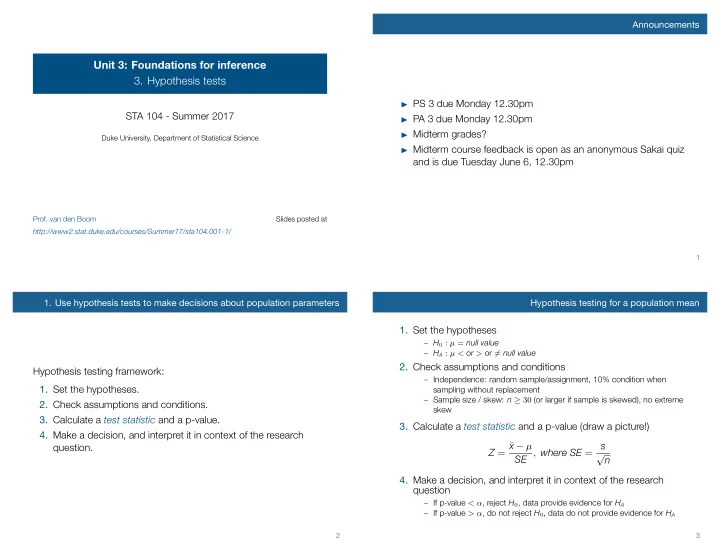
Announcements Unit 3: Foundations for inference 3. Hypothesis tests PS 3 due Monday 12.30pm STA 104 - Summer 2017 PA 3 due Monday 12.30pm Midterm grades? Duke University, Department of Statistical Science Midterm course feedback


slide-1
SLIDE 1

Unit 3: Foundations for inference

  • 3. Hypothesis tests

STA 104 - Summer 2017

Duke University, Department of Statistical Science

  • Prof. van den Boom

Slides posted at http://www2.stat.duke.edu/courses/Summer17/sta104.001-1/

Announcements ▶ PS 3 due Monday 12.30pm ▶ PA 3 due Monday 12.30pm ▶ Midterm grades? ▶ Midterm course feedback is open as an anonymous Sakai quiz

and is due Tuesday June 6, 12.30pm

1

  • 1. Use hypothesis tests to make decisions about population parameters

Hypothesis testing framework:

  • 1. Set the hypotheses.
  • 2. Check assumptions and conditions.
  • 3. Calculate a test statistic and a p-value.
  • 4. Make a decision, and interpret it in context of the research

question.

2

Hypothesis testing for a population mean

  • 1. Set the hypotheses

– H0 : µ = null value – HA : µ < or > or ̸= null value

  • 2. Check assumptions and conditions

– Independence: random sample/assignment, 10% condition when sampling without replacement – Sample size / skew: n ≥ 30 (or larger if sample is skewed), no extreme skew

  • 3. Calculate a test statistic and a p-value (draw a picture!)

Z = ¯ x − µ SE , where SE = s √n

  • 4. Make a decision, and interpret it in context of the research

question

– If p-value < α, reject H0, data provide evidence for HA – If p-value > α, do not reject H0, data do not provide evidence for HA

3

slide-2
SLIDE 2

Application exercise: 3.2 Hypothesis testing for a single mean

See course website for details.

4

Clicker question

Which of the following is the correct interpretation of the p-value from App Ex 3.2? (a) The probability that average GPA of Duke students has changed since 2001. (b) The probability that average GPA of Duke students has not changed since 2001. (c) The probability that average GPA of Duke students has not changed since 2001, if in fact a random sample of 63 Duke students this year have an average GPA of 3.58 or higher. (d) The probability that a random sample of 63 Duke students have an average GPA of 3.58 or higher, if in fact the average GPA has not changed since 2001. (e) The probability that a random sample of 63 Duke students have an average GPA of 3.58 or higher or 3.16 or lower, if in fact the average GPA has not changed since 2001.

5

Common misconceptions about hypothesis testing

  • 1. P-value is the probability that the null hypothesis is true

A p-value is the probability of getting a sample that results in a test statistic as or more extreme than what you actually

  • bserved (and in favor of the null hypothesis) if in fact the null

hypothesis is correct. It is a conditional probability, conditioned

  • n the null hypothesis being correct.
  • 2. A high p-value confirms the null hypothesis.

A high p-value means the data do not provide convincing evidence for the alternative hypothesis and hence that the null hypothesis can’t be rejected.

  • 3. A low p-value confirms the alternative hypothesis.

A low p-value means the data provide convincing evidence for the alternative hypothesis, but not necessarily that it is confirmed.

6

  • 2. Hypothesis tests and confidence intervals at equivalent

significance/confidence levels should agree

Two sided

−1.96 1.96

0.95 0.025 0.025

95% confidence level is equivalent to two sided HT with α = 0.05 One sided

−1.96 1.96

0.95 0.025 0.025

95% confidence level is equivalent to

  • ne sided HT with α = 0.025

7

slide-3
SLIDE 3

Clicker question

What is the confidence level for a confidence interval that is equivalent to a two-sided hypothesis test at the 1% significance level? Hint: Draw a picture and mark the confidence level in the center. (a) 0.80 (b) 0.90 (c) 0.95 (d) 0.98 (e) 0.99

8

Clicker question

What is the confidence level for a confidence interval that is equivalent to a one-sided hypothesis test at the 1% significance level? Hint: Draw a picture and mark the confidence level in the center. (a) 0.80 (b) 0.90 (c) 0.95 (d) 0.98 (e) 0.99

9

Clicker question

A 95% confidence interval for the average normal body temperature

  • f humans is found to be (98.1 F, 98.4 F). Which of the following is

true? (a) The hypothesis H0 : µ = 98.2 would be rejected at α = 0.05 in favor of HA : µ ̸= 98.2. (b) The hypothesis H0 : µ = 98.2 would be rejected at α = 0.025 in favor of HA : µ > 98.2. (c) The hypothesis H0 : µ = 98 would be rejected using a 90% confidence interval. (d) The hypothesis H0 : µ = 98.2 would be rejected using a 99% confidence interval.

10

  • 3. Results that are statistically significant are not necessarily practically

significant

Clicker question

All else held equal, will the p-value be lower if n = 100 or n = 10, 000? (a) n = 100 (b) n = 10, 000

11

slide-4
SLIDE 4
  • 4. Hypothesis tests are prone to decision errors

Decision fail to reject H0 reject H0 H0 true ✓ Type 1 Error, α Truth HA true Type 2 Error, β Power, 1 − β

▶ A Type 1 Error is rejecting the null hypothesis when H0 is true: α

– For those cases where H0 is actually true, we do not want to incorrectly reject it more than 5% of those times – Increasing α increases the Type 1 error rate, hence we prefer to small values of α

▶ A Type 2 Error is failing to reject the null hypothesis when HA is

true: β

▶ Power is the probability of correctly rejecting H0, and hence the

complement of the probability of a Type 2 Error: 1 − β

12

Summary of main ideas

  • 1. Use hypothesis tests to make decisions about population

parameters

  • 2. Hypothesis tests and confidence intervals at equivalent

significance/confidence levels should agree

  • 3. Results that are statistically significant are not necessarily

practically significant

  • 4. Hypothesis tests are prone to decision errors

13