Capacitance Studies on Anode Measurements and Simulations Caspar - - PowerPoint PPT Presentation

capacitance studies on anode
SMART_READER_LITE
LIVE PREVIEW

Capacitance Studies on Anode Measurements and Simulations Caspar - - PowerPoint PPT Presentation

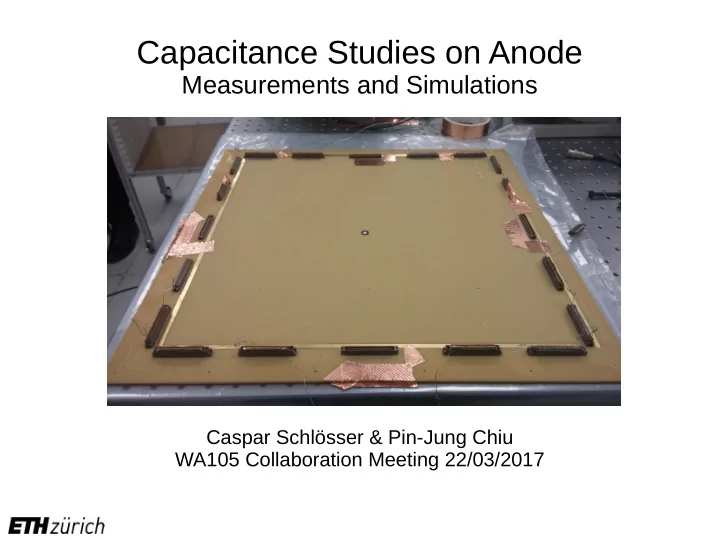
Capacitance Studies on Anode Measurements and Simulations Caspar Schlsser & Pin-Jung Chiu WA105 Collaboration Meeting 22/03/2017 Goal Capacitance studies of the anode: Measurements: capacitance measurements with LCR meter


slide-1
SLIDE 1

Caspar Schlösser & Pin-Jung Chiu WA105 Collaboration Meeting 22/03/2017

Capacitance Studies on Anode

Measurements and Simulations

slide-2
SLIDE 2

WA105 Collaboration Meeting 2

Goal

Capacitance studies of the anode:

  • Measurements:

capacitance measurements with LCR meter

  • Simulations:

capacitance simulations to model the anode and cross check with the results from the measurements

Outline

  • 1. Motivation → Pulsing measurements
  • 2. Measurements with LCR meter
  • 3. Simulations with a simplified model
  • 4. Equivalent circuit studies
slide-3
SLIDE 3

WA105 Collaboration Meeting 3

Pulsing Measurements

slide-4
SLIDE 4

WA105 Collaboration Meeting 4

Pulsing measurements

  • pulsing took place before Christmas last year
  • 32 channels were pulsed simultaneously with 150

mV through a 1 pF capacitor 150 pC charge ≜

One connector pulsed

slide-5
SLIDE 5

WA105 Collaboration Meeting 5

Pulsing measurements

  • pulsing took place before Christmas last year
  • 32 channels were pulsed simultaneously with 150 mV

through a 1 pF capacitor 150 pC charge ≜

  • pulse shape: square wave with, frequency ~3 Hz, 50% duty

cycle, rise/fall times ~100 ns

rise/fall times: ~100 ns Period: ~0.3 s

Event viewer time window

slide-6
SLIDE 6

WA105 Collaboration Meeting 6

Pulsing measurements

  • Noise reduction: cuts in Fourier space for f > 0.5 MHz

view 0 view 1 32 pulsed channels in view 1

slide-7
SLIDE 7

WA105 Collaboration Meeting 7

Pulsing measurements zoom

32 pulsed channels in view 1 view 0

view 1

Induced signal on other channels

slide-8
SLIDE 8

WA105 Collaboration Meeting 8

Pulsing measurements

767 ADC counts

  • induced signal on other

channels: ~ 1.6-7.6 %

  • only small dependence on

distance of non-pulsed channel to pulsed channel or view (parallel or perpendicular)

slide-9
SLIDE 9

WA105 Collaboration Meeting 9

Measurements with LCR meter

slide-10
SLIDE 10

WA105 Collaboration Meeting 10

Cross-Talk Study Capacitance between any of the two strips and all the others are connected to ground (ground terminal of the LCR meter for a reference ground). Capacitance to ground All strips are connected to the anode back strip and the anode back strip is left floating. Capacitance measured between 1 strip and the ground.

Measurement Setup

LCR meter

Ground of LCR meter Anode back strip Anode (measured strips in blue; else in red)

LCR meter

Ground of LCR meter Anode back strip Anode (measured strips in blue; else in red)

slide-11
SLIDE 11

WA105 Collaboration Meeting 11

Cross Talk Study – Strip-to-strip parallel capacitance

Strip-to-strip parallel capacitance decreases rapidly with distance Measurement conditions: Humidity: 39.8 % Temperature: 19.4 °C Capacitance measured between parallel strips with varying distance All other strips grounded

  • n both ends
slide-12
SLIDE 12

WA105 Collaboration Meeting 12

Cross Talk Study – Strip-to-strip perpendicular capacitance

Very similar capacitance measured between all combinations of perpendicular strips Measurement conditions: Humidity: 39.8 % Temperature: 19.4 °C middle edge Capacitance measured between perpendicular strips Comparison to capacitance between parallel strips: All other strips grounded

  • n both ends
slide-13
SLIDE 13

WA105 Collaboration Meeting 13

Capacitance to ground

Capacitance measured between 1 strip and ground All other strips are connected to the anode back strip and the anode back strip is left floating Capacitance to ground ~ 78 pF

slide-14
SLIDE 14

WA105 Collaboration Meeting 14

Simulations with a Simplified Model

slide-15
SLIDE 15

WA105 Collaboration Meeting 15

Capacitance Matrix

  • Anode consisting of

parallel/perpendicular strips acts like a capacitor.

  • From the pulsing measurement,

~1.6 – 7.6 % signal on other strips were observed.

  • To understand the interference

between any of the two strips, the capacitance matrix is introduced.

  • Diagonal elements: capacitance

between one strip and all the others (total capacitance).

  • Off-diagonal elements: capacitance

between any of the two strips.

slide-16
SLIDE 16

WA105 Collaboration Meeting 16

Simplified Model in Simulation

  • In the measurement of 50x50 cm2 PCB, there are 160 strips in each view.
  • For simplicity in simulation, a simplified model with 12 strips were used,

and linearly calculated to 160 strips to cross check with the results from the measurement.

3D geometry

y1 y2 y3 y4 y5 y6 y7 y8 y9 y10 y11 y12 x1 x2 x3x4 x5 x6x7 x8 x9 x10 x11 x12

y1 y12 y1 x1 x12 x12 To replicate the measurement, 1V is applied to 1 strip and all the others are set to ground. Capacitance matrix contains all the 12 strips in x view and the 12 strips in y view. With this matrix, capacitance between parallel and perpendicular strips can be obtained.

slide-17
SLIDE 17

WA105 Collaboration Meeting 17

Results from Simulations and Measurements

1 strip and ground closest parallel strips perpendicular strips Result from simulation 41.83 pF 3.34 pF 0.22 pF Result from measurement 78 pF 7.6 pF 0.5 pF

Simulations with different configurations are in progress, e.g. keep the other strips floating.

slide-18
SLIDE 18

WA105 Collaboration Meeting 18

Equivalent circuit studies

slide-19
SLIDE 19

WA105 Collaboration Meeting 19

Equivalent circuit studies

  • simulation of equivalent circuit of multiple anode strips
  • ngoing
  • Goal: compare simulated induced signals to the ones
  • bserved during pulsing of anode
slide-20
SLIDE 20

WA105 Collaboration Meeting 20

Conclusion

  • Capacitance measurements:

➔ Capacitance between parallel strips decreases rapidly with

distance→capacitance between 3rd closest strips (0.5 pF) less than 10% of closest strips (7.6 pF).

➔ Capacitance between perpendicular strips (0.5 pF) ~10% of

closest parallel capacitance (7.6 pF). Each strip couples to 160 perpendicular strips.

➔ Capacitance to ground ~ 78 pF.

  • Capacitance simulations:

➔ We were able to model the anode and have a preliminary

  • understanding. Different configurations are in progress.